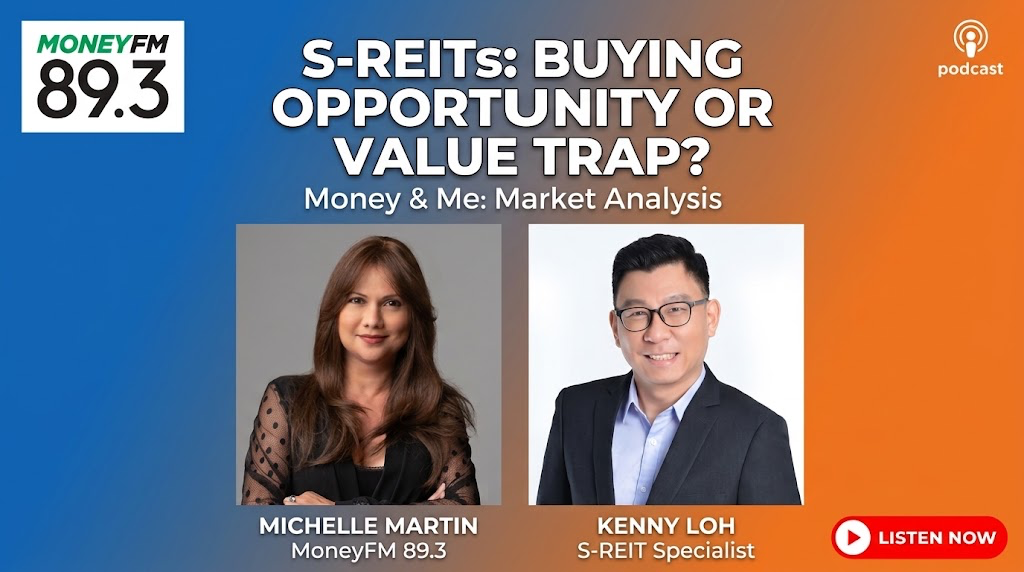
Money and Me: Which Billion-Dollar REIT Bets Will Pay Off?

  • Post author:

Segment 1: Industrial REITs (Questions 1–3)

Q1: Industrial REITs have once again been highlighted as one of the more resilient sectors. What continues to set them apart from office and retail REITs today?

• “While retail relies on consumer footfall and office adapts to flexible work, industrial REITs are the backbone of the structural economy—e-commerce, advanced manufacturing, and supply chains. You can delay a shopping trip or work from home, but a logistics hub or a data center cannot be replicated virtually.”

• They benefit from longer leases (longer WALE) and sticky tenants who invest heavy capital into fitting out the spaces (like cleanrooms or cold-chain logistics), making it highly disruptive for them to move.

Q2: Many industrial REITs have been actively rejuvenating their portfolios. What does that involve, and why is it important for long-term returns?

• “Portfolio rejuvenation is basically real estate asset surgery. It means selling off old, single-user factories that have low ceiling heights and poor floor loading, and using that cash to build or buy modern, multi-story ramp-up logistics hubs or high-spec facilities.”• It is vital because industrial land in Singapore has shorter lease tenures (often 30 years). If a manager sits on an aging asset, its value decays to zero. By redeveloping or recycling, they boost the net property income (NPI) yield and defend the long-term Net Asset Value (NAV) of the REIT.

Q3: Which segments within industrial real estate are seeing the strongest opportunities today – traditional factories, logistics, data centres or business parks?

• “Logistics and AI-ready data centers are running away with the trophy right now. Traditional factories face cost pressures, and business parks are seeing a bit of supply overhang, but modern logistics facilities near our ports are enjoying near-full occupancy and very strong positive rental reversions.”

Segment 2: OUE REIT & Crowne Plaza Divestment (Questions 4–6)

Q4: Selling a well-known asset can sometimes surprise investors. How do you decide whether a divestment is creating value rather than shrinking the portfolio?

• “Investors often fall into the trap of thinking ‘bigger is always better.’ It’s not. You measure value creation by looking at capital efficiency. If a manager sells an asset at a premium to valuation, uses the cash to lower high leverage, and avoids huge upcoming repair costs, that is value creation—even if the total portfolio size shrinks temporarily.”

• Crowne Plaza’s master lease expires by 2028. OUE REIT is essentially selling the asset before they have to shell out massive capital expenditures (CapEx) for a major hotel refurbishment. They passed that future bill to the buyer.

Q5: This transaction includes a special distribution for unitholders. Beyond the immediate payout, what should investors really be looking at when assessing a deal like this?

• “Don’t just look at the short-term ‘sugar rush’ of a special payout. Look at the permanent structural repair of the balance sheet. In OUE REIT’s case, their aggregate leverage drops beautifully from a tight 41.5% down to a very comfortable 36.6%. That gives them the debt headroom to hunt for better, higher-yielding assets later.”

Q6: More broadly, do you think we’ll see more REIT managers recycling mature assets over the next year instead of simply pursuing new acquisitions?

• “Absolutely. The era of ‘cheap debt-funded buying’ is over. With interest rates staying higher for longer, the best way for a REIT to grow without diluting investors via massive rights issues is capital recycling—selling the old to fund the new.”

Segment 3: CapitaLand Ascendas REIT (CLAR) Tuas Acquisition (Questions 7–9)

Q7: CapitaLand Ascendas REIT says this acquisition will enhance distributions while strengthening its logistics exposure. What stands out to you about this deal?

• “Three things stand out: Location, Specifications, and Certainty. It’s a modern 2021 ramp-up facility right next to the upcoming Tuas Mega Port. It comes 100% occupied with a 5-year lease and a built-in 2% annual rent escalation. It is an immediate cash-flow generator.”

Q8: When REIT managers describe an acquisition as “DPU-accretive”, what questions should investors ask before taking that at face value?

• “Investors must ask: ‘Is it accretive because of real property performance, or is it just financial engineering?'”• 

Key Questions to Highlight:

1. What is the funding mix? Are they taking on cheap short-term debt that will reset at higher rates later?2. Is the Net Property Income (NPI) yield higher than the cost of funding? (For CLAR, the 6.5% NPI yield comfortably beats their funding costs, making it genuinely accretive).

Q9: With logistics assets remaining in demand, are valuations becoming stretched, or do you still see attractive opportunities in this space?

• “Valuations are tight, but they are justified by the scarcity of prime land. In Singapore, you can’t just build another logistics hub anywhere. The demand from multinational companies wanting to anchor themselves in Singapore ensures that while you pay a premium, the defensive nature of the income is worth it.”

Segment 4: CICT’s S$3.9 Billion Paragon Acquisition (Questions 10–12)

Q10: This is one of the biggest REIT transactions we’ve seen this year. What was your first reaction when the deal was announced?

• “My first thought was: ‘Wow, this is a massive, bold chess move.’ Swapping Asia Square Tower 2 for Paragon is Asia’s largest REIT showing everyone how to pivot out of a stabilised office asset into a flagship, freehold retail asset with a massive medical tourism tailwind.”

Q11: CICT is effectively selling one major asset and buying another. What should investors focus on when deciding whether this is a smart capital allocation move?

• “Focus on the yield spread and the land tenure. They sold an asset yielding around 3% (Asia Square Tower 2) and bought an asset yielding 3.9% (Paragon). That’s an immediate yield pickup. Furthermore, they are unlocking the freehold value of Paragon, which gives the REIT generational resilience.”

• Also point out the “secret weapon” of Paragon—the medical center next to Mount Elizabeth. It’s not just fashion retail; it’s a defensive healthcare play.

Q12: Looking beyond this transaction, do you think we’re entering a period where successful REITs will be defined less by interest rates and more by management’s ability to buy, sell and recycle assets effectively?

• “100%. We are moving from a macro-driven REIT market to a manager-driven REIT market. When interest rates were 1%, any manager could look smart just by buying properties. Today, the winners will be defined by their surgical skill in asset management—knowing exactly when to harvest value from an old asset and where to plant the capital for tomorrow’s growth.”

Kenny Loh is a distinguished Wealth Advisory Director (RNF# LKK300389588 Representing Financial Alliance) with a specialization in holistic investment planning and estate management. He excels in assisting clients to grow their investment capital and establish passive income streams for retirement. Kenny also facilitates tax-efficient portfolio transfers to beneficiaries, ensuring tax-efficient capital appreciation through risk mitigation approaches and optimized wealth transfer through strategic asset structuring.

In addition to his advisory role, Kenny is an esteemed SGX Academy trainer specializing in S-REIT investing and regularly shares his insights on MoneyFM 89.3. He holds the titles of Certified Estate & Legacy Planning Consultant and CERTIFIED FINANCIAL PLANNER (CFP).

With over a decade of experience in holistic estate planning, Kenny employs a unique “3-in-1 Will, LPA, and Standby Trust” solution to address clients’ social considerations, legal obligations, emotional needs, and family harmony. He holds double master’s degrees in Business Administration and Electrical Engineering, and is an Associate Estate Planning Practitioner (AEPP), a designation jointly awarded by The Society of Will Writers & Estate Planning Practitioners (SWWEPP) of the United Kingdom and Estate Planning Practitioner Limited (EPPL), the accreditation body for Asia.

Arrange for a non-obligatory one-to-one free consultation here!

You can join his Telegram channel #REITirement – SREIT Singapore REIT Market Update and Retirement related news. https://t.me/REITirement
If you need any financial advice, please contact kennyloh@fapl.sg


2026

2025

2024

2023

2022

2021

2020

Continue ReadingMoney and Me: Which Billion-Dollar REIT Bets Will Pay Off?

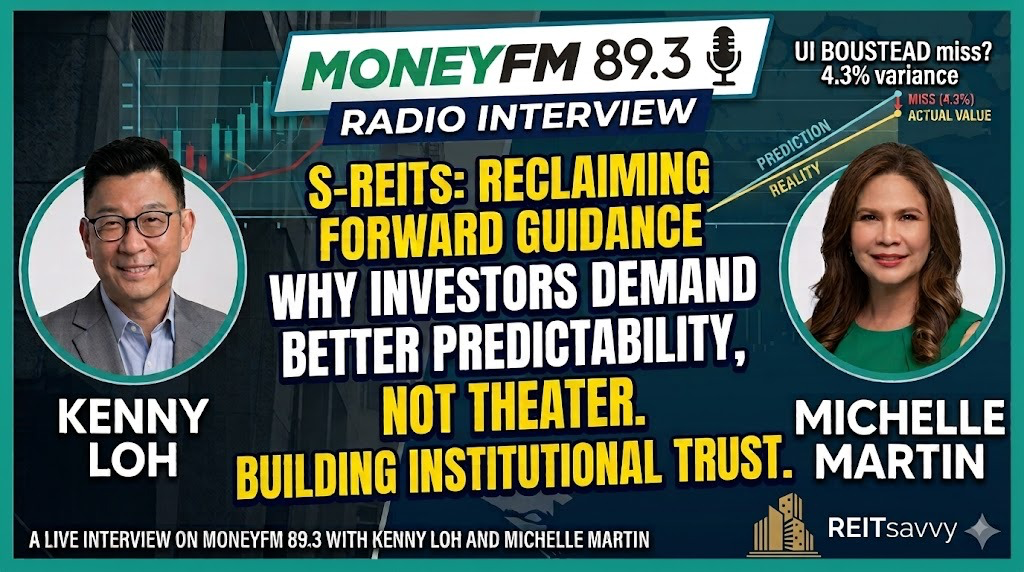
🚀 𝐇𝐮𝐠𝐞 𝐌𝐢𝐥𝐞𝐬𝐭𝐨𝐧𝐞𝐬 𝐟𝐨𝐫 𝐭𝐡𝐞 𝐒-𝐑𝐄𝐈𝐓 𝐂𝐨𝐦𝐦𝐮𝐧𝐢𝐭𝐲! 🚀

  • Post author:

I am incredibly excited to share that we have officially launched the inaugural edition of the 𝐑𝐄𝐈𝐓𝐬𝐚𝐯𝐯𝐲 𝐒-𝐑𝐄𝐈𝐓𝐬 𝐏𝐮𝐥𝐬𝐞 over on our dedicated REITsavvy page! 📊🇸🇬

For years, my mission has been to simplify the complex world of Singapore Real Estate Investment Trusts, helping investors build robust, resilient passive income streams. This new monthly report is the next step in that journey—bringing you data-driven clarity, macro insights, and sector deep dives without the fluff.


If you haven’t seen it yet, here is a quick look at what we are tracking inside the 𝐑𝐄𝐈𝐓𝐬𝐚𝐯𝐯𝐲 · 𝐒-𝐑𝐄𝐈𝐓𝐬 𝐏𝐮𝐥𝐬𝐞 · 𝐌𝐚𝐲 2026.

🔹𝐒𝐞𝐜𝐭𝐨𝐫-𝐛𝐲-𝐒𝐞𝐜𝐭𝐨𝐫 𝐏𝐞𝐫𝐟𝐨𝐫𝐦𝐚𝐧𝐜𝐞: How Retail, Office, Industrial, Hospitality, and Specialized REITs are navigating the current economic climate.

🔹𝐄𝐬𝐬𝐞𝐧𝐭𝐢𝐚𝐥 𝐕𝐚𝐥𝐮𝐚𝐭𝐢𝐨𝐧 𝐌𝐞𝐭𝐫𝐢𝐜𝐬: A clean breakdown of average distribution yields, price-to-NAV ratios, and gearing levels across the board.

🔹𝐌𝐚𝐜𝐫𝐨 & 𝐈𝐧𝐭𝐞𝐫𝐞𝐬𝐭 𝐑𝐚𝐭𝐞 𝐎𝐯𝐞𝐫𝐯𝐢𝐞𝐰𝐬: Direct insights into how global monetary policy shifts impact local S-REIT valuations.

🔹𝐌𝐚𝐫𝐤𝐞𝐭 𝐌𝐨𝐯𝐞𝐫𝐬: A snapshot of the top-performing and lagging REITs to help you spot potential portfolio opportunities.


📥 𝐆𝐞𝐭 𝐘𝐨𝐮𝐫 𝐂𝐨𝐩𝐲 & 𝐒𝐡𝐚𝐫𝐞 𝐭𝐡𝐞 𝐊𝐧𝐨𝐰𝐥𝐞𝐝𝐠𝐞
We want to empower as many income investors as possible. The REITsavvy · S-REITs Pulse · May 2026.pdf is completely free to download and share with anyone who wants to stay on top of the Singapore market.

👉 Head over to the official REITsavvy Page to grab your copy, follow the page for future monthly updates, and share it with your network!

Let’s keep growing our wealth and building sustainable income streams together.

Drop a comment on the main post and let me know your thoughts on the May data! 👇


#SREITs #SingaporeREITs #PassiveIncome #DividendInvesting #REITsavvy #FinancialFreedom #WealthManagement


Kenny Loh is a distinguished Wealth Advisory Director (RNF# LKK300389588 Representing Financial Alliance) with a specialization in holistic investment planning and estate management. He excels in assisting clients to grow their investment capital and establish passive income streams for retirement. Kenny also facilitates tax-efficient portfolio transfers to beneficiaries, ensuring tax-efficient capital appreciation through risk mitigation approaches and optimized wealth transfer through strategic asset structuring.

In addition to his advisory role, Kenny is an esteemed SGX Academy trainer specializing in S-REIT investing and regularly shares his insights on MoneyFM 89.3. He holds the titles of Certified Estate & Legacy Planning Consultant and CERTIFIED FINANCIAL PLANNER (CFP).

With over a decade of experience in holistic estate planning, Kenny employs a unique “3-in-1 Will, LPA, and Standby Trust” solution to address clients’ social considerations, legal obligations, emotional needs, and family harmony. He holds double master’s degrees in Business Administration and Electrical Engineering, and is an Associate Estate Planning Practitioner (AEPP), a designation jointly awarded by The Society of Will Writers & Estate Planning Practitioners (SWWEPP) of the United Kingdom and Estate Planning Practitioner Limited (EPPL), the accreditation body for Asia.

Arrange for a non-obligatory one-to-one free consultation here!

You can join his Telegram channel #REITirement – SREIT Singapore REIT Market Update and Retirement related news. https://t.me/REITirement
If you need any financial advice, please contact kennyloh@fapl.sg

Continue Reading🚀 𝐇𝐮𝐠𝐞 𝐌𝐢𝐥𝐞𝐬𝐭𝐨𝐧𝐞𝐬 𝐟𝐨𝐫 𝐭𝐡𝐞 𝐒-𝐑𝐄𝐈𝐓 𝐂𝐨𝐦𝐦𝐮𝐧𝐢𝐭𝐲! 🚀

S-REIT Market Outlook 2026: Cracking the “K-Shape” Recovery, Retail Inflows, and the New CPFIS Update

  • Post author:

The Singapore Real Estate Investment Trust (S-REIT) market is experiencing a massive tug-of-war between micro-level operational strength and macro-level financial pressure. Whether you are looking to maximize your passive income or optimize your retirement funds, this comprehensive market briefing breaks down the three massive trends shaping the S-REIT landscape right now—and a monumental new regulatory update that changes the game for CPF investors.

1. The $925M Retail Capital Shift: A Strategic Hunt for Yield

Retail investors are aggressively voting with their wallets, pouring a staggering $925 million into S-REITs up to late May 2026. This massive reallocation of capital is being driven by a stark reality: low-risk local cash alternatives have completely lost their edge.

The Macro Disconnect: Cash vs. Property Yields• T-Bills & SSBs Flatten Out: The yield on the 6-month Singapore Treasury Bill (T-bill) has stabilized at a low 1.48%. Similarly, Singapore Savings Bonds (SSBs) offer a first-year return of just 1.46%.• Fixed Deposits Cool Off: Bank fixed deposit rates have largely hit a ceiling between 1.50% to 1.60% for standard 6-to-12-month tenors.• The S-REIT Advantage: In comparison, the average dividend yield for Singapore REITs stands at a highly attractive 5.9%, with several quality industrial and specialized counters pushing yields north of 7% to 9%.

With a spread of over 400 basis points between T-bills and average property yields, local investors are moving out of cash to protect their purchasing power against sticky inflation.

Key Moving Counters: Where is the Money Going?• UI Boustead REIT: Topped the entire sector for retail inflows relative to its market cap, bringing in $62.8 million as opportunistic buyers capitalized on its strong 92.2% occupancy and new logistics expansion in Japan.• Daiwa House Logistics Trust (DHLT) & Parkway Life REIT: Strongly accumulated as defensive anchors due to high structural income visibility, with locked-in master leases extending well past 2030.• CapitaLand India Trust (CLINT) & CapitaLand Ascendas REIT (CLAR): Highly favored for robust leasing momentum in tech-industrial parks and data center infrastructure.

2. Industrial S-REITs: Operational Resilience Meets Asset Rejuvenation

Industrial real estate continues to be the star performer of the sector. Structural demand from e-commerce, localized logistics, and AI data infrastructure is allowing top-tier managers to extract high single-to-double-digit positive rental reversions.

Standout Execution in the Current Environment:• CapitaLand Ascendas REIT (CLAR): Successfully delivered a strong +10.6% rental reversion across its Singapore and US portfolios. Furthermore, management expertly insulated its balance sheet via a massive S$903.5 million equity fund raising, bringing aggregate leverage down to a very safe ~37.3%.• Mapletree Logistics Trust (MLT): Provided a textbook lesson in capital recycling. MLT divested 6 older, low-yielding properties at an average premium of 20% to valuation, immediately redeploying that liquidity into modern Grade-A logistics assets in high-growth corridors like Mumbai, India.• Alpha Integrated REIT: A masterclass in proactive asset management, sustaining an incredible streak of positive rental reversions for over 14 consecutive quarters by engaging tenants aggressively well ahead of lease expiries.

3. The Deal Boom: Cracking the “K-Shaped” Disconnect

Acquisition activity has picked up sharply, with S-REITs announcing over S$6.3 billion in deals in the first few months of the year alone—highlighted by CapitaLand Integrated Commercial Trust (CICT) acquiring Paragon for S$3.9 billion.

Why is Deal-Making Back?

The Federal Reserve’s pause on interest rates (stabilizing around 3.5% to 3.75%) has removed the paralyzing valuation uncertainty of the last two years. Managers can finally price debt and model equity fund management with confidence.

Have S-REITs Finally Turned the Corner?

Yes, structurally they have—but the recovery is strictly K-shaped. This split dynamic determines who wins and who falls behind:

▲ Upper Arm (The Winners): Large-cap, sponsor-backed blue chips (CapitaLand, Mapletree, Frasers). They feature strong balance sheets, powerful capital recycling options, and the ability to drive accretive DPU growth.▼ Lower Arm (The Laggards): Highly leveraged, small-to-mid-cap REITs with older assets. Squeezed by the ‘Refinancing Wall’ as fixed hedges expire, forcing them to absorb higher interest expenses that compress distributions.

The Price Disconnect: Many investors wonder why REIT stock prices remain lackluster when buildings are full. The answer is the Refinancing Wall. S-REITs are currently rolling over cheap, old fixed-rate debt (locked in at 1.5% years ago) into today’s higher 3.5% market baseline. Even when top-line rental revenue grows beautifully, the higher interest costs chew up those gains, keeping short-term distributions flat.

The Split Market: The upper arm of the K belongs to the mega-cap blue chips that can aggressively divest mature assets at a premium and buy modern assets. The lower arm of the K contains highly leveraged, smaller REITs with older properties that face a long, slow grind to refinance without diluting unitholders. Stock selection is everything.

4. Landmark Update: Elite UK REIT Joins CPFIS

Effective June 9, 2026, Elite UK REIT (SGX: MENU) announced that its Singapore Dollar (SGD) counter has been officially included under the Central Provident Fund Investment Scheme (CPFIS) for the Ordinary Account (OA).

Is this the first REIT under CPFIS?

No, major local blue chips are already eligible. However, Elite UK REIT is the first and only pure-play UK-focused REIT to achieve CPFIS status. Clearing the stringent liquidity, governance, and capital safety filters mandated by the CPF Board is a massive regulatory stamp of approval for a foreign-asset vehicle.

Why was it included?

The REIT offers a uniquely resilient, institutional-grade underlying business structure:• Sovereign-Backed Income: Over 99% of its gross rental income is derived directly from the UK Government (primarily the Department for Work and Pensions), functioning as mission-critical public social infrastructure.• High Cash Flow Visibility: Features virtually 100% rent collection, paid three months in advance, fully backed by AA-rated sovereign credit.

Why would CPF holders want to invest?

The standard CPF Ordinary Account offers a guaranteed but static 2.5% return. With major brokerages highlighting Elite UK REIT’s sustainable forward dividend yield of around 9%, it offers an incredible 6.5% yield pickup. It provides a direct, highly accessible gateway for local savers to diversify their retirement funds into UK real estate right on the SGX platform.

The Essential Risks to Consider

As with any high-yielding asset, higher returns come with clear trade-offs that CPF investors must carefully weigh:• Concentration & Lease Renewal Risk (2028 Horizon): The UK Government’s Department for Work and Pensions (DWP) contributes roughly 92% of the REIT’s gross rental income. A significant cluster of these leases comes up for renewal/regearing in 2028. Any physical consolidation by the UK government could impact future vacancy rates.• Foreign Exchange (FX) Translation Risk: While the REIT is naturally hedged operationally (generating rent and holding debt in British Pounds), a severely weakening Sterling against a strengthening Singapore Dollar will structurally shrink the actual SGD dividend payout received by local investors.• Capital Volatility: Moving your funds out of the CPF-OA means trading a principal-guaranteed, risk-free 2.5% return for secondary market equity price fluctuations. Position sizing under the 35% CPFIS stock limit remains critical.

Summary for Investors

The worst of the macroeconomic interest rate storm is officially behind us, and the reopening of the multi-billion-dollar acquisition gateway proves that confidence is returning. However, in a K-shaped recovery environment, the days of buying the entire sector and hoping for equal gains are over. Focus on quality sponsors, robust capital recycling track records, and clear distribution visibility to navigate the market successfully.

Disclaimer: This article is for educational and informational purposes only and does not constitute financial advice. Investors should conduct their own due diligence or consult a licensed financial representative before deploying cash or CPFIS funds into market securities.

Kenny Loh is a distinguished Wealth Advisory Director (RNF# LKK300389588 Representing Financial Alliance) with a specialization in holistic investment planning and estate management. He excels in assisting clients to grow their investment capital and establish passive income streams for retirement. Kenny also facilitates tax-efficient portfolio transfers to beneficiaries, ensuring tax-efficient capital appreciation through risk mitigation approaches and optimized wealth transfer through strategic asset structuring.

In addition to his advisory role, Kenny is an esteemed SGX Academy trainer specializing in S-REIT investing and regularly shares his insights on MoneyFM 89.3. He holds the titles of Certified Estate & Legacy Planning Consultant and CERTIFIED FINANCIAL PLANNER (CFP).

With over a decade of experience in holistic estate planning, Kenny employs a unique “3-in-1 Will, LPA, and Standby Trust” solution to address clients’ social considerations, legal obligations, emotional needs, and family harmony. He holds double master’s degrees in Business Administration and Electrical Engineering, and is an Associate Estate Planning Practitioner (AEPP), a designation jointly awarded by The Society of Will Writers & Estate Planning Practitioners (SWWEPP) of the United Kingdom and Estate Planning Practitioner Limited (EPPL), the accreditation body for Asia.

Arrange for a non-obligatory one-to-one free consultation here!

You can join his Telegram channel #REITirement – SREIT Singapore REIT Market Update and Retirement related news. https://t.me/REITirement

If you need any financial advice, please contact kennyloh@fapl.sg


2026

2025

2024

2023

2022

2021

2020

Continue ReadingS-REIT Market Outlook 2026: Cracking the “K-Shape” Recovery, Retail Inflows, and the New CPFIS Update