Tailored Portfolio Solutions: Precision Investing for Your Future
  • Post author:

In an era of market volatility and information overload, a “one-size-fits-all” investment strategy is no longer sufficient. True wealth management requires a sophisticated, institutional-grade approach that aligns your capital with your specific life goals, risk tolerance, and liquidity needs.

I provide a comprehensive suite of investment vehicles, moving beyond traditional boundaries to build robust, multi-asset portfolios.

Our Investment Universe

We utilize a broad spectrum of asset classes and strategies to ensure your portfolio is truly diversified across different economic cycles.

  • Equities & ETFs: Direct access to global stock markets and low-cost Exchange Traded Funds for efficient market exposure and core growth.
  • Unit Trusts (UT): Curated access to top-tier active fund managers across specialized sectors, regions, and fixed-income strategies.
  • Alternative Investments: Institutional-level access to non-traditional assets, including private credit, trade finance, and real estate, designed to provide low correlation to public equity markets.
  • Quant Strategies: Data-driven, algorithmic approaches that remove emotional bias and capitalize on market inefficiencies through systematic execution.
  • Real Estate Focus: Deep expertise in structuring REIT-heavy portfolios for consistent yield and long-term capital appreciation.

The Customization Process

Our methodology is rooted in a “Client-First” architecture. We don’t just pick products; we build a framework.

  1. Needs Discovery: We begin by defining your “Why”—whether it is legacy planning, retirement income, or aggressive capital growth.
  2. Risk Calibration: Using advanced risk-profiling tools, we determine your psychological and financial capacity for volatility.
  3. Strategic Asset Allocation: We blend traditional and alternative assets to optimize your efficient frontier—aiming for the highest possible return for your chosen level of risk.
  4. Active Monitoring & Rebalancing: Markets shift, and so do life circumstances. We provide ongoing oversight to ensure your portfolio remains aligned with your original objectives.
  5. Why Diversification Matters: By spreading investments across uncorrelated assets—like combining the steady income of Private Credit with the growth potential of Quant-driven Equities—we aim to reduce “drawdowns” (peak-to-trough declines) and smooth out your investment journey.

Secure Your Legacy

Investment management is not just about the numbers; it’s about the peace of mind that comes from knowing your wealth is being managed with professional rigor and a clear vision.

Ready to institutionalize your personal wealth strategy?

Let’s review your current holdings and discuss how a customized, diversified framework can better serve your long-term objectives.

Click Here to Book a Private Consultation

Kenny Loh is a distinguished Wealth Advisory Director with a specialization in holistic investment planning and estate management. He excels in assisting clients to grow their investment capital and establish passive income streams for retirement. Kenny also facilitates tax-efficient portfolio transfers to beneficiaries, ensuring tax-efficient capital appreciation through risk mitigation approaches and optimized wealth transfer through strategic asset structuring.

In addition to his advisory role, Kenny is an esteemed SGX Academy trainer specializing in S-REIT investing and regularly shares his insights on MoneyFM 89.3. He holds the titles of Certified Estate & Legacy Planning Consultant and CERTIFIED FINANCIAL PLANNER (CFP).

With over a decade of experience in holistic estate planning, Kenny employs a unique “3-in-1 Will, LPA, and Standby Trust” solution to address clients’ social considerations, legal obligations, emotional needs, and family harmony. He holds double master’s degrees in Business Administration and Electrical Engineering, and is an Associate Estate Planning Practitioner (AEPP), a designation jointly awarded by The Society of Will Writers & Estate Planning Practitioners (SWWEPP) of the United Kingdom and Estate Planning Practitioner Limited (EPPL), the accreditation body for Asia.

If you need any financial advice, please contact kennyloh@fapl.sg

You can join his Telegram channel #REITirement – SREIT Singapore REIT Market Update and Retirement related news. https://t.me/REITirement
Continue ReadingTailored Portfolio Solutions: Precision Investing for Your Future

Navigating the Giants: A Singaporean Guide to Investing in US vs. SG Stocks

  • Post author:

For many Singapore-based investors, the local market feels like home—stable, familiar, and conveniently denominated in SGD. However, the allure of the US market, with its world-famous tech titans and immense scale, is hard to ignore.

As we move through 2026, the contrast between these two markets remains stark. Whether you are a local Singaporean or an expat, understanding the structural and tax differences is vital to avoid expensive surprises.


1. Growth Potential: Sprints vs. Marathons

The primary differentiator is the velocity of growth.

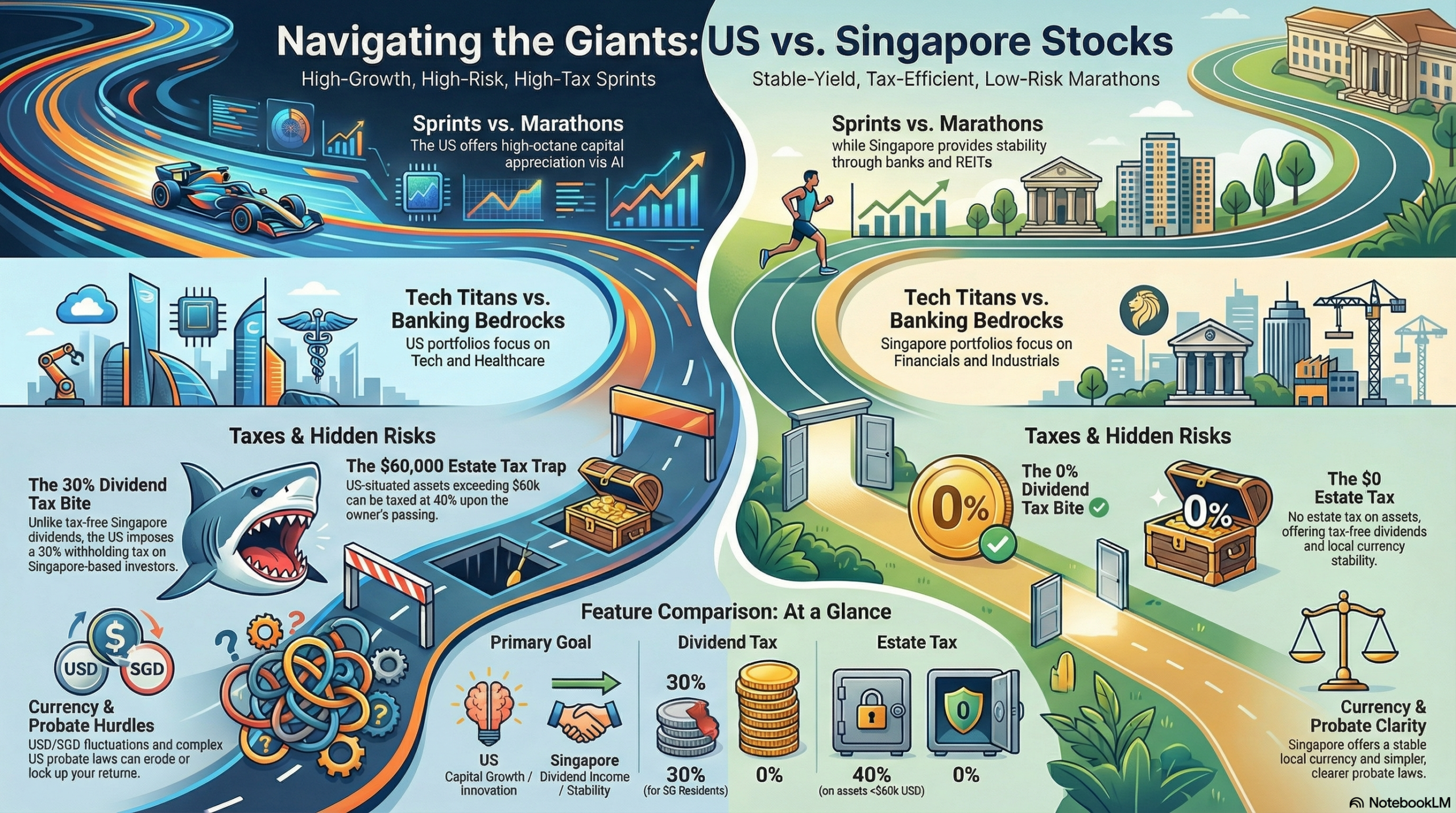
  • US Market: Historically, the US (represented by indices like the S&P 500 or Nasdaq) is the go-to for capital appreciation. In 2026, the focus remains heavily on the AI infrastructure buildout, with massive capital expenditure driving potential double-digit earnings growth for market leaders.
  • Singapore Market: The Straits Times Index (STI) is often characterized as a “yield play.” While the US offers high-octane growth, Singapore offers stability and resilience. For 2026, the STI is supported by strong bank earnings and a recovering REIT sector, making it ideal for those prioritizing steady wealth preservation over aggressive gains.

2. Sectors: Tech Titans vs. Banking Bedrocks

The “flavor” of your portfolio changes significantly depending on where you shop.

  • US: Dominated by Technology, Healthcare, and Consumer Discretionary. It is the birthplace of “Magnificent Seven” style companies that lead global innovation in AI, cloud computing, and biotech.
  • Singapore: Heavily weighted toward Financials (the “Big Three” banks), Real Estate (REITs), and Industrials. If you want exposure to the digital frontier, the US is king; if you want exposure to the backbone of Southeast Asian trade and property, Singapore is your base.

3. The Tax Bite: Withholding and Estate Taxes

This is where many Singaporean investors get caught off guard.

  • Dividend Withholding Tax (WHT): Singapore does not tax dividends. However, the US imposes a 30% withholding tax on dividends paid to non-resident aliens (including Singaporeans), as there is currently no tax treaty between the US and Singapore to reduce this rate.Tip: If you are yield-hungry, US stocks are “expensive” tax-wise. You may prefer Ireland-domiciled ETFs which can reduce this WHT to 15% due to the US-Ireland tax treaty.
  • US Estate Tax: This is the “hidden” risk. For non-resident aliens, the US estate tax exemption is a mere $60,000. If your US-situated assets (stocks, property) exceed this value at the time of your passing, your estate could be taxed at rates up to 40%. In contrast, Singapore abolished estate duty in 2008. Check the article here on How to Navigate US Estate Tax for Singaporean Investors.

4. Probate and Jurisdictional Hurdles

Investing across borders adds a layer of legal complexity known as Probate.

  • The Challenge: If a Singapore-based investor passes away holding significant US stocks in a personal brokerage account, their executors may need to apply for a Grant of Probate in a US court to unlock those assets. This is often a slow, expensive process involving US lawyers.
  • The Workaround: Many investors use “Joint-Tenancy” accounts or hold assets through a corporate wrapper or a trust to ensure a smoother transition of wealth to beneficiaries.

5. USD vs. SGD: The Currency “Double Whammy”

When you buy US stocks, you aren’t just betting on a company; you’re betting on the USD/SGD exchange rate.

  • The Drag: Historically, the Singapore Dollar has shown long-term strength against the Greenback. If the USD weakens while your stocks are up, your actual returns in SGD terms will be lower.
  • 2026 Outlook: Current trends suggest a more cyclical decline for the USD as global interest rates normalize. For a Singaporean investor, a 10% gain in a US stock could be wiped out if the USD drops 10% against the SGD.

Comparison Summary

FeatureUS Stock MarketSingapore Stock Market (STI)
Primary GoalCapital Growth / InnovationDividend Income / Stability
Dividend Tax30% (for SG residents)0%
Estate Tax40% (above $60k USD)0%
Currency RiskHigh (USD fluctuations)None (for SG residents)
Top SectorsTech, AI, HealthcareBanking, REITs, Industrials

In conclusion, navigating the choice between the US and Singaporean stock markets requires a careful balance of ambition and pragmatism. While the US market offers unrivaled growth potential through its dominance in global tech and AI, it comes with a significantly more complex “tax and legal tail” for Singapore-based investors. The 30% Dividend Withholding Tax and the looming 40% US Estate Tax on assets above $60,000 are critical hurdles that can erode long-term wealth if not managed through specific structures like Ireland-domiciled ETFs.

Furthermore, investors must remain vigilant about probate complications across different jurisdictions and the constant fluctuations of the USD/SGD exchange rate, which can act as a silent drag on your total returns. Ultimately, the Singapore market remains a powerhouse for stable, tax-free dividends and local currency security, while the US serves as the essential engine for capital appreciation. A well-diversified portfolio for a Singapore resident often utilizes both—relying on the STI for a resilient income core and the US markets for high-octane growth, provided one is mindful of the regulatory and currency risks involved.

Kenny Loh is a seasoned Wealth Advisory Director with deep expertise in comprehensive investment planning and estate management. He is dedicated to helping clients strategically grow their investment capital, generate sustainable passive income for retirement, and seamlessly transition wealth to future generations. Through meticulous asset structuring, he ensures tax-efficient portfolio transfers, allowing beneficiaries to benefit from tax-free capital appreciation while optimizing long-term financial security. With a professional approach and a wealth of experience, Kenny empowers clients to preserve and enhance their legacies with confidence.

Arrange for a non-obligatory one-to-one free consultation here!

Important: The information and opinions in this article are for general information purposes only. They should not be relied on as professional financial advice. Readers should seek unbiased financial advice that is customised to their specific financial objectives, situations & needs. This advertisement or publication has not been reviewed by the Monetary Authority of Singapore.

Continue ReadingNavigating the Giants: A Singaporean Guide to Investing in US vs. SG Stocks

Navigating U.S. Estate Tax on U.S. Stock Holdings: A Guide for Singapore Investors

  • Post author:

Introduction

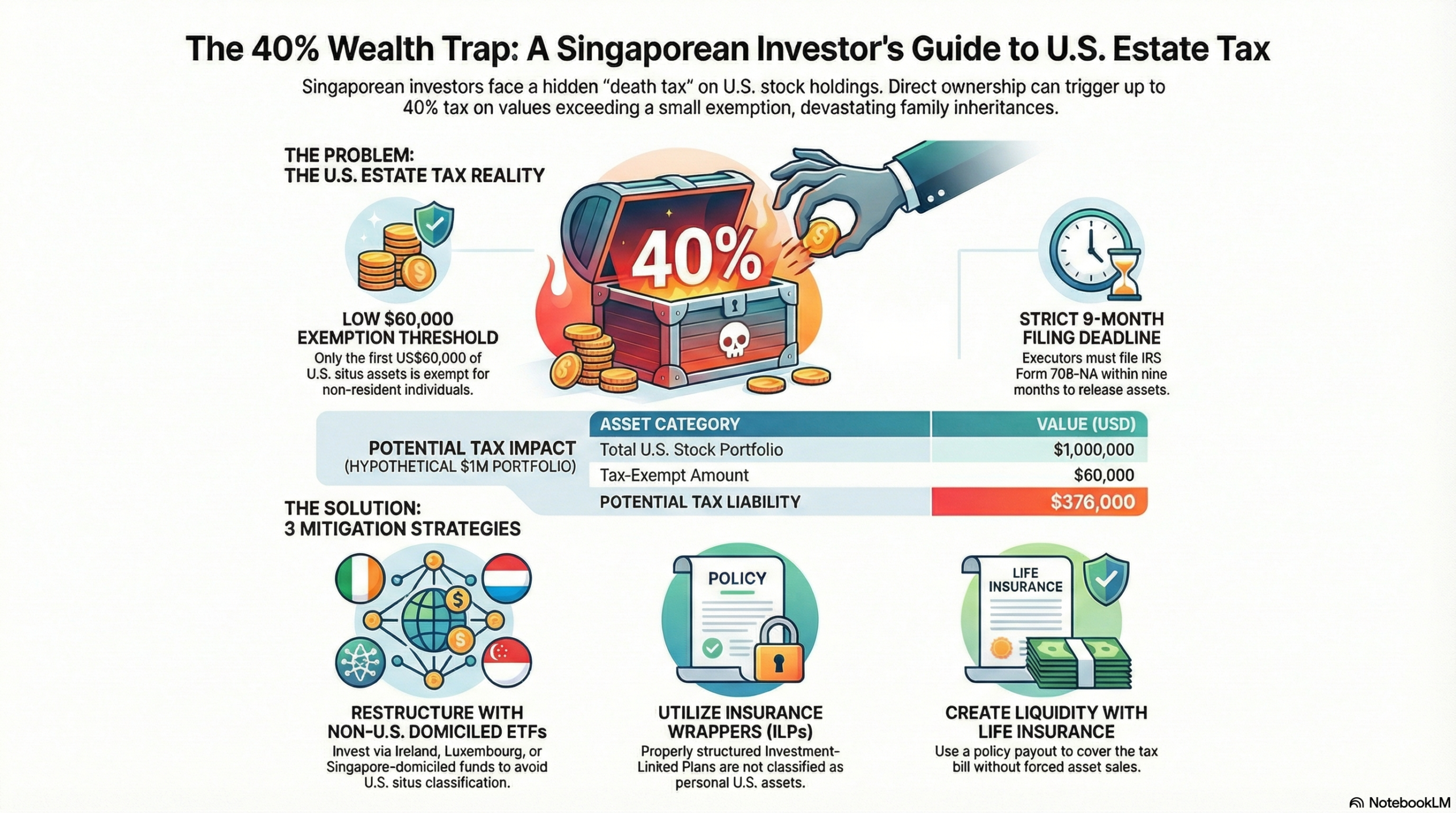
Apple, Nvidia, Tesla, Microsoft, Amazon…… many of us, especially younger investors, are drawn to these US Stocks, known for their stellar performance over the years. The S&P 500 has delivered an average annual return of 10.33% since 1957 (Investopedia). However, did you know that owning these stocks directly as a non-U.S. person (like us) can trigger a significant tax burden upon death? This tax, the U.S. estate tax, can claim up to 40% of the value of your US assets, drastically reducing the wealth passed on to your beneficiaries.

Understanding the US Estate Tax

The US estate tax applies to “US situs” assets owned by non-resident, non-citizen individuals at the time of their death. These assets include shares in companies incorporated in the US, US real estate, certain US-based bonds and mutual funds, and even cash deposits held with US brokers.

Unfortunately, the threshold for exemption is extremely low for non-US persons. Only the first US$60,000 of US situs assets is exempt from tax. Any value above that amount may be subject to estate tax, at rates that can go as high as 40%.

For example, a Singaporean investor with a portfolio of US stocks valued at US$1 million would only receive an exemption of US$60,000. The remaining US$940,000 would be subject to estate tax, potentially resulting in a tax bill of up to US$376,000!

Furthermore, the executor of the estate must file IRS Form 706-NA within nine months of the investor’s death and settle the tax liability to obtain a Federal Transfer Certificate. Without this certificate, US custodians may refuse to release or transfer the deceased’s assets to their beneficiaries.

Estate Planning Strategies to Reduce Exposure

So how can we mitigate this devastating tax burden? Here are 5 strategies that you can possibly execute to do so.

Restructuring your Portfolio

  • Keep direct U.S. stock holdings below US$60,000
  • Increase exposure via non-US ETFs or mutual funds that invest in U.S. markets but are domiciled in Ireland, Luxembourg, or Singapore

These instruments (unit trusts, ETFs, mutual funds etc.), despite investing in US equities, won’t be subjected to the US estate tax as they are not domiciled in the US. For Singaporeans, this could be investing in unit trusts through brokers like Phillip Securities, or ETFs listed on the Singapore Exchange (SGX).

Use an Insurance Wrapper

  • Purchase investment-linked insurance plans (ILPs) that invest in US equities
  • Death benefit proceeds are not classified as US situs assets if structured properly

You can involve an insurance-based investment product, such as investment-linked insurance policies (ILPs). They typically combine investment in global markets with life insurance coverage. So even if there is US stock exposure within the ILP, it should not be subject to US Estate Tax as the asset is not held by the investor personally.

However, you have to ensure that the policyholder and beneficiary structures are clear.

Set Up a Holding Company

  • Hold US stocks via a non-US corporation (e.g. setting a company in Singapore)
  • The company, not the individual, owns the US assets, potentially removing them from the personal estate

But! It may give rise to other tax considerations, such as capital gains tax upon sale of the company’s shares. In addition, it gives rise to additional tax complications depending on jurisdiction. Proper legal and tax advice is essential before implementing this structure.

Create a Trust Structure

  • Transfer U.S. stocks into a foreign irrevocable trust

Trusts can be especially useful to pass down your wealth to future generations. However, trust creation and maintenance involve higher costs and usually require professional management, and the structure must be carefully designed to avoid triggering adverse tax consequences in other jurisdictions.

Cash Creation via Life Insurance

  • Purchase a life insurance policy whose death payout covers the expected U.S. estate tax
  • This ensures liquidity for your estate without forced asset sales

Lastly, you can purchase a life insurance policy with a death benefit sufficient to cover the anticipated estate tax. This ensures that the estate has enough liquidity to settle any tax due without having to sell US investments under pressure or delay asset distribution to beneficiaries.

This may be a good strategy if you already have a large US asset portfolio. However, you need to forecast accurately your estate value and tax liability. Also, unlike some of the other solutions, this still requires you to file tax with the IRS, which is not an easy procedure.

Conclusion

Many of us are either unaware or are indifferent of the complications arising from this US Estate Tax. But it can take away a significant portion of your wealth (up to 40%!) that you can transfer to your future generations. Therefore, it is crucial to mitigate these effects in order to preserve your wealth for your future generations. Failing to plan is planning to fail! Also, to quote:

Kenny Loh is a seasoned Wealth Advisory Director with deep expertise in comprehensive investment planning and estate management. He is dedicated to helping clients strategically grow their investment capital, generate sustainable passive income for retirement, and seamlessly transition wealth to future generations. Through meticulous asset structuring, he ensures tax-efficient portfolio transfers, allowing beneficiaries to benefit from tax-free capital appreciation while optimizing long-term financial security. With a professional approach and a wealth of experience, Kenny empowers clients to preserve and enhance their legacies with confidence.

Arrange for a non-obligatory one-to-one free consultation here!

Important: The information and opinions in this article are for general information purposes only. They should not be relied on as professional financial advice. Readers should seek unbiased financial advice that is customised to their specific financial objectives, situations & needs. This advertisement or publication has not been reviewed by the Monetary Authority of Singapore.

Continue ReadingNavigating U.S. Estate Tax on U.S. Stock Holdings: A Guide for Singapore Investors