By Shauna O’Brien
November 12th, 2012
After several years of outperformance, McDonald’s shares hit a big snag recently. Has the company turned back the clock in a bad way?
MacDonald’s Chart (MCD): Break Support!
The Skinner Era: A Comeback Story
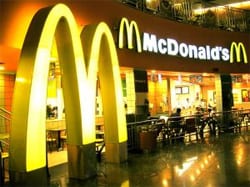 In 2004, following the unexpected passing on CEO Jim Cantalupo, McDonald’s appointed Jim Skinner as its new CEO. Skinner had been with the company for over 40 years, starting off flipping burgers. He climbed his way up the ladder in the next few decades, no one could have anticipated the turnaround Skinner orchestrated once he took over as chief executive.
You see, back in 2004, McDonald’s stock was in the pits. The company traded at roughly $25 per share with annual revenue of around $17 billion. Skinner knew that the company needed a change, and he knew that MCD needed to be better positioned in the market. By studying competitor’s strategies and marketing tactics, he decided that improving customer service, updating restaurants, and changing the menu — adding new and healthier choices for customers — was essential to McDonald’s success. This strategy was designed to catapult the company ahead of its fast food competition, and that it did.
Eight years later, Skinner retired from the company and was replaced by Donald Thompson. By the time Skinner had retired, MCD stock hit over $100 before pulling back to around $90 per share, a 377% increase from the price prior to Skinner talking the helm. At the time of his retirement, the menu offered over 100 options, the customer service made significant improvement, and customers were able to eat in cleaner, more up to date restaurants. McDonald’s yearly revenue also climbed to $27 billion by 2011, up 59% since Skinner became CEO.
Additionally, during the Skinner years, McDonald’s dividend payouts increased drastically. McDonald’s paid an annual dividend of only 40 cents in 2003. The dividend increased every year thereafter, and the company now pays $3.08 annually.
The Post-Skinner Era: Not a Good Start
In July 2012, Donald Thompson took over as McDonald’s CEO. Thompson had worked for the company for 12 years, and became the company’s first African American CEO. Since the management change was announced, the company’s stock has declined 10 points. But the change in management is far from the only reason for MCD’s pullback.
Why McDonald’s Keeps Falling
The company can point to several reasons for its recent underperformance. Let’s take a look at a few of those factors below.
Weak monthly same-store sales
In October 2012, MCD saw its first decline in same-store sales since 2003. Its sales fell 1.8% in the period, including a 2.2% decline in its U.S. restaurants. Sales dropped globally as well, decreasing by 2.2% in Europe, and 2.4% in the Asia Pacific, Middle East, and Africa region.
The company intimated that competition was getting fierce with lead competitors Burger King and Wendy’s. Although both were hit hard by the recession, the companies were being proactive about it, adding new choices to their menus including more breakfast and salad options.
Third quarter miss on earnings
McDonald’s third quarter profit was reported at $1.46 billion, or $1.43 per share, a 3% decline from 2011′s third quarter results. That total missed Wall Street’s expectation of $1.47 per share.
Revenue also declined to $7.15 billion, narrowly beating analysts’ view of $7.14 billion.
Analysts are becoming less bullish on the stock
With the decline of MCD’s stock, and more importantly its same-store sales, many analysts have become cautious with their estimates. Analysts at UBS cut their 2013 estimates for the company, resulting from declined sales and weak currency. Additionally, analysts at Oppenheimer issued cautious commentary regarding the company. Oppenheimer rated the company a “Perform,” but noted that they were expecting the company’s next few quarters to be weak.
Lower restaurant traffic
McDonald’s has been seeing decreased traffic in many of their restaurants. The company has been facing problems with competitors, which has decreased the total amount of monthly customers for the company. In response, McDonalds has increased advertising on their dollar menu and their value meals, which have brought down sales.
Are Consumers Getting Weary of McDonald’s?
The king of fast food is slipping. Analysts now expect a 1.05% fall in McDonald’s U.S. fast food market share, as the company battles for customer dollars with restaurants like Burger King, Wendys, and YUM! Brands (YUM

 ) restaurants including Taco Bell, Pizza Hut, and KFC. The recent global economic recession has only made the fight for market share fiercer.
Many customers are simply looking for healthier dining options. Many fast food giants have been offering healthier choices to keep up with competition. Wendy’s has Garden Sensations salads, McDonald’s has a Fruit ‘n Yogurt Parfait, Burger King has a Veggie Burger, and Arby’s has a Light Menu. These restaurants have been offering health foods since the 90’s, but it was not until recent times that offering these healthier choices was essential.
It is clear that if McDonald’s wants to remain on top, they must continue with innovations and improving the quality of their company’s operations. Lack of innovation just may continue to eat into its massive 49.6% fast food market share.
What McDonald’s Can Do to Stop the Bleeding
McDonald’s will have to do something in order to turn around its recent decline. Formerly, the company was aggressive with investments and acquisitions. Between the years of 1998 and 2000, MCD acquired Donato’s Pizza, Chipotle Mexican Grill, and Boston Market (it later divested its interests in these entities to focus on its core business). Possible future acquisitions may help the company become more diverse and hold onto market share.
McDonald’s restaurants are 80% franchisee-owned. As such, the company takes on a certain amount of risk allowing so many outside companies run the vast majority of its locations. corporation. Although there are benefits to franchising restaurants, including lower costs, allowing a separate company to run a part of a corporation can result in operational issues and lack of control. It is possible that McDonald’s may do better if they obtained more control over their company by owning a larger portion of their restaurants.
Over the last few years, McDonalds has made several major innovations which had given the company great success. The first innovation the company made was outsourcing their drive thru window order taking. In order to make the ordering process as quick and accurate as possible, the company created an outsourcing system which allowed on site employees to work on customers orders, while another person not actually in the building was taking the order. Secondly, the company expanded their dollar menu to breakfast items, allowing daily commuters to order money saving breakfast items. Additionally, the company expanded their menu, and started offering specialty coffees at a competitive price. The company can’t just rest on its laurels, however. It’ll need continued innovation in the fast food space to turn its fortunes back around.
The Bottom Line
It’s up to McDonald’s to prove to the world that it can stay on top of the fast food industry. Its store traffic and sales have begun to slip. The company’s stock price is right at 52-week lows. Can a new CEO stem the tide and deliver the same sort of results that the legendary Jim Skinner did? Only time will tell.
McDonald’s(MCD)is not recommended at this time, holding a Dividend.com DARS™ Rating of 3.4 out of 5 stars.
Be sure to visit our complete recommended list of the Best Dividend Stocks, as well as a detailed explanation of our ratings system here.

