Beyond the Will: Why a Robust Estate Planning Structure is Your Family’s Ultimate Safety Net

  • Post author:

When we hear the term “estate planning,” most of us think of one thing: writing a Will. It’s a vital first step, certainly. But viewing a Will as the entirety of your estate plan is like bringing only an umbrella to a hurricane. It might help in one specific kind of weather, but it won’t protect you from the flood, the wind, or the power outage.

True estate planning isn’t about a single document; it is about creating a comprehensive, resilient structure designed to address the multifaceted reality of life’s “what-ifs.” This is especially critical once you pass age 40, a time when family responsibilities are often highest, assets have grown more complex, and the risks of health crises become more tangible.

The objective is clear: to ensure your family is protected in every conceivable life state. To achieve this, you must move beyond simple asset distribution and embrace a structure that proactively manages different scenarios.


Understanding the Three Life States

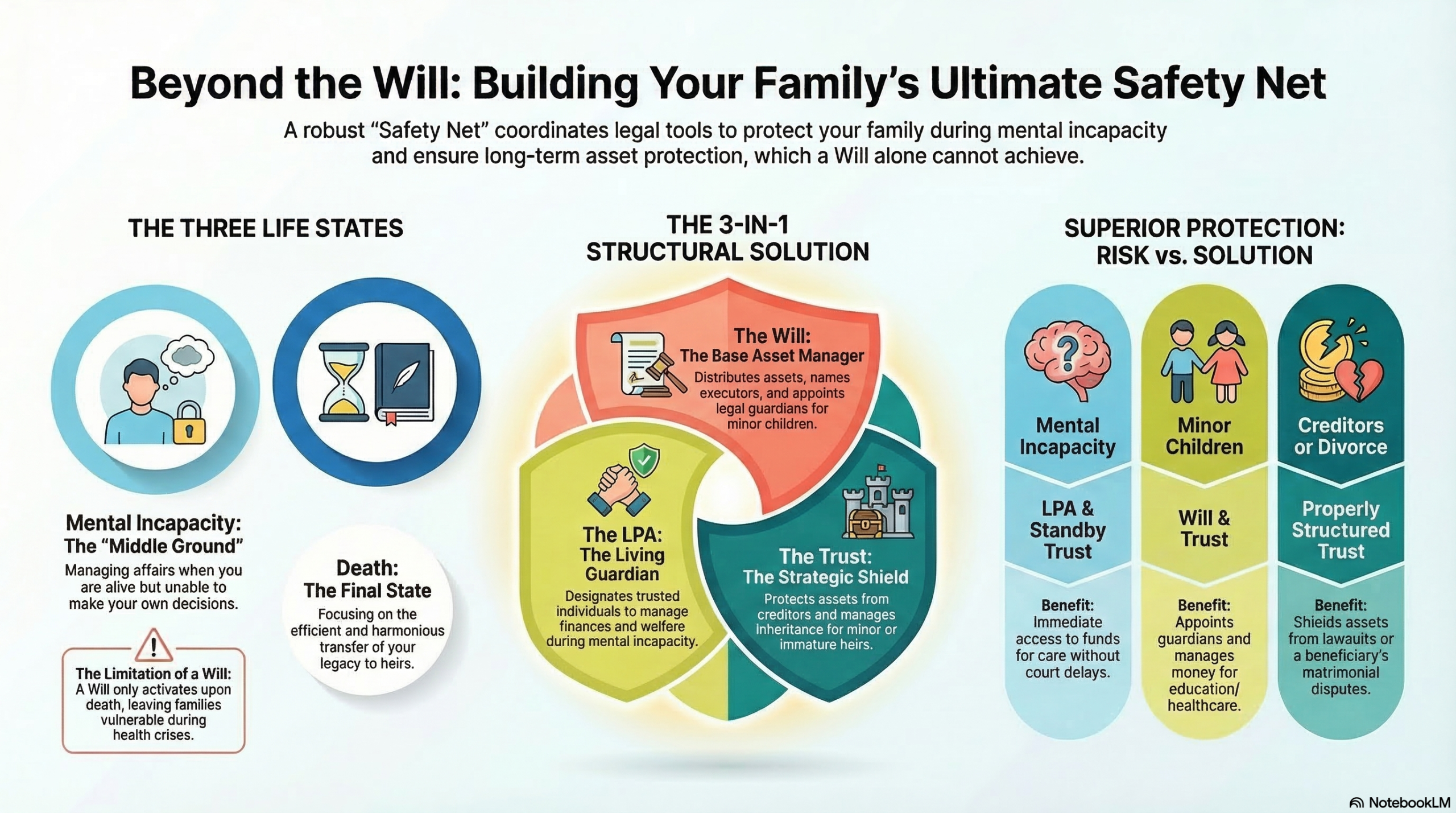
To appreciate the need for a robust structure, we must first recognize that estate planning addresses more than just death. It must manage your affairs across three distinct scenarios:

  1. Good Health: This is where you are now—active, capable, and in control. The goal here is organization and laying the groundwork for the future.
  2. Mental Incapacity: This is the oft-ignored middle ground. Due to accident, illness, or age, you may become alive but unable to make your own decisions. Without a plan, your family faces a legal nightmare just to pay your bills or make medical choices for you.
  3. Death: The final state. The focus here shifts to the efficient, harmonious transfer of your legacy to the next generation.
The Anatomy of a Proper Estate Planning Structure

A simple Will only addresses the third scenario (Death). A proper estate planning structure coordinates multiple tools, each designed to excel in different scenarios while complementing the others.

The Role of a Will: The Base Asset Manager

A Will is the cornerstone of distribution. It specifies who gets what assets, points a finger at who will be in charge (the Executor), and—most critically for parents—appoints guardians for minor children. It provides clarity and prevents your estate from falling into the rigid, one-size-fits-all rules of government intestacy law.

The Role of an LPA: The Living Guardian

The Lasting Power of Attorney (LPA) is perhaps the most critical component while you are alive. It bridges the gap during mental incapacity. It allows you to appoint trusted individuals (Donees) to manage your property, finances, and personal welfare if you lose the ability to do so yourself. Without an LPA, your family may have to apply to court for deputyship—a costly, lengthy, and distressing process.

The Role of a Trust: The Ultimate Strategy and Protection Tool

A Trust adds a layer of sophistication, protection, and flexibility that a Will cannot match. By transferring assets to a Trust, they are managed by Trustees for your chosen beneficiaries. This provides several powerful scenario-based advantages:

  • Scenario: Spendthrift Heirs. Instead of giving a large lump sum to a financially immature beneficiary, a Trust can distribute income gradually, ensuring the inheritance lasts.
  • Scenario: Minor Children. A Will can nominate guardians, but a Trust manages the money precisely for the child’s maintenance, education, and healthcare until they reach a responsible age.
  • Scenario: Creditor/Divorce Protection. Properly structured Trusts can shield assets from potential lawsuits, business creditors, or a beneficiary’s matrimonial disputes.
  • Scenario: Mental Incapacity. Unlike a Will, which only activates upon death, a standby trust can immediately activate upon incapacity, allowing Trustees to use assets for your care without legal delays.

Scenario Matrix: Putting the Structure to the Test

To maximize clarity, consider how these different tools interact to protect a family, such as a married couple (“Me” and “Spouse”).

  • Scenario 1: Both “Me” and “Spouse” are in Good Health.
    • Need: The baseline plan is set up, organized, and reviewed annually. Assets are nominated correctly (CPF, Insurance), and the structure is “active status,” ready for any shift.
  • Scenario 2: “Me” becomes Mentally Incapacitated.
    • Need: Immediate management of medical care and bills.
    • Structured Solution: My LPA activates. My designated Donee takes control of finances. If a Trust exists, Trustees can also deploy funds for my maintenance. My Will remains inactive.
  • Scenario 3: “Me” Dies.
    • Need: Efficient transfer of assets, care for minor children, support for surviving spouse.
    • Structured Solution: My Will activates. CPF and Insurance pay out directly to nominees. Jointly held property passes to the spouse. If I have young children, guardians are appointed via the Will, and assets might flow into a Testamentary Trust for their managed support.
  • Scenario 4: The Complex Scenario (Concurrent Events).
    • Example: “Me” becomes mentally incapacitated, and subsequently, “Spouse” dies.
    • Need: Who is managing the incapacitated person’s care while also managing the deceased spouse’s estate?
    • Structured Solution: This requires a robust structure. “Me” has an active LPA with backup donees. “Spouse” had a Will & Testamentary Trust, providing managed income to support “Me” and their children, overseen by reliable Trustees.

The Dangers of “Just a Will”

Failing to set up this broader structure leaves gaping holes:

  1. No Protection in Incapacity: A Will provides zero guidance or authority if you are alive but incapacitated.
  2. Inflexibility: A Will is rigid. It generally provides lump-sum distributions, which may not suit vulnerable or immature beneficiaries.
  3. Probate Delays: A Will must go through probate—a court process that can take months, freezing assets when your family needs them most. Trusts can often bypass probate entirely.
  4. No Creditor Shield: Assets distributed via a Will become the beneficiary’s property, making them vulnerable to creditors or divorce settlements.

Take Action: It’s Time to Structure Your Legacy

Estate planning is not a morbid task to be feared; it is an act of profound love and responsibility. It is the ultimate gift of certainty and harmony to those you care about.

Delaying your planning is simply planning to delay your family’s security. A comprehensive structure minimizes the potential for family disputes, speeds up wealth transfer, avoids unnecessary legal costs, and protects you and your assets while you are alive.

Do not settle for just an umbrella. Work with qualified estate planning professionals—lawyers, financial advisors, and trust experts—to build a multi-layered, resilient “Safety Net” structure that guarantees your family is truly protected, in every life state, for generations to come.

Start today. Your family is worth it.


Kenny Loh is a distinguished Wealth Advisory Director (RNF# LKK300389588 Representing Financial Alliance) with a specialization in holistic investment planning and estate management. He excels in assisting clients to grow their investment capital and establish passive income streams for retirement. Kenny also facilitates tax-efficient portfolio transfers to beneficiaries, ensuring tax-efficient capital appreciation through risk mitigation approaches and optimized wealth transfer through strategic asset structuring.

In addition to his advisory role, Kenny is an esteemed SGX Academy trainer specializing in S-REIT investing and regularly shares his insights on MoneyFM 89.3. He holds the titles of Certified Estate & Legacy Planning Consultant and CERTIFIED FINANCIAL PLANNER (CFP).

With over a decade of experience in holistic estate planning, Kenny employs a unique “3-in-1 Will, LPA, and Standby Trust” solution to address clients’ social considerations, legal obligations, emotional needs, and family harmony. He holds double master’s degrees in Business Administration and Electrical Engineering, and is an Associate Estate Planning Practitioner (AEPP), a designation jointly awarded by The Society of Will Writers & Estate Planning Practitioners (SWWEPP) of the United Kingdom and Estate Planning Practitioner Limited (EPPL), the accreditation body for Asia.

Arrange for a non-obligatory one-to-one free consultation here!

You can join his Telegram channel #REITirement – SREIT Singapore REIT Market Update and Retirement related news. https://t.me/REITirement

If you need any financial advice, please contact kennyloh@fapl.sg
Continue ReadingBeyond the Will: Why a Robust Estate Planning Structure is Your Family’s Ultimate Safety Net

Navigating U.S. Estate Tax on U.S. Stock Holdings: A Guide for Singapore Investors

  • Post author:

Introduction

Apple, Nvidia, Tesla, Microsoft, Amazon…… many of us, especially younger investors, are drawn to these US Stocks, known for their stellar performance over the years. The S&P 500 has delivered an average annual return of 10.33% since 1957 (Investopedia). However, did you know that owning these stocks directly as a non-U.S. person (like us) can trigger a significant tax burden upon death? This tax, the U.S. estate tax, can claim up to 40% of the value of your US assets, drastically reducing the wealth passed on to your beneficiaries.

Understanding the US Estate Tax

The US estate tax applies to “US situs” assets owned by non-resident, non-citizen individuals at the time of their death. These assets include shares in companies incorporated in the US, US real estate, certain US-based bonds and mutual funds, and even cash deposits held with US brokers.

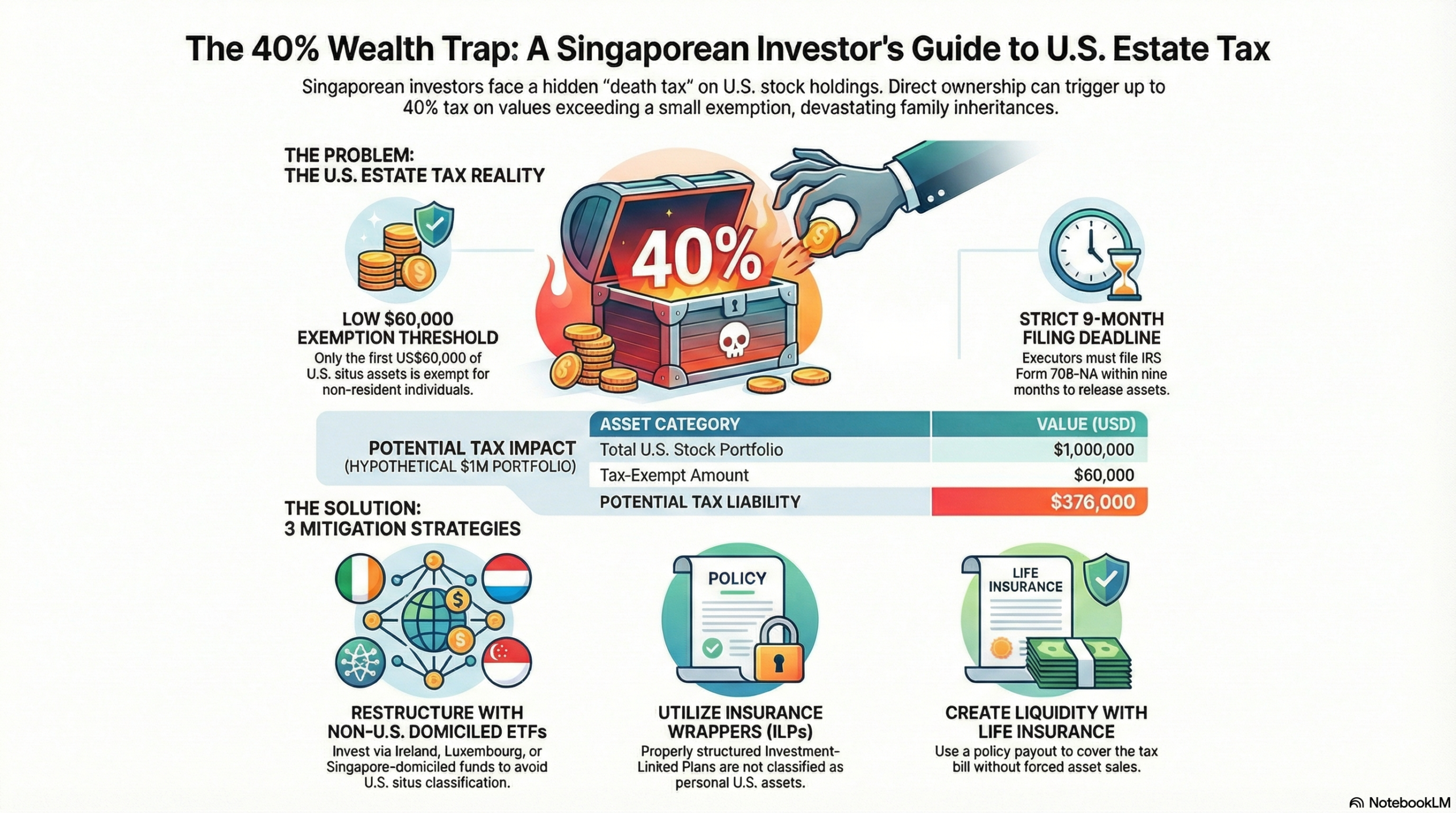
Unfortunately, the threshold for exemption is extremely low for non-US persons. Only the first US$60,000 of US situs assets is exempt from tax. Any value above that amount may be subject to estate tax, at rates that can go as high as 40%.

For example, a Singaporean investor with a portfolio of US stocks valued at US$1 million would only receive an exemption of US$60,000. The remaining US$940,000 would be subject to estate tax, potentially resulting in a tax bill of up to US$376,000!

Furthermore, the executor of the estate must file IRS Form 706-NA within nine months of the investor’s death and settle the tax liability to obtain a Federal Transfer Certificate. Without this certificate, US custodians may refuse to release or transfer the deceased’s assets to their beneficiaries.

Estate Planning Strategies to Reduce Exposure

So how can we mitigate this devastating tax burden? Here are 5 strategies that you can possibly execute to do so.

Restructuring your Portfolio

  • Keep direct U.S. stock holdings below US$60,000
  • Increase exposure via non-US ETFs or mutual funds that invest in U.S. markets but are domiciled in Ireland, Luxembourg, or Singapore

These instruments (unit trusts, ETFs, mutual funds etc.), despite investing in US equities, won’t be subjected to the US estate tax as they are not domiciled in the US. For Singaporeans, this could be investing in unit trusts through brokers like Phillip Securities, or ETFs listed on the Singapore Exchange (SGX).

Use an Insurance Wrapper

  • Purchase investment-linked insurance plans (ILPs) that invest in US equities
  • Death benefit proceeds are not classified as US situs assets if structured properly

You can involve an insurance-based investment product, such as investment-linked insurance policies (ILPs). They typically combine investment in global markets with life insurance coverage. So even if there is US stock exposure within the ILP, it should not be subject to US Estate Tax as the asset is not held by the investor personally.

However, you have to ensure that the policyholder and beneficiary structures are clear.

Set Up a Holding Company

  • Hold US stocks via a non-US corporation (e.g. setting a company in Singapore)
  • The company, not the individual, owns the US assets, potentially removing them from the personal estate

But! It may give rise to other tax considerations, such as capital gains tax upon sale of the company’s shares. In addition, it gives rise to additional tax complications depending on jurisdiction. Proper legal and tax advice is essential before implementing this structure.

Create a Trust Structure

  • Transfer U.S. stocks into a foreign irrevocable trust

Trusts can be especially useful to pass down your wealth to future generations. However, trust creation and maintenance involve higher costs and usually require professional management, and the structure must be carefully designed to avoid triggering adverse tax consequences in other jurisdictions.

Cash Creation via Life Insurance

  • Purchase a life insurance policy whose death payout covers the expected U.S. estate tax
  • This ensures liquidity for your estate without forced asset sales

Lastly, you can purchase a life insurance policy with a death benefit sufficient to cover the anticipated estate tax. This ensures that the estate has enough liquidity to settle any tax due without having to sell US investments under pressure or delay asset distribution to beneficiaries.

This may be a good strategy if you already have a large US asset portfolio. However, you need to forecast accurately your estate value and tax liability. Also, unlike some of the other solutions, this still requires you to file tax with the IRS, which is not an easy procedure.

Conclusion

Many of us are either unaware or are indifferent of the complications arising from this US Estate Tax. But it can take away a significant portion of your wealth (up to 40%!) that you can transfer to your future generations. Therefore, it is crucial to mitigate these effects in order to preserve your wealth for your future generations. Failing to plan is planning to fail! Also, to quote:

Kenny Loh is a seasoned Wealth Advisory Director with deep expertise in comprehensive investment planning and estate management. He is dedicated to helping clients strategically grow their investment capital, generate sustainable passive income for retirement, and seamlessly transition wealth to future generations. Through meticulous asset structuring, he ensures tax-efficient portfolio transfers, allowing beneficiaries to benefit from tax-free capital appreciation while optimizing long-term financial security. With a professional approach and a wealth of experience, Kenny empowers clients to preserve and enhance their legacies with confidence.

Arrange for a non-obligatory one-to-one free consultation here!

Important: The information and opinions in this article are for general information purposes only. They should not be relied on as professional financial advice. Readers should seek unbiased financial advice that is customised to their specific financial objectives, situations & needs. This advertisement or publication has not been reviewed by the Monetary Authority of Singapore.

Continue ReadingNavigating U.S. Estate Tax on U.S. Stock Holdings: A Guide for Singapore Investors

Don’t Leave Their Future to Chance: Why Young Families Need an Estate Plan Now

  • Post author:

For most young parents, “estate planning” sounds like something reserved for the wealthy or the elderly. But if you have minor children, an estate plan isn’t about how much money you have; it’s about legal guardianship and protection. It is the ultimate act of parental responsibility—ensuring that if the unthinkable happens, your children are raised by the people you choose and supported by the assets you’ve worked hard to build.


The Hidden Risks of Silence

Leaving your family’s future to “the system” creates three immediate crises:

  • The Guardianship Gap: Without a legal Will naming guardians, your children could be placed in temporary protective custody (foster care) while a judge—a stranger—decides which relative is most “fit” to take them.
  • The “Eighteen-Year-Old” Windfall: In many jurisdictions, if you die without a trust, your children receive their entire inheritance in one lump sum the moment they turn 18 (Singapore 21). Most teenagers aren’t equipped to manage a house, life insurance payouts, and savings accounts responsibly.
  • The Probate Drain: Without a plan, your assets can be locked in probate court for years. This “freezes” your bank accounts, meaning your family might not have the cash flow to pay for the mortgage or school fees during the most stressful time of their lives.

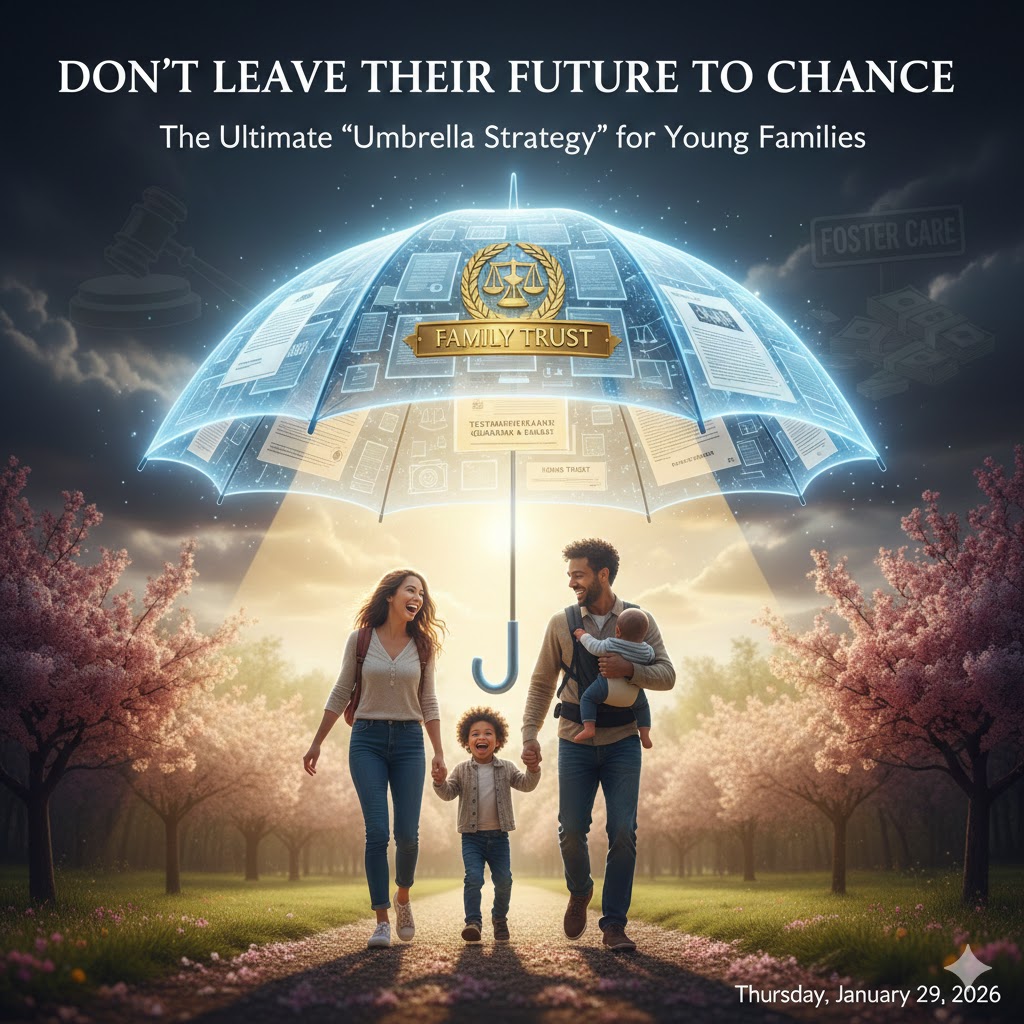
The Solution: The “Umbrella” of Protection

Think of estate planning as an “Umbrella Strategy.” You don’t buy a car seat because you expect to crash; you buy it so your child is safe if you do. Your estate plan should consist of three core layers:

1. Legal Guardianship & The Letter of Wishes

This is your voice in the room when you aren’t there. You formally name Testamentary Guardians to provide physical care. To go a step further, include a Letter of Wishes. This is a personal guide for the guardians detailing your values, your hopes for your children’s education, and even small details like their favorite traditions.

2. The Protective Trust Structure

Instead of giving money directly to children, assets should be held in a Trust. You can use a “Pot Trust” strategy, which keeps the family’s wealth in one pool to cover all children’s needs—like healthcare and education—until the youngest reaches a certain age. This ensures that a five-year-old has the same financial support for college that their older sibling already received.

3. Asset & Remarriage Protection

A well-structured trust protects your children’s inheritance from more than just their own youth. It shields the money from future creditors, lawsuits, or a messy divorce. It also prevents “accidental disinheritance,” ensuring that if a surviving spouse remarries, your assets are legally earmarked for your children rather than a new partner.


Building the Right Structure

To help a family move from “exposed” to “protected,” we follow a comprehensive process. We begin by drafting a Will to establish the legal foundation of guardianship and executors. Next, we implement a Living or Testamentary Trust to dictate exactly how and when wealth is distributed, ensuring it’s used for the children’s Health, Education, Maintenance, and Support (HEMS).

Beyond the assets, we ensure Liquidity by aligning life insurance policies with the trust so cash is available immediately. Finally, we establish Durable and Healthcare Powers of Attorney. This ensures that if you are only temporarily incapacitated, a trusted person can manage your finances and make medical decisions without your family having to sue for guardianship in court.


Your Next Step

Don’t let a judge decide who raises your children or how your hard-earned assets are spent. By putting a structure in place today, you are giving your family the gift of certainty.

Important: The information and opinions in this article are for general information purposes only. They should not be relied on as professional financial advice. Readers should seek unbiased financial advice that is customised to their specific financial objectives, situations & needs. This advertisement or publication has not been reviewed by the Monetary Authority of Singapore.

Kenny Loh is a distinguished Wealth Advisory Director with a specialization in holistic investment planning and estate management. He excels in assisting clients to grow their investment capital and establish passive income streams for retirement. Kenny also facilitates tax-efficient portfolio transfers to beneficiaries, ensuring tax-efficient capital appreciation through risk mitigation approaches and optimized wealth transfer through strategic asset structuring.

In addition to his advisory role, Kenny is an esteemed SGX Academy trainer specializing in S-REIT investing and regularly shares his insights on MoneyFM 89.3. He holds the titles of Certified Estate & Legacy Planning Consultant and CERTIFIED FINANCIAL PLANNER (CFP).

With over a decade of experience in holistic estate planning, Kenny employs a unique “3-in-1 Will, LPA, and Standby Trust” solution to address clients’ social considerations, legal obligations, emotional needs, and family harmony. He holds double master’s degrees in Business Administration and Electrical Engineering, and is an Associate Estate Planning Practitioner (AEPP), a designation jointly awarded by The Society of Will Writers & Estate Planning Practitioners (SWWEPP) of the United Kingdom and Estate Planning Practitioner Limited (EPPL), the accreditation body for Asia.

If you need any financial advice, please contact kennyloh@fapl.sg
罗国强(Kenny Loh) 是一位杰出的财富咨询总监,专长于综合投资规划与遗产管理。他擅长协助客户实现投资资本增值,并建立退休被动收入来源。同时,他通过税务优化的方式帮助客户将投资组合高效转移给受益人,运用风险缓释策略确保资本增值的税务效率,并通过战略性资产配置实现财富传承的最优化。

除咨询工作外,罗国强是新加坡交易所学院(SGX Academy)的特聘讲师,专注于新加坡房地产投资信托(S-REIT)投资领域,并定期在MoneyFM 89.3电台分享专业见解。他拥有认证遗产与传承规划顾问(Certified Estate & Legacy Planning Consultant)及国际认证财务规划师(CFP)资格。

在逾十年的综合遗产规划经验中,他独创“遗嘱、持久授权书与备用信托三合一”解决方案,兼顾客户的社会责任、法律义务、情感需求及家庭和谐。他持有工商管理硕士与电气工程硕士双学位,并获英国遗嘱撰写及遗产规划从业者协会(SWWEPP)与亚洲认证机构遗产规划从业者有限公司(EPPL)联合授予副遗产规划从业师(AEPP)专业资格。

Arrange for a non-obligatory one-to-one free consultation here!

立即预约免费一对一咨询(无需承担任何义务)!

Continue ReadingDon’t Leave Their Future to Chance: Why Young Families Need an Estate Plan Now