After identifying a good stock and calculate the intrinsic value, the next important step is to develop a trading plan or investment plan of when to buy and when to sell. The first thing before I enter the position is to look for excuse for not to buy because it is easier to identify the not to buy signals.
When Not to Buy?
 When the stock in on the down trend. I check whether the stock price is below 20D, 50D and 200D MA line. I do not want to buy a stock which may go lower and lower. I also use other Technical Indicators (MA, MACD, Parabolic Stop and Reversal, Bollinger Band, RSI, Stochastic) to confirm my analysis. Below is stock chart for S&P500, I show some Technical Indicators (MA, MACD and Bollinger Band) only on the charts otherwise the charts will be overcrowded when I include all six Technical Indicators.
 - When the stock breaks below a strong support line.
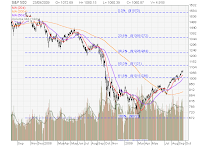 If there is no clear support line on the chart, I will use Fibonacci retracement to identify the support level. 61.8% Fibonacci retracement level is a critical support or resistance level that I will pay special attention to.
-
When there are reversal patterns shown on the chart like Head & Shoulders, Double tops, Triple Tops.
-
When the stock price are testing the resistance or on top of the resistance of a channel.
When to Buy?
- When the stock is on an up trend. The stock is above 20D, 50D & 200D MA, and all technical indicators show bullish convergence.
There are still lot more patterns I need to learn to perfect my entry points. I will continue to share in my stock chart analysis.


