Five biggest Chinese real estate plays on SGX

  • Post author:

On Friday the China National Bureau of Statistics reported that investment in real estate development from January through September had grown by 13.8%. The five biggest stocks/trusts on SGX with exposure to the Greater China real estate market all outperformed the major Chinese index benchmarks in the year-to-date. The five stocks/trusts are:

  1. Hongkong Land Holdings Ltd (H78). The company which is quoted and traded in US Dollars (USD) has generated a total return of 34.85% and maintains a dividend yield of 2.69%. In SGD terms, the total return converts to 32.84% in the year-to-date. The company owns and manages prime office and retail space in Hong Kong and through subsidiaries, it is active across Asia. With market capitalisation of approximately SGD 17 billion, the company is part of the Straits Times Index (STI) and has displayed a similar volatility level to the STI over the past two years. The investor relations page can be found here.
     
  2. Keppel Land Ltd (K17). The company has produced a total return of 64.67% in the 2012 year-to-date and maintains a dividend yield of 5.81%. Keppel Land is geographically diversified in Asia, with current focus on Singapore, China, Vietnam, Indonesia and India. The market capitalisation of Keppel Land is approximately SGD 5.3 billion. The investor relations page can be found here.
     
  3. Yanlord Land Group Ltd (Z25). The company has generated a total return of 32.98% in the 2012 year-to-date and does not maintain a dividend yield. The market capitalisation of the company is approximately SGD 2.5 billion. Yanlord Land is a real estate developer based in Mainland China that focuses on developing high-end residential, commercial and integrated property projects in Mainland China. The investor relations page can be found here.
     
  4. CapitaRetail China Trust (AU8U); The REIT has generated a total return of 53.22% in the 2012 year-to-date. CapitaRetail China Trust (CRCT) is the first Mainland China shopping mall REIT listed on SGX, with a portfolio of nine income-producing shopping malls. The market capitalisation of the REIT is approximately SGD 1.1 billion. The investor relations page can be found here.
     
  5. Ying Li International Real Estate (5DM); The company has generated a total return of 31.37% in the 2012 year-to-date. Like Yanlord, Ying Li International Real Estate does not maintain a dividend yield. The market capitalisation of the Chongqing commercial property developer is approximately SGD 724 million. The investor relations page can be found here.
     
    Dynasty REIT was launched last week and will be Singapore’s first Renminbi (RMB) denominated Real Estate Investment Trust (REIT). It has been established with the investment strategy of principally investing in income-producing commercial real estate located in Mainland China, as well as real estate-related assets. The closing time for the IPO is 12pm, 24 October 2012, with an afternoon listing on SGX scheduled for 30 October.
     
    The offer price of per units of the Dynasty REIT is RMB 4.40 to RMB 4.70, equivalent to SGD 0.855 to SGD 0.915 per Unit. Over the past 5 years, the Singapore Dollar has depreciated 0.25% to the Renminbi in contrast to appreciating 16.50% to the US Dollar. The units of the Dynasty REIT will be quoted and traded in both RMB and SGD. Dynasty REIT will have two trading counters:  a primary RMB counter and a secondary SGD counter. This provides investors with the flexibility to buy or sell the Units through either counter. Trades made in the Dynasty REIT RMB counter will be settled through the SGX-ST in RMB while trades made in the SGD counter will be settled through the SGX-ST in SGD. The units are fully fungible and any units acquired via the Dynasty REIT RMB counter or the Dynasty REIT SGD counter can be traded on the other counter seamlessly.

Dynasty REIT’s initial portfolio comprises of:

  1. Nanjing International Finance Center, which has 51 stories of mixed-use office and retail building with two basement levels with a 95.5% committed occupancy rate as of 31 May 2012.
     
  2. Dalian Tianxing Roosevelt Center, a retail mall with 5 stories and 2 basement levels and a 93.2% occupancy rate as of 31 May 2012.   
     
  3. Shanghai International Capital Plaza, which includes 29 stories of a mixed-use office and retail building with one basement level and a committed occupancy rate of 86.8%.  

Annualised, the forecast distribution yield of Dynasty REIT is 6.8% to 7.1% for 2012. This is based on the maximum and minimum offering prices. Based on these prices, the forecast distribution yield for the next year, 2013, is 7.0% to 7.3%. In the absence of an undertaking of a waived distribution of sponsor entitlements, the distribution yields would have been 3.2% for 2012 and 4.1% to 4.2% for 2013. The REIT sponsor [ARA Asset Management] has provided the Manager [ARA Trust Management (Dynasty) Pte. Ltd] with an undertaking that it shall waive (or shall procure the waiver of) entitlement to distributions on the sponsor units. Based on maximum to minimum offering prices, waivers amount to between RMB 6.9 million to RMB 7.2 million for the Forecast Period 2012 and thereafter between RMB 16.7 million to RMB 17.3 million for every financial year until the financial year ending 31 December 2017.  More information can be found in The Dynasty REIT prospectus can be obtained here.

Source: SGX My Gateway.


Continue ReadingFive biggest Chinese real estate plays on SGX

Big US Banks (JPM, C, RY, BAC) With Nice Charts

  • Post author:
Commentary:

Four big name banking stocks have been flying higher recently, all up between 13 and 39% in the last three months. While the upward progress is continuing in two, the other two stocks have paused in a sideways consolidation. Ultimately, the question is whether the uptrend is going to continue? Technical analysis is not always a crystal ball, but by using simple tools you can determine when the trend is strong and when it is not.


JPMorgan Chase & Co. (NYSE:JPM)


JPMorgan Chase & Co. (NYSE:JPM) is up 22.06% in the last three months, and as of October 16 continued to forge upward hitting the highest price ($43.11) seen in five months. The uptrend is well defined since the 2012 low of $30.83 in June, and a trend channel signals an area of resistance from $44 to $45. Just beyond this is the 52-week high at $46.49. Created by a trendline in July is support at $40, and a drop below it will likely push the price to the next trendline and support region at $37.30 to $36.40. Traders will look to pick up the stock long on pull-backs that hold above support; dropping below support is a sign a decline may be coming.

SEE: Technical Analysis: Support And Resistance


Citigroup, Inc. (NYSE:C)


As of the $37.40 close on October 16, Citigroup, Inc. (NYSE:C) is up 38.94% in the last three months. Volume pushed higher on the October 15 and the next day as well, showing interest in the stock. Resistance is close by at the 52-week high of $38.40. A divergence on the RSI shows that momentum may be dying, making the volume burst look more like a trend finale rather than a sustainable buying boom. If the price moves above the 52-week high, resistance is expected between $40 and $41, with $40 being the price target for those that are long. A drop below $34 is the first sign that the stock may be weakening; moving below $32 will likely result in a further decline.

SEE: Momentum And The Relative Strength Index


Royal Bank of Canada (NYSE:RY)


Royal Bank of Canada (NYSE:RY) is up 13.86% over the last three months, as of the October 16 close. Most of the gain came in August and in early September, but the stock has moved sideways since then. The 52-week high is at $59.60 and is at the closest pivotal level, with a rise above it indicating a breakout of the current range and a continuation of the uptrend. Divergence on the RSI over the last two months, warns that an upside breakout may not occur, and if it does it might not last. Support is at $56.50, and if the price drops below it there is little support until $54 to $53 where the trendline which began in June intersects.

SEE: The Anatomy Of Trading Breakouts


Bank of America Corporation (NYSE:BAC)


The stock of Bank of America Corporation (NYSE:BAC) has also been moving more sideways since creating a swing high at $9.79 in mid-September. If the price rallies above that high, it is a positive sign giving a target of $10.75. The 52-week high is at $10.10, a key level to watch if the upside breakout occurs. Support is provided by the short-term range at $8.70. A downside breakout gives a target of $7.75, but could go lower as key support is not until the $7 area.


Bottom Line:

Price movement is the ultimate tool, as it is unwise to fight a trend. These banking stocks have been pushing higher for the last three months, and may continue to surge. Dropping through the support areas warns that the trend may be weakening. However, if the price pulls back toward support without breaking through it, such occurrences are often buying opportunities. Trends and trend channels provide levels to buy or sell, and an RSI indicator can help determine the strength of a trend, but its signals should not be acted on in isolation.

 
Charts courtesy of stockcharts.com

At the time of writing, Cory Mitchell did not own shares in any of the companies mentioned in this article.

 
Continue ReadingBig US Banks (JPM, C, RY, BAC) With Nice Charts

SGX: Bull or Bear?

  • Post author:

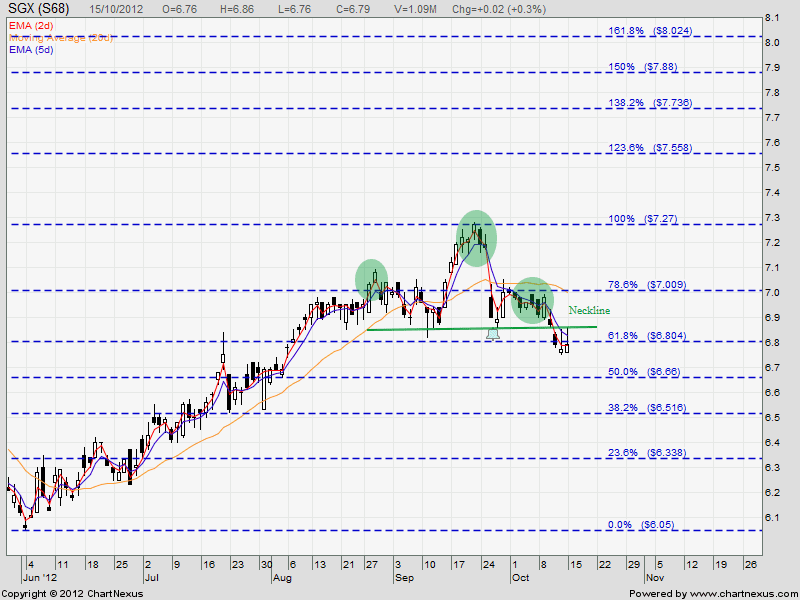
It can go either way for SGX. Anyway, just need to wait for the release of quarterly earning result before deciding how to trade SGX.

Bullish Sign from the Chart:

  • SGX rebound from 61.8% FR and looks like this support level is good from past 3 sessions.
  • 2 consecutive Inverted Hammers candlesticks pattern were formed at this support level, indicate potential reversal.
  • If this 61.8% Fibonacci Retracement Level is a good support, SGX has potential to reach 161.8% (about $8.00) in a few months time.
  • 200D SMA support is at about $6.70 indicates limited down side risk.
  • Dividend Yield of about 4% paid out quarterly should limit the selling pressure.

Bearish Signs from the Chart:

  • 2/5 EMA are both bearish on daily and weekly chart.
  • Head & Shoulders chart pattern are form with neckline at about $6.85. Price target for the breakout is $6.50.
  • Current price is below 20D and 50D SMA.


Key Statistics for SGX

Current P/E Ratio (ttm) 24.9634
Estimated P/E            (06/2013            ) 22.9630
Earnings Per Share (SGD) (ttm) 0.2732
Est.            EPS (SGD) (06/2013) 0.2970
Est. PEG Ratio 3.6449
Market Cap (M SGD) 7,286.71
Shares Outstanding (M) 1,068.43
Enterprise Value (M SGD) (ttm) 6,589.03
Enterprise Value/EBITDA (ttm) 17.87
Price/Book (mrq) 8.7442
Price/Sale (ttm) 11.2624
Dividend Indicated Gross Yield 3.96%
Next Earnings Announcement 10/18/2012


Continue ReadingSGX: Bull or Bear?