How to Change Your Money Mindset for the Better

  • Post author:

This article originally appeared on Payment1.com.


Our views on money are greatly influenced by how we were raised and what money concepts we were made to believe growing up. Most of us were introduced to the same sequence of life events: going to school, moving on to college, and then finding a job. This particular format made us think that once we’ve found a job, we won’t have to worry about money anymore. And, boy, were we wrong.


Most of us who are actually lucky to have found jobs live from paycheck to paycheck. This means having enough money to pay the monthly bills, have enough food on the table, go out a few nights every month, and possibly get to travel once or twice every year; but you know for sure you’d want more out of this life if you had the chance. You want to try out new dishes at fancy restaurants without having to live on instant noodles in the next few days. For sure, you want to travel more, fly business class, and stay in hotels with more than 3 stars. You definitely want to have enough funds to save and invest.

 

Source

How we go about our finances is deeply rooted in the mindset we are accustomed to. Therefore, transforming this mindset is a great step in improving the way we deal with financial matters. Here are a few tips on how to start your own transformation.


Revisit the way you talk to yourself about money. The story we tell ourselves every day becomes our very life, so be mindful of your script. Examine your inner dialogue and see if you have been too hard on yourself when it comes to money matters. Transform this inner chatter by adopting more hopeful and positive insights. If you have been beating yourself up for the student loan debts you haven’t finished paying off yet, try focusing on how much you’ve paid, rather than how much you still owe the next time you think about it. It’s simple, but it’s a start.


Always remind yourself that you are treading your own financial journey. This is important to remember especially in this day and age when we have all-day access to the life of others — or at least the way they curate it online. It’s easy to feel a pang of jealousy when you see your feed filled with travel photos, new purchases, weddings, and babies. Social media have been notorious in making people feel depressed, so never lose sight of the fact that you own your financial journey; because if you do, you might end up spending money on things you don’t need just to “keep up.”


Avoid emotional spending. Speaking of spending money on things you don’t need, we sometimes spend money to regain some sense of control. However, after using all that money and see how the impulsive buy messed up your monthly budget, you lose your sense of control again. The cycle goes on and on. When you find yourself scouring online shopping sites at the end of a very stressful workday, stand up and take a walk instead; and remind yourself that buying a second parka jacket (which will probably end up sitting unused at the back of your closet) will just stress you out more down the road.


Change your debt mindset, too. It may be hard to be positive about all the money you owe, but you can give it a try if it means lifting the weight off your shoulders somehow. Decide that you want to get out of debt soon and make a debt plan, complete with timelines, action items, and personal deadlines. Create a tracker of your progress in paying off your debt and view it exactly like that: progress. You are moving forward and out of debt, and soon enough you will have more funds to move around with.


It takes effort and courage to change your money mindset, and these tips can get you started. In a nutshell, these tips emphasize that in order to unlearn negative views on money, you must stay on top of your inner dialogue and thought patterns with regards to your finances. One effective way to recognize your thought patterns and inner dialogues is through talk therapy. A licensed therapist, like those at BetterHelp, can help you identify your cognitive biases. By doing so, you are leaving room for more productive and positive ideas on how to elevate your financial situation.


Continue ReadingHow to Change Your Money Mindset for the Better

Possible Reasons Why Your Personal Loan Application Got Denied

  • Post author:

This article originally appeared on Payment1.com

Source


When your personal loan application gets denied, it can be disappointing. Most people are also puzzled. Even people with strong credit scores can get denied, and it makes them wonder why. Below are a few common reasons why banks deny personal loan applications so the next time you apply for one, you’ll know what and what not to do.


  1.  Bad credit score


Let’s get the most obvious reason out of the way. When you have a bad credit score, lenders are most likely to deny your personal loan applications. Your credit score is what tells banks the likelihood of you paying them back for the loan. If your track record is not very good when it comes to paying what you owe, chances are your bank will be resistant to granting you loans.


  1. The loan amount is too high


Lenders will take into account your capacity to pay back when you apply for a loan. When you fill out that loan application form and put in too high of an amount in the “desired loan amount” field, banks will most likely deny your application. To avoid this mistake, use an online loan calculator. Loan calculators can tell you how much you can borrow given your current income.


  1.       Unstable employment record


Because banks consider your ability to pay the loan off in the long run, they will be looking at your employment record. So if you have an unstable employment record or worse, no employment at all, banks will be hesitant to grant your loan application. Lenders will require certain employment tenure or length of service, which is why banks typically require you to submit a certificate of employment.


  1.  Insufficient income


When you don’t make enough to apply for a loan, you will most likely not get approved. You need to be able to make the monthly loan repayments, and If you do not make enough money to pay them and at the same time address your basic needs as well, lenders will not grant you a loan. This is because you are most likely to use your income for your basic needs than to pay off the loan.


  1.  You have too much debt


When you apply for a personal loan, your bank will do a background check to see if you have any outstanding loans. This is so they are sure that you have the capacity to pay. If you meet the minimum income requirement and have a good credit score but have several outstanding loans, they will most likely be hesitant to grant you another one. The more loans you have, the less capacity you have to pay back an additional loan.


  1.  How you fill out the loan application


If you have any mistakes or inconsistencies in your loan application, lenders might not grant you your personal loan. Your data needs to be complete, correct, and consistent. Lying on your application will get you denial and could possibly land you on your bank’s bad side.


Consider the list above the next time you apply for a personal loan. Make sure you fill out the application completely and honestly, have a good credit score and enough income to make the payments, and make sure you’ve been employed a while.

Continue ReadingPossible Reasons Why Your Personal Loan Application Got Denied

Singapore REIT Fundamental Analysis Comparison Table – 3 June 2019

  • Post author:

Technical Analysis of FTSE ST REIT Index (FSTAS8670)

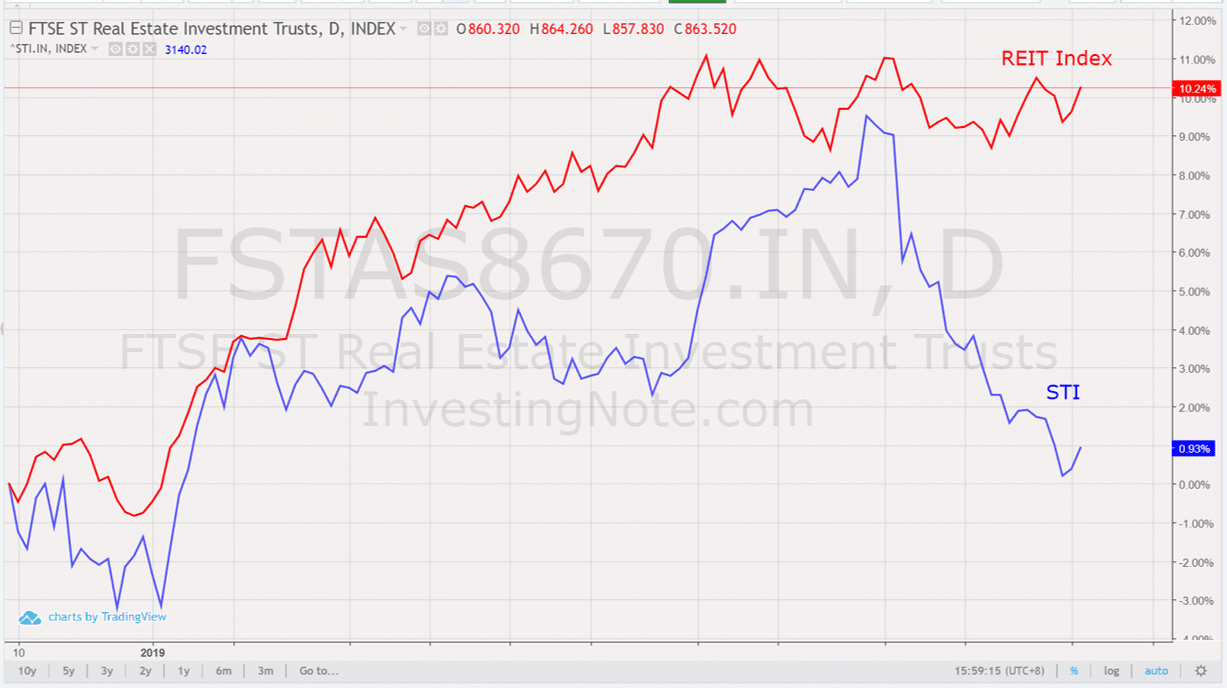
FTSE ST Real Estate Investment Trusts (FTSE ST REIT Index) changed from 869.49  to 858.67 (-1.24%) as compared to last post on Singapore REIT Fundamental Comparison Table on May 5, 2019.

The REIT index is currently facing immediate resistance of 875 (the previous high in 2018) and trading within a falling wedge consolidation range between 848 to 870.  Based on the current chart pattern and and momentum,  the sentiment is BULLISH and the trend for Singapore REIT direction is still UP with a pause. All eyes will be focusing on whether the REIT index can break the 2018 high (875) and 2013 high (892) back in May 2013. Another scenario would be a break down of the 848 immediate support and we will see a larger correction of REIT index, heading towards the 200D SMA support of about 820.


Fundamental Analysis of 39 Singapore REITs

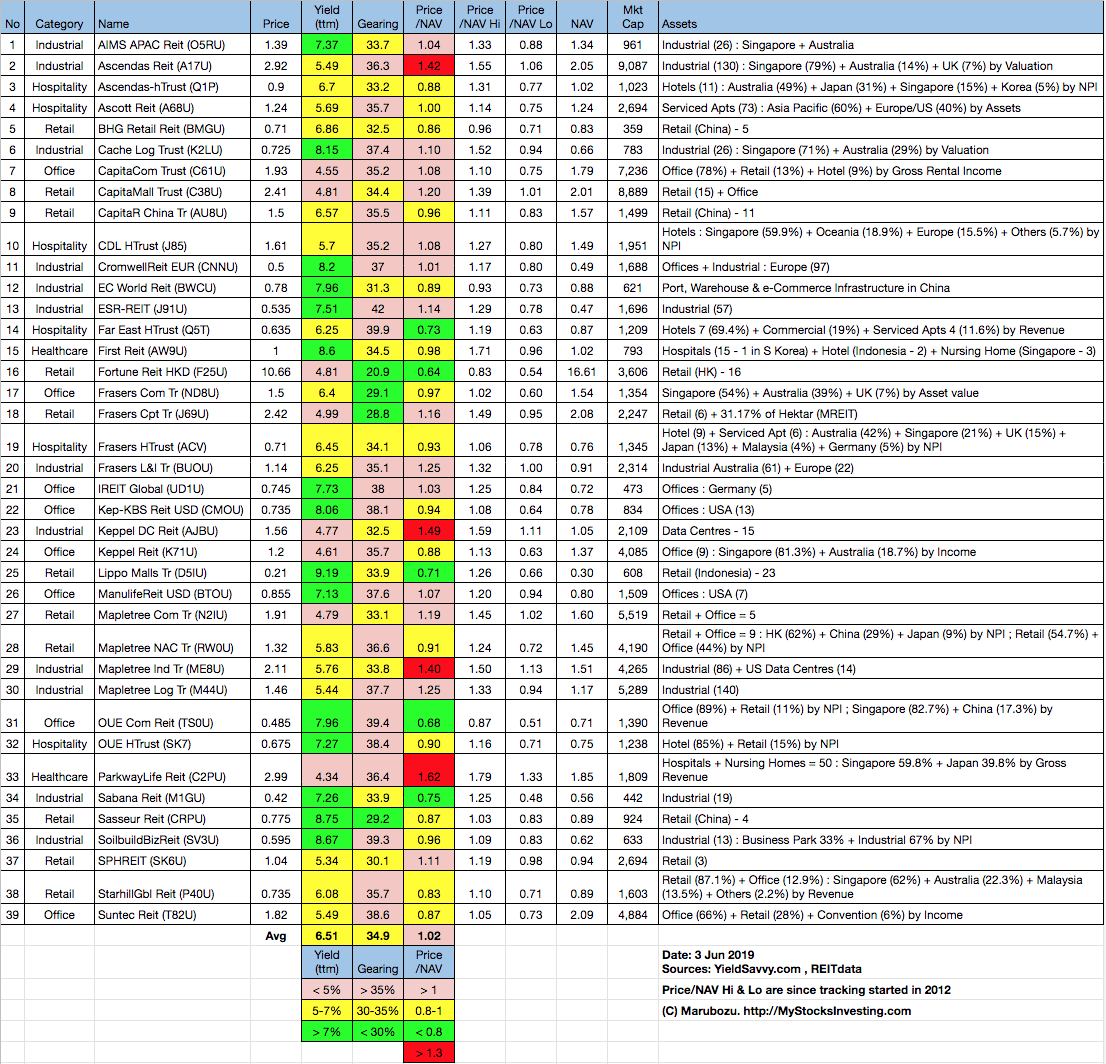
The following is the compilation of 39 REITs in Singapore with colour coding of the Distribution Yield, Gearing Ratio and Price to NAV Ratio. This gives investors a quick glance of which REITs are attractive enough to have an in-depth analysis. The 2 new IPO ARA US Hospitality Trust and Eagle Hospitality Trust are not included in this table due to insufficient data points.

  • Price/NAV decreases from 1.03 to 1.02 (Singapore Overall REIT sector is slightly over value now).
  • Distribution Yield increases from 6.40% to 6.51% (take note that this is lagging number). About 38.5% of Singapore REITs (15 out of 39) have Distribution Yield > 7%.
  • Gearing Ratio increases from 34.7% to 34.9%. 22 out of 39 have Gearing Ratio more than 35%. In general, Singapore REITs sector gearing ratio is healthy. Note: The limit of gearing ratio for REITs listed in Singapore Stock Exchange is 45%.
  • The most overvalue REIT is Parkway Life (Price/NAV = 1.62), followed by Ascendas REIT (Price/NAV = 1.42), Keppel DC REIT (Price/NAV = 1.49) and Mapletree Industrial Trust (Price/NAV = 1.40).
  • The most undervalue (base on NAV) is Fortune REIT (Price/NAV = 0.64), followed by OUE Comm REIT (Price/NAV = 0.68), Lippo Mall Indonesia Retail Trust (Price/NAV = 0.71), Sabana REIT (Price/NAV = 0.75) and Far East Hospitality Trust (Price/NAV = 0.73).
  • The Highest Distribution Yield (TTM) is Lippo Mall Indonesia Retail Trust (9.19%), followed by First REIT (8.60%), SoilBuild BizREIT (8.67%),  Sasseur REIT (8.75%)  and Cromwell European REIT (8.20%).
  • The Highest Gearing Ratio are ESR REIT (42.0%), Far East HTrust (39.9%) and OUE Comm REIT (39.4%) and SoilBuild BizREIT  (39.3%)
  • Top 5 REITs with biggest market capitalisation are Ascendas REIT ($9.0B), CapitaMall Trust ($8.9B), Capitaland Commercial Trust ($7.2B), Mapletree Commercial Trust ($5.5B) and Mapletree Logistic Trust ($5.3B)
  • The bottom 3 REITs with smallest market capitalisation are BHG Retail REIT ($359M), Sabana REIT ($442M) and iREIT Global REIT ($473M)

Disclaimer: The above table is best used for “screening and shortlisting only”. It is NOT for investing (Buy / Sell) decision. To learn how to use the table and make investing decision, Sign up next REIT Investing Seminar here to learn how to choose a fundamentally strong REIT for long term investing for passive income generation

  • 1 month increases from 1.82283% to 1.88538%
  • 3 month increases from 1.94507% to 2.00338%
  • 6 month increases from 2.00014% to 2.06215%
  • 12 month increases from 2.12550% to 2.18675%

Based on current probability of Fed Rate Monitor, the US Fed Reserve reduce the interest rate by 50bps to  2.00% in 2019. Probability of keeping the interest rate at 2.25-2.50% is only 3.2%! This means US Fed Reserve will cut the interest rate by end of this year! This is a big change from last month.

Summary

Fundamentally the whole Singapore REITs is slightly over value now. The big cap REITs are getting expensive and the distribution yield are not so attractive currently. Most of the DPU yield for big cap REIT is below 5% now. The yield spread between big cap and small cap REIT remains wide. This indicates value picks only in small and medium cap REITs.  For reference, 10-years risk free yield rate for latest Singapore Saving Bonds is 2.16%.

Yield spread (reference to 10 year Singapore government bond of 2.062%) has widened from 4.15% to 4.448%. DPU yield for a number of small and mid-cap REITs are still very attractive  (>8%) at the moment.  It is expected the next move would be on small and medium size REITs due to higher risk premium compared to big cap REITs.

Technically, the REIT index is still trading in a bullish territory and have been very defensive compared to STI. With the potential rate cut in 2019, don’t be surprise REIT index to break the resistance (875 and 892) to move higher.


If you need an independent professional review on your current REIT portfolio and need any recommendation, you may engage me in the REIT portfolio Advisory. REITs Portfolio Advisory.  https://mystocksinvesting.com/course/private-portfolio-review/


Continue ReadingSingapore REIT Fundamental Analysis Comparison Table – 3 June 2019