Navigating the Giants: A Singaporean Guide to Investing in US vs. SG Stocks
  • Post author:

For many Singapore-based investors, the local market feels like home—stable, familiar, and conveniently denominated in SGD. However, the allure of the US market, with its world-famous tech titans and immense scale, is hard to ignore.

As we move through 2026, the contrast between these two markets remains stark. Whether you are a local Singaporean or an expat, understanding the structural and tax differences is vital to avoid expensive surprises.


1. Growth Potential: Sprints vs. Marathons

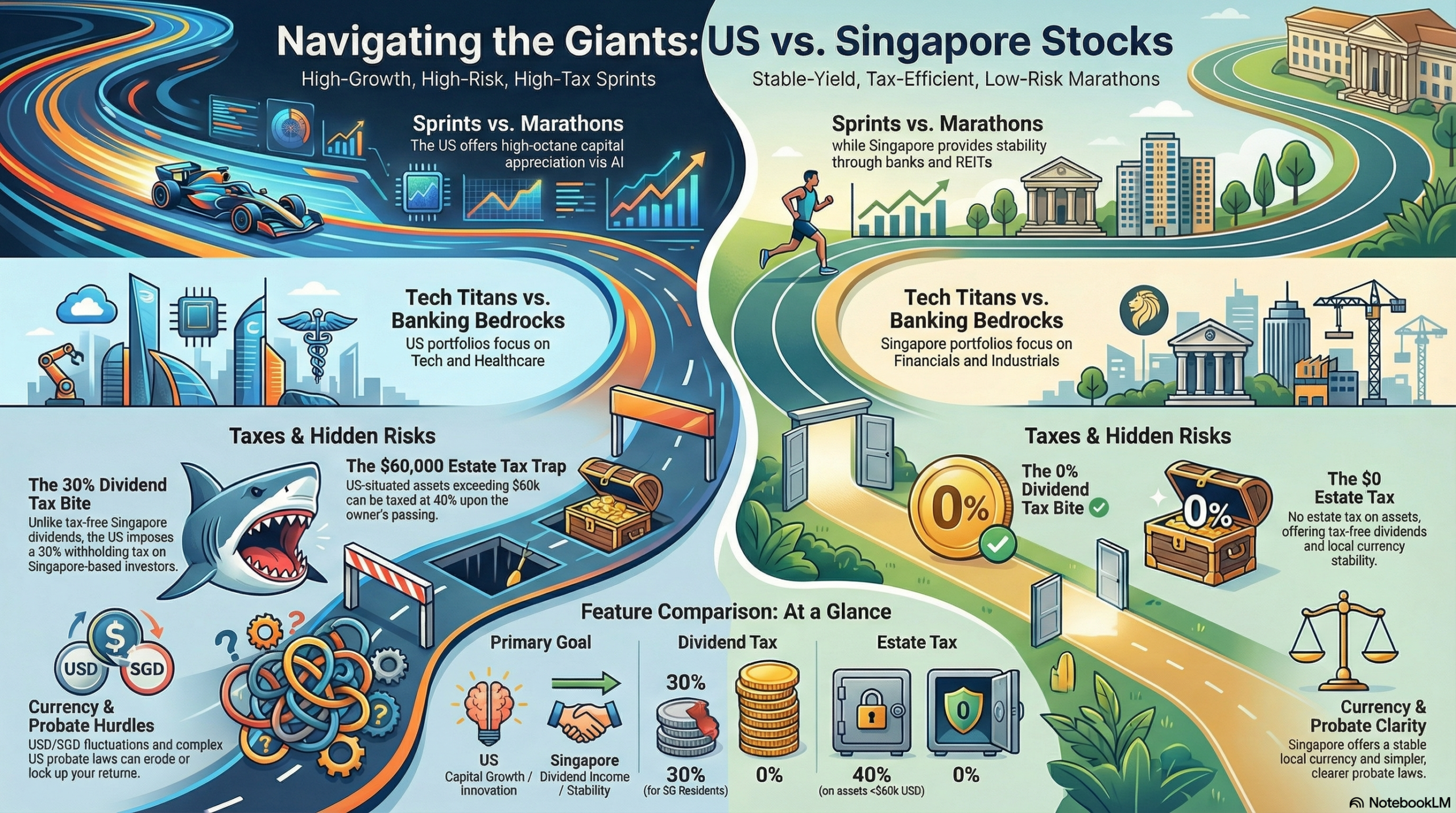
The primary differentiator is the velocity of growth.

  • US Market: Historically, the US (represented by indices like the S&P 500 or Nasdaq) is the go-to for capital appreciation. In 2026, the focus remains heavily on the AI infrastructure buildout, with massive capital expenditure driving potential double-digit earnings growth for market leaders.
  • Singapore Market: The Straits Times Index (STI) is often characterized as a “yield play.” While the US offers high-octane growth, Singapore offers stability and resilience. For 2026, the STI is supported by strong bank earnings and a recovering REIT sector, making it ideal for those prioritizing steady wealth preservation over aggressive gains.

2. Sectors: Tech Titans vs. Banking Bedrocks

The “flavor” of your portfolio changes significantly depending on where you shop.

  • US: Dominated by Technology, Healthcare, and Consumer Discretionary. It is the birthplace of “Magnificent Seven” style companies that lead global innovation in AI, cloud computing, and biotech.
  • Singapore: Heavily weighted toward Financials (the “Big Three” banks), Real Estate (REITs), and Industrials. If you want exposure to the digital frontier, the US is king; if you want exposure to the backbone of Southeast Asian trade and property, Singapore is your base.

3. The Tax Bite: Withholding and Estate Taxes

This is where many Singaporean investors get caught off guard.

  • Dividend Withholding Tax (WHT): Singapore does not tax dividends. However, the US imposes a 30% withholding tax on dividends paid to non-resident aliens (including Singaporeans), as there is currently no tax treaty between the US and Singapore to reduce this rate.Tip: If you are yield-hungry, US stocks are “expensive” tax-wise. You may prefer Ireland-domiciled ETFs which can reduce this WHT to 15% due to the US-Ireland tax treaty.
  • US Estate Tax: This is the “hidden” risk. For non-resident aliens, the US estate tax exemption is a mere $60,000. If your US-situated assets (stocks, property) exceed this value at the time of your passing, your estate could be taxed at rates up to 40%. In contrast, Singapore abolished estate duty in 2008. Check the article here on How to Navigate US Estate Tax for Singaporean Investors.

4. Probate and Jurisdictional Hurdles

Investing across borders adds a layer of legal complexity known as Probate.

  • The Challenge: If a Singapore-based investor passes away holding significant US stocks in a personal brokerage account, their executors may need to apply for a Grant of Probate in a US court to unlock those assets. This is often a slow, expensive process involving US lawyers.
  • The Workaround: Many investors use “Joint-Tenancy” accounts or hold assets through a corporate wrapper or a trust to ensure a smoother transition of wealth to beneficiaries.

5. USD vs. SGD: The Currency “Double Whammy”

When you buy US stocks, you aren’t just betting on a company; you’re betting on the USD/SGD exchange rate.

  • The Drag: Historically, the Singapore Dollar has shown long-term strength against the Greenback. If the USD weakens while your stocks are up, your actual returns in SGD terms will be lower.
  • 2026 Outlook: Current trends suggest a more cyclical decline for the USD as global interest rates normalize. For a Singaporean investor, a 10% gain in a US stock could be wiped out if the USD drops 10% against the SGD.

Comparison Summary

FeatureUS Stock MarketSingapore Stock Market (STI)
Primary GoalCapital Growth / InnovationDividend Income / Stability
Dividend Tax30% (for SG residents)0%
Estate Tax40% (above $60k USD)0%
Currency RiskHigh (USD fluctuations)None (for SG residents)
Top SectorsTech, AI, HealthcareBanking, REITs, Industrials

In conclusion, navigating the choice between the US and Singaporean stock markets requires a careful balance of ambition and pragmatism. While the US market offers unrivaled growth potential through its dominance in global tech and AI, it comes with a significantly more complex “tax and legal tail” for Singapore-based investors. The 30% Dividend Withholding Tax and the looming 40% US Estate Tax on assets above $60,000 are critical hurdles that can erode long-term wealth if not managed through specific structures like Ireland-domiciled ETFs.

Furthermore, investors must remain vigilant about probate complications across different jurisdictions and the constant fluctuations of the USD/SGD exchange rate, which can act as a silent drag on your total returns. Ultimately, the Singapore market remains a powerhouse for stable, tax-free dividends and local currency security, while the US serves as the essential engine for capital appreciation. A well-diversified portfolio for a Singapore resident often utilizes both—relying on the STI for a resilient income core and the US markets for high-octane growth, provided one is mindful of the regulatory and currency risks involved.

Kenny Loh is a seasoned Wealth Advisory Director with deep expertise in comprehensive investment planning and estate management. He is dedicated to helping clients strategically grow their investment capital, generate sustainable passive income for retirement, and seamlessly transition wealth to future generations. Through meticulous asset structuring, he ensures tax-efficient portfolio transfers, allowing beneficiaries to benefit from tax-free capital appreciation while optimizing long-term financial security. With a professional approach and a wealth of experience, Kenny empowers clients to preserve and enhance their legacies with confidence.

Arrange for a non-obligatory one-to-one free consultation here!

Important: The information and opinions in this article are for general information purposes only. They should not be relied on as professional financial advice. Readers should seek unbiased financial advice that is customised to their specific financial objectives, situations & needs. This advertisement or publication has not been reviewed by the Monetary Authority of Singapore.

Continue ReadingNavigating the Giants: A Singaporean Guide to Investing in US vs. SG Stocks

What Investors Could Do to Their Portfolio During This Uncertainty?

  • Post author:

Today’s economy is one marked by heightened uncertainty. As the world recovers from a pandemic that underscored persistent and recurring issues, the World Bank reports that global conflicts like the Russian invasion of Ukraine have worsened economic conditions. Ultimately, we might be seeing an extended period of slow growth and aggravated inflation.

For investors, making crucial decisions is critical to ensuring financial security under such turbulent conditions. With everything going on, it’s important to build a strong portfolio to see you through what could be a prolonged period of uncertainty.

Here are some things that you can do to your portfolio in the current economic climate.


Diversify your Portfolio


Investments are inherently risky, so it’s important to build resilience in your portfolio that can offset losses you might incur in certain markets. This is why you should invest in different asset classes, from stocks to ETFs. Even if you have investments that have performed well for you, it’s important not to pin it all on very few assets. You should also hedge by investing in markets that move in the opposite direction to your most volatile assets. Say, if you have stocks that are known to be volatile, you would also want to invest in bonds or investment funds.


Consider spread betting


Spread betting is a derivative strategy where you can speculate on both rising and falling financial markets, without owning the underlying asset that you’re betting on. Depending on your bet, you would either buy the market to go long, or sell it to go short, and the profitability of your spread would be determined by the accuracy of your bets. FXCM explains that spread betting’s advantages include flexibility, available leverage, market diversity, and ease of trade. As with any form of trading, spread betting necessitates carefully thought out strategies such as breakout, news-based, reversal, or trend market spread betting. If properly executed, aside from being lucrative, spread betting also has the added benefit of being tax-free and commission-free.


Invest in energy


Investing in energy is practically non-negotiable. Since oil is a commodity, it has value as an asset and can be traded as an investment derivative. Even though the oil and gas sector has a tendency to be cyclical, and can be volatile due to external factors that influence its distribution, its prices are always bound to go up. Timing is a critical factor in the successful turnout of your energy investments. But especially these days, the war that Russia waged on Ukraine has caused the stock prices of oil to soar, following its collapse during the pandemic. UBS analyst Giovanni Staunovo states oil will continue to garner demand, and it is only expected to improve further as China reopens and summer travel in the northern hemisphere begins to rise.


Putting money into what you believe in


Real estate investment trusts (REITs) are companies that own real estate that produce income. REIT investments are perfect for diversifying your portfolio and are a good choice in uncertain times since they provide high yields, good values, great profitability, and strong growth rates. REIT specialist Kenny Loh has stated that since the reopening of borders has been normalised, it has not had any adverse effects on healthcare and office REITS, while hospitality REITs look promising. In today’s economic state, the profitability of REITs may be largely beneficial for investors.


Uncertainty can hit any time, but there are always ways to protect yourself from these occurrences. So if you’re aiming for financial security, then it’s important to start making the proper investments now.

Continue ReadingWhat Investors Could Do to Their Portfolio During This Uncertainty?

Technology – The Best Long Term Growth Stocks

  • Post author:

Author: Kevin Mercadante

As Warren Buffet said, time in the market beats timing the market. The earlier you start investing, the better it will be for you in the long run. Every individual investor always has the decision between buying individual stocks or investing in an index fund. 

Getting only one stock is similar to gambling if you don’t know what you’re doing or if you’re not an angel investor. On the other hand, an index fund is broad, and all of your assets get diversified, but the profits are too small. Click here to read more. 

For example, if you had invested a couple of dollars into Bitcoin ten years ago, now you would be a millionaire. Many investors say that you need to buy stocks and hold onto them forever, but which are they. 

We’re going to take a look at some of the best options where you can put your hard-earned money and make sure that it works for you while you sleep. There are a few key things that you need to look for before you start investing. 

The first thing is to make sure that the stock is at a reasonable price. If it’s too expensive, it may start losing its value. The next thing to look for is the people that run the company. They need to be transparent, honest, and results-oriented. 

Without those character traits, it’s highly unlikely that a company will succeed. The final thing to look for is the rewards. The returns need to be in your favor to give you the initiative to invest.  

Tech Companies 

As soon as computers and smartphones entered pop culture, their spot in investment portfolios got reserved. They’re going to be a part of this century, and there’s nothing that’s going to change that. Companies like Apple, Microsoft, Amazon, and Google are too big to fail.

They’re the top three when it comes to tech, and no other company comes even close. Let’s start with Apple. They were the first business in the world to have a trillion-dollar market cap. That’s insane. They’re also the largest holding of Buffet’s portfolio. 

Whenever a new iPhone comes out, it’s like a frenzy that takes over the United States. Everyone wants to be the first owner, and even if it’s not that different than the previous model, people are still going to buy it. The same thing is true about their laptops and tablets. Follow this link for more info https://techland.time.com/2012/05/07/six-reasons-why-apple-is-successful/

Steve Jobs did a wonderful job of bringing Apple to the place where it is today. Next on the list is Microsoft. These two companies are neck and neck, each one excelling in its own niche. They were third on the list when it comes to a trillion-dollar market cap, but Bill Gates has been the richest man on Earth for more than anyone can remember. 

The Windows operating system is a staple everywhere, and they keep coming up with new technologies. Amazon changes things up a little bit. Even though they’re competing with Microsoft about cloud technology, they are still the leader when it comes to retail selling. 

Whenever you want to buy something and get it at your doorstep the next day, Amazon is your first choice. Bezos is the richest person in the world, and he’s a financial genius. Even though he stepped down from his position as CEO, his skills and expertise have brought Amazon to the marketplace of the world, and they’re not going anywhere soon. 

Finally, there’s Google. They fall under the company Alphabet, but everyone knows them as a search engine. They recently bought YouTube, and they dominate everything that we search online. Click on this link to read more. 

Have a question that you need to be answered? You go to Google. Want to watch a funny video of a dog falling in the water? You go to YouTube. It will take decades for something else to take their spot, and they’re so big that it’s almost impossible for that to happen.  

Dividends 

There’s an old story about a rabbit and a turtle racing each other. The rabbit was exceptionally faster than the turtle, and it laid down next to a tree to rest. As it slept, the turtle walked. Slowly but surely, the turtle crossed the finish line and beat the rabbit in the race. 

While tech companies are like the rabbit, dividend stocks are more like the turtle. They have smaller profits, but they’re stable and mature. They’re most popular with older investors since they don’t want to take on that much risk. You can go to reviews of Motley Fool Stock Advisor and see why they work so well. There’s no volatility, and it’s true that the best stocks grow with time—most of the companies that are included in these lists payout around two to three percent annually. 

However, if the business is unable to pay off the dividends, it can cut them out for the year. Because of that, the stocks may go down, so you need to be careful in this scenario too. If everything is going well, the dividends can go as high as 10 percent per year. 

The most important thing for you to do is diversification. Don’t put all of your eggs in one basket. The more you diversify, the better it will be for you in the long run. Invest in competing firms because when one fails, the other one picks up the slack. There are many options available; you just need to do your research. 

Continue ReadingTechnology – The Best Long Term Growth Stocks