Structuring Wealth the Right Way: How High-Net-Worth Individuals Build Resilient Investment Frameworks

  • Post author:

For most investors, the first question in wealth management is simple: “What returns can I get?” But High-Net-Worth (HNW) individuals know that returns are never the right starting point. With significant wealth comes complex responsibilities, including managing tax exposure, ensuring asset protection, and preparing for seamless intergenerational transfer to your dependents. In short, the wealthiest investors understand that structure precedes performance.


A well-designed framework transforms wealth from a passive store of value into a resilient, multi-generational ecosystem. This article explores the right way HNW individuals structure their investments, following two guiding principles: building the foundation before performance, and sequencing financial planning in the most effective order.
Beyond Returns: Building the Foundation First

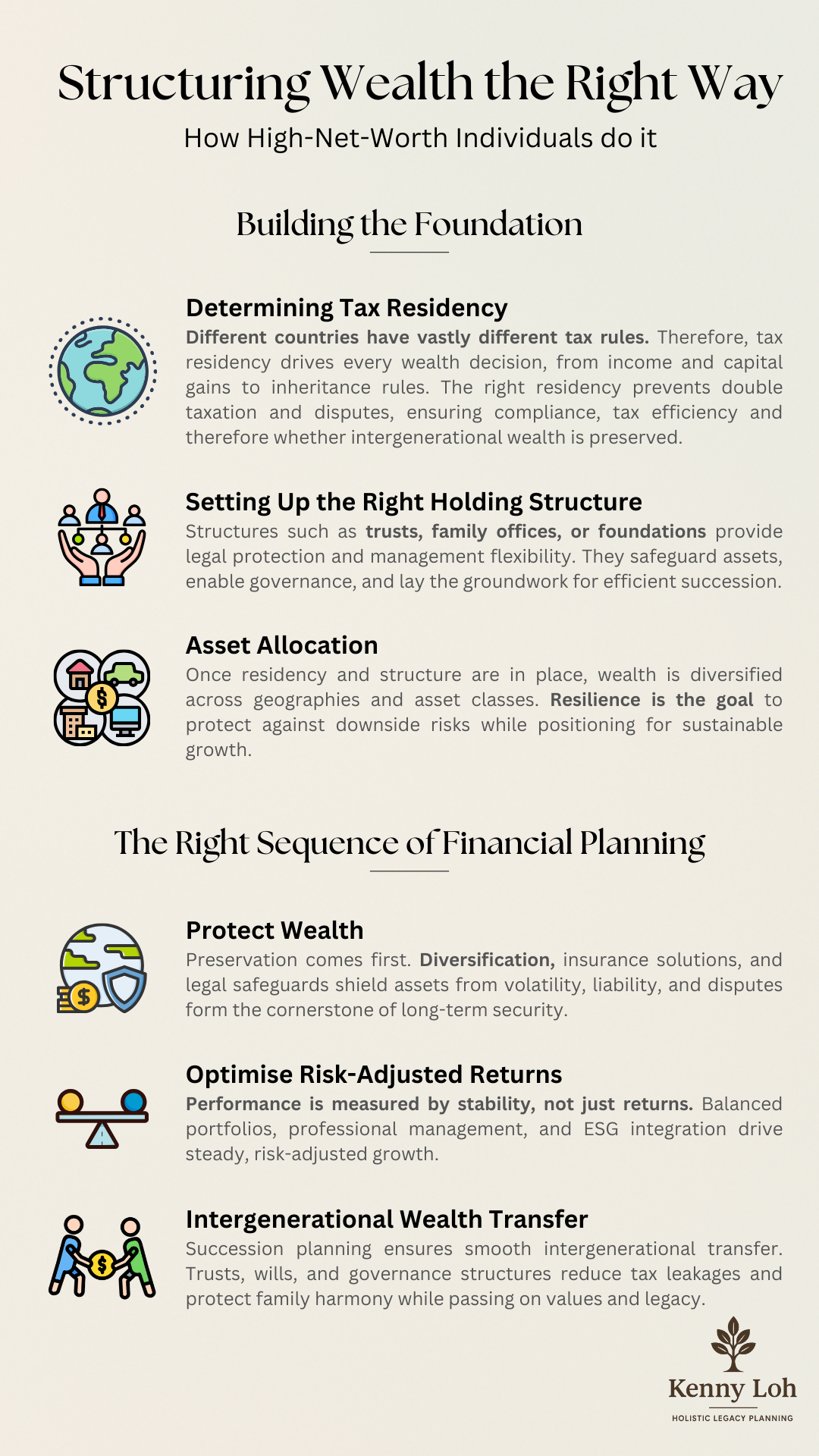
1. Determining Tax Residency

The first and most decisive step is identifying and securing optimal tax residency. This will influence almost every aspect of wealth management, from the taxation of investment income to inheritance and estate rules, as rules can differ vastly between different countries and territories. For example, Singapore has no estate tax, yet for non-US persons holding US assets, estate tax can range up to 40%. These residency decisions can mean the difference between wealth erosion and wealth preservation.

2. Setting Up the Right Holding Structure

Once residency is established, the next layer is creating a suitable holding structure. The goal here is twofold: protection and flexibility.
● Protection: Assets held directly in personal names are exposed to risks ranging from creditor claims and lawsuits to political instability. By contrast, structures such as trusts, family investment companies, and private foundations shield assets, providing legal separation and insulation.
● Flexibility: Holding structures allow families to exercise governance, delegate management to professionals, and introduce succession mechanisms. For instance, trusts can embed rules on how and when wealth should be distributed, while family offices consolidate decision-making across investments, philanthropy, and estate management.
Crucially, these structures also form the foundation for efficient estate planning, helping families avoid fragmentation of wealth and legal disputes in future generations.

3. Asset Allocation: The Engine of Growth

Only after residency and structure are in place do HNW individuals turn to asset allocation. For them, allocation is not about speculation but about resilience. Portfolios are diversified across geographies, currencies, and asset classes — from equities and bonds to alternatives such as private equity, real estate, and hedge funds.
The principle is simple: protect against downside risks while positioning for sustainable growth. Liquidity is carefully managed to meet lifestyle needs, philanthropic commitments, and opportunistic investments, while illiquid assets provide long-term capital appreciation.

The Right Sequence of Financial Planning

Now that we’ve discussed structures in place, wealth can still be lost if managed wrongly. HNW individuals therefore follow a disciplined sequence that reflects both prudence and foresight.

1. Protect Wealth

Preservation is arguabily the most important factor. Wealth that is not protected is wealth at risk — from market volatility, unforeseen liabilities, or even family disputes. Protection strategies include:
● Diversification across asset classes and jurisdictions.
● Insurance solutions to mitigate concentrated risks.
● Legal frameworks (such as trust structures!) to ring-fence personal assets from business or professional exposure.
Protection is the cornerstone upon which all future planning rests.

2. Optimise Risk-Adjusted Returns

Only after safeguarding current wealth should performance and returns be discussed. but not in the traditional sense. For HNW investors, the measure of success is not absolute returns, but risk-adjusted returns. A 7% return with low volatility may be more valuable than a 12% return that exposes the portfolio to extreme downside risks.
This requires disciplined portfolio construction, professional asset management, and continuous rebalancing. It also involves integrating alternative assets, ESG considerations, and thematic opportunities that align with both financial objectives and family values.

3. Seamless Wealth Transfer

The final step is ensuring wealth transitions to the next generation seamlessly and efficiently. Without careful estate planning, taxes, legal disputes, or administrative inefficiencies can erode significant portions of wealth.
To avoid this, HNW families integrate succession planning into their structures from the outset. Tools such as family trusts, foundations, and wills are complemented by governance mechanisms that preserve both financial assets and family harmony. At its best, this stage is not only about minimising estate and inheritance taxes, but also about transmitting values, vision, and purpose across generations.
________________________________________

For HNW individuals, investment success is not defined by a single year’s performance but by the resilience of wealth over decades and generations. By prioritising tax residency, establishing robust holding structures, and following a disciplined sequence of protection, optimisation, and transfer, they ensure that wealth serves both present needs and future legacies.

Important: The information and opinions in this article are for general information purposes only. They should not be relied on as professional financial advice. Readers should seek unbiased financial advice that is customised to their specific financial objectives, situations & needs. This advertisement or publication has not been reviewed by the Monetary Authority of Singapore.

Kenny Loh is a distinguished Wealth Advisory Director with a specialization in holistic investment planning and estate management. He excels in assisting clients to grow their investment capital and establish passive income streams for retirement. Kenny also facilitates tax-efficient portfolio transfers to beneficiaries, ensuring tax-efficient capital appreciation through risk mitigation approaches and optimized wealth transfer through strategic asset structuring.

In addition to his advisory role, Kenny is an esteemed SGX Academy trainer specializing in S-REIT investing and regularly shares his insights on MoneyFM 89.3. He holds the titles of Certified Estate & Legacy Planning Consultant and CERTIFIED FINANCIAL PLANNER (CFP).

With over a decade of experience in holistic estate planning, Kenny employs a unique “3-in-1 Will, LPA, and Standby Trust” solution to address clients’ social considerations, legal obligations, emotional needs, and family harmony. He holds double master’s degrees in Business Administration and Electrical Engineering, and is an Associate Estate Planning Practitioner (AEPP), a designation jointly awarded by The Society of Will Writers & Estate Planning Practitioners (SWWEPP) of the United Kingdom and Estate Planning Practitioner Limited (EPPL), the accreditation body for Asia.

罗国强(Kenny Loh) 是一位杰出的财富咨询总监,专长于综合投资规划与遗产管理。他擅长协助客户实现投资资本增值,并建立退休被动收入来源。同时,他通过税务优化的方式帮助客户将投资组合高效转移给受益人,运用风险缓释策略确保资本增值的税务效率,并通过战略性资产配置实现财富传承的最优化。

除咨询工作外,罗国强是新加坡交易所学院(SGX Academy)的特聘讲师,专注于新加坡房地产投资信托(S-REIT)投资领域,并定期在MoneyFM 89.3电台分享专业见解。他拥有认证遗产与传承规划顾问(Certified Estate & Legacy Planning Consultant)及国际认证财务规划师(CFP)资格。

在逾十年的综合遗产规划经验中,他独创“遗嘱、持久授权书与备用信托三合一”解决方案,兼顾客户的社会责任、法律义务、情感需求及家庭和谐。他持有工商管理硕士与电气工程硕士双学位,并获英国遗嘱撰写及遗产规划从业者协会(SWWEPP)与亚洲认证机构遗产规划从业者有限公司(EPPL)联合授予副遗产规划从业师(AEPP)专业资格。

Arrange for a non-obligatory one-to-one free consultation here!

立即预约免费一对一咨询(无需承担任何义务)!
Continue ReadingStructuring Wealth the Right Way: How High-Net-Worth Individuals Build Resilient Investment Frameworks

The Money Ladder: How to Build Consistent Income That Pays You Every Month

  • Post author:

Are you a retiree looking for dependable passive income? Or an investor who wants your investments to generate cash flow to cover monthly expenses? The “money laddering” strategy is a simple, structured way to achieve this goal by creating predictable, repeating cash flow.

View the CNA Money Mind: Cash Flow Generation using Laddering Strategy.

What is a Money Laddering Strategy?

Laddering is the process of splitting your total investment capital into smaller parts (or “rungs”). Instead of putting all your money into one asset that pays out once a year, you invest in multiple assets that mature or pay out at different, staggered times.

The Key Benefit: This ensures money flows into your bank account regularly, often monthly or quarterly, instead of waiting a full year or more for returns. This stable cash flow is valuable even when the market is flat or interest rates are falling.

You can build ladders using a mix of assets, including short-term bills, government bonds, Dividend ETFs, and REITs (Real Estate Investment Trusts). The goal is to choose your own risk level, from safe and slow to higher yielding options.

Case Study 1: The Retiree’s Safe Ladder (Lowest Risk)

This strategy prioritizes safety and liquidity above all else. It’s perfect for retirees or cautious investors whose primary goal is preserving capital while ensuring a fixed income stream.

The Strategy: Singapore Savings Bonds (SSBs) Mini-Ladder

A practical way to start small is to build a mini-ladder using Singapore Savings Bonds (SSBs).

  • How it works: SSBs pay interest every six months. By splitting a modest sum (e.g., S$1,000) and investing it across 12 different SSB issues over 12 consecutive months, you create an effective monthly payout schedule.
  • Payout Start: You start receiving your first payout in Month 7. After that, a payout will arrive every month as the interest from each bond issue kicks in.
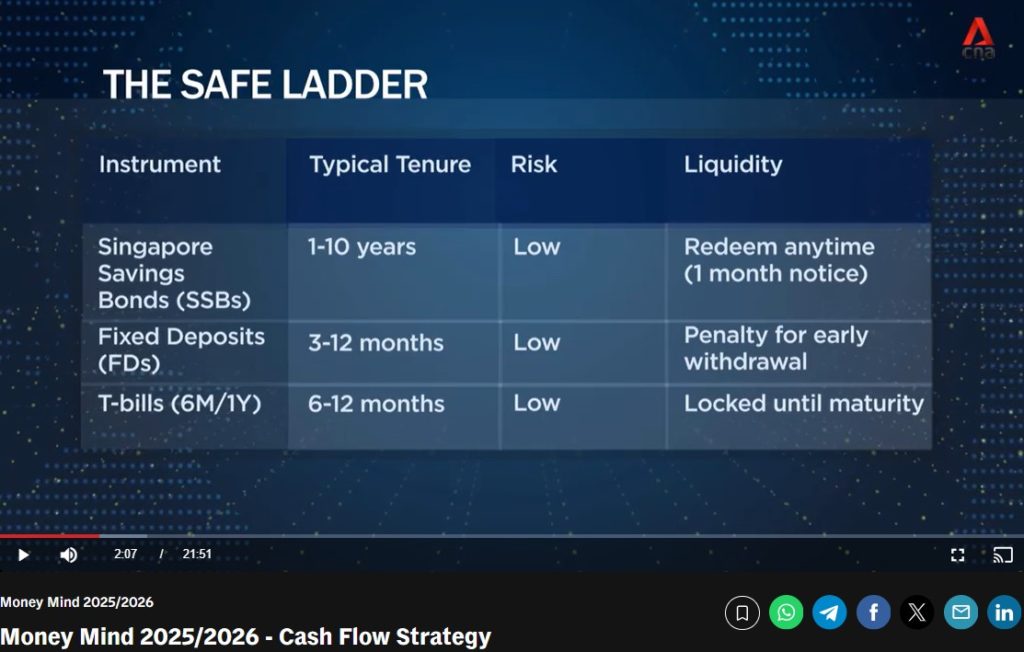
  • Instruments & Risk: This ladder uses instruments with low risk and high liquidity:
    • SSBs: Low risk, redeemable anytime with one month’s notice.
    • Fixed Deposits (FDs): Low risk, but penalizes early withdrawal.
    • T-bills (6M/1Y): Low risk, locked until maturity.
  • Trade-off: The investment is simple, low maintenance, and government-backed, but the yield is generally low (e.g., around 1.33% for a recent 1-year rate).

Case Study 2: The Business Owner’s Balanced Ladder (Moderate Risk)

This strategy is suitable for investors or business owners who want to beat low fixed deposit rates and are comfortable taking on a little more market movement to potentially triple their yield.

The Strategy: Blending Stability with Market Exposure

The Balanced Ladder blends the stability of low-risk instruments with moderate exposure to income-paying listed assets.

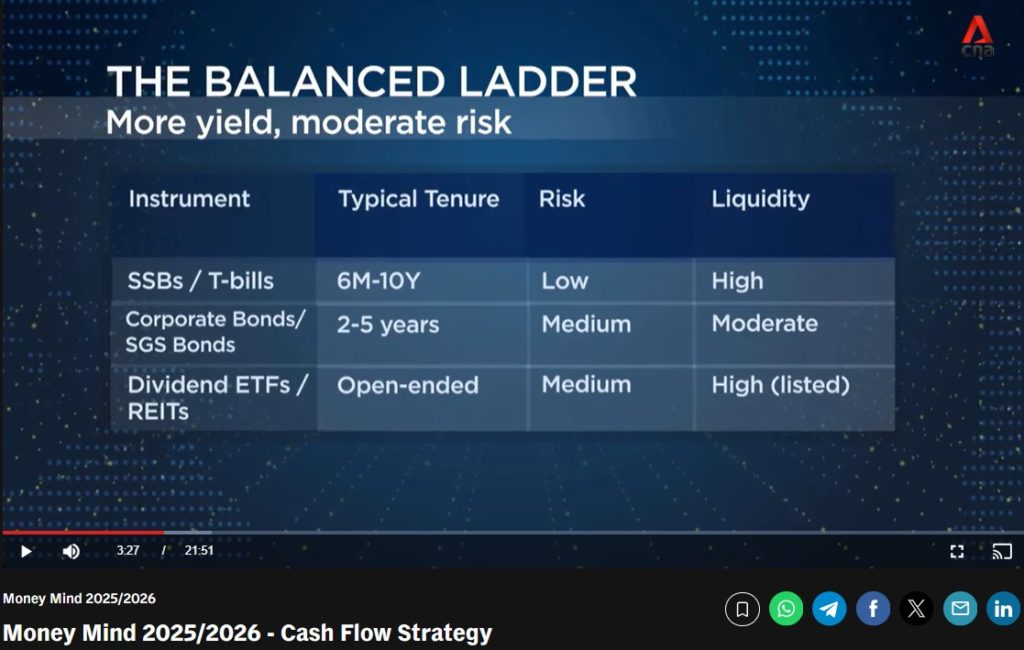
  • How it works: It combines fixed-income assets with growth assets to achieve a higher, but still stable, return. A typical 60/40 allocation (60% fixed income, 40% growth) can yield around 3.5%.
  • Instruments & Risk:
    • Low Risk (For Stability): SSBs and T-bills (6 months to 10 years).
    • Medium Risk (For Moderate Yield): Corporate Bonds (2-5 years) and SGS Bonds (Singapore Government Securities).
    • Medium Risk (For Income/Growth): Dividend ETFs and REITs (listed, open-ended).
  • Purpose: Short-term bills ensure steady cash flow and liquidity; bond funds provide stability; and REITs/ETFs offer potential capital growth and higher income. The idea is to balance safety and growth.

Case Study 3: The Active Investor’s Dividend Ladder (Higher Income)

This strategy is for investors who are comfortable with volatility and want to maximize monthly cash flow from their portfolio to pay for monthly expenses.

The Strategy: Targeting High-Yield Payouts

This ladder uses high-yielding, income-focused assets that are planned to pay out at different times throughout the year.

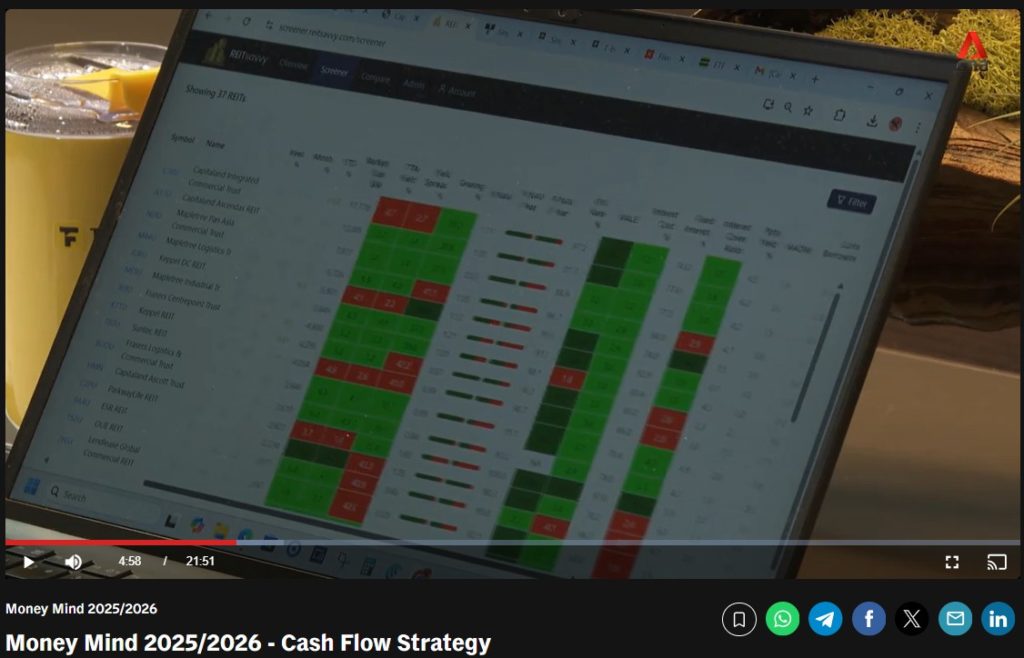
  • How it works: By tracking the payout dates of different assets, you can set up a rhythm to receive cash flow almost every month. A 5% yield on a S$50,000 portfolio can generate about S$2,500 a year.
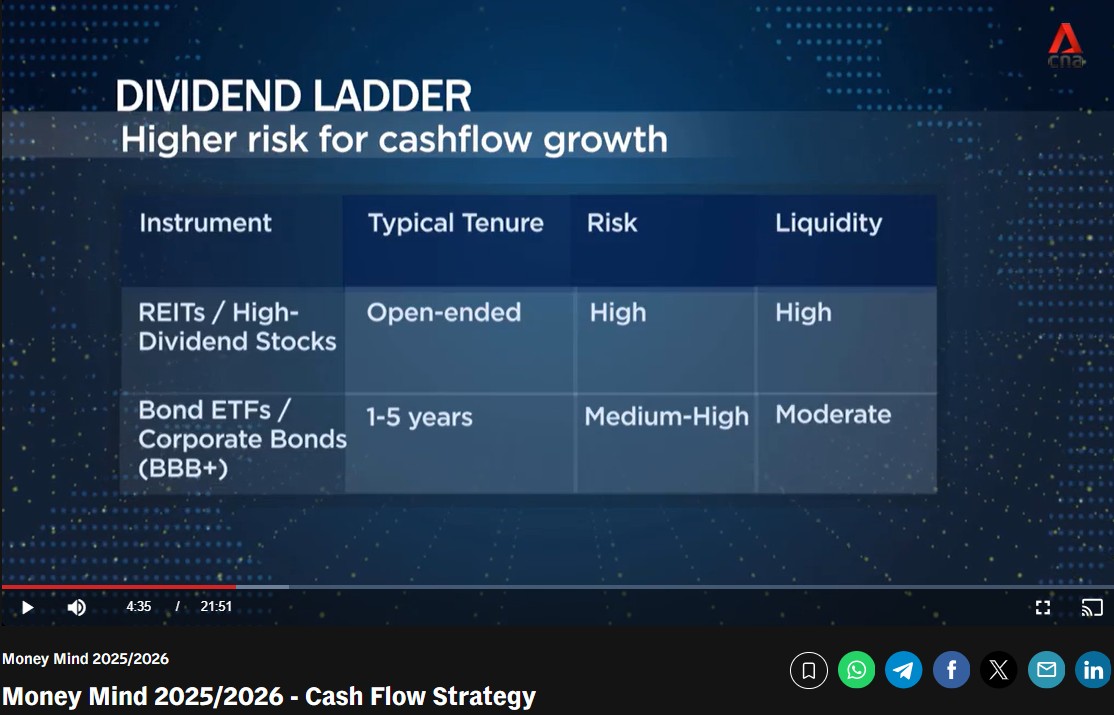
  • Instruments & Risk:
    • High Risk (For Yield): REITs and High-Dividend Stocks (open-ended).
    • Medium-High Risk (For Support): Bond ETFs and higher-rated Corporate Bonds (1-5 years).
  • Important Note: While payouts can grow as companies raise dividends, you must remember that companies can pause or cut dividends. Consistency and stability of the underlying business matter as much as the headline yield.

🔑 The Discipline of Laddering

No matter which ladder you choose, discipline is key.

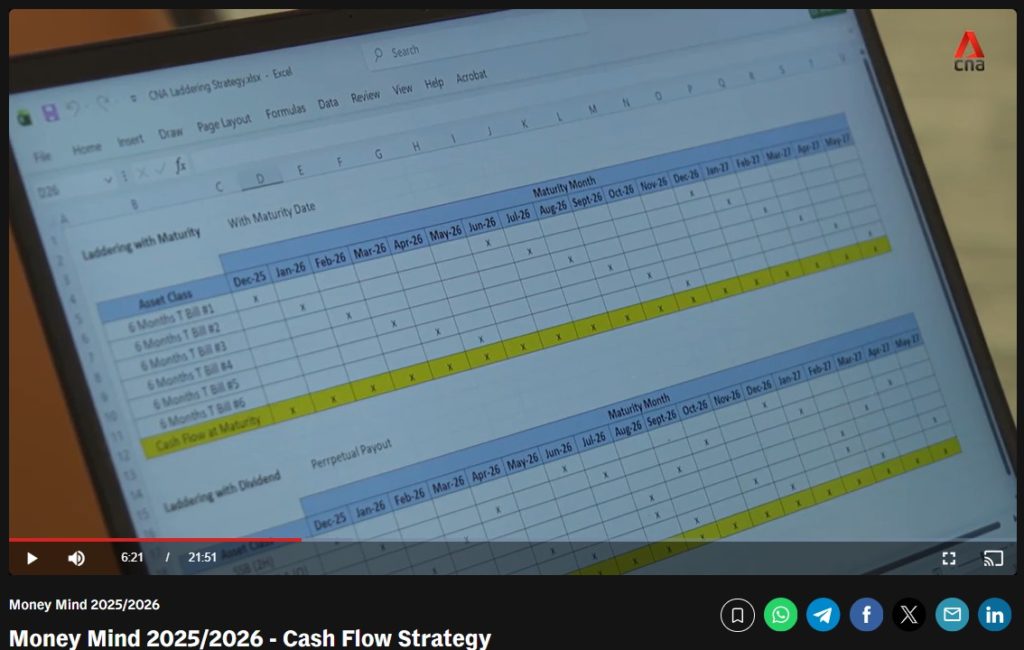
  • Reinvesting is Crucial: When an asset matures (e.g., a 6-month T-bill), you must roll it over (reinvest it) into the next cycle. Skipping this step breaks the rhythm of your cash flow.
  • Tracking: Many investors automate this process by setting up a spreadsheet or using reminders to track maturity dates and reapplication windows.
  • Market Opportunity: The continuous cash flow provides a major advantage: when there is a market correction, you have cash available to invest immediately at lower prices, helping you capture the upside later.

The goal of any money ladder is simple: to create a dependable, steady cash flow that you can count on, all while your money keeps working.

Kenny Loh is a distinguished Wealth Advisory Director with a specialization in holistic investment planning and estate management. He excels in assisting clients to grow their investment capital and establish passive income streams for retirement. Kenny also facilitates tax-efficient portfolio transfers to beneficiaries, ensuring tax-efficient capital appreciation through risk mitigation approaches and optimized wealth transfer through strategic asset structuring.

In addition to his advisory role, Kenny is an esteemed SGX Academy trainer specializing in S-REIT investing and regularly shares his insights on MoneyFM 89.3. He holds the titles of Certified Estate & Legacy Planning Consultant and CERTIFIED FINANCIAL PLANNER (CFP).

With over a decade of experience in holistic estate planning, Kenny employs a unique “3-in-1 Will, LPA, and Standby Trust” solution to address clients’ social considerations, legal obligations, emotional needs, and family harmony. He holds double master’s degrees in Business Administration and Electrical Engineering, and is an Associate Estate Planning Practitioner (AEPP), a designation jointly awarded by The Society of Will Writers & Estate Planning Practitioners (SWWEPP) of the United Kingdom and Estate Planning Practitioner Limited (EPPL), the accreditation body for Asia.

If you need any financial advice, please contact kennyloh@fapl.sg

You can join his Telegram channel #REITirement – SREIT Singapore REIT Market Update and Retirement related news. https://t.me/REITirement

Continue ReadingThe Money Ladder: How to Build Consistent Income That Pays You Every Month

(Interview) Veteran Investment Advisors Share Expert Tips for Singapore Investors

  • Post author:

In this insightful interview, Kenny Loh and John Dasson, share their personal investment journeys and offer valuable advice for Singaporean investors at all stages of life. Both are seasoned investment advisors from Financial Alliance, Singapore’s largest independent financial advisory firm.

Discover their unique approaches to investing, how the investment landscape has evolved over the years, and learn from the biggest mistakes they’ve seen people make.

Key topics covered:

🔹 How to kickstart your investment journey
🔹 Investment philosophy: Then vs Now
🔹 Common investment mistakes and how to avoid them
🔹 Tips for young working adults who haven’t started investing
🔹 The advantage of working with an independent financial advisory firm

Bonus:

🔸 The future of alternative investments
🔸 Cryptocurrency: A promising investment or a risky bet?
🔸 REIT investing: What new investors should consider
🔸 Tailoring your portfolio for retirement …and more!

Video Highlights

  • Introduction and Career Journeys
    • Self Introduction
    • John shares his 13-year journey in wealth advisory
    • Kenny talks about his career switch from the corporate world
  • Investment Strategies (02:26)
    • John explains his three-bucket strategy
    • Kenny emphasizes a defensive-first approach
    • Importance of diversification
  • Common Investment Mistakes (05:52)
    • Investing without clear goals
    • Emotional management in investing
    • Risks of unregulated investment structures
  • Advice for Young Investors (11:05)
    • Start investing early
    • Importance of education and understanding risk tolerance
    • Benefits of compounding returns
  • Diversification of REITs and Alternative Investments (16:36)
    • Discussion on REITs and their challenges
    • Importance of diversifying into alternative investments
    • Potential of trade financing and private equity
  • Cryptocurrency and Estate Planning (21:00)
    • Views on cryptocurrency as an investment
    • Importance of estate planning for crypto assets
    • Strategies for wealth distribution and protection
  • Estate Planning (25:32)
    • Importance of having a will and updating asset statements
    • Structuring testamentary trusts for minors
    • Managing international assets and properties
  • Tax Considerations for Investment Portfolios (28:40)
  • How should one manage their portfolio as they approach retirement? (31:24)

Kenny Loh is a Wealth Advisory Director and REITs Specialist of Singapore’s top Independent Financial Advisor. He helps clients construct diversified portfolios consisting of different asset classes from REITs, Equities, Bonds, ETFs, Unit Trusts, Private Equity, Alternative Investments, Digital Assets and Fixed Maturity Funds to achieve an optimal risk adjusted return. Kenny is also a CERTIFIED FINANCIAL PLANNER, SGX Academy REIT Trainer, Certified IBF Trainer of Associate REIT Investment Advisor (ARIA) and also invited speaker of REITs Symposium and Invest Fair.  You can join my Telegram channel #REITirement – SREIT Singapore REIT Market Update and Retirement related news. https://t.me/REITirement

Continue Reading(Interview) Veteran Investment Advisors Share Expert Tips for Singapore Investors