Singapore REIT Fundamental Analysis Comparison Table – 12 Oct 2013

  • Post author:

FTSE ST Real Estate Investment Trusts (FTSE ST REIT) Index changes from 699.17 to 735.74 compare to last post on Singapore REIT Fundamental Comparison Table on Sept 6, 2013. The index is still trading below 200D SMA and technically bearish. However, there is sign of potential reversal if the index break the recent high of 750 as it will be forming an Inverted Head and Shoulders, a reversal chart pattern. Alternatively, the index will continue the down trend if rejected at the down trend channel resistance at about 740.
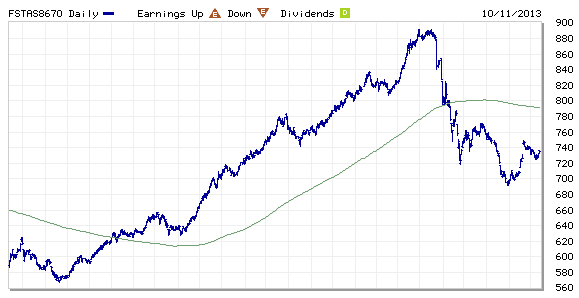
FTSE ST REIT Index Oct11-2013

Compare to last Singapore REIT comparison table:

  • Price/NAV increases from 0.9763 to 1.018.
  • Dividend Yield decreases from  6.41% to 6.23%.
  • Gearing Ratio remains the more or less the same at 33.07%.
  • In Short, some Singapore REIT become attractive in terms of valuation and distribution yield again. However technically Singapore REIT is still on down trend and the price can go even lower although fundamental looks attractive. Stock picks are important and have to be selective base on fundamental and technically analysis. The uncertainty in term of interest hike in near future remains high and this causes limited upside potential for Singapore REITs.

Singapore REIT NAV Gearing Distribution Yield Comparison Table 11-Oct-2013


Bubble Chart (Distribution Yield vs Price/NAV) – Value for Money

Singapore REIT Bubble Chart (Value) Oct11-2013


Bubble Chart (Gearing Ratio vs Price/NAV) – Risk Avoidance

Singapore REIT Bubble Chart (Risk) Oct11-2013

Compare to last Bubble Charts here.

Find out how do I conduct research on Singapore REIT, how to interpret those financial ratio in the comparison table, when is the best time to buy using simple Trend Analysis. Furthermore it is important to understand the BIGGER TREND so that your investment will not be losing money in the down trend market. Find out WHERE and HOW to read the FTSE ST Real Estate Investment Trust Index because timing is very critical in making any investment decision.  Check out my next public tutorial on  “How to pick Singapore REIT for Dividend Investing” .
Continue ReadingSingapore REIT Fundamental Analysis Comparison Table – 12 Oct 2013

First REIT: Fundamental & Technical Analysis

  • Post author:

Fundamental Analysis

  • Last Price = $1.105
  • NAV = $0.895
  • Price / NAV = 1.2346
  • Distribution Yield = 6.195%
  • Gearing Ratio = 33.4%
  • Plus Points: Rental pegged at SGD and USD & Long Master Lease.
  • Minus Point: Gearing at the high side.

FIRST REIT last presentation at Macquarie ASEAN Conference on Aug 28, 2013.

Technical Analysis

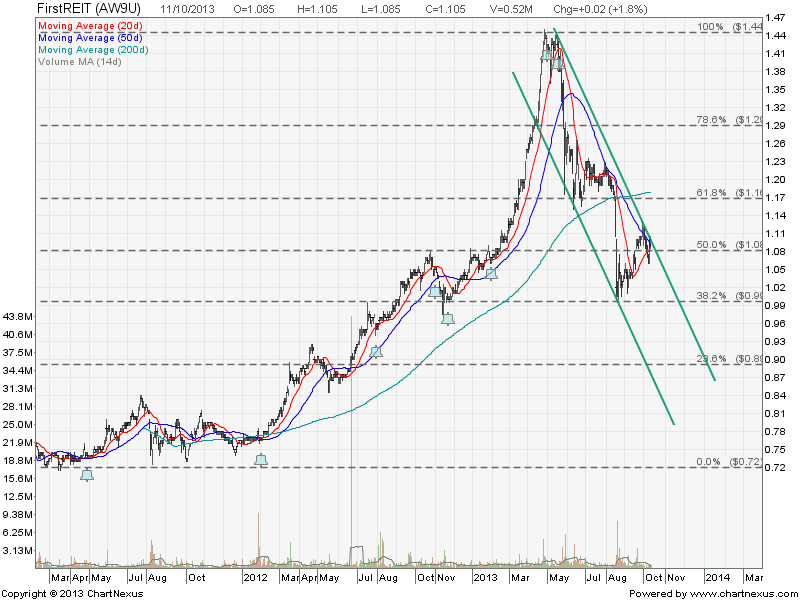
First REIT is technically bearish (below 200D SMA) and currently seems like trading within a down trend channel. Currently the stock price is testing the down trend channel resistance. If rejected at this resistance and break the recent support of $1.06, First REIT will continue the down trend.

2013Oct12-FirstREIT-800x600

See Singapore REIT Comparison Table here.

Continue ReadingFirst REIT: Fundamental & Technical Analysis

Huntington Bank’s Acquisition Of Camco Financial Start Of Something Big? (HBAN, CAFI)

  • Post author:

By Benzinga.com

Thursday was a good morning for those who recently went in on Camco Financial (NASDAQ: CAFI).

Huntington Bank (NASDAQ: HBAN) announced its acquisition of Camco for a value at approximately $97 million, including outstanding options and warrants.

Tim Melvin is one of those who bought in just last week. It was a stroke of luck for him.

“It could have been any one of the 25 or 30 (banks),” Melvin said over the phone. ‘”It was an accident.”

Melvin said Camco had been on the radar for a while, its stock trading a pretty good discount to its tangible book value. His firm saw the Ohio-based bank assets dropping steadily over the last quarter and they eventually added it to their portfolio.

“This is the first of many,” he said about the transaction. Melvin expects to see two dozen of the smaller banking firms shutting down or consolidating over the next few years. “It’s a difficult time for the small-town banker.”

Camco operated 22 banking offices throughout eastern and southern Ohio. It had over $750 million in total assets, but was able to sell it off very cheaply. Melvin said the smaller banks are being squeezed down by, among others, low interest margins and higher regulatory costs.

“We see the same story 30 times over,” he continued, “small, cheap banks, have steady credit approval, pressure form the outside to fix or sell the bank.”

Melvin saw activists and investors taking positions in the stock and when they finally got around to call reports, he and his firm pulled the string. Camco shareholders may elect to receive 0.7264 shares of Huntington stock or $6 a share in cash. He will wait on taking new shares of Huntington, which could change when he sees the new proxy.

“There is no room for organic growth,” he said. Melvin sees no organic growth overall in the banking industry – Camco couldn’t move anywhere because there is no business. The former stockbroker believes it makes sense for the smaller banks (25 branches or less) to sell. It’s cheaper for the big banks to buy those small ones instead of opening up new branches.

“CAFI is just part of an ongoing story. Most will end up with the same fate.”

Over the last 15 years, the number of banks has gone down, while the number of branches has gone up. Melvin said the only way to grow is to buy a competitor.

Melvin said by being the first of expected transactions over the next few years, the takeovers can now start to snowball. “There was no set of rules to play,” he said, questioning what type of qualified mortgages and capital requirements would need to be in place for such a buy.

“Regulatory costs are going to be a lot higher for these banks,” he added. The small banks are subject to the same rules of J.P. Morgan Chase (NYSE: JPM) and Citi (NYSE: C). The difference? The big banks have such a higher number of employees and customers.

Melvin says the current government shutdown does not come into play with these takeover. But as it continues on, Melvin rests easy with Huntington.

“I’ll keep buying stocks at 80 percent book value while it works.”

Tim Melvin is a value investor, money manager and writer. He has spent the last 27 years as in the financial services and investment industry as a broker, adviser and portfolio manager. He has also written and lectured extensively on the markets with his work appearing on RealMoney.com, DailySpecualtion.Com as well as several print publication including Active Trader and the Wall Street Digest. Click to watch Tim Melvin’s FREE webinar and learn how to break through volatility using his value stock strategy.

Continue ReadingHuntington Bank’s Acquisition Of Camco Financial Start Of Something Big? (HBAN, CAFI)