When it comes to legacy and wealth planning, “setting up a trust” is often treated as the ultimate status symbol. We see it in movies, read about it in articles covering ultra-high-net-worth families, and hear wealth managers mention it as the gold standard of asset protection.
But let’s strip away the prestige and look at the reality. A trust is a powerful legal structure, but it is also an ongoing operational commitment that involves setup fees, annual administrative maintenance, and a transfer of legal ownership.
The honest truth? Not everyone needs a trust. For many people, a robust Will, a Lasting Power of Attorney (LPA), and proper insurance nominations are more than enough.
So, how do you know if you are crossing the line from needing a basic estate plan to needing a full structural trust? Instead of looking at complex legal definitions, let’s look at your actual life.
Ask yourself the following questions to see which scenario fits your reality.
Scenario 1: The Maturity Question
“If something happens to me tomorrow, will my beneficiaries spend their inheritance wisely?”
Imagine you leave behind a significant life insurance payout or a large cash portfolio.
- If your children are minors (under 21): Legally, they cannot receive large sums of money directly. The court will appoint a guardian to manage it, or the funds will be tied up until they hit adulthood.
- If your children are in their early 20s: If a 22-year-old suddenly receives a $1 million windfall, will they invest it in their future, or will it disappear into high-end cars, lifestyle inflation, and poor business ventures?
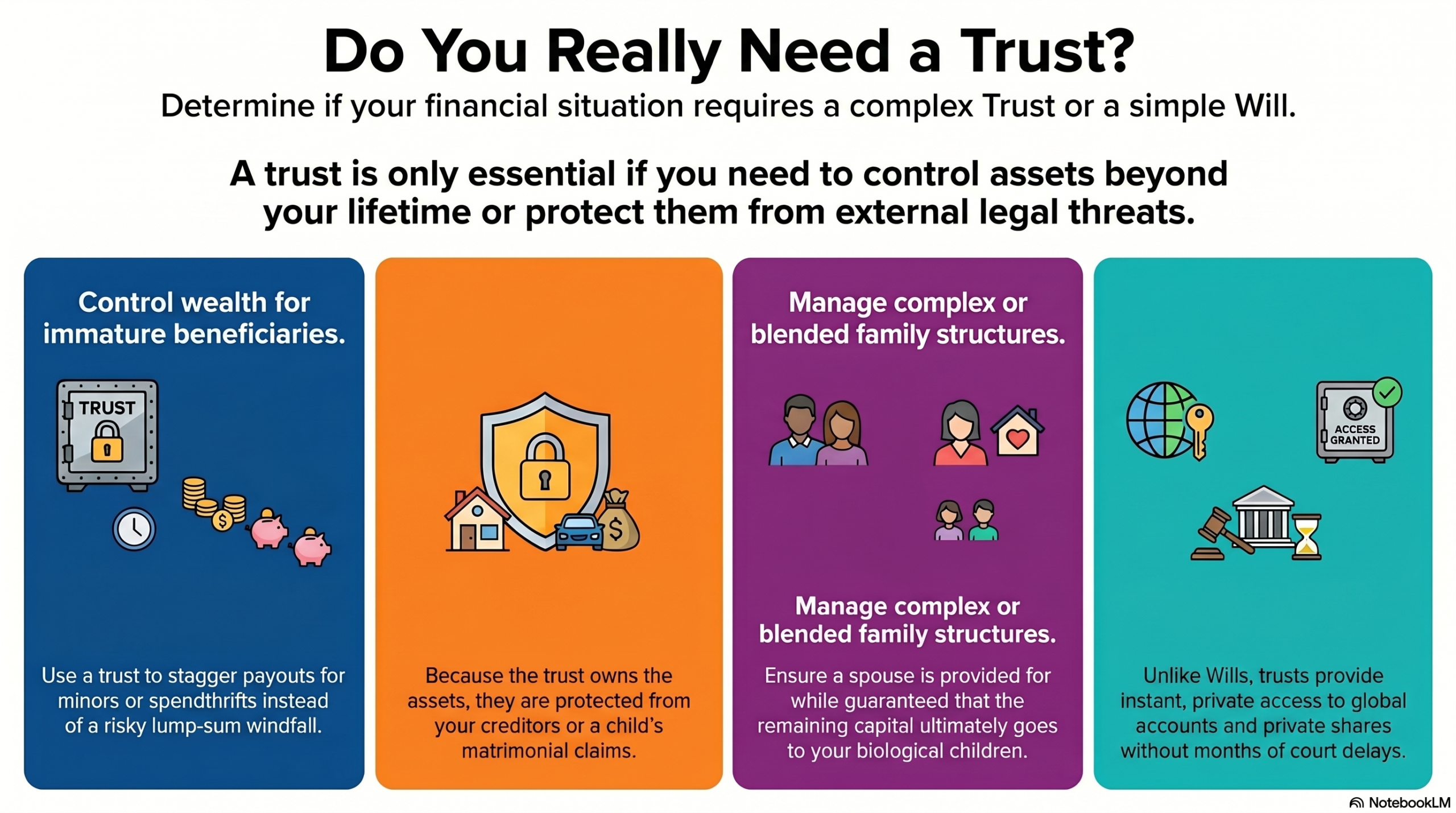
How a Trust Answers This: If you find yourself worrying about the financial maturity of your loved ones, a trust is highly relevant. A trust allows you to act as a “ghost pilot.” Instead of a lump-sum payout, the corporate trustee can distribute a fixed monthly allowance for living expenses, pay universities directly for tuition, or unlock specific percentages of the wealth only when your children hit maturity milestones (e.g., 25, 30, and 35 years old).
.
Scenario 2: The Asset Protection Question
“Am I exposed to professional lawsuits, or do I worry about family divorces eroding our wealth?”
Think about your profession and the future relationships of your heirs.
- Are you a business owner, a medical specialist, or a corporate director where a personal or professional lawsuit could target your personal balance sheet?
- If you pass your wealth down to your child, and their marriage unfortunately ends in a messy divorce years later, are you comfortable knowing that a portion of your family’s hard-earned wealth could be claimed as a matrimonial asset by an ex-spouse?
How a Trust Answers This: When you put assets into an irrevocable trust, you technically transfer the legal ownership of those assets to the trustee. Because you no longer legally “own” the wealth, future creditors, lawsuits, or bankruptcy claims against you cannot touch it. Similarly, because the assets are held safely within the trust wrapper for your child rather than being owned by them outright, it adds a formidable layer of defense against matrimonial asset division during a divorce.
.
Scenario 3: The Complex Family Dynamics Question
“Does my family structure look different from a traditional, single-nucleus model?”
Standard estate laws and default Wills are designed for traditional family structures.
- Are you part of a blended family where there are children from a previous marriage as well as a current marriage?
- Do you want to ensure your current spouse is financially taken care of for the rest of their life, but guarantee that the remaining capital ultimately goes to your biological children rather than a future stepfather or stepmother?
- Do you have a family member with special needs who will require lifelong financial care long after you are gone?
How a Trust Answers This: A Will can easily be contested, and once an asset is willed directly to a spouse, you lose all control over what they do with it next. A trust solves this beautifully through a “Life Interest” clause. You can structure the trust so that your spouse receives all the investment income or has the right to live in the family property for life. However, upon their passing, the trust rules dictate that the core assets automatically route to your children—ensuring everyone you love is protected exactly how you intended.
.
Scenario 4: The Asset Complexity Question
“Does my wealth cross international borders, or do I own private company shares?”
Look closely at what you actually own.
- Do you own real estate in multiple countries, global equity portfolios, or shares in a private limited family business?
- Are you aware of how long it takes for a court to grant a Grant of Probate to execute a standard Will when cross-border assets are involved? (Hint: It can take many months, sometimes years, during which your family’s access to funds is completely frozen).
How a Trust Answers This: Unlike a Will, which only activates after you pass away and must go through a lengthy public court validation process (probate), a trust is alive right now. Because the trust already owns the global accounts or company shares, the transition of management upon your passing is instantaneous and completely private. There is no probate, no frozen bank accounts, and no operational downtime for your family business.
The Verdict: Do You Actually Need a Trust?
If you answered “No” to all the questions above—meaning your children are mature adults, you have no high-risk liability exposure, your family structure is straightforward, and your wealth is entirely local and liquid—you likely do not need a trust right now. A pristine Will and an updated Lasting Power of Attorney are your best moves.
However, if you answered “Yes” to even one of these questions, a trust should shift from a distant luxury to an active conversation in your wealth strategy.
Remember, a trust is only as good as the overarching estate strategy it supports. Before you jump into picking a trustee or moving your funds, it is vital to map out your entire asset ecosystem and define your true family objectives first.
Unsure where your estate stands? Don’t try to self-diagnose your legacy needs. Schedule an estate planning consultation today to evaluate your asset profile, review your family goals, and discover if a trust is the right vehicle for your future.
Kenny Loh is a distinguished Wealth Advisory Director (RNF# LKK300389588 Representing Financial Alliance) with a specialization in holistic investment planning and estate management. He excels in assisting clients to grow their investment capital and establish passive income streams for retirement. Kenny also facilitates tax-efficient portfolio transfers to beneficiaries, ensuring tax-efficient capital appreciation through risk mitigation approaches and optimized wealth transfer through strategic asset structuring.
In addition to his advisory role, Kenny is an esteemed SGX Academy trainer specializing in S-REIT investing and regularly shares his insights on MoneyFM 89.3. He holds the titles of Certified Estate & Legacy Planning Consultant and CERTIFIED FINANCIAL PLANNER (CFP).
With over a decade of experience in holistic estate planning, Kenny employs a unique “3-in-1 Will, LPA, and Standby Trust” solution to address clients’ social considerations, legal obligations, emotional needs, and family harmony. He holds double master’s degrees in Business Administration and Electrical Engineering, and is an Associate Estate Planning Practitioner (AEPP), a designation jointly awarded by The Society of Will Writers & Estate Planning Practitioners (SWWEPP) of the United Kingdom and Estate Planning Practitioner Limited (EPPL), the accreditation body for Asia.
Arrange for a non-obligatory one-to-one free consultation here!
You can join his Telegram channel #REITirement – SREIT Singapore REIT Market Update and Retirement related news. https://t.me/REITirement
If you need any financial advice, please contact kennyloh@fapl.sg