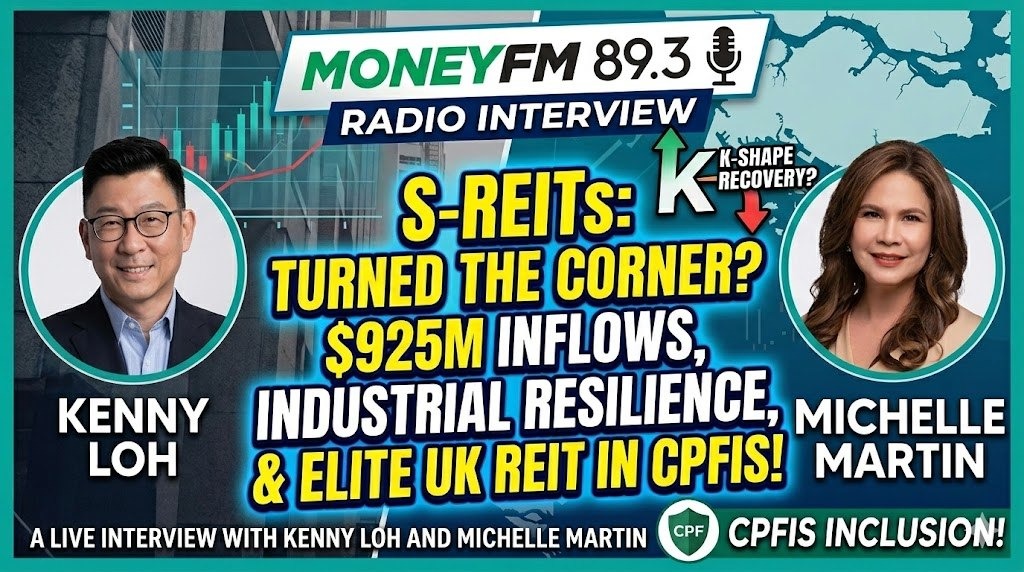
The Singapore Real Estate Investment Trust (S-REIT) market is experiencing a massive tug-of-war between micro-level operational strength and macro-level financial pressure. Whether you are looking to maximize your passive income or optimize your retirement funds, this comprehensive market briefing breaks down the three massive trends shaping the S-REIT landscape right now—and a monumental new regulatory update that changes the game for CPF investors.
1. The $925M Retail Capital Shift: A Strategic Hunt for Yield
Retail investors are aggressively voting with their wallets, pouring a staggering $925 million into S-REITs up to late May 2026. This massive reallocation of capital is being driven by a stark reality: low-risk local cash alternatives have completely lost their edge.
The Macro Disconnect: Cash vs. Property Yields• T-Bills & SSBs Flatten Out: The yield on the 6-month Singapore Treasury Bill (T-bill) has stabilized at a low 1.48%. Similarly, Singapore Savings Bonds (SSBs) offer a first-year return of just 1.46%.• Fixed Deposits Cool Off: Bank fixed deposit rates have largely hit a ceiling between 1.50% to 1.60% for standard 6-to-12-month tenors.• The S-REIT Advantage: In comparison, the average dividend yield for Singapore REITs stands at a highly attractive 5.9%, with several quality industrial and specialized counters pushing yields north of 7% to 9%.
With a spread of over 400 basis points between T-bills and average property yields, local investors are moving out of cash to protect their purchasing power against sticky inflation.
Key Moving Counters: Where is the Money Going?• UI Boustead REIT: Topped the entire sector for retail inflows relative to its market cap, bringing in $62.8 million as opportunistic buyers capitalized on its strong 92.2% occupancy and new logistics expansion in Japan.• Daiwa House Logistics Trust (DHLT) & Parkway Life REIT: Strongly accumulated as defensive anchors due to high structural income visibility, with locked-in master leases extending well past 2030.• CapitaLand India Trust (CLINT) & CapitaLand Ascendas REIT (CLAR): Highly favored for robust leasing momentum in tech-industrial parks and data center infrastructure.
2. Industrial S-REITs: Operational Resilience Meets Asset Rejuvenation
Industrial real estate continues to be the star performer of the sector. Structural demand from e-commerce, localized logistics, and AI data infrastructure is allowing top-tier managers to extract high single-to-double-digit positive rental reversions.
Standout Execution in the Current Environment:• CapitaLand Ascendas REIT (CLAR): Successfully delivered a strong +10.6% rental reversion across its Singapore and US portfolios. Furthermore, management expertly insulated its balance sheet via a massive S$903.5 million equity fund raising, bringing aggregate leverage down to a very safe ~37.3%.• Mapletree Logistics Trust (MLT): Provided a textbook lesson in capital recycling. MLT divested 6 older, low-yielding properties at an average premium of 20% to valuation, immediately redeploying that liquidity into modern Grade-A logistics assets in high-growth corridors like Mumbai, India.• Alpha Integrated REIT: A masterclass in proactive asset management, sustaining an incredible streak of positive rental reversions for over 14 consecutive quarters by engaging tenants aggressively well ahead of lease expiries.
3. The Deal Boom: Cracking the “K-Shaped” Disconnect
Acquisition activity has picked up sharply, with S-REITs announcing over S$6.3 billion in deals in the first few months of the year alone—highlighted by CapitaLand Integrated Commercial Trust (CICT) acquiring Paragon for S$3.9 billion.
Why is Deal-Making Back?
The Federal Reserve’s pause on interest rates (stabilizing around 3.5% to 3.75%) has removed the paralyzing valuation uncertainty of the last two years. Managers can finally price debt and model equity fund management with confidence.
Have S-REITs Finally Turned the Corner?
Yes, structurally they have—but the recovery is strictly K-shaped. This split dynamic determines who wins and who falls behind:
| ▲ Upper Arm (The Winners): Large-cap, sponsor-backed blue chips (CapitaLand, Mapletree, Frasers). They feature strong balance sheets, powerful capital recycling options, and the ability to drive accretive DPU growth.▼ Lower Arm (The Laggards): Highly leveraged, small-to-mid-cap REITs with older assets. Squeezed by the ‘Refinancing Wall’ as fixed hedges expire, forcing them to absorb higher interest expenses that compress distributions. |
The Price Disconnect: Many investors wonder why REIT stock prices remain lackluster when buildings are full. The answer is the Refinancing Wall. S-REITs are currently rolling over cheap, old fixed-rate debt (locked in at 1.5% years ago) into today’s higher 3.5% market baseline. Even when top-line rental revenue grows beautifully, the higher interest costs chew up those gains, keeping short-term distributions flat.
The Split Market: The upper arm of the K belongs to the mega-cap blue chips that can aggressively divest mature assets at a premium and buy modern assets. The lower arm of the K contains highly leveraged, smaller REITs with older properties that face a long, slow grind to refinance without diluting unitholders. Stock selection is everything.
4. Landmark Update: Elite UK REIT Joins CPFIS
Effective June 9, 2026, Elite UK REIT (SGX: MENU) announced that its Singapore Dollar (SGD) counter has been officially included under the Central Provident Fund Investment Scheme (CPFIS) for the Ordinary Account (OA).
Is this the first REIT under CPFIS?
No, major local blue chips are already eligible. However, Elite UK REIT is the first and only pure-play UK-focused REIT to achieve CPFIS status. Clearing the stringent liquidity, governance, and capital safety filters mandated by the CPF Board is a massive regulatory stamp of approval for a foreign-asset vehicle.
Why was it included?
The REIT offers a uniquely resilient, institutional-grade underlying business structure:• Sovereign-Backed Income: Over 99% of its gross rental income is derived directly from the UK Government (primarily the Department for Work and Pensions), functioning as mission-critical public social infrastructure.• High Cash Flow Visibility: Features virtually 100% rent collection, paid three months in advance, fully backed by AA-rated sovereign credit.
Why would CPF holders want to invest?
The standard CPF Ordinary Account offers a guaranteed but static 2.5% return. With major brokerages highlighting Elite UK REIT’s sustainable forward dividend yield of around 9%, it offers an incredible 6.5% yield pickup. It provides a direct, highly accessible gateway for local savers to diversify their retirement funds into UK real estate right on the SGX platform.
The Essential Risks to Consider
As with any high-yielding asset, higher returns come with clear trade-offs that CPF investors must carefully weigh:• Concentration & Lease Renewal Risk (2028 Horizon): The UK Government’s Department for Work and Pensions (DWP) contributes roughly 92% of the REIT’s gross rental income. A significant cluster of these leases comes up for renewal/regearing in 2028. Any physical consolidation by the UK government could impact future vacancy rates.• Foreign Exchange (FX) Translation Risk: While the REIT is naturally hedged operationally (generating rent and holding debt in British Pounds), a severely weakening Sterling against a strengthening Singapore Dollar will structurally shrink the actual SGD dividend payout received by local investors.• Capital Volatility: Moving your funds out of the CPF-OA means trading a principal-guaranteed, risk-free 2.5% return for secondary market equity price fluctuations. Position sizing under the 35% CPFIS stock limit remains critical.
Summary for Investors
The worst of the macroeconomic interest rate storm is officially behind us, and the reopening of the multi-billion-dollar acquisition gateway proves that confidence is returning. However, in a K-shaped recovery environment, the days of buying the entire sector and hoping for equal gains are over. Focus on quality sponsors, robust capital recycling track records, and clear distribution visibility to navigate the market successfully.
Disclaimer: This article is for educational and informational purposes only and does not constitute financial advice. Investors should conduct their own due diligence or consult a licensed financial representative before deploying cash or CPFIS funds into market securities.
Kenny Loh is a distinguished Wealth Advisory Director (RNF# LKK300389588 Representing Financial Alliance) with a specialization in holistic investment planning and estate management. He excels in assisting clients to grow their investment capital and establish passive income streams for retirement. Kenny also facilitates tax-efficient portfolio transfers to beneficiaries, ensuring tax-efficient capital appreciation through risk mitigation approaches and optimized wealth transfer through strategic asset structuring.
In addition to his advisory role, Kenny is an esteemed SGX Academy trainer specializing in S-REIT investing and regularly shares his insights on MoneyFM 89.3. He holds the titles of Certified Estate & Legacy Planning Consultant and CERTIFIED FINANCIAL PLANNER (CFP).
With over a decade of experience in holistic estate planning, Kenny employs a unique “3-in-1 Will, LPA, and Standby Trust” solution to address clients’ social considerations, legal obligations, emotional needs, and family harmony. He holds double master’s degrees in Business Administration and Electrical Engineering, and is an Associate Estate Planning Practitioner (AEPP), a designation jointly awarded by The Society of Will Writers & Estate Planning Practitioners (SWWEPP) of the United Kingdom and Estate Planning Practitioner Limited (EPPL), the accreditation body for Asia.
Arrange for a non-obligatory one-to-one free consultation here!
You can join his Telegram channel #REITirement – SREIT Singapore REIT Market Update and Retirement related news. https://t.me/REITirement
If you need any financial advice, please contact kennyloh@fapl.sg
2026
2025
- Money and Me: Are S-REITs Still Worth the Climb? (October 2025)
- Money and Me: S-REITs vs Banks – Is It Time to Rotate? (August 2025)
- Money and Me: Are S-REITs Still Worth the Risk in 2025? (July 2025)
- Money and Me: REITs Among Upcoming IPO’s and what you need to know (June 2025)
- Money and Me: S-REITs Bounce Back? China’s REIT Game-Changer and the hunt for yield of up to 8% (May 2025)
- Money and Me: How are S-REIT’s doing amidst the Tariffs Turnaround? (April 2025)
- 𝗠𝗼𝗻𝗲𝘆 𝗮𝗻𝗱 𝗠𝗲: 𝗦-𝗥𝗘𝗜𝗧𝘀 𝗥𝗮𝗹𝗹𝘆, 𝗧𝗿𝗲𝗮𝘀𝘂𝗿𝘆 𝗬𝗶𝗲𝗹𝗱𝘀 𝗗𝗿𝗼𝗽, 𝗮𝗻𝗱 𝗖𝗗𝗟’𝘀 𝗙𝗮𝗺𝗶𝗹𝘆 𝗗𝗿𝗮𝗺𝗮 (March 2025)
- Money and Me: CPF Special Account Closure, Retirement Planning, and Investment Strategies with Kenny Loh (February 2025)
- Money and Me: What is your T-Bill to S-REIT allocation? (January 2025)
2024
- Money and Me: Trump’s Second Term, Bitcoin, Tesla, AI, and Suntec REIT Mandatory Cash Offer (December 2024)
- Money and Me: Data Centered S-REITs; here is what you need to know (November 2024)
- Money and Me: Finding attractive S-REITs in a rate cutting environment (October 2024)
- Money and Me: What’s behind the S-REIT Rally? Fed Rate Cuts, and should Finfluencers be managed? (September 2024)
- Money and Me: Navigating S-REITs Amid Earnings Season and Potential US Rate Cuts (August 2024)
- Money and Me: Navigating Challenges for Mapletree REITs and REITs related to Changi Business Park
(June 2024) - Money and Me: Winners and Losers Among S-REITs, Frasers Property’s Profit Plunge, and the Impact of Sustained High Interest Rates (May 2024)
- Money and Me: Manulife US REIT where could it be heading? Are we at the tail end of the down cycle for S-Reits? (April 2024)
- Money and Me: Will more S-REIT’s suspend distributions? (March 2024)
- Money and Me: US Office Reits – the immediate outlook is bleak but there are opportunities for investors (February 2024)
- Money and Me: Why S-REIT investors are focused on valuations in 2024? (January 2024)
2023
- Money and Me: Can Manulife US REIT be saved? (December 2023)
- Money and Me: Finding bargains in the S-REITs sector today (November 2023)
- Money and Me: How a contrarian investor reads a sell-off (October 2023)
- Money and Me: Finding bargains in the S-REITs sector today (September 2023)
- Money and Me: S-REITs earning stars and landscape quakes (August 2023)
- Money and Me: 3 Singapore REITs to watch (July 2023)
- Money and Me: Are S-REITs in for a promising 2H2023? (June 2023)
- Money and Me: How might the expectations of an impending recession affect S-REITs? (May 2023)
- Money and Me: S-REITs’ 2023 1st quarter report card review (April 2023)
- Money and Me: S-REITs that will hold up well in an increasing interest rate environment (March 2023)
- Money and Me: Winners and losers of latest S-REITs earnings season (February 2023)
- Money and Me: S-REITs’ 2023 outlook (January 2023)
2022
- Money & Me: Is 2023 the year of recovery for S-REITs? (December 2022)
- Money & Me: What happens after the recent S-REIT crash? (November 2022)
- Money & Me: Further Interest Rate Hikes, FHT’s failed Privatization bid (September 2022)
- Money & Me: Q3 2022 SREIT winners (August 2022)
- Money and Me: REIT picking in an inflationary environment (July 2022)
- Money and Me: Are Hospitality REITs the clear way to play the reopening trade in Singapore? (June 2022)
- Money and Me: Can S-REITs maintain its upswing from Q1? (May 2022)
- Money & Me: The case for being bullish on S-REITs amid the Ukraine crisis (March 2022)
- Money & Me: Optimism for S-REIT’s given earnings signals and mapping the possibilities for shareholders in the Mapletree merger (February 2022)
- Money & Me: Mapletree merger, growth in commercial S-Reits and the potential return of Reit IPOs in 2022 (January 2022)
2021
- Money & Me: First Reit, CapitaLand, Daiwa, Digital Core Reit and the best of the S-Reit pivots (December 2021)
- Money and Me: VTL’s and hospitality and retail, a new Reit ETF and Making sense of offers for SPH (November 2021)
- Money and Me: Who benefits from the ESR – ARA Logos Logistics Trust merger? (October 2021)
- Money and Me: China’s Evergrande Group property and the spillover in the property market, breaking down what CapitaLand Invest means for the investor and global REITs to watch (September 2021)
- Money and Me: Are retail and hospitality aggressive plays given the pace of reopening? (August 2021)
- Money and Me: Which REITs have seen a limited impact on occupancy during COVID? (July 2021)
- Money and Me: An overview of the REIT performance (June 2021)
- Money and Me: S-REIT’s: which are most likely and which least likely to be affected by new social restrictions? (May 2021)
- Money and Me: What’s the link between bond yields and S-REITs? (April 2021)
2020
- Money and Me: REITS that did well in 2020 (December 2020)
- Money and Me: An overview of S-REITS, value rotations and REITS paying out higher dividends (November 2020)
- Money and Me: Yield Generating Asset Classes (October 2020)
- Money and Me: The REIT outlook within and beyond Singapore (August 2020)
- Money and Me: Ugly Duckling Earnings turning into Beautiful S- Reit swans? (July 2020)
- Money and Me: V for S-REITs? (June 2020)
- Money and Me: Will revenge spending help REITs? (May 2020)
- Money and Me: What REITs to Look out for? (April 2020)
- Money and Me: Crazy REIT Sales (March 2020)