Exclusive Insights: Interview with ALOG REIT CEO, Ms Karen Lee

  • Post author:

In this coverage of the ESR-REIT and ARA LOGOS Logistics Trust merger, I had the opportunity to speak to Ms Karen Lee, CEO of ALOG REIT on the 8 November 2021.


Proposed merger of ESR REIT with ARA LOGOS Logistics Trust: Resources


Cold Storage Logistics


[Editors note: Cold Storage Facilities are facilities that store frozen or chilled goods, such as frozen food, chilled food and pharmeceuticals. Demand for such facilities around the world is high, especially nowadays since the COVID-19 Vaccines are in high demand and most of them require such facilities.]

Kenny: I heard that Cold Storage Logistics are a new asset class, just like Data Centres. What do you think about the future growth of this sector, and would there be any rerating of the REIT as this asset class is added into your portfolio?

Karen: I wouldn’t say Cold Storage and Data Centres are the same, but they are both specialised sectors. If you look across the other Industrial REITs in Singapore, not many of them have dedicated Cold Storage facilities. ALOG has one such facility (ALOG Cold Centre at 2 Fishery Port Road). Depending on industrial requirements, these facilities can be configured accordingly (freezer, chiller, ambient etc.). Right now, especially because of COVID, there is a shortage of Cold Storage facilities islandwide, meaning our facility has an occupancy close to 100%.

However, landlords typically do not build such facilities because the capex is very high. Some dedicate only a portion of their property to have Cold Storage facilities. Since our current sponsor is a logistics developer (LOGOS), they have experience in building specialised facilities such as Cold Storage.

Kenny: For Cold Storage Facilities, which countries have higher demand for such facilities?

Karen: All countries have high demand for such facilities. Due to COVID and the supply chain disruption, there’s a shortage in Cold Storage. You’ll be surprised at how much frozen food and pharmaceutical products are being stored in the event of future supply chain disruptions. 

Kenny: So in the near term, is ALOG planning for acquisitions of Cold Storage Facilities (or conversion to such facilities) or only when the Merger with ESRREIT is complete?

Karen: Right now we are at a standstill (due to the ongoing merger) but we do have tenants who are enquiring about converting to Cold Storage facilities and, we are still exploring those on a case-by-case basis.


Merger of ESR REIT and ARA LOGOS Logistics Trust


Kenny: Regarding the Merger, is there a Plan B for ALOG, in case the merger with ESR REIT does not go through?

Karen: If the merger doesn’t go through, it’ll be business as usual for ALOG. Having said that, we are quite confident the merger will go through, as we have articulated the merits of the merger for both REITs. On our own, we can still grow, albeit at a slower pace. ALOG, as a relatively small REIT, can’t possibly acquire large transactions at one go, we’ll have to break it up. However, a larger REIT will benefit from the economies of scale. Investors need to see that scale is very important for REITs to grow.

Post-merger, we have a clear path to grow ESR-LOGOS REIT. Our enlarged sponsor has over US$50 billion in New Economy AUM and US$10 billion in Development Work-in-Progress New Economy pipeline. It is a very large pipeline for any REIT sponsor to offer. I have also been communicating to investors that for ALOG holders, you are not selling out, but rather you are rolling over 90% of units to an enlarged platform, as well as capitalising on existing returns with the 10% cash.

Kenny: Only a little more than a year ago, you took over as ALOG’s CEO. Is this succession and the merger pre-planned?

Karen: Back when I took over as CEO of ARA LOGOS Logistics Trust (Formerly Cache Logistics Trust), the only transaction that happened was only ARA’s acquisition of LOGOS in March last year. The decision to merge with ESR REIT was as recent as 2 months ago, where Adrian and I discussed the merits of a potential merger between the two REITs after the proposed merger of ESR Cayman and ARA Asset Management was announced.

The biggest challenge moving forward is how quickly we can execute the plans and strategies we have been articulating to the unitholders, in terms of acquisitions.

Kenny: What do you think will be the biggest challenge that your team will face post-merger, and how will your team plan to resolve them? 

Karen: We have been quite busy with the transaction, therefore we are still in the midst of discussions about the integration process. We need to evaluate the talents available on both sides and pick the best man for the job, for the new roles the enlarged REIT will have. 

I would say the biggest challenge moving forward is how quickly we can execute the plans and strategies we have been articulating to the unitholders, in terms of acquisitions. We have not been given a timeline to do so but it will be important for us to execute them quickly so that we would be credible in delivering what we said we would do. We would also set out to be included in more indices in the future, improving trading liquidity and visibility to institutional investors, and in time to come, be in the same league as some of the bigger players.

Kenny: Investors and Analysts are looking at whether you can execute what you have promised.

Karen: I think Adrian and I have delivered what we have promised for our respective REITs. For ALOG, we articulated 3 key tasks we would do, namely Acquisitions, Divesting Non-Core Assets and AEIs. Once we delivered them, ALOG had a good re-rating after we carried out these corporate actions.

Kenny: Would you foresee immediate acquisitions to be carried out post merger?

Karen: Out of the over US$50 billion in New Economy AUM and US$10 billion in Development Work-in-Progress New Economy pipeline across 10 countries where the Sponsor has presence in, US$2 billion of these are core assets that are immediately visible and executable. Adrian and I will look at the c.S$2 billion of immediately visible and executable New Economy pipeline we have been talking about, to identify which assets are ready to be injected into the REIT.


Performance of ARA LOGOS Logistics Trust
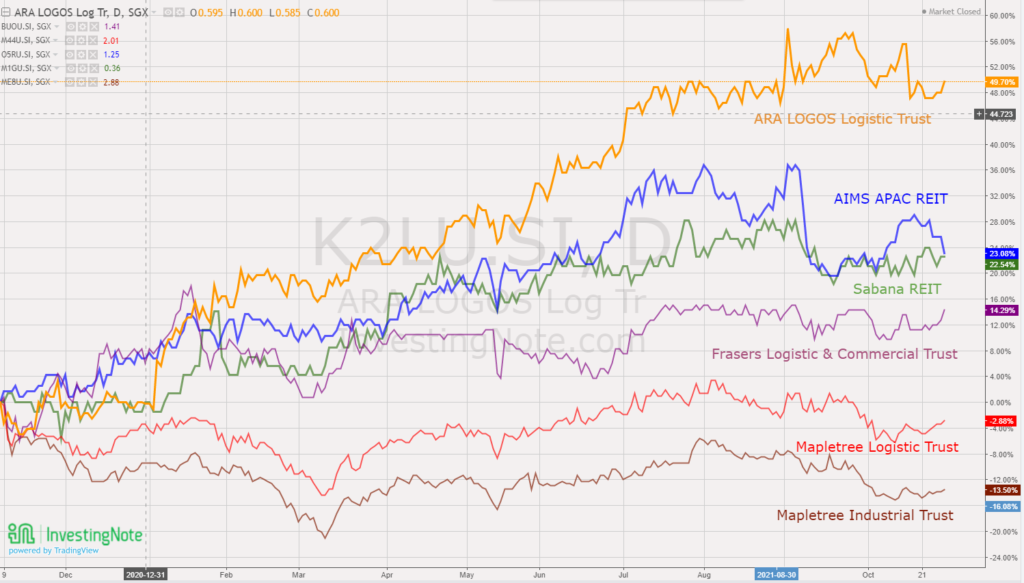

 
ARA LOGOS Logistics Trust’s stellar performance compared to other Industrial S-REITs.
 

In the past 18 months, we have maintained high portfolio occupancy rates, achieved positive rental reversion, divested non-core assets to rebalancing our portfolio, and managed to reduce leverage and lower our all-in financing costs. We executed Asset Enhancements to ensure our assets remain competitive and relevant to our tenants.

Kenny: I would like to congratulate you on the great performance of ALOG for the past year, beating other Industrial S-REITs. What do you think you have done right?

Karen: I must thank you for these kind words. When I took over in August 2020, the immediate task was to improve the performance of the REIT. Prior to me taking over, the rebranding of Cache Logistics Trust to ARA LOGOS Logistics Trust signified a fresh start, with a new sponsor (LOGOS) onboard. LOGOS demonstrated its commitment to grow the REIT, and alignment of interests with unitholders, via asset injection. We completed our first portfolio acquisition in Australia earlier this year, and LOGOS backstopped the entire preferential offering when we did the fund raising for that acquisition. 

Coming from an operator background, it is really important to strengthen the portfolio operating metrics. In the past 18 months, we have maintained high portfolio occupancy rates, achieved positive rental reversion, divested non-core assets to rebalancing our portfolio, and managed to reduce leverage and lower our all-in financing costs. We executed Asset Enhancements to ensure our assets remain competitive and relevant to our tenants. The market can see that we have put in significant efforts to deliver these results, and the results have shown. I am proud of my team in helping us to deliver the stellar results of ALOG, creating value for our unitholders. Once again, being transparent to our unitholders and delivering what we have outlined is very critical. For the enlarged REIT itself, we would be following a similar strategy.


Kenny Loh is a Senior Financial Advisory Manager and REITs Specialist of Singapore’s top Independent Financial Advisor. He helps clients construct diversified portfolios consisting of different asset classes from REITs, Equities, Bonds, ETFs, Unit Trusts, Private Equity, Alternative Investments, Digital Assets and Fixed Maturity Funds to achieve an optimal risk adjusted return. Kenny is also a CERTIFIED FINANCIAL PLANNER, SGX Academy REIT Trainer, Certified IBF Trainer of Associate REIT Investment Advisor (ARIA) and also invited speaker of REITs Symposium and Invest Fair.  You can join my Telegram channel #REITirement – SREIT Singapore REIT Market Update and Retirement related news. https://t.me/REITirement
Continue ReadingExclusive Insights: Interview with ALOG REIT CEO, Ms Karen Lee

Daiwa House Logistics Trust IPO: Prospectus and Summary

  • Post author:
 

Summary of Daiwa House Logistics Trust


Overview

DHLT is a Singapore real estate investment trust (“REIT”) established with the investment strategy of principally investing in a portfolio of income-producing logistics and industrial real estate assets located across Asia. DHLT’s key objectives are to provide Unitholders with regular and stable distributions, and to achieve long-term growth in DPU and net asset value (“NAV”) per Unit, while maintaining an optimal capital structure and strengthening the portfolio in scale and quality.


Fundamental and Financial Ratios

  • Type = Logistics and Industrial Properties in Japan
  • Sponsor = Daiwa House Industry Co., Ltd. (TYO:1925)
  • REIT Manager: Daiwa House Asset Management Asia Pte. Ltd
  • Total Units Offered = 244,438,000
  • Portfolio = 14 Logistics and Industrial Properties in Japan
  • Portfolio Size = ¥80,570.0 million (S$952.9 million)
  • IPO Offer Price = S$0.80
  • NAV per unit = S$0.81
  • Price / NAV = 0.988
  • Gearing Ratio = 43.8%
  • Forecasted Distribution Yield = 6.3% (2021), 6.5% (2022)
  • Distribution Policy = 100% till 2022. At least 90% from 2023 onwards. Semi-annual distribution.

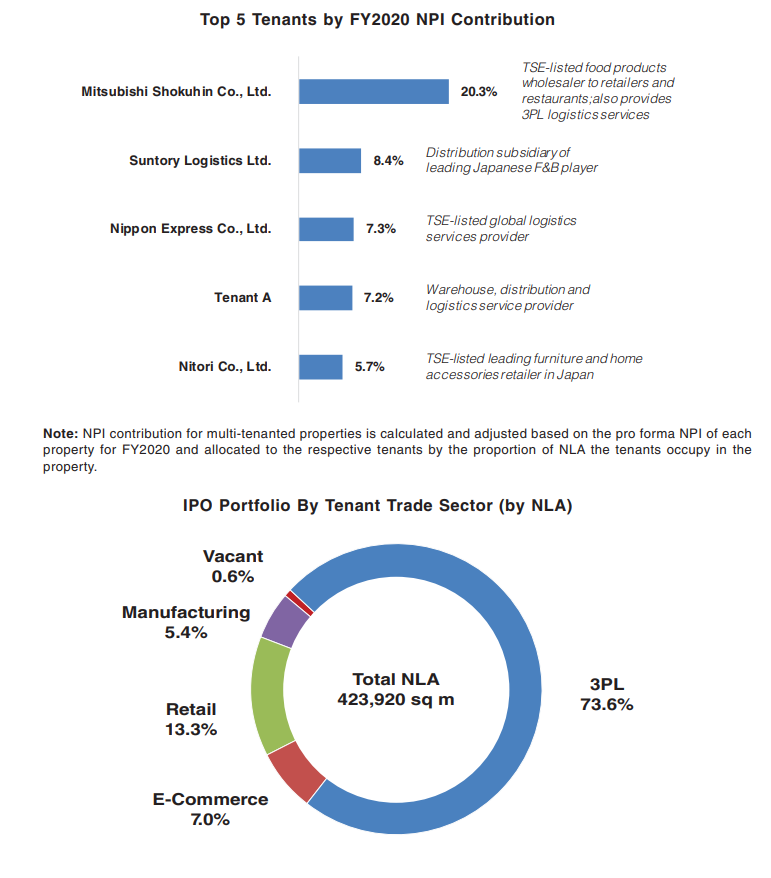
Lease Management Ratios

Debt Management Ratios

  • Forecasted Interest Coverage Ratio = 9.3x (2021), 10.3x (2022)

IPO Information

  • IPO Offer Price = S$0.80
  • Offer Closing Date: 24 November 2021 at 12:00pm
  • Listing Date: 26 November 2021 at 2:00pm

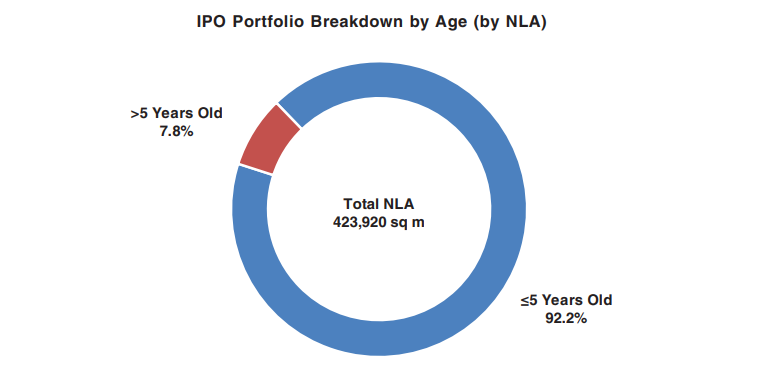
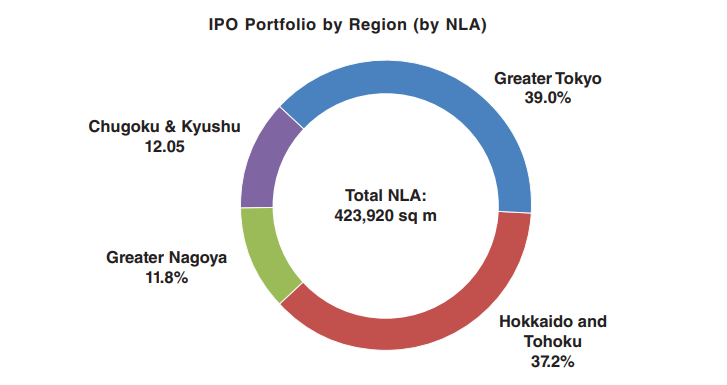
Portfolio Overview

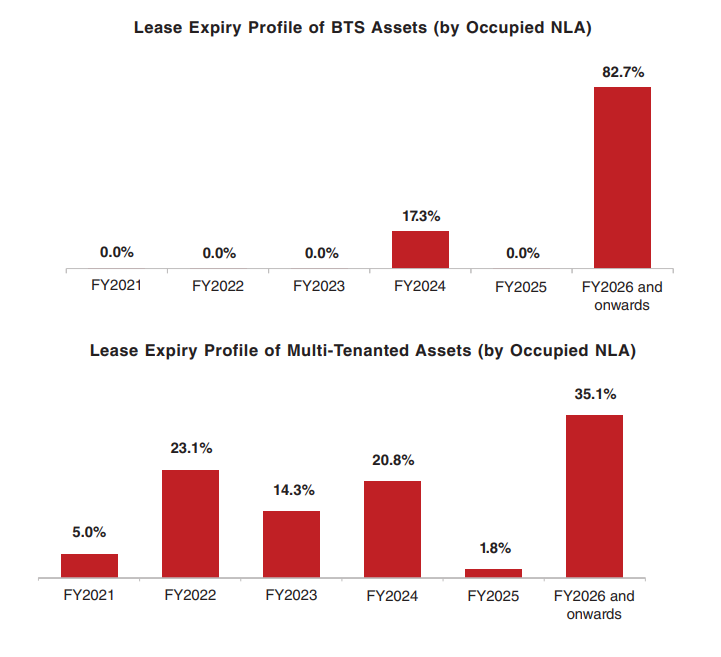
Lease Details

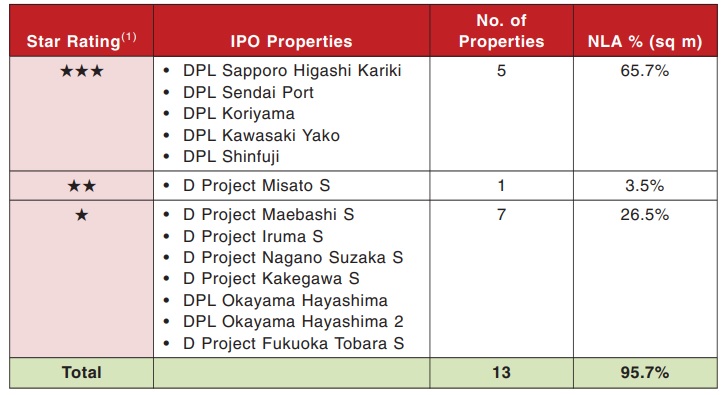
ESG Commitment

The IPO Portfolio demonstrates the Manager’s commitment to ESG principles. Approximately 95.7% of the IPO Portfolio by NLA is certified green by the DBJ Green Building Certification Programme, the leading programme in Japan which evaluates and measures the environmental and social awareness characteristics of real estate properties.

DHLT’s portfolio properties are well-equipped with systems which help to conserve and generate energy. For instance, energy-efficient LED lights are installed in all but one property in the IPO Portfolio. Additionally, 10 out of the 14 properties in the IPO Portfolio are equipped with solar power generation systems on their roof-tops, which are operated by Daiwa Energy Co., Ltd.

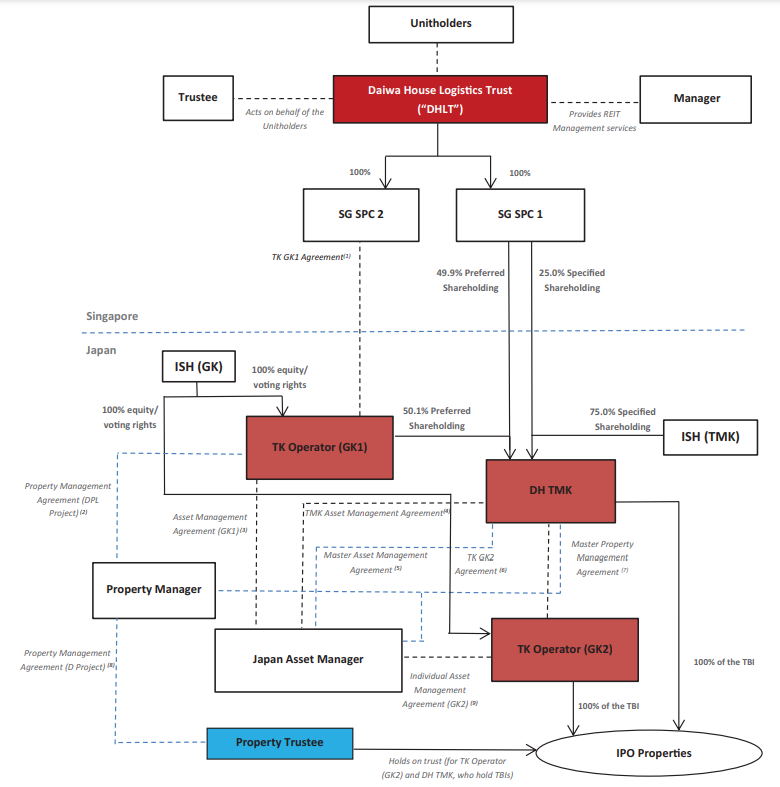
Structure and Property Pipeline

View the Daiwa House Logistics Trust IPO Prospectus here.

Kenny Loh is a Senior Financial Advisory Manager and REITs Specialist of Singapore’s top Independent Financial Advisor. He helps clients construct diversified portfolios consisting of different asset classes from REITs, Equities, Bonds, ETFs, Unit Trusts, Private Equity, Alternative Investments, Digital Assets and Fixed Maturity Funds to achieve an optimal risk adjusted return. Kenny is also a CERTIFIED FINANCIAL PLANNER, SGX Academy REIT Trainer, Certified IBF Trainer of Associate REIT Investment Advisor (ARIA) and also invited speaker of REITs Symposium and Invest Fair.  You can join my Telegram channel #REITirement – SREIT Singapore REIT Market Update and Retirement related news. https://t.me/REITirement

Continue ReadingDaiwa House Logistics Trust IPO: Prospectus and Summary

Exclusive Insights: Q&A during Manulife US REIT Operational Update

  • Post author:

On 3 November 2021, Manulife US REIT (“MUST”) [SGX:BTOU] released its operational updates for the third quarter ended 30 September 2021. I have been invited for a call with the management team for updates on MUST’s 3Q 2021 operations as well as on the U.S. office landscape. I would like to thank Manulife US REIT for this opportunity.


Q&A Section


In this section I’ll be touching on selected questions regarding MUST’s operations, and their outlook moving forward.

Q: Just wondering, what is your outlook on acquisitions, will you be able to complete an acquisition this year or maybe by next year?

A: We’ve looked through 46 properties this year, and we are definitely getting closer to finding properties that we would be interested in acquiring.

Q: There were some occupancy exits in Q3 2021. How would you characterize these tenants at this point of time?

A: The most notable occupancy exit would be a tenant in Atlanta, they had an option to terminate a floor relating to the tenant’s IT department. Although this department has already been working remotely distributed since pre-COVID, and COVID has only accelerated that transition. Therefore they took the option to terminate that lease.

However, this particular tenant is notably one of our biggest tenants in terms of occupied square footage, and also has very long lease terms. Therefore this drop in occupancy shouldn’t be due to overall market sentiment changes toward the US office market.


Less than 20% of buildings in the US are currently green. In the next couple of years, when regulation on carbon emissions kick in, there will be an inevitable rush to ‘green’ your buildings in the near future.


Q. I noticed you have conservatively recorded portfolio devaluations for the past few years. Just wondering if we can expect a turnaround within the next year.

A: We do feel that our values are conservative, but we cannot rule out the possibility that there will still be a decline. Broadly speaking however, the US office market has been flat but is starting to see positive signs in the leasing market (in terms of rent growth etc), and that should be reflected as we approach our next round of valuation. Furthermore, independent third-party valuers that conduct valuation on our properties may have different views on how valuation is conducted, although we are optimistic.

Q: I am quite heartened to see that MUST is a proponent of going green, and are aiming to achieve 100% of your properties with green certification. Can you give us a sense of how much capex to expect from greening your portfolio (and in the future maintaining the status)?

A: Certainly we won’t be seeing additional discernable capex spending to get to the 100% goal (of seeing our entire portfolio green-certified) next year. We’re looking at the one remaining building, specifically the Energy Star award which takes a year to achieve. Our policy in the future is to ‘green as we go along.’ Recently for example, we renewed energy contracts and moved them to renewable energy sources. The gradual switching to greener and more sustainable options shouldn’t impact capex dramatically, as these are costs that we would have already taken into account anyway.

Also, 8 out of 9 properties in our portfolio are already green (meaning they are LEED and/or Energy Star certified). This means that these properties are already meeting the standards, meaning no additional capex is needed to make it greener. That being said, additional capex to ‘green’ existing buildings which do not meet the above-mentioned standards can be relatively significant.


Large, corporate tenants are already looking beyond energy ratings and green building certifiations. They want to know your environmental philosophies and goals as a sponsor.


Q: Generally, are tenants particular about looking for green and sustainable buildings?

A: Definitely we are seeing an increase in the number of tenants who are looking for green buildings. It has been quite slow in America but it has been steadily increasing. One relatively large tenant in particular has been specific in terms of getting to know about MUST’s green prospects. Big corporate tenants are already looking beyond things such as certification. 

One key point to take note is that a lot of American government agencies actually do not allow their office spaces to be in non-green buildings. With USA pledged to net-zero by 2050, steps have already been taken to ensure its goals are met. In New York by 2024, building owners can incur fines if their carbon emissions exceed a certain level. 


Growth in the US Office Sector


Recovery of Leasing Activity

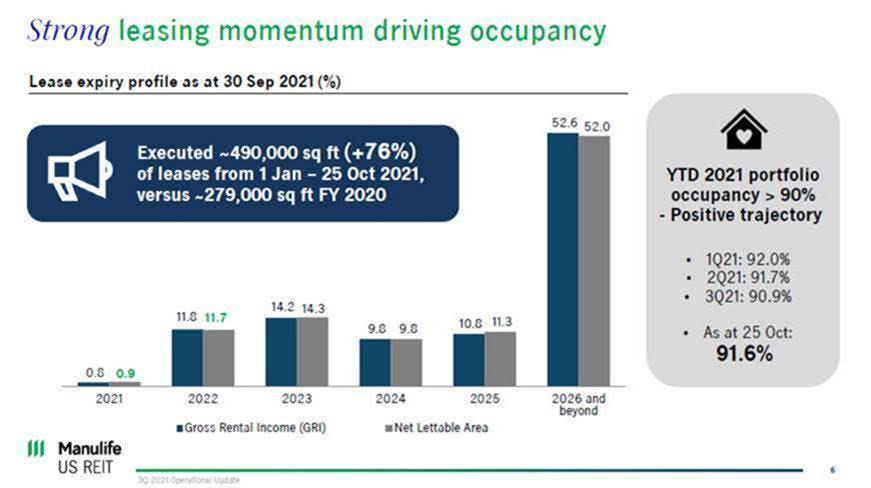
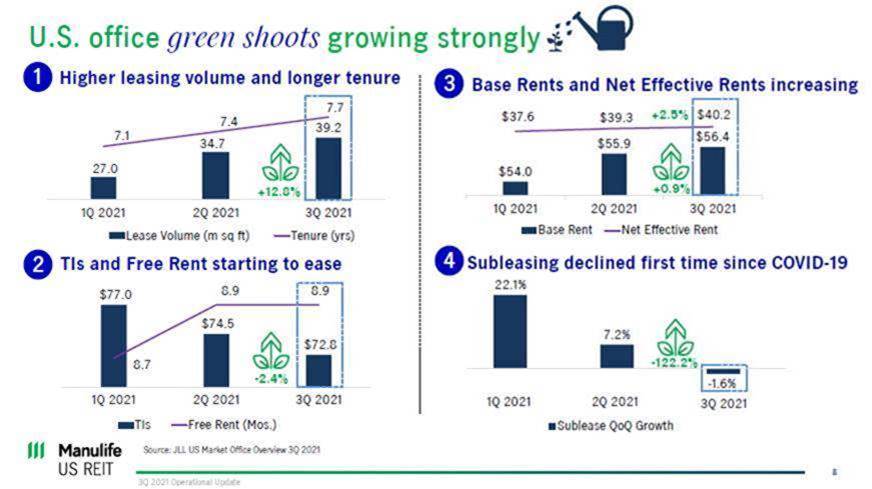
MUST: We have hardly any more leases coming due in 2021, having executed ~490,000 sq ft in leases from 1 Jan to 25 Oct 2021 – a significant volume which shows that tenants are now more certain about their space needs and are ready to sign leases again. This is a change from when COVID-19 first started last year and leasing activity slowed drastically.

Surge in New Leases

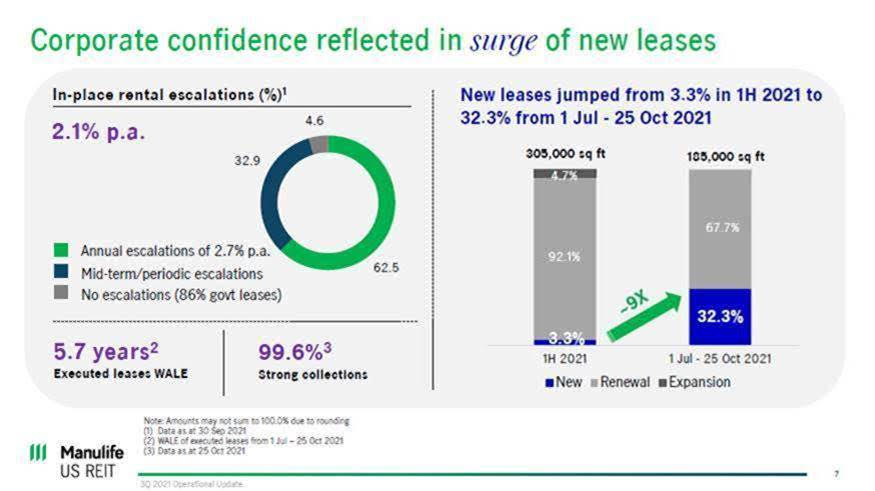
MUST: In particular, we have seen new leases jumping from 3.3% in 1H 2021 to 32.3% from 1 July to 25 Oct 2021, which shows that there is new demand for our office space in the market (i.e. we are not just renewing existing leases). This demonstrates healthy fundamentals in the U.S. office market and good demand for our buildings.

Reduction of Subleasing

MUST: Finally, our performance dovetails with what’s happening across the broader U.S. market, where leasing volume is up and tenants are signing longer leases. Base rents and net effective rents (which take away the effect of tenant improvement allowances and free rent) are recovering, and subleasing declined for the first time since COVID-19.

*Subleasing is the re-renting of property space by an existing tenant to a third party for a portion of the tenant’s existing lease contract. A large volume of sublease space was put on the market when COVID-19 first struck, due to tenants’ uncertainty about their space needs while some also faced financial difficulty. The fact that this is now declining shows that either existing tenants are expanding, or they are more certain about their financial stability and space needs.

Kenny Loh is a Senior Financial Advisory Manager and REITs Specialist of Singapore’s top Independent Financial Advisor. He helps clients construct diversified portfolios consisting of different asset classes from REITs, Equities, Bonds, ETFs, Unit Trusts, Private Equity, Alternative Investments, Digital Assets and Fixed Maturity Funds to achieve an optimal risk adjusted return. Kenny is also a CERTIFIED FINANCIAL PLANNER, SGX Academy REIT Trainer, Certified IBF Trainer of Associate REIT Investment Advisor (ARIA) and also invited speaker of REITs Symposium and Invest Fair.  You can join my Telegram channel #REITirement – SREIT Singapore REIT Market Update and Retirement related news. https://t.me/REITirement
Continue ReadingExclusive Insights: Q&A during Manulife US REIT Operational Update