Singapore REIT Monthly Update (Nov 07 – 2021)

  • Post author:

Technical Analysis of FTSE ST REIT Index (FSTAS351020)

FTSE ST Real Estate Investment Trusts (FTSE ST REIT Index) increased slightly from 842.13 to 872.79 (+3.64%) compared to the last month update. Currently the Singapore REIT index is still trading with a range between 816 and 890.

  • As for now, Short term direction: Up.
  • Medium direction: Sideway.
  • Immediate Support at 816, followed by 775.
  • Immediate Resistance at 890.

Previous chart on FTSE ST REIT index can be found in the last post: Singapore REIT Fundamental Comparison Table on October 3, 2021.

Fundamental Analysis of 38 Singapore REITs

The following is the compilation of 38 Singapore REITs with colour coding of the Distribution Yield, Gearing Ratio and Price to NAV Ratio.

  • Note 1: The Financial Ratio are based on past data and there are lagging indicators.
  • Note 2: This REIT table takes into account the dividend cuts due to the COVID-19 outbreak. Yield is calculated trailing twelve months (ttm), therefore REITs with delayed payouts might have lower displayed yields, thus yield displayed might be lower.
  • Note 3: REITs highlighted in green (32 REITs) have been updated with the latest Q3 2021 business updates/earnings. REITs highlighted in yellow (6 REITs) are still using Q2 2021 business updates/earnings.

(Source: https://stocks.cafe/kenny/advanced)


  • Price/NAV increased to 1.03
    • Increased from 1.01 in October 2021.
    • Singapore Overall REIT sector is at fair value now.
    • Take note that NAV is adjusted downward for most REITs due to drop in rental income during the pandemic (Property valuation is done using DCF model or comparative model)
  • TTM Distribution Yield increased to 5.83%
    • Increased from 5.79% in October 2021.
    • 10 of 38 (26.3%) Singapore REITs have distribution yields of above 7%.
    • Do take note that these yield numbers are based on current prices taking into account the delayed distribution/dividend cuts due to COVID-19, and post circuit breaker recovery.
  • Gearing Ratio decreased to 37.31% 
    • Decreased from 37.41% in October 2021.
    • Gearing Ratios are updated quarterly. This takes into account the recent Q3 2021 business updates.
    • In general, Singapore REITs sector gearing ratio is healthy but increased due to the reduction of the valuation of portfolios and an increase in borrowing due to Covid-19.
  • Most overvalued REITs (based on Price/NAV)
    • Parkway Life REIT (Price/NAV = 2.02)
    • Keppel DC REIT (Price/NAV = 1.93)
    • Mapletree Industrial Trust (Price/NAV = 1.53)
    • Mapletree Logistics Trust (Price/NAV = 1.52)
    • Ascendas REIT (Price/NAV = 1.38)
    • Frasers Logistics and Commercial Trust (Price/NAV = 1.34)
  • Most undervalued REITs (based on Price/NAV)
    • Lippo Malls Indonesia Retail Trust (Price/NAV = 0.57)
    • BHG Retail REIT (Price/NAV = 0.60)
    • First REIT (Price/NAV = 0.74)
    • Suntec REIT (Price/NAV = 0.75)
    • Capitaland China Trust (Price/NAV = 0.76)
    • OUE Commercial REIT (Price/NAV = 0.77)
  • Highest Distribution Yield REITs (ttm)
    • First REIT (10.73%)
    • United Hampshire REIT (8.94%)
    • Sabana REIT (8.57%)
    • Sasseur REIT (8.27%)
    • Elite Commercial REIT (8.01%)
    • Keppel Pacific Oak US REIT (7.86%)
    • Reminder that these yield numbers are based on current prices taking into account delayed distribution/dividend cuts due to COVID-19.
    • Some REITs opted for semi-annual reporting and thus no quarterly DPU was announced.
  • Highest Gearing Ratio REITs
    • ARA Hospitality Trust (48.4%)
    • Suntec REIT (44.3%)
    • Lippo Malls Retail Trust (42.3%)
    • Frasers Hospitality Trust (42.2%)
    • Elite Commercial REIT (42.1%)
    • Manulife US REIT (42.0%)
  • Total Singapore REIT Market Capitalisation increased by 3.86% to S$109.2 Billion.
    • Increased from S$105.1 Billion in October 2021.
  • Biggest Market Capitalisation REITs:
    • Capitaland Integrated Commercial Trust ($13.99B)
    • Ascendas REIT ($13.12B)
    • Mapletree Logistics Trust ($8.59B)
    • Mapletree Industrial Trust ($7.23B)
    • Mapletree Commercial Trust ($7.14B)
    • No change in Top 5 rankings since August 2021.
  • Smallest Market Capitalisation REITs:
    • BHG Retail REIT ($271M)
    • ARA Hospitality Trust ($383M)
    • First REIT ($418M)
    • Lippo Malls Indonesia Retail Trust ($430M)
    • United Hampshire REIT ($458M)

Disclaimer: The above table is best used for “screening and shortlisting only”. It is NOT for investing (Buy / Sell) decision. If you need help to start building your own investment portfolio, or want a portfolio review, book a consultation with Kenny now! First consultation is free. 


Top 20 Best Performers of the Month (November 2021)

 (Source: https://stocks.cafe/kenny/advanced)


SG 10 Year & US 10 Year Government Bond Yield

  • SG 10 Year: 1.77% (increased from 1.57%)
  • US 10 Year: 1.46% (decreased from 1.47%)


Major REIT News in October 2021

ESR REIT and ARA LOGOS Logistics Trust propose $1.4 billion merger

The managers of ESR-Reit and ARA Logos Logistics Trust (ARA Logos) have proposed a $1.4 billion merger, where ESR-Reit will acquire all of ARA Logos’ units in exchange for a combination of cash and new units.

The proposed merger, which will result in the merged entity being named ESR-Logos Reit, will be effected by way of a trust scheme of arrangement. ARA Logos unitholders will receive a scheme consideration of $0.95 per ARA Logos unit – comprising $0.095 in cash and 1.6765 new ESR-Reit units, to be issued at $0.51 apiece. – The Business Times


See Exclusive Insights: Interview with ESR REIT CEO


Summary

Fundamentally, the whole Singapore REITs landscape is currently at fair value due to the recent correction based on the average Price/NAV value of the S-REITs. Below is the market cap heat map for the past 1 month. Generally, most S-REITs in the past month have increased in market cap. Noteworthily, 3 of the Top 5 Performers are Hospitality Trusts, namely Frasers Hospitality Trust (6.32%) and CDL Hospitality Trust (12.15%), and Ascott Residence Trust (15.22%).

(Source: https://stocks.cafe/kenny/overview)

Yield spread (in reference to the 10 year Singapore government bond of 1.77% as of 7th November 2021) tightened slightly from 4.21% to 4.10%. This is due to the 10 year Singapore government bond rate increasing from 1.57% to 1.77%.

The risk premium is attractive to accumulate Singapore REITs in stages to lock in the current price and to benefit from long-term yield after the recovery. Moving forward, it is expected that DPU will increase due to the recovery of global economy, as seen in the previous few earning updates. NAV is expected to be adjusted upward due to revaluation of the portfolio.

Technically the REIT Index is currently on short term uptrend moving towards the resistance zone at 875-890. With the containment of China Evergrande debt issue and re-opening of the borders, it is expected the stablelisation of the share price of Singapore REIT and the return of the dividend  for the next few quarters. Based on the latest earning releases, most of the REITs are growing in DPU and cautiously optimistic moving into 2022. 

You can listen to my monthly REIT radio interview on MoneyFM89.3 here.


Note: This above analysis is for my own personal research and it is NOT a buy or sell recommendation. Investors who would like to leverage my extensive research and years of Singapore REIT investing experience can approach me separately for a REIT Portfolio Consultation.

Kenny Loh is a Senior Financial Advisory Manager and REITs Specialist of Singapore’s top Independent Financial Advisor. He helps clients construct diversified portfolios consisting of different asset classes from REITs, Equities, Bonds, ETFs, Unit Trusts, Private Equity, Alternative Investments, Digital Assets and Fixed Maturity Funds to achieve an optimal risk adjusted return. Kenny is also a CERTIFIED FINANCIAL PLANNER, SGX Academy REIT Trainer, Certified IBF Trainer of Associate REIT Investment Advisor (ARIA) and also invited speaker of REITs Symposium and Invest Fair.  You can join my Telegram channel #REITirement – SREIT Singapore REIT Market Update and Retirement related news. https://t.me/REITirement
Continue ReadingSingapore REIT Monthly Update (Nov 07 – 2021)

Exclusive Insights: Interview with ESR REIT CEO, Mr Adrian Chui

  • Post author:

On the 26th October 2021, I had the opportunity to speak to Mr Adrian Chui, CEO and Executive Director of ESR REIT. As you may have known, the recent announcement of ESR REIT’s proposed Merger with ARA LOGOS Logistics Trust has sparked many questions amongst investors. 

Proposed merger of ESR REIT with ARA LOGOS Logistics Trust: Resources

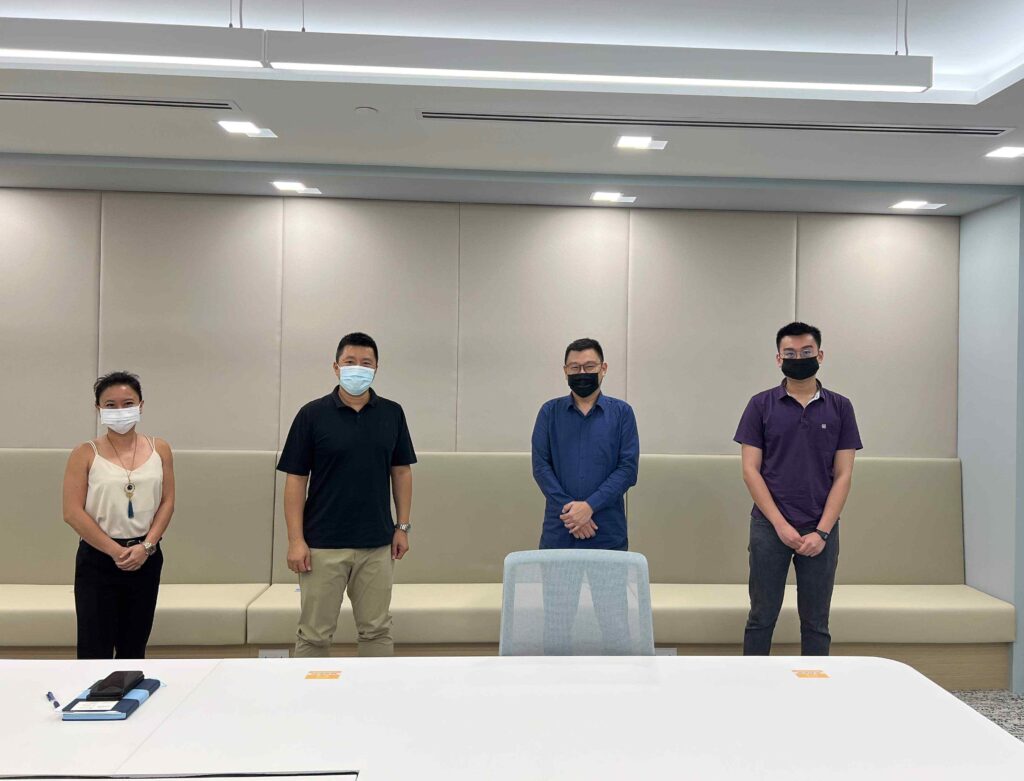
During my visit to ESR Bizpark @ Changi, on behalf of investors, in an interview with Mr Adrian Chui and Ms Charlane-Jayne Chang (Head of Capital Markets and Investor Relations), I asked several questions regarding the proposed merger with ARA LOGOS Logistics Trust, ESR-LOGOS REIT’s future strategy, and what to expect moving forward.


Kenny: Is the ESR REIT – ARA LOGOS Logistics Trust merger dependent on ESR’s successful acquisition of ARA Asset Management?

Adrian: Yes the merger is conditional on that. If ESR’s acquisition of ARA Asset Management (including LOGOS) does not go through, the REIT merger will not go through. Before the announcement of ESR’s acquisition of ARA Asset Management, both parties (ESR Cayman and LOGOS) have their own property pipelines from our respective Sponsors. The REIT merger will also remove conflicts of interest when ESR acquires ARA Asset Management as the enlarged ESR-LOGOS REIT will trade as 1 enlarged REIT with access to enlarged ESR Cayman’s pipeline of assets and tenant base.


Kenny: The new banking facilities have a lower weighted average “all-in” finance cost of 2.25% per annum. Have you considered ‘green bonds’, that have an even lower finance cost?

Adrian: Yes – we are keen to look at green bonds and/or sustainable loans as we embark on our ESG offerings as an enlarged ESR-LOGOS REIT. Post-merger we will review our ESG offerings, plan and then roll out our ESG offerings. It is necessary to align both REIT’s ESG plans, before embarking on further green initiatives. Green loans and/or bonds will be part of our capital structure going forward.


Kenny: After the ARA LOGOS Logistics Trust merger, what will be ESR-LOGOS REIT’s strategy moving forward, in terms of property pipeline? The current portfolio of properties is Singapore and Australia centric.

Adrian: We will look to follow the footprint of our Sponsor, ESR Cayman. They have properties in Singapore, China, Japan, Australia, India and Korea. Freehold and/or longer land lease assets will be the focus of our growth strategy in order to address the short underlying land lease of Singapore industrial properties. As such, overseas expansion will pick up with Australia, Japan and possibly China as the key overseas markets. These are countries where ESR Cayman has a long established footprint and full real estate value chain with Australia & Japan being developed countries. As REITs should primarily consist of stabilised assets, the properties have to be in countries where there is rule of law, and money can flow in and out easily. Our Sponsor’s assets in Japan are also relatively new and freehold.

Kenny: Also Japan’s cost of debt is very low. For example ParkwayLife REIT at ~0.6% average cost of debt.


“Overall, we are quite excited for the future. Wherever we invest is going to be in the jurisdiction in which ESR Group has a presence in.”


Kenny: I also see that ESR Group have a share in Cromwell. Does this mean anything?

Adrian: Nope. Different jurisdictions. Our focus will be on APAC.


Kenny: Judging by your responses, despite ESR being a major shareholder in Sabana REIT and also AIMS APAC REIT, I don’t think you’ll be interested in acquiring these two REITS already.

Adrian: In terms of acquiring properties, we would be focusing on our Sponsor’s pipeline of assets. For example, Sponsor has some assets in Japan which we can easily acquire.

Also, as a REIT CEO, when we look at every investment, we look at how it will benefit the REIT. A fundamental issue for ESR-REIT now is that most of our assets are in Singapore, where land leases are short, which means that our yield is relatively higher at about 6% as an equity risk premium is required for short land leasehold assets compared to freehold. As our Sponsor’s asset pipeline consists of freehold and longer land lease assets, this is more valuable to us. Post-merger, with a larger asset base, lower cost and wider access to funding, we can do more and faster.

Kenny: Because your NAV will drop over the years.

Adrian: Exactly. If Singapore industrial assets are also freehold, our yield will be lower than 6%. Now that the REIT will be bigger (S$5.4b total assets), we are in NAREIT Global Index, and we have visible and executable pipeline of assets from our Sponsor with longer land leases, that should be the direction moving forward, acquiring properties with longer land leases, so that the NAV won’t constantly keep dropping. Previously, when our total asset size was smaller, buying a portfolio of properties (such as Sabana REIT acquisition) to help us get into NAREIT would be quite sensible. Now we are already a NAREIT-indexed REIT.

In terms of growing, every year since we became ESR REIT, we generally acquire assets, at about 15-20% of our then portfolio size. This excludes merger years which are one-off.


“Our philoshophy is that whenever you want to perform an acquisition, you must be able to digest (and manage it).”


Kenny: Last question: Do you personally have a target on how big your market cap should be, or Sponsor tells you to meet this target? For strategic reasons.

Adrian: The answer from the Sponsor is always ‘as big as sensibly possible’. For me, I look at a practical point of view on what I believe the market can accept in terms of size and risk. We also take into account other factors such as resources (you need people to do the work and due diligence properly). Post-merger, with a larger asset base, lower costs of funding, wider access to capital and looking at my Sponsor’s asset pipeline, $800m to $1 billion per annum of acquisitions in the next 3 years is plausible.

Charlene: I think importantly, with our track record we have been very disciplined with the way acquisitions are done, it has been done in a properly staged and “digestible” size which are value-accretive to unitholders.

Adrian: We are quite aware that once you make one wrong move, that’s it. Our philoshophy is that when you want to acquire, you must be able to digest (and manage it). One recent example would be the recent acquisitions of 46 Tanjong Penjuru and 10% investment in ESR Logistics Partnership (“EALP”) which is accompanied by a manageable c.S$149.6mil Equity Fund Raising exercise (consisting of a c.$100mil Placement Tranche and c.$50m Pref Offer tranche for our existing unitholders) which was 3.6 times subscribed (Editors note: Read more about it here). We cannot just ‘gobble’ up on assets for growth sake without considering execution and funding risk. We want to make sure our team is able to manage the assets that we acquire also, making sure it is within our comfort zone and risk appetite.

Kenny Loh is a Senior Financial Advisory Manager and REITs Specialist of Singapore’s top Independent Financial Advisor. He helps clients construct diversified portfolios consisting of different asset classes from REITs, Equities, Bonds, ETFs, Unit Trusts, Private Equity, Alternative Investments, Digital Assets and Fixed Maturity Funds to achieve an optimal risk adjusted return. Kenny is also a CERTIFIED FINANCIAL PLANNER, SGX Academy REIT Trainer, Certified IBF Trainer of Associate REIT Investment Advisor (ARIA) and also invited speaker of REITs Symposium and Invest Fair.  You can join my Telegram channel #REITirement – SREIT Singapore REIT Market Update and Retirement related news. https://t.me/REITirement


Continue ReadingExclusive Insights: Interview with ESR REIT CEO, Mr Adrian Chui

Travel Insurance during COVID-19: Which should you get? (VTL)

  • Post author:

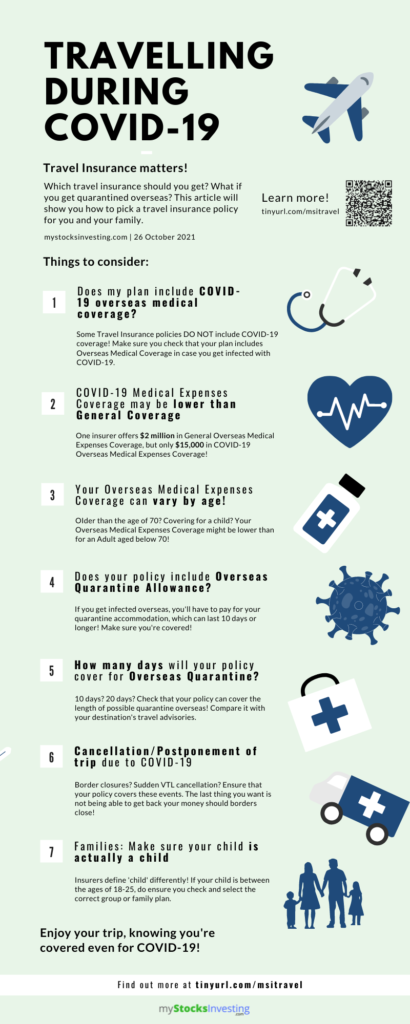
With the opening of Singapore’s borders, and the expansion of the Vaccinated Travel Lane scheme to 11 countries, more Singaporeans are looking forward to travel. But comparing to the pre-pandemic era, there are many more considerations to take into account. The largest one being COVID-19 Travel Insurance Coverage. This article will discuss the many options available, and the many things to look out for.


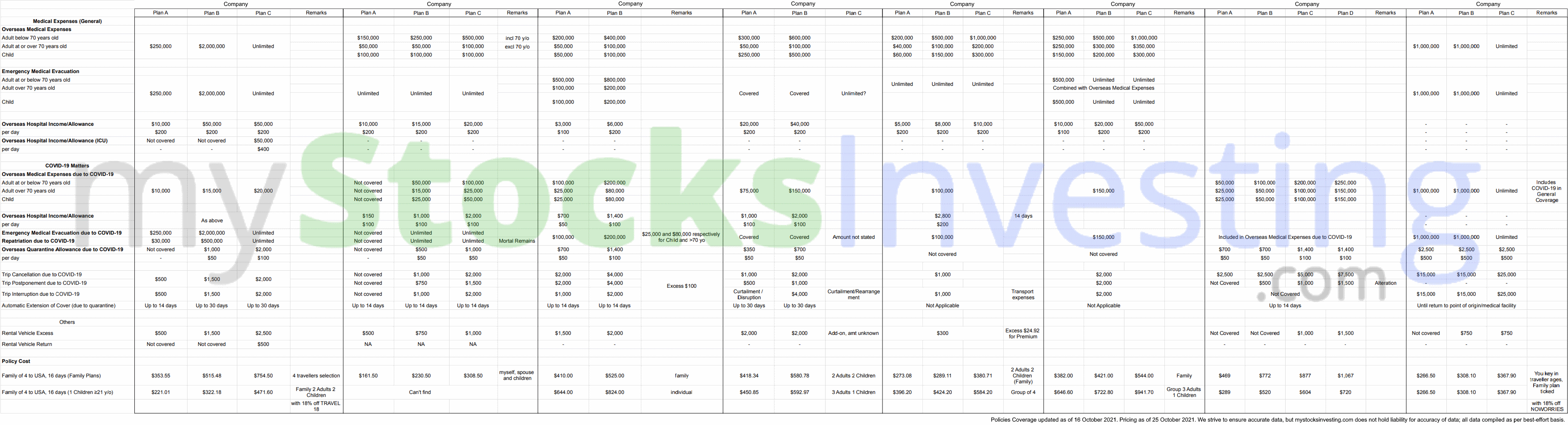
Overview of Plans: Table of Policies


The following table details the many plans on offer, from 8 different insurers. Only Travel Insurance policies that are offering plans with COVID-19 coverage are shown below.

An example of a Family of 4 planning a 16-day trip to the United States of America is shown below.


Travel Insurance policies, with COVID-19 coverage.


This comparison table includes each travel insurance policy for 8 different insurance companies. There are significant differences between them, so you should keep a look out for them. If you are really unsure on which would be the best single trip insurance during this era of COVID-19 travel, do look for me to discuss on which plan suits you and your family the best.


1. Some Travel Insurance policies DO NOT include COVID-19 coverage!


If you are looking for a travel insurance plan during this pandemic, take note of this! Below is an example of a travel insurance plan that does not have COVID-19 coverage.

Some policies do not have COVID-19 coverage.

Meaning if you do get COVID-19 abroad, you will NOT be covered! Be sure to look at each policy in-depth, and read the fine print.


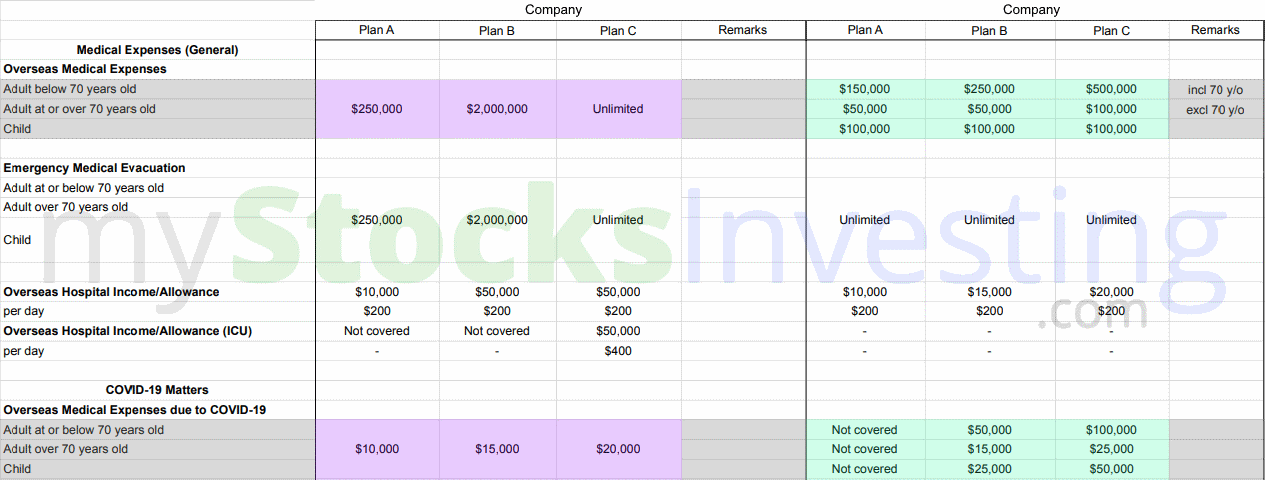
2. Overseas Medical Expenses Coverage ≠ COVID-19 Overseas Medical Expenses Coverage


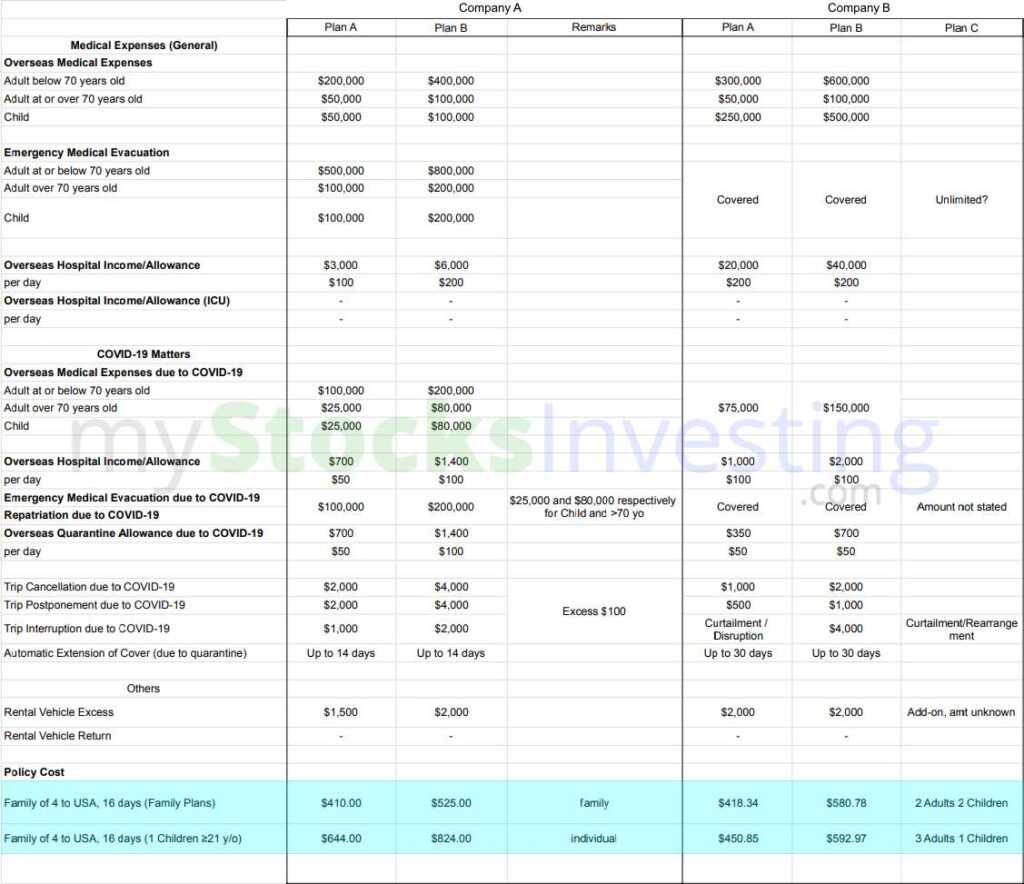
Look closely at these 2 companies’ travel insurance policy. The following image will show that the coverage for non-COVID medical expenses and COVID-related medical expenses are vastly different.


Example of travel insurance policies of 2 companies, and their plans.

Let’s say you subscribe to Plan B in the first example. If you incur Overseas Medical Expenses due to COVID-19, instead of $2,000,000 in coverage, your coverage will only actually be $15,000. Is $15,000 coverage in Overseas Medical Expenses really enough?

In the second example, subscribing to Plan A will not cover you for any COVID-19 related medical expenses. This reinforces the first point where some policies do not include COVID-19 related medical expenses. 

These differences in COVID-related and non-COVID related coverages also apply other aspects such as Emergency Medical Evacuation, Repatriation and Trip Cancellation.


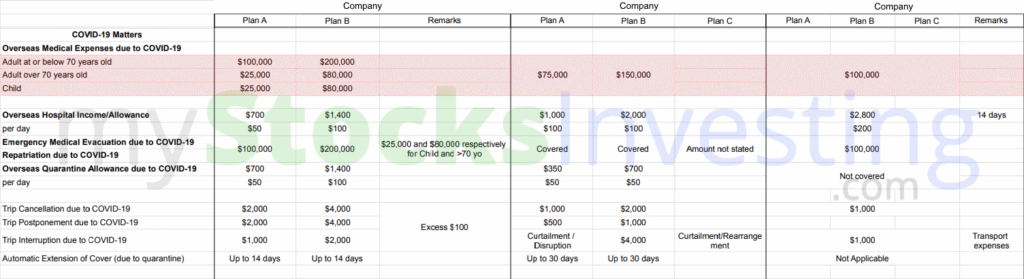
3. COVID-19 Medical Expenses Coverage can vary by age


Depending on your age, coverage for COVID-19 related Overseas Medical Expenses can vary from plan to plan. Differences are highlighted in red. In the example below, some policies offer lesser coverage for Children and/or Adults aged >70 then Adults aged <70 (Company A’s plans), while some offer the same coverage, regardless of age. (Company B and C’s plans) Ensure that the policy you choose to purchase suits your needs. 


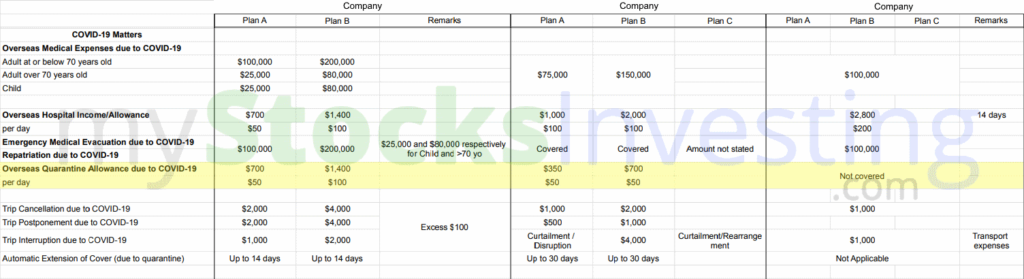
4. Does your policy include Overseas Quarantine Allowance?


If you test positive for COVID-19 prior to your departure for your return flight, chances are you will not be allowed to board the flight back to Singapore. (Highlighted in yellow below) In that case, you will be subject to overseas quarantine, whether it be at a hospital, a government facility, or remaining at your place of residence. For example, in the United States, you are to isolate for at least 10 days.


You will not be allowed to travel back to Singapore for 14 days if you test positive on your pre-departure COVID-19 test.

The cost of quarantine isn’t small. For example, in the USA, one night of accomodation in Los Angeles can cost upwards of $200 per night per room/apartment. Multiply that by 14 days, and that will set you back more than $2,800.

Some travel insurance polices include Quarantine Allowance, while some do not!

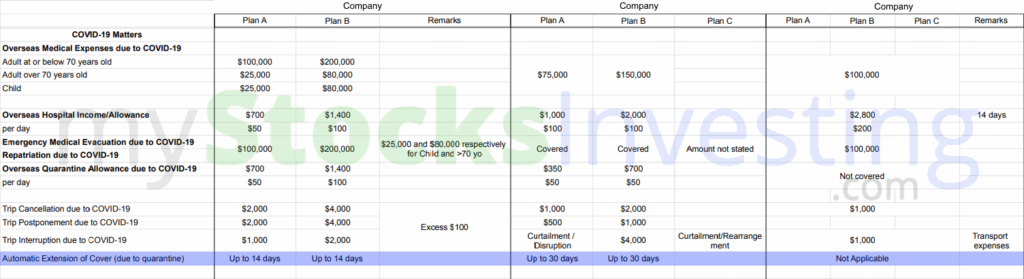
Highlighted in yellow is the Quarantine Allowance due to COVID-19. First row shows total coverage, while the second row shows the coverage per day. Note that depending on the cost of accomodation in your chosen country, it may not cover the cost of quarantine completely. $100 per day can help soften the blow to your finances should you be subject to overseas quarantine.

If you subscribe to the third insurer’s plan in this example, you will not have any COVID-19 quarantine allowance should you be subject to quarantine and isolation overseas! Be sure to check if your policy will cushion the financial repurcussions of testing positive for COVID-19 overseas. 


5. How many days will your policy cover for Overseas Quarantine?


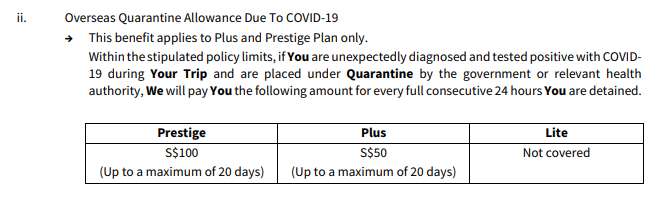
Most policies offer Automatic Extension of Cover, due to quarantine. Do read the policies in detail! Different companies offer different lengths of automatic extension. For example, this is a snapshot of a policy taken from one of the plans. This policy offers up to 20 days of coverage due to overseas quarantine. Meaning if you have to quarantine >20 days due to COVID-19, you won”t be covered after 20 days.


This policy offers up to 20 days of coverage due to overseas quarantine.


Below is a comparison table of the number of days each policy covers for quarantine length. One good way to check if your policy’s maximum quarantine allowance length is enough, is to check your chosen countries’ health advisories’ COVID-19 quarantine/isolation length.


Comparison of Automatic Extension of Cover (in days)


Different policies offer different additional lengths of quarantine coverage. (See highlight in blue) Do look through each policy to see if it fits your needs.


6. Will your policy cover cancellation/postponement/interruption of your trip due to COVID-19 related issues?


Border closures? Sudden VTL cancellation? Ensure that your policy covers these events. The last thing you want is any of these events happening, and not being able to get back your money.


Comparison of Trip Cancellation/Postponement/Interruption coverage due to COVID-19 related issues


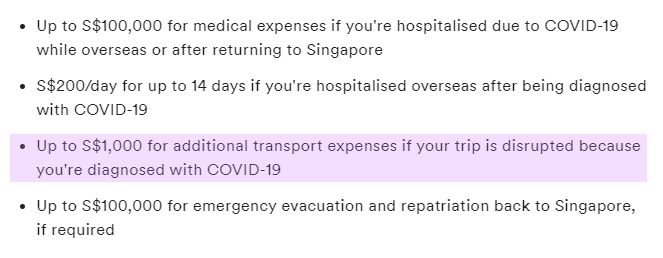
Highlighted in green are the trip cancellation/postponement/interruption policy differences. Do study each policy differently, as each policy’s fine print is different. For example, Company C’s Trip Interruption has coverage for $1,000 in additional transport expenses. (Highlighted in purple)


7. (For families) Check whether your child is actually a child!


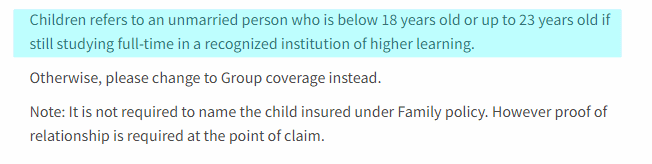
According to the insurer, is your child really a child? In a sense, this depends from insurer to insurer. If your child does not fit the criteria of being a child, use the “group” option while purchasing your insurance plan, not the families option. This is to prevent complications, in case you need to perform a claim. Which in the COVID-19 era, is more common due to the possbility of getting quarantined overseas.


An example of an insurer’s definition of children

Some insurers charge about the same, regardless of whether you select the “group” option (if your child does not fit the definition of a child) or the “family” option. Some insurers charge a lot more, simply because your child is one year too old (e.g 22 years old instead of 21). 

If your child is between the ages of 18-25, depending on the insurer, one might classify them as a child while another might not. Be sure to compare insurance plans according to the insurer’s definition of your children.


Highlighted in blue is an example. Policy costs alone, Company B does not charge you a lot more if you select a “group” plan instead of a “family” plan. Company A’s family plans are more affordable as a family, but if your child is not a child (according to definition), the price is increased by a considerable amount.

Still lost? Do look for me to discuss on which travel insurance plan suits you and your family the best! We need to factor in all the possibilities caused by COVID-19 during this period.


Kenny Loh is a Senior Financial Advisory Manager and REITs Specialist of Singapore’s top Independent Financial Advisor. He helps clients construct diversified portfolios consisting of different asset classes from REITs, Equities, Bonds, ETFs, Unit Trusts, Private Equity, Alternative Investments, Digital Assets and Fixed Maturity Funds to achieve an optimal risk adjusted return. Kenny is also a CERTIFIED FINANCIAL PLANNER, SGX Academy REIT Trainer, Certified IBF Trainer of Associate REIT Investment Advisor (ARIA) and also invited speaker of REITs Symposium and Invest Fair.  You can join my Telegram channel #REITirement – SREIT Singapore REIT Market Update and Retirement related news. https://t.me/REITirement
Continue ReadingTravel Insurance during COVID-19: Which should you get? (VTL)