ARA US Hospitality Trust IPO Prospectus & Summary

  • Post author:

ARA US Hospitality Trust

ARA US Hospitality Trust is a hospitality stapled group comprising ARA H-REIT, a real estate
investment trust constituted in Singapore, and ARA H-BT, a registered business trust (“BT”)
constituted in Singapore. ARA H-REIT is established with the principal investment strategy of
investing primarily, directly or indirectly, in a portfolio of income-producing real estate which is
used primarily for hospitality and/or hospitality-related purposes, located in the U.S., as well as
real estate-related assets in connection with the foregoing. On the other hand, ARA H-BT is
established with the principal investment strategy of investing in a portfolio of real estate primarily
used for hospitality and/or hospitality-related purposes, located in the U.S., as well as real
estate-related assets in connection with the foregoing, and to carry on the business of managing
and operating real estate used primarily for hospitality and/or hospitality-related purposes, located
in the U.S. The Managers presently intend for ARA H-REIT to hold income-producing real estate
while ARA H-BT will be the master-lessee and manage and operate these assets.

Related News

https://www.channelnewsasia.com/news/business/ara-us-hospitality-trust-seeks-to-raise-us-451-million-in-11497244

  • Type = US Hospitality Sector
  • Sponsor = ARA Asset Management (Own 9.5% of ARA US Hospitality Trust)
  • Total Unit Offered = 379,776,300
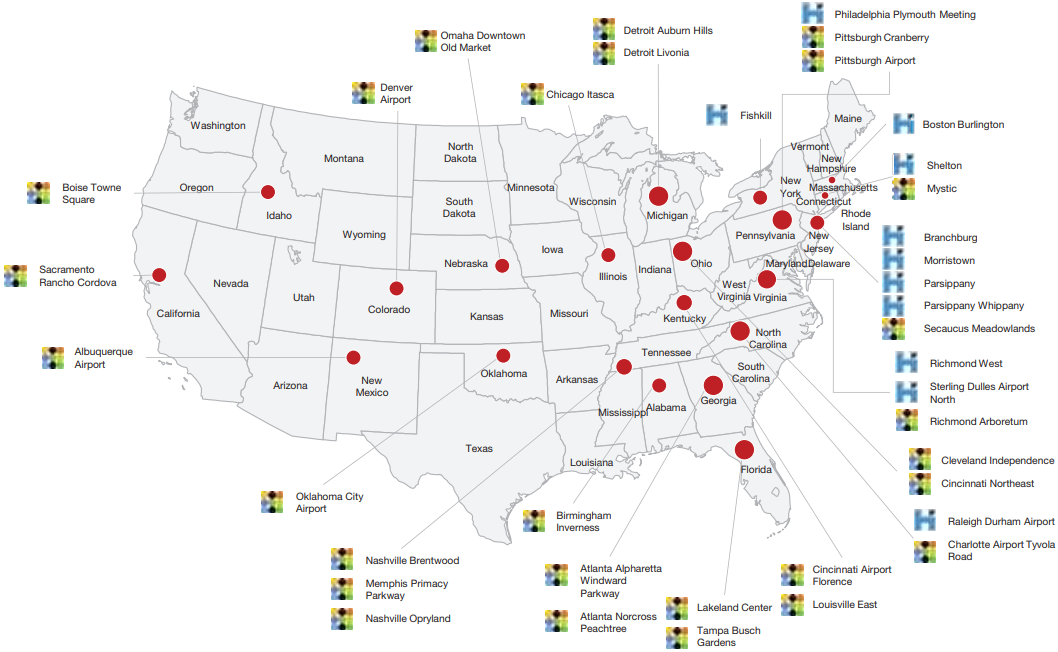
  • Portfolio = 38 Hotel in US (across 21 states, 4950 rooms)
  • Portfolio Size = US$719.5. Million
  • Market Capitalisation = US$749.1 Million
  • IPO Offer Price = US$0.88
  • NAV per unit = US$0.86
  • Price / NAV = 1.023
  • Distribution Yield = 8.0% (2019), 8.2% (2020)
  • Distribution Policy = 100% for 2019. 90% for 2020. Semi Annual Payout.
  • Gearing Ratio = 35.9% (calculated value from balance sheet)
  • Plan Listing: May 9, 2019

See ARA US Hospitality Trust IPO Prospectus here.


Compare to other Singapore REITs here.

Continue ReadingARA US Hospitality Trust IPO Prospectus & Summary

Singapore REIT Fundamental Analysis Comparison Table – 5 May 2019

  • Post author:

Technical Analysis of FTSE ST REIT Index (FSTAS8670)

FTSE ST Real Estate Investment Trusts (FTSE ST REIT Index) continued the bullish rally raising from 866.27 to 869.49 (+0.37%) as compared to last post on Singapore REIT Fundamental Comparison Table on April 1, 2019.

The REIT index continues to trade upward in the uptrend and currently getting very near to the immediate resistance of 875 (the previous high in 2018) after the recent minor correction which was supported by the 50D SMA.  Based on the current chart pattern and and momentum,  the sentiment is BULLISH and the trend for Singapore REIT direction is UP. All eyes will be focusing on whether the REIT index can break the 2018 high (875) and 2013 high (892) back in May 2013. We shall see whether the following fundamental REIT data to support the technical bull run.


Fundamental Analysis of 39 Singapore REITs

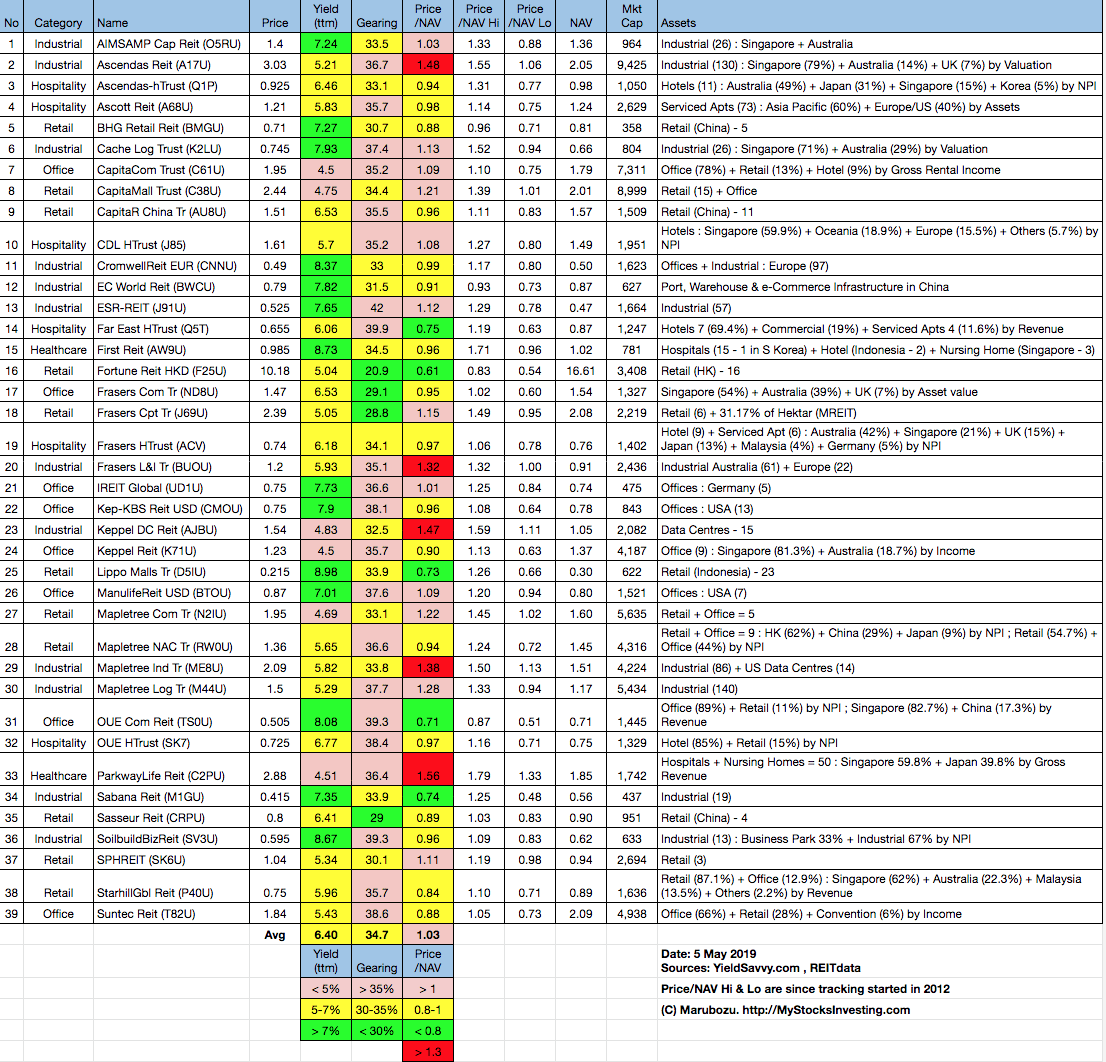
The following is the compilation of 39 REITs in Singapore with colour coding of the Distribution Yield, Gearing Ratio and Price to NAV Ratio. This gives investors a quick glance of which REITs are attractive enough to have an in-depth analysis. There are currently 39 REITs in Singapore after VIVA Industrial Trust merged into ESR REIT.

  • Price/NAV stays at 1.03 (Singapore Overall REIT sector is slightly over value now).
  • Distribution Yield decreases from 6.47% to 6.40% (take note that this is lagging number). About 35.9% of Singapore REITs (14 out of 39) have Distribution Yield > 7%.
  • Gearing Ratio stays at 34.7%.  21 out of 39 have Gearing Ratio more than 35%. In general, Singapore REITs sector gearing ratio is healthy. Note: The limit of gearing ratio for REITs listed in Singapore Stock Exchange is 45%.
  • The most overvalue REIT is Parkway Life (Price/NAV = 1.56), followed by Ascendas REIT (Price/NAV = 1.48), Keppel DC REIT (Price/NAV = 1.47), Mapletree Industrial Trust (Price/NAV = 1.38) and Frasers Logistics & Industrial Trust (Price/NAV = 1.32).
  • The most undervalue (base on NAV) is Fortune REIT (Price/NAV = 0.61), followed by OUE Comm REIT (Price/NAV = 0.71), Lippo Mall Indonesia Retail Trust (Price/NAV = 0.73), Sabana REIT (Price/NAV = 0.74) and Far East Hospitality Trust (Price/NAV = 0.75).
  • The Highest Distribution Yield (TTM) is Lippo Mall Indonesia Retail Trust (8.98%), followed by First REIT (8.73%), SoilBuild BizREIT (8.67%),  Cromwell European REIT (8.37%) and OUE Com REIT (8.08%).
  • The Highest Gearing Ratio are ESR REIT (42.0%), Far East HTrust (39.9%) and OUE Comm REIT (39.3%) and SoilBuild BizREIT  (39.3%)
  • Top 5 REITs with biggest market capitalisation are Ascendas REIT ($9.4B), CapitaMall Trust ($9.0B), Capitaland Commercial Trust ($7.3B), Mapletree Commercial Trust ($5.6B) and Mapletree Logistic Trust ($5.4B)
  • The bottom 3 REITs with smallest market capitalisation are BHG Retail REIT ($358M), Sabana REIT ($437M) and iREIT Global REIT ($475M)

Disclaimer: The above table is best used for “screening and shortlisting only”. It is NOT for investing (Buy / Sell) decision. To learn how to use the table and make investing decision, Sign up next REIT Investing Seminar here to learn how to choose a fundamentally strong REIT for long term investing for passive income generation.


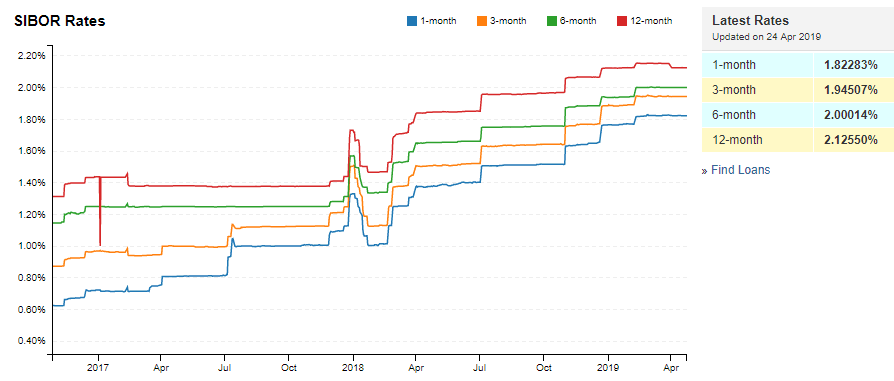
  • 1 month decreases from 1.82608% to 1.82283%
  • 3 month increases from 1.94405% to 1.94507%
  • 6 month decreases from 2.00034% to 2.00014%
  • 12 month decreases from 2.15188% to 2.12550%

Based on current probability of Fed Rate Monitor, the US Fed Reserve may keep the interest rate at 2.50% in 2019. There is no rate hike in 2019 at the moment.

Summary

Fundamentally the whole Singapore REITs is slightly over value now. The big cap REITs are getting expensive and the distribution yield are not so attractive currently. The yield spread between big cap and small cap REIT remains wide. This indicates value picks only in small and medium cap REITs.  For reference, 10-years risk free yield rate for latest Singapore Saving Bonds is 2.13%.

Yield spread (reference to 10 year Singapore government bond of 2.253%) has tightened from to 4.39% to 4.15%.  DPU yield for a number of small and mid-cap REITs are still very attractive  (>8%) at the moment.  It is expected the next move would be on small and medium size REITs due to higher risk premium compared to big cap REITs.

Technically, the REIT index is trading in a bullish uptrend but we need to see whether the index can break the resistance (875 and 892) to move higher. Current bullish trend in Singapore REIT index has priced in “no further rate hike” in 2019.

If you are REIT investors, it is strongly recommended to attend the coming Singapore REITs Symposium on May 18. First 30 signups via promo code (msinvesting) will be entitled to a mystery gift and it’s redeemable on ground at ShareInvestor’s booth. Click the REITs Symposium here to register.

http://www.reitsymposium.com/index.html


http://www.reitsymposium.com/index.html


http://www.reitsymposium.com/index.html

See Program Highlights of the coming REITs Sympsosium here.

Relevant posts:

If you need an independent professional review on your current REIT portfolio and need any recommendation, you may engage me in the REIT portfolio Advisory. REITs Portfolio Advisory.  https://mystocksinvesting.com/course/private-portfolio-review/


Continue ReadingSingapore REIT Fundamental Analysis Comparison Table – 5 May 2019

Build an Emergency Fund: Avoid Financial Disaster

  • Post author:

This article was originally published at HiCharlie.com” – Share with permission.


Life’s usually pretty amazing. But when it throws an emergency at you, can your wallet handle it? According to a recent study by the Urban Institute, nearly 22 percent of adults struggled to cover a $400 unexpected expense. Folks ages 18-34 were hit the hardest and were more prone to using risky, high-interest means like payday loans to make ends meet, resulting in greater financial stress.

To avoid facing the same fate, you need to build and maintain a healthy emergency fund. What’s that? It’s a pool of money that’s only gets used when life throws you a major curveball. That way, when your car breaks down, your pet gets sick, or you lose your job, you’ll have the cash stashed away to deal with it sans taking on more debt.

Follow the steps below and you’ll be well on your way to dealing with the unexpected with ease.

Determine Your Needs

Since everyone’s situation is different, there is no hard and fast rule about how much you need to have in your emergency fund. However, the collective personal finance mind says that you should strive to save 3-6 months of living expenses. If you’re the breadwinner for your family or your income fluctuates, it doesn’t hurt to pad that number a bit.

To gauge your essential monthly expenses, take a look at your budget (or create one) and add up all of your must-haves like shelter, food, transportation, utilities, medicine, minimum debt payments, etc.

Remember, since some of your expenses can vary month to month, be sure to give yourself some wiggle room. Next, multiply your monthly budget by the number of months that you want to cover. The total is your emergency fund savings goal.

Tip: If you want some extra help, check out this emergency fund calculator, or this one.

Open an Account

Your emergency fund should have its own account that you can tap into when needed, but that you won’t see or touch regularly. This will make it tougher to spend the money on other, less dire situations. And, although it may be tempting, avoid putting the funds into risky investments like stocks because you could lose money if the market declines. To get the best results, consider putting this cash into a money market account or a high-yield savings account. It will be safe, separate from your day to day finances, and will actually grow a little due to interest.

Stockpile the Cash

The first two steps are quick and easy to complete. However, depending on your needs and your means, you could be in this phase for the long haul. Saving thousands (maybe even tens of thousands) of dollars is a daunting prospect.

Don’t be discouraged! Start small and initially aim to get a few hundred in the bank. Then, work your way up and celebrate each milestone. What you’re doing isn’t easy. But when life inevitably throws a tantrum, it will be worth it.

Here are several ways that you can expedite the stockpiling process:

  • Cut expenses and bank the savings. Tight budget? Check out these tips.
  • Automate your savings. Set up a regular transfer from your checking account to your emergency fund.
  • Earn more cash. Think about starting a side hustle, working overtime, or selling your unused stuff.
  • Put windfalls to good use. Gifts, bonuses, and tax refunds can make your emergency fund balance soar.

Remember: Don’t stick your hand in the cookie jar unless it’s a true emergency. (Getting a last minute invite to go on a cruise doesn’t count!)

Tip: While building an emergency fund needs to be a priority, it’s OK to juggle more than one financial goal. For example, if you have high-interest credit card debt, it’s a good idea to get that paid off ASAP. It’s important to find the right mix of saving and debt pay off for your situation.

Move on to the Next

While congratulations are in order, you can’t sit on your laurels for too long. You’re in a great position to ramp up (or start) saving for retirement, put money aside for planned home repairs or upgrades, or open an account to fund the vacation of your dreams. You can also put more money toward your mortgage, student loans, or other debts. Of course, if you take money from the emergency fund, you should replenish it as soon as possible.

Conclusion

Building a solid emergency fund doesn’t happen overnight. Just like with retirement, it takes discipline and patience to save a large amount of money for “someday.” But — having that well-inflated cushion will allow you to rest easy and fully focus on living your best life. If you’re having trouble maintaining discipline and motivation, speaking with a licensed therapist (like those at BetterHelp) can help.

Tell Charlie: What are your favorite hacks for building an emergency fund?

Please note: We don’t have an affiliation with or personally endorse any of the services linked to in this post. We’re just trying to give you some ideas.


Continue ReadingBuild an Emergency Fund: Avoid Financial Disaster