SME Succession Planning: The 90-Day Danger Zone That Can Destroy Your Business

  • Post author:

As an SME owner, you’ve spent years—perhaps decades—building your business from the ground up. You’ve weathered market shifts, hiring challenges, and economic crashes. But there is one risk that most founders keep on the back burner, even though it’s the single biggest threat to their legacy: Business Succession Planning.

A recent article in The Business Times highlighted a sobering reality that I see far too often in my work as a legacy and estate planner: When a founder delays succession planning, the business doesn’t just stall—it bleeds value.

If you aren’t there tomorrow, what happens to your business in the first 90 days? That window usually decides whether your company survives for the next generation or becomes a cautionary tale.

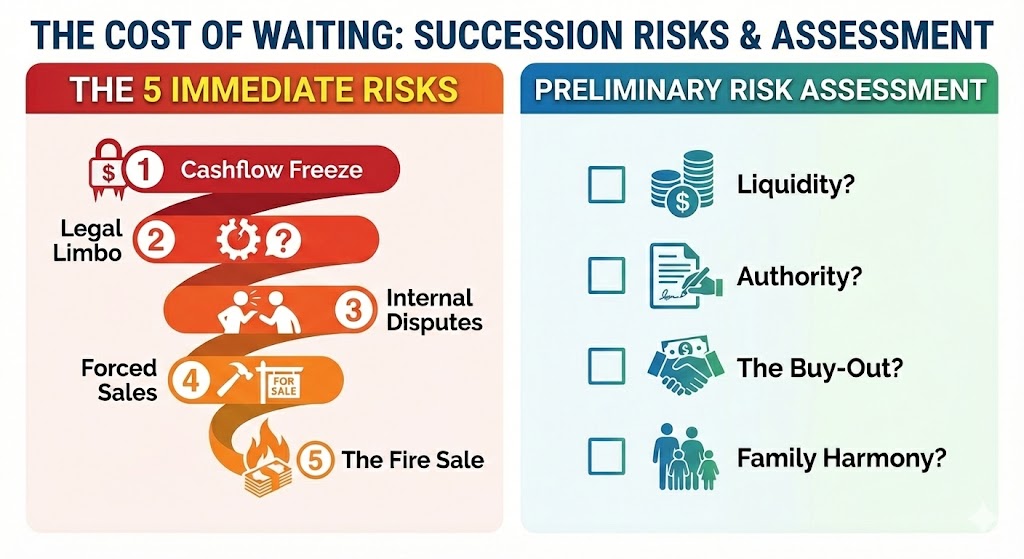
The 5 Immediate Risks of “Waiting Until Later”

When a founder passes away or becomes incapacitated without a structured plan, five things tend to happen simultaneously, creating a “perfect storm” for the business:

  • The Cashflow Freeze: Shares and personal assets often get locked in probate for months. While your accounts are frozen, your obligations aren’t. Payroll, suppliers, and bank loans remain due. Many businesses simply don’t have the liquidity to survive this window.
  • Operational Legal Limbo: Without a clear successor or legal authority, the “engine room” stops. Bank mandates stall, new contracts can’t be signed, and existing clients may hesitate to renew, fearing the business is unstable.
  • Internal Disputes: In the absence of a written roadmap, even the most tight-knit families and business partners can fall into conflict. When no one knows the “right” way forward, decision-making becomes paralyzed.
  • Forced Sales and Control Loss: If surviving partners want to keep the business but can’t afford to buy out your deceased estate’s stake, they may be forced to bring in external buyers. This leads to “value leakage” and a loss of the original vision.
  • The Fire Sale: Without trusts or structured liquidity, a lifetime of work is often liquidated at a fraction of its true worth just to cover taxes or immediate debts.

How We Replace Chaos with Structure

My role as a Business Succession and Legacy Planner is to ensure that your business is an “evergreen” asset—one that can thrive independently of your day-to-day presence. We achieve this by addressing each risk factor with a concrete, legal, and financial solution.

To combat Asset Freezes, we establish immediate liquidity strategies—often through specialized insurance or business trusts—to ensure payroll and bills are met from Day 1. To solve Legal Limbo, we create clear governance frameworks and Power of Attorney structures so authority is transferred instantly and legally, keeping operations seamless.

When it comes to Partner Conflict, I facilitate and draft funded Buy-Sell Agreements. This ensures surviving partners have the immediate cash to buy out shares at a fair, pre-agreed price, preventing messy disputes. Finally, to prevent Legacy Erosion, we use trusts and estate structuring to ensure your family is provided for financially without the business needing to be dismantled or sold off to pay them out.


Preliminary Succession Risk Assessment

Are you prepared? Take a moment to answer these four questions honestly. If you answer “No” or “I’m not sure” to any of them, your business is currently at risk.

  1. Liquidity: If you passed away tomorrow, does the business have a dedicated source of cash (separate from frozen bank accounts) to pay staff and suppliers for at least 3 to 6 months?
  2. Authority: Is there a legal document currently in place that grants a specific person the immediate right to sign contracts and manage bank accounts in your absence?
  3. The Buy-Out: If you have business partners, is there a legally binding agreement—and a dedicated fund—to buy out your shares so your family gets the cash and the partners keep the business?
  4. Family Harmony: Have you sat down with your heirs and partners to document exactly who will lead and who will own the shares, or is it “assumed” everyone will just figure it out?
Secure Your Legacy Today

Business succession planning isn’t about “leaving” your business; it’s about strengthening it. It’s about ensuring that the values, culture, and financial success you’ve built can endure for decades to come.

Don’t leave your life’s work to chance or the slow grind of the probate courts. I specialize in helping SME owners navigate these complex emotional and financial waters to create a bulletproof estate and succession strategy.

Important: The information and opinions in this article are for general information purposes only. They should not be relied on as professional financial advice. Readers should seek unbiased financial advice that is customised to their specific financial objectives, situations & needs. This advertisement or publication has not been reviewed by the Monetary Authority of Singapore.

Kenny Loh is a distinguished Wealth Advisory Director with a specialization in holistic investment planning and estate management. He excels in assisting clients to grow their investment capital and establish passive income streams for retirement. Kenny also facilitates tax-efficient portfolio transfers to beneficiaries, ensuring tax-efficient capital appreciation through risk mitigation approaches and optimized wealth transfer through strategic asset structuring.

In addition to his advisory role, Kenny is an esteemed SGX Academy trainer specializing in S-REIT investing and regularly shares his insights on MoneyFM 89.3. He holds the titles of Certified Estate & Legacy Planning Consultant and CERTIFIED FINANCIAL PLANNER (CFP).

With over a decade of experience in holistic estate planning, Kenny employs a unique “3-in-1 Will, LPA, and Standby Trust” solution to address clients’ social considerations, legal obligations, emotional needs, and family harmony. He holds double master’s degrees in Business Administration and Electrical Engineering, and is an Associate Estate Planning Practitioner (AEPP), a designation jointly awarded by The Society of Will Writers & Estate Planning Practitioners (SWWEPP) of the United Kingdom and Estate Planning Practitioner Limited (EPPL), the accreditation body for Asia.

If you need any financial advice, please contact kennyloh@fapl.sg

罗国强(Kenny Loh) 是一位杰出的财富咨询总监,专长于综合投资规划与遗产管理。他擅长协助客户实现投资资本增值,并建立退休被动收入来源。同时,他通过税务优化的方式帮助客户将投资组合高效转移给受益人,运用风险缓释策略确保资本增值的税务效率,并通过战略性资产配置实现财富传承的最优化。

除咨询工作外,罗国强是新加坡交易所学院(SGX Academy)的特聘讲师,专注于新加坡房地产投资信托(S-REIT)投资领域,并定期在MoneyFM 89.3电台分享专业见解。他拥有认证遗产与传承规划顾问(Certified Estate & Legacy Planning Consultant)及国际认证财务规划师(CFP)资格。

在逾十年的综合遗产规划经验中,他独创“遗嘱、持久授权书与备用信托三合一”解决方案,兼顾客户的社会责任、法律义务、情感需求及家庭和谐。他持有工商管理硕士与电气工程硕士双学位,并获英国遗嘱撰写及遗产规划从业者协会(SWWEPP)与亚洲认证机构遗产规划从业者有限公司(EPPL)联合授予副遗产规划从业师(AEPP)专业资格。

Arrange for a non-obligatory one-to-one free consultation here!

立即预约免费一对一咨询(无需承担任何义务)!

Continue ReadingSME Succession Planning: The 90-Day Danger Zone That Can Destroy Your Business

The Art of Nominations – Leaving a Legacy, Not a Lawsuit

  • Post author:


Empowering estate planning: wills, trusts, LPA, CPF nomination, scam risks & legacy protection—clarity meets action.

Seminar Synopsis:

As Singapore’s population ages and personal asset portfolios grow more complex, timely and comprehensive estate planning has never been more critical. This seminar aims to raise public awareness and empower attendees to take decisive action through a structured Holistic Estate Planning framework—covering key pillars such as Will creation, Trust setup, Lasting Power of Attorney (LPA), and CPF Nomination.

Participants will gain insights into emerging challenges such as financial scams, cognitive decline, tax implications, and fragmented asset ownership. The session will explore how these risks impact estate planning and highlight how Trust structures can offer effective, long-term solutions to safeguard assets and intentions.

A key highlight of the session includes on-the-spot CPF Nomination checking, assistance to make an online nomination and as well witnessing, ensuring attendees leave with actionable progress toward safeguarding their legacy. This seminar is a call to action for responsible, forward-looking estate planning—anchored in clarity, protection, and peace of mind.

Seminar Agenda

  • Navigating Estate Planning in a New Era Overview of emerging challenges and risks in legacy planning
  • CPF Nomination: Dos and Don’ts Key guidelines and common pitfalls to avoid
  • Trust, Will & LPA: Common Nomination Mistakes Clarifying misconceptions and improving structure in estate tools
  • Overview of Estate Planning Services Practical solutions and support for long-term planning
  • CPF Nomination Onsite Facilitation Hands-on assistance and witnessing for CPF nominations


Event Details


  • November 8 (Saturday), 10am – 12:30pm GMT+8.
  • 10 Collyer Quay Singapore, 049315, Ocean Financial Centre
  • Free Admission. Registration is required.
 

Speakers


Mr. Kenny Loh is a Certified Estate Planning Consultant and also a CERTIFIED FINANCIAL PLANNER (CFPTM). Kenny has more than 10 years in Holistic Estate Planning experience, using a unique “3-in-1 Will, LPA and Standby Trust” solution, to address his client’s social consideration, legal obligation, emotional needs and family’s harmony in his approach. Kenny has a double master’s degree in Business Administration and Electrical Engineering, and also an AEPP (Associate Estate Planning Practitioner) jointly awarded by The Society of Will Writers & Estate Planning Practitioners (SWWEPP) of The United Kingdom, in collaboration with Estate Planning Practitioner Limited (EPPL), the accreditation body for Asia.

Mr. Liang Weirong is a Senior Deputy Director in the Central Provident Fund Board. He is passionate in encouraging citizens to make their legacy plans and he is a frequent speaker at public forums and media engagements, including CNA’s Deep Dive podcast, where he offered clarity on complex issues such as CPF nominations and legacy planning. He led his team to roll out the revolutionary online nomination service that allow CPF members to make their nominations conveniently.

Mr Tan Check How has over 18 years of experience in trust and fiduciary services, with a focus on estate and legacy planning. He works closely with clients, advisers, and stakeholders across all wealth tiers to deliver tailored trust solutions. He has supported families throughout Southeast Asia, Greater China, and Europe, and is fluent in English and Chinese.


Mr. Kenny Loh is a Certified Estate Planning Consultant and also a CERTIFIED FINANCIAL PLANNER (CFP). Kenny has more than 10 years in Holistic Estate Planning experience, using a unique “3-in-1 Will, LPA and Standby Trust” solution, to address his client’s social consideration, legal obligation, emotional needs and family’s harmony in his approach. Kenny has Double Master degree in Business Administration and Electrical Engineering, and also an AEPP (Associate Estate Planning Practitioner) jointly awarded by The Society of Will Writers & Estate Planning Practitioners (SWWEPP) of The United Kingdom, in collaboration with Estate Planning Practitioner Limited (EPPL), the accreditation body for Asia.
 
Check out Kenny Loh profile here and also Estate Planning Services.
Continue ReadingThe Art of Nominations – Leaving a Legacy, Not a Lawsuit

Navigating U.S. Estate Tax on U.S. Stock Holdings: A Guide for Singapore Investors

  • Post author:

Introduction

Apple, Nvidia, Tesla, Microsoft, Amazon…… many of us, especially younger investors, are drawn to these US Stocks, known for their stellar performance over the years. The S&P 500 has delivered an average annual return of 10.33% since 1957 (Investopedia). However, did you know that owning these stocks directly as a non-U.S. person (like us) can trigger a significant tax burden upon death? This tax, the U.S. estate tax, can claim up to 40% of the value of your US assets, drastically reducing the wealth passed on to your beneficiaries.

Understanding the US Estate Tax

The US estate tax applies to “US situs” assets owned by non-resident, non-citizen individuals at the time of their death. These assets include shares in companies incorporated in the US, US real estate, certain US-based bonds and mutual funds, and even cash deposits held with US brokers.

Unfortunately, the threshold for exemption is extremely low for non-US persons. Only the first US$60,000 of US situs assets is exempt from tax. Any value above that amount may be subject to estate tax, at rates that can go as high as 40%.

For example, a Singaporean investor with a portfolio of US stocks valued at US$1 million would only receive an exemption of US$60,000. The remaining US$940,000 would be subject to estate tax, potentially resulting in a tax bill of up to US$376,000!

Furthermore, the executor of the estate must file IRS Form 706-NA within nine months of the investor’s death and settle the tax liability to obtain a Federal Transfer Certificate. Without this certificate, US custodians may refuse to release or transfer the deceased’s assets to their beneficiaries.


Estate Planning Strategies to Reduce Exposure

So how can we mitigate this devastating tax burden? Here are 5 strategies that you can possibly execute to do so.

  1. Restructuring your Portfolio

  • Keep direct U.S. stock holdings below US$60,000
  • Increase exposure via non-US ETFs or mutual funds that invest in U.S. markets but are domiciled in Ireland, Luxembourg, or Singapore

These instruments (unit trusts, ETFs, mutual funds etc.), despite investing in US equities, won’t be subjected to the US estate tax as they are not domiciled in the US. For Singaporeans, this could be investing in unit trusts through brokers like Phillip Securities, or ETFs listed on the Singapore Exchange (SGX).

  1. Use an Insurance Wrapper

  • Purchase investment-linked insurance plans (ILPs) that invest in US equities
  • Death benefit proceeds are not classified as US situs assets if structured properly

You can involve an insurance-based investment product, such as investment-linked insurance policies (ILPs). They typically combine investment in global markets with life insurance coverage. So even if there is US stock exposure within the ILP, it should not be subject to US Estate Tax as the asset is not held by the investor personally.

However, you have to ensure that the policyholder and beneficiary structures are clear.

  1. Set Up a Holding Company

  • Hold US stocks via a non-US corporation (e.g. setting a company in Singapore)
  • The company, not the individual, owns the US assets, potentially removing them from the personal estate

But! It may give rise to other tax considerations, such as capital gains tax upon sale of the company’s shares. In addition, it gives rise to additional tax complications depending on jurisdiction. Proper legal and tax advice is essential before implementing this structure.

  1. Create a Trust Structure

  • Transfer U.S. stocks into a foreign irrevocable trust

Trusts can be especially useful to pass down your wealth to future generations. However, trust creation and maintenance involve higher costs and usually require professional management, and the structure must be carefully designed to avoid triggering adverse tax consequences in other jurisdictions.

  1. Cash Creation via Life Insurance

  • Purchase a life insurance policy whose death payout covers the expected U.S. estate tax
  • This ensures liquidity for your estate without forced asset sales

Lastly, you can purchase a life insurance policy with a death benefit sufficient to cover the anticipated estate tax. This ensures that the estate has enough liquidity to settle any tax due without having to sell US investments under pressure or delay asset distribution to beneficiaries.

This may be a good strategy if you already have a large US asset portfolio. However, you need to forecast accurately your estate value and tax liability. Also, unlike some of the other solutions, this still requires you to file tax with the IRS, which is not an easy procedure.

Conclusion

Many of us are either unaware or are indifferent of the complications arising from this US Estate Tax. But it can take away a significant portion of your wealth (up to 40%!) that you can transfer to your future generations. Therefore, it is crucial to mitigate these effects in order to preserve your wealth for your future generations. Failing to plan is planning to fail!

Kenny Loh is a Wealth Advisory Director and REITs Specialist of Singapore’s top Independent Financial Advisor. He helps clients construct diversified portfolios consisting of different asset classes from REITs, Equities, Bonds, ETFs, Unit Trusts, Private Equity, Alternative Investments, Digital Assets and Fixed Maturity Funds to achieve an optimal risk adjusted return. Kenny is also a CERTIFIED FINANCIAL PLANNER, SGX Academy REIT Trainer, Certified IBF Trainer of Associate REIT Investment Advisor (ARIA) and also invited speaker of REITs Symposium and Invest Fair.  You can join my Telegram channel #REITirement – SREIT Singapore REIT Market Update and Retirement related news. https://t.me/REITirement

Continue ReadingNavigating U.S. Estate Tax on U.S. Stock Holdings: A Guide for Singapore Investors