Singapore REIT Fundamental Analysis Comparison Table – 2 January 2017

  • Post author:

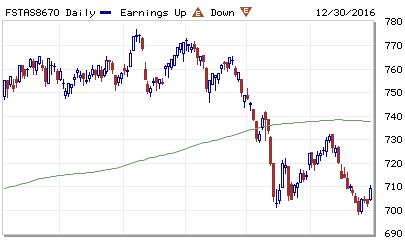
FTSE ST Real Estate Investment Trusts (FTSE ST REIT Index) decreases from 722.05 to 709.49 (-1.74%) compare to last post on Singapore REIT Fundamental Comparison Table on Dec 5, 2016. The index is trading below the 200D SMA.  Take note that the 200D SMA is no longer sloping up and is currently flat. If the index continues to trade below 200D SMA and the 200D starts to slope down, the Singapore REIT sector will reverse to a confirmed down trend. FTSE ST Real Estate Investment Trust Index is currently forming a Falling Wedge and is finding a short term support at about 700. Keep an eye to see whether this support holds in the next few months. SGX S-REIT (REIT.SI) Index decreases from 1111.15 to 1092.36 (-1.69%).

ftse-st-reit-index-jan2-2017ftse-st-reit-index-6m-jan2-2017

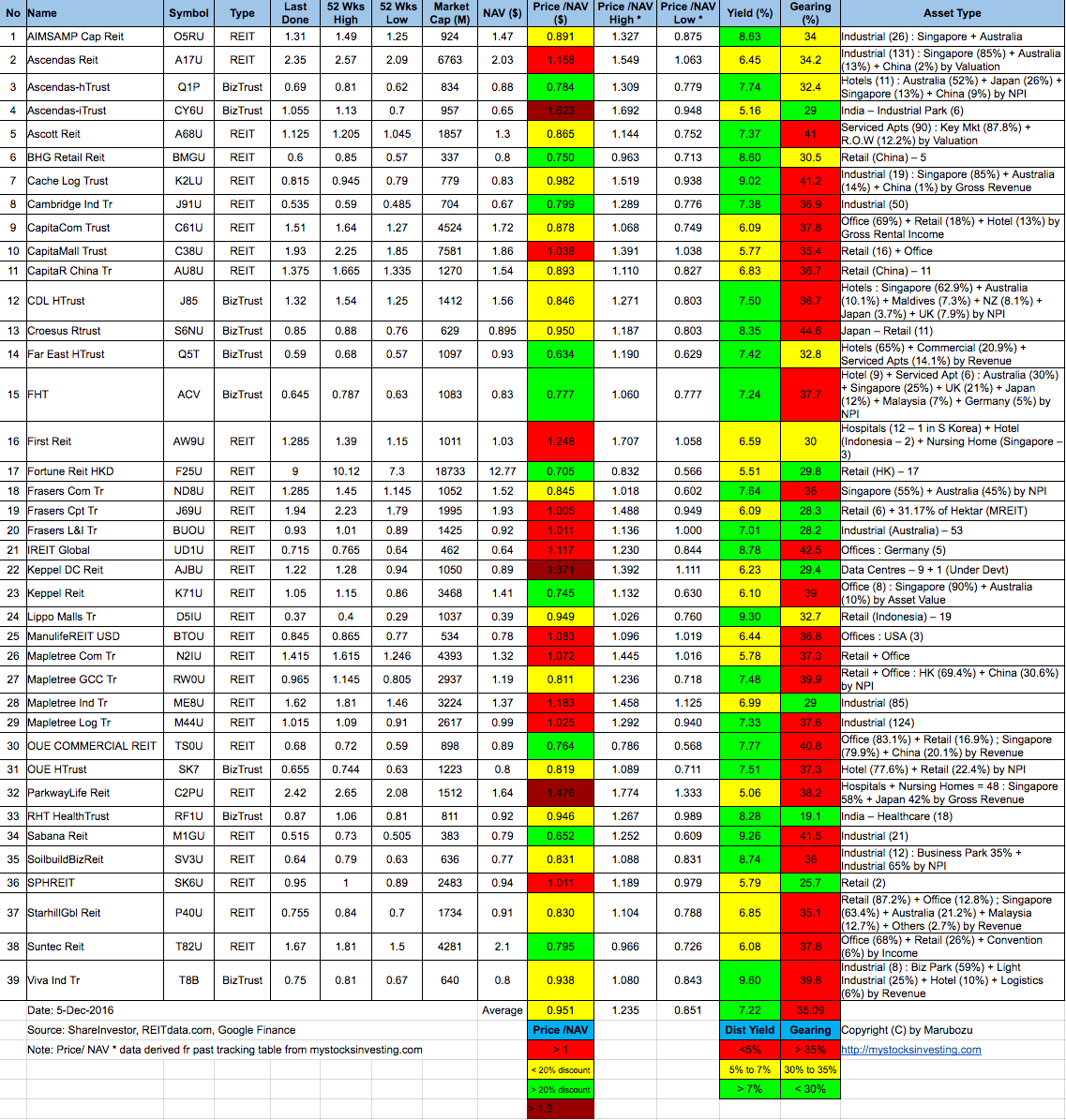
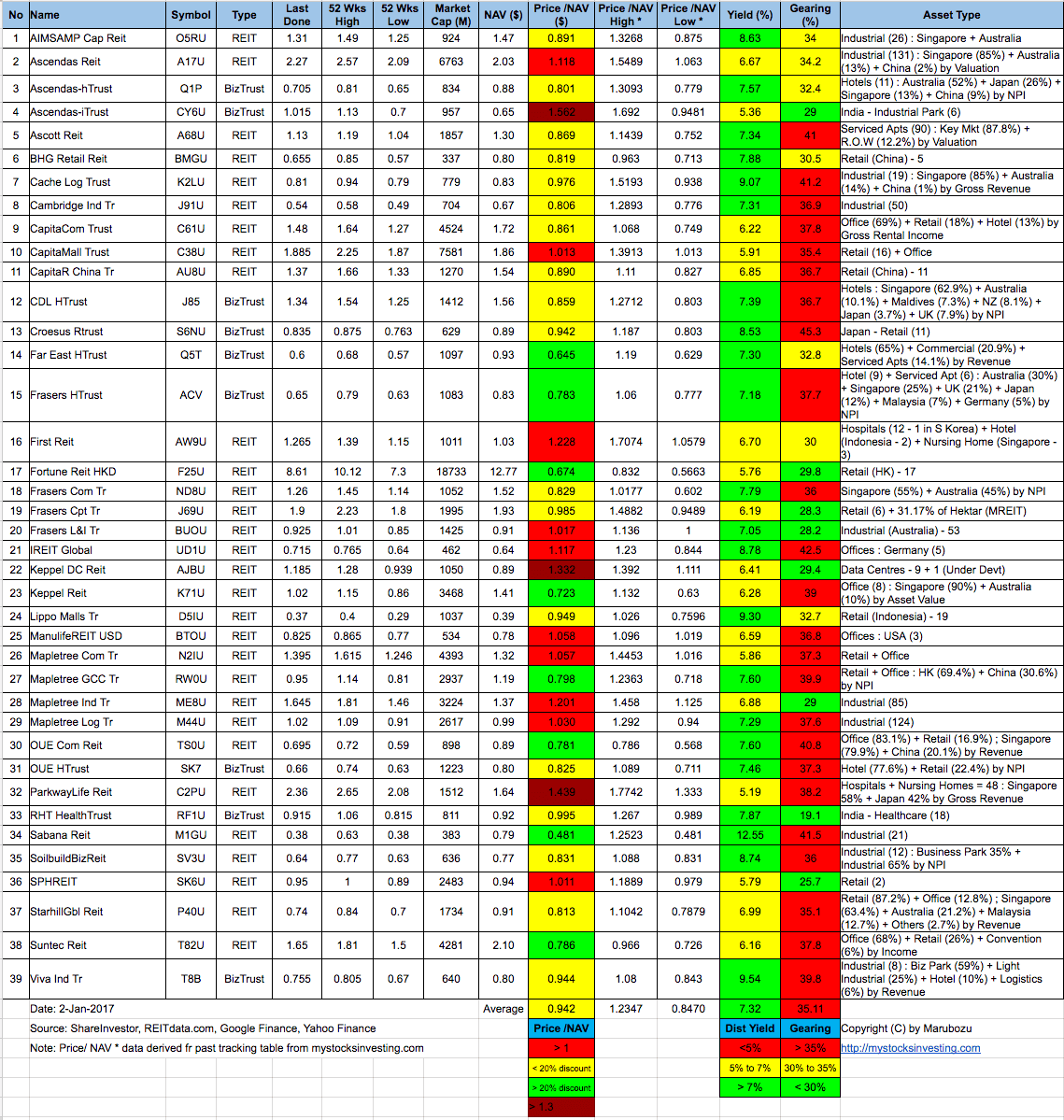
  • Price/NAV decreases from  0.951 to 0.942 (Singapore Overall REIT sector is under value now) after recent sell off. Current Price/NAV is getting closer to Feb 2015 low of 0.91. See Singapore REIT Table Feb-2016 here.
  • Distribution Yield increases from 7.22% to 7.32% (take note that this is lagging number). More than half of Singapore REITs (22 out of 39) have Distribution Yield > 7%. High yield REITs mainly from Hospitality Trust and small cap Industrial REIT. However, some of the big cap & fundamentally strong REITs become attractive again. How to spot those Fundamentally strong REIT with attractive yield to build up a Passive Income Portfolio?
  • Gearing Ratio increases from 35.09% to 35.11%.  24 out of 39 have Gearing Ratio more than 35%.
  • Most overvalue is Ascendas iTrust (Price/NAV = 1.562), followed by Parkway Life (Price/NAV = 1.439) and Keppel DC REIT (Price/NAV = 1.332)
  • Most undervalue (base on NAV) is Sabana REIT (Price/NAV = 0.481), followed by Far East HTrust (Price/NAV = 0.645) and Fortune REIT (Price/NAV = 0.674).
  • Highest Distribution Yield is Sabana REIT (12.55%), followed by Viva Industrial Trust (9.54%) and Lippo Malls Indonesia Retail Trust (9.30%).
  • Highest Gearing Ratio is Croesus Retail Trust (45.3%), iREIT Global (42.5%), Sabana REIT (41.5%), Cache Logistic Trust (41.2%), Ascott REIT (41.0%) and OUE Commercial REIT (40.8%)
singapore-reit-fundamental-analysis-and-comparison-table-2-jan-2017


Disclaimer: The above table is best used for “screening and shortlisting only”. It is NOT for investing (Buy / Sell) decision. To learn how to use the table and make investing decision, Sign up next REIT Investing Seminar here to learn how to choose a fundamentally strong REIT for long term investing for passive income generation.


  • Singapore Interest Rate decreases from 0.07% to 0.06%.
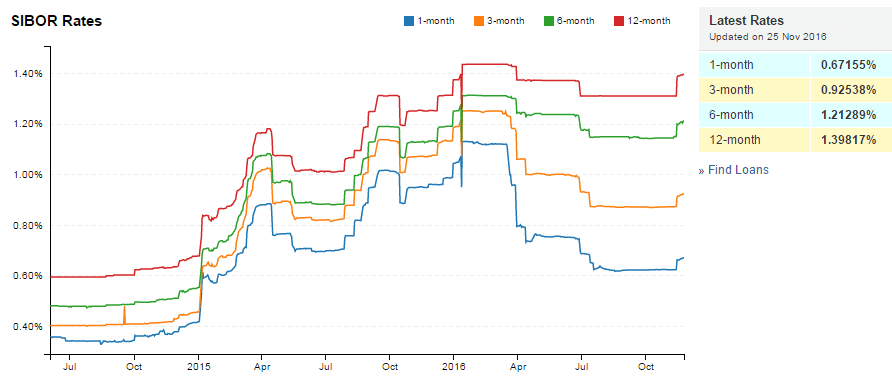
  • Take note of the past historical interest rate and how high the rate can go. This is an important factor to keep a close eye for Singapore REIT investing because REIT leverages on debt to generate DPU. Current Singapore interest rate is abnormally low and will not stay low forever.

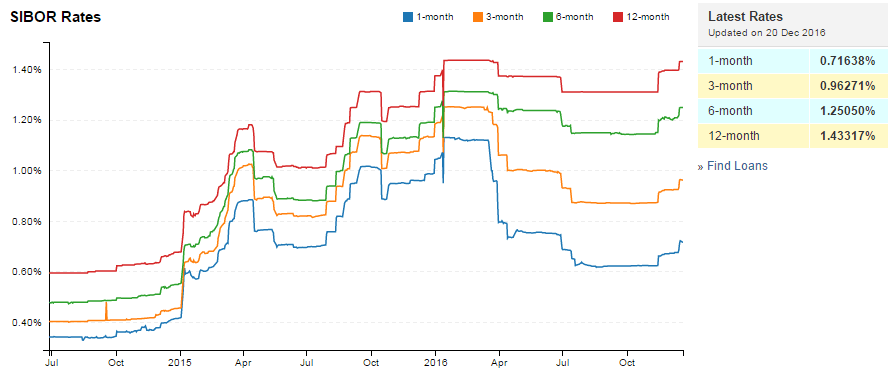
singapore-interest-rate-jan2-2017 singapore-sibor-jan2-2017

  • 1 month increases from 0.67155% to 0.71638%
  • 3 month increases from  0.92538% to 0.96271%
  • 6 month increases from  1.21289% to 1.25050%
  • 12 month increases from 1.39817% to 1.43317%

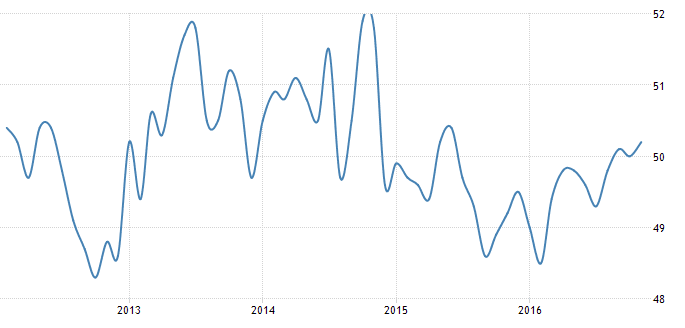
singapore-manufacturing-pmi-jan2-2017

Manufacturing PMI in Singapore increased to 50.20 in November from 50 in October of 2016. Manufacturing PMI in Singapore averaged 50.03 from 2012 until 2016, reaching an all time high of 51.90 in October of 2014 and a record low of 48.30 in October of 2012.

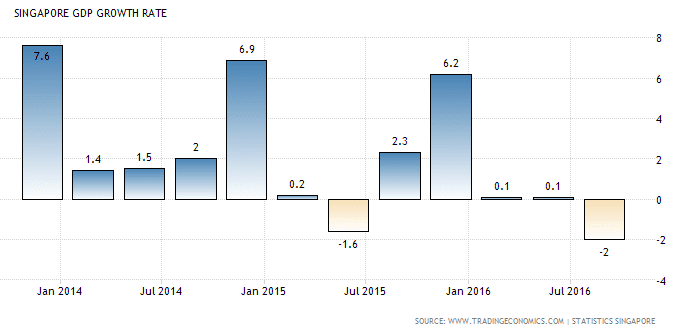
singapore-gdp-growth-rate-jan2-2017

The Singaporean economy contracted a seasonally-adjusted annualized 2 percent on quarter in the three months to September of 2016, compared to a 4.1 percent decline in preliminary estimates. Markets were expecting a 2.5 percent contraction. GDP Growth Rate in Singapore averaged 6.82 percent from 1975 until 2016, reaching an all time high of 37.20 percent in the first quarter of 2010 and a record low of -13.50 percent in the fourth quarter of 2008.

Singapore REITs sector continued the selling off after US Fed rate hike. Technically FTSE ST REIT index is bearish and is on down trend. Another round of sell off is expected if the index breaks the 700 support level. Current valuation base on Price/NAV and Distribution yield become attractive again. As long as the index finds a good support at 700, there are good opportunities to pick up some fundamental strong REIT. Two questions may interest all the retail investors: WHEN is the right and safe time and WHAT REIT to pick? Check out the next Investing in Singapore REIT course here.

See my Singapore REIT 2017 Market Outlook here.

Original post from https://mystocksinvesting.com

Check out coming seminars at https://mystocksinvesting.com/events


Continue ReadingSingapore REIT Fundamental Analysis Comparison Table – 2 January 2017

How investments are reacting to ‘surprising’ US events

  • Post author:

My view on Singapore REIT sector in 2017 on The New Paper .

Merry Christmas and Wish everyone a Prosperous 2017 !


By Linette Heng

The Fed’s interest rate hike and Mr Trump’s victory are impacting ETFs, Reits and Forex here

Many people were expecting the US Federal Reserve to raise interest rates this month.

But what caught them and stock markets around the world by surprise was the Fed saying it would likely raise the interest rates another three times next year.

Considering that the Fed had raised them twice since 2006, the announcement was indeed a surprise. But surprises seem to be the new norm.

Tycoon Donald Trump’s stunning win in the US presidential election last month initially drew jitters of a possible stock market crash.

Instead, his conciliatory victory speech, which sparked expectations of him increasing fiscal spending to spur economic growth, was the catalyst for a global stock market rally.

The Straits Times Index (STI) has gained around 4 per cent since the election on Nov 8.

In light of these two “surprising” events, here are how three common investment products have reacted so far.

EXCHANGE-TRADED FUND (ETF)

ETFs are investment funds listed and traded intraday on a stock exchange that provides exposure to international markets and asset classes that may be inaccessible to individual investors.

Most Asian equity markets slumped after the Fed’s announcement, the Singapore Exchange (SGX) noted in a market update last week.

India was particularly badly hit – foreign investors have been trimming their holdings of Indian stocks since Prime Minister Narendra Modi’s move last month to demonetise the country’s high-denomination currency notes – 500 and 1,000 rupees.

Gold prices, which tend to move inversely against the US dollar, were also affected by the greenback’s recent strength. They are heading for a sixth weekly decline and hovering at a 10-month low.

As a result, some of the most active ETFs on SGX in the December month-to-date were iShares MSCI India Index ETF and SPDR Gold Shares ETF.

US ETFs were previously in the spotlight in anticipation of the Fed’s interest rates hikes, according to an SGX report on Dec 10. Earlier this month, the db x-trackers S&P 500 Inverse Daily UCITS ETF was the most active, registering a 33-fold surge in turnover from the year-ago period.

REAL ESTATE INVESTMENT TRUST (REIT)

In theory, Singapore Reits are sensitive – like any other real estate investments – to rising interest rates as they leverage on debt to generate rental income.

The sector is also facing headwind as the Singapore economy is not doing well, and there is an oversupply in commercial office and industrial property, explained financial blogger and investment coach Kenny Loh, who specialises in Reits.

Due to mounting expectations of an interest rate hike, the SGX S-REIT Index has corrected by 5 per cent since its year-to-date peak in early September, SGX said in a market update last week.

After the Fed’s announcement, the sector did not see any knee-jerk reaction because the expectation had already been priced in, said Mr Loh.

He pointed out that not all sectors and Reits are facing challenges because some portfolios in the healthcare or industrial sectors are more defensive in nature.

kenny-loh-reit-investment

OCBC analyst Deborah Ong recommended hospitality Reits because the current price levels are looking attractive for some of the Reits under coverage.

Her picks included Ascott Residence Trust and CDL Hospitality Trusts.

“In particular, OUE Hospitality Trust looks attractive to us, with anchor tenants Michael Kors and Victoria’s Secret finally open at Mandarin Gallery, and the potential for increased contributions from Crowne Plaza Changi Airport following the opening of Terminal 4 in the second half of 2017,” she said.

Mr Loh urged retail investors to understand their investment objective and do a risk profile first before deciding which Reit to invest in.

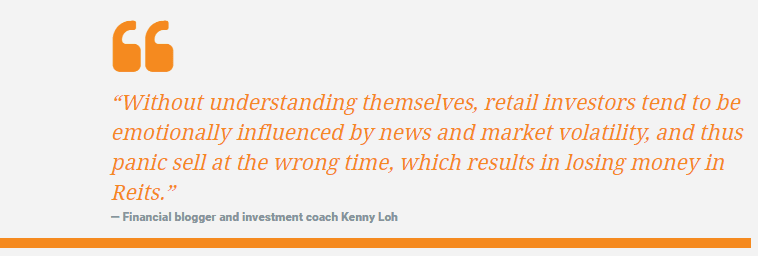
“Without understanding themselves, retail investors tend to be emotionally influenced by news and market volatility, and thus panic sell at the wrong time, which results in losing money in Reits.”

FOREIGN EXCHANGE

Three currencies – the Malaysian ringgit, South Korean won and Singapore dollar – have led the decline against the US dollar when compared with levels prior to Mr Trump’s victory, noted a report by IG Markets this week.

The Fed’s rate signal triggered a renewed rise in US bond yields, boosting the dollar and stoking worries about the risk of capital outflows from emerging markets in Asia, reported Reuters on Monday.

The ringgit fell to its weakest level since the 1998 financial crisis, while the South Korean won hit a nearly six-month low on Monday.

The Singapore dollar sank to a near one-year low against the US dollar last week – right after the Fed raised interest rates.

Yesterday, it tumbled to its weakest in seven years – at about 5pm, the greenback was fetching 1.4444 Singapore dollars.

What US Fed rate hike means for S’pore

The US Federal Reserve raised a key interest rate by a quarter of a percentage point last week, and indicated another three increases next year, one more than originally projected.

This is the first time rates have been raised since December last year and only the second time in a decade.

The more aggressive approach in 2017 signals the Fed’s confidence in the US economy’s recovery, but it could mean trouble for Singapore.

Local businesses and consumers can expect more belt-tightening in the coming year as borrowing costs here will grow amid forecasts of slower economic growth.

The three-month Sibor, or Singapore interbank offered rate, which is used to price home loans and is typically highly correlated with US interest rates, is now at about 0.96, about 10 per cent higher than last month and its highest rate since June.

Check out next Singapore REIT Investing course in 2017 here.

Continue ReadingHow investments are reacting to ‘surprising’ US events

Singapore REIT Fundamental Analysis Comparison Table – 5 December 2016

  • Post author:

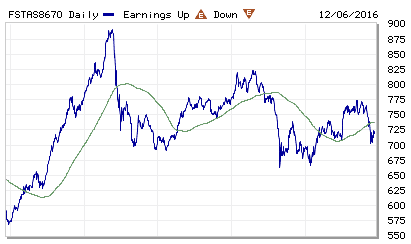
FTSE ST Real Estate Investment Trusts (FTSE ST REIT Index) decreases from 730.39 to 722.05 (-1.14%) compare to last post on Singapore REIT Fundamental Comparison Table on Nov 5, 2016. The index is trading below the 200D SMA.  Take note that the 200D SMA is no longer sloping up and is currently flat. If the index continues to trade below 200D SMA and the 200D starts to slope down, the Singapore REIT sector will reverse to a confirmed down trend.  SGX S-REIT (REIT.SI) Index decreases from 1125.83 to 1111.15 (-1.30%).

ftse-st-reit-index-dec6-2016ftse-st-reit-index-6m-dec6-2016

  • Price/NAV decreases from  0.969 to 0.951 (Singapore Overall REIT sector is under value now) after recent sell off.
  • Distribution Yield increases from 7.07% to 7.22% (take note that this is lagging number). More than half of Singapore REITs (20 out of 39) have Distribution Yield > 7%. High yield REITs mainly from Hospitality Trust and small cap Industrial REIT. Selection of Singapore REITs have become much more important now because not all the high yield REITs has strong fundamental.
  • Gearing Ratio decreases from 35.15% to 35.09%.  24 out of 39 have Gearing Ratio more than 35%.
  • Most overvalue is Ascendas iTrust (Price/NAV = 1.623), followed by Parkway Life (Price/NAV = 1.476) and Keppel DC REIT (Price/NAV = 1.371)
  • Most undervalue (base on NAV) is Far East HTrust (Price/NAV = 0.634), followed by Sabana REIT (Price/NAV = 0.652) and Keppel REIT (Price/NAV = 0.745).
  • Highest Distribution Yield is Viva Industrial Trust (9.60%), Lippo Malls Indonesia Retail Trust (9.30%) followed by Sabana REIT (9.26%).
  • Highest Gearing Ratio is Croesus Retail Trust (44.6%), iREIT Global (42.5%), Sabana REIT (41.5%), Cache Logistic Trust (41.2%), Ascott REIT (41.0%) and OUE Commercial REIT (40.8%)

singapore-reit-fundamental-analysis-and-comparison-table-5-dec-2016

Disclaimer: The above table is best used for “screening and shortlisting only”. It is NOT for investing (Buy / Sell) decision. To learn how to use the table and make investing decision, Sign up next REIT Investing Seminar here to learn how to choose a fundamentally strong REIT for long term investing for passive income generation.


  • Singapore Interest Rate decreases from 0.12% to 0.07%

singapore-interest-rate-dec6-2016

singapore-sibor-dec6-2016

  • 1 month increases from 0.62417% to 0.67155%
  • 3 month increases from 0.87242% to 0.92538%
  • 6 month increases from 1.14530% to 1.21289%
  • 12 month increases from 1.31225% to 1.39817%

singapore-manufacturing-pmi-dec6-2016

Manufacturing PMI in Singapore increased to 50.20 in November from 50 in October of 2016. Manufacturing PMI in Singapore averaged 50.03 from 2012 until 2016, reaching an all time high of 51.90 in October of 2014 and a record low of 48.30 in October of 2012.

singapore-gdp-growth-rate-dec6-2016

The Singaporean economy contracted a seasonally-adjusted annualized 2 percent on quarter in the three months to September of 2016, compared to a 4.1 percent decline in preliminary estimates. Markets were expecting a 2.5 percent contraction. GDP Growth Rate in Singapore averaged 6.82 percent from 1975 until 2016, reaching an all time high of 37.20 percent in the first quarter of 2010 and a record low of -13.50 percent in the fourth quarter of 2008.


Singapore REITs in general is under value due the recent sell off after Donald Trump won the the US Presidential Election, and the market is anticipate a 80% probability of rate hike in Dec 2016. Distribution yield for some Singapore REITs with bigger market capitalization has become a little bit more attractive again. Should there be any knee jerk reaction if Janet Yellen announces the rate hike next week, it is a good opportunities to pick up some fundamental strong REIT.

Technically Singapore REITs sector is in bearish territory after breaking down the 200D SMA support. We need to wait for the Singapore REIT Index to find the support after FOMC meeting next week to plan the entry. Happy hunting but don’t hunt the wrong one!

Original post from https://mystocksinvesting.com

Check out coming seminars at https://mystocksinvesting.com/events


Continue ReadingSingapore REIT Fundamental Analysis Comparison Table – 5 December 2016