SGX to cut board lot size from Jan 19, 2015

  • Post author:

Anita Gabriel, TheBusiness TimesTuesday, Aug 26, 2014

MARK this date – Jan 19, 2015. That’s when retail investors will be able to start buying securities listed on the Singapore Exchange (SGX) in smaller lots of 100 units from 1,000 units currently.

In a statement on Monday, SGX said the reduction in standard board lot size of securities listed on the exchange from 1,000 to 100 units will make it more affordable for retail investors to invest in a wider range of equities.

“The reduced board lot size will benefit all investors and make it easier to invest in blue chips and index component stocks which tend to be higher-priced. It will also allow institutional investors to better manage their risk exposures through finer asset allocation of funds,” said SGX chief executive Magnus Bocker.

SGX’s move to cut lot sizes is also generally viewed as a safeguard measure in the wake of last October’s penny stock crash. By making blue chip stocks more attainable to retail investors, it is hoped that they will invest more in these safer counters than load their portfolios with relatively more risky, lowly-priced shares.

As a result of the change, a minimum subscription and allocation value – S$500 for mainboard counters and S$200 for Catalist counters – will be imposed on investors applying for shares offered during the initial public offering (IPO).

“This is to address the possibility of disproportionately high trading costs that may be incurred by IPO applicants who are allotted the minimum number of shares (one board lot of 100 shares) at the minimum issue price for IPO shares,” said SGX.

For example, if a company is offering its shares at 50 Singapore cents a share, then the minimum an investor can subscribe for is 1,000 shares (S$500). If the share is being offered at S$10 a piece, then the minimum subscription allowed is for 100 units (S$1,000).

With this change, SGX said that companies now have discretion to set their own minimum subscription quantity, which must be in multiples of 100 shares.

This means that the minimum subscription quantity of shares may differ from one IPO to another, depending on the issue price for the IPO shares.

The new board lot size will apply to ordinary shares, including shares traded on GlobalQuote, real estate investment trusts, business trusts, company warrants, structured warrants and extended settlement contracts. Existing counters with board lot sizes of 100 or less units will remain unchanged.

The board lot sizes for exchange traded funds – except for SPDR Straits Times Index (STI) ETF and ABF Singapore Index Bond Fund for which the board lot size will be reduced to 100 units – American Depositary Receipts and fixed income instruments, including retail bonds, Singapore Government Securities and preference shares will remain unchanged.

Beginning in September, SGX will introduce a separate column – “BLot” – on the SGX website’s price page to indicate the board lot size of each counter. With that, the board lot size will be removed from the counter names as practised now with the exception of sister counters and temporary odd lot rights counters. (Counters which do not have the standard board lot size of 1,000 units are currently indicated with the board lot size as part of the counter name, for example, Creative50.) In January next year, the “BLot” column will clearly indicate which securities have a board lot of 100 units.

SGX said investors can continue to trade in odd lots in the Unit Share Market.

However, once the board lot is reduced, the maximum quantity of units that can be traded in the Unit Share Market will be cut from 999 to 99 effective Jan 19, 2015.

Naturally, it’s a move hailed by the chief of an investors grouping here.

“This is a much-anticipated move that will be welcomed by our citizens,” said David Gerald, president and CEO of Securities Investors Association (Singapore).

“Now that blue chip stocks are more accessible, I would encourage retail investors to seriously consider share investing as a way to diversify their portfolio and grow their savings for retirement,” he added.

http://news.asiaone.com/news/business/sgx-cut-board-lot-size-jan-19-next-year#sthash.XxpFUi27.dpuf
Continue ReadingSGX to cut board lot size from Jan 19, 2015

The Nuts And Bolts Of MSR And TDSR

  • Post author:

Guest Post: By iCompareLoan Editorial Team


TDSR, or Total Debt Servicing Ratio, is a relatively new regulation in Singapore’s real estate market. Introduced only on 28 June 2013 after seven rounds of property cooling measures had been implemented since 14 September 2009, nonetheless the Government did not regard it as yet another series of cooling measure. Rather it was hailed as long-term measure to ensure that financial institutions practise prudence when disbursing property loans.

In contrast, MSR, or Mortgage Servicing Ratio, was mandated for MAS-regulated financial institutions (FIs) for the first time, during the seventh round of cooling measures in January 2013. Before only mortgages by HDB have to follow a MSR.

Given that TDSR and MSR are likely here to stay, let us set the record straight between the two.


Table 1: Comparing MSR And TDSR

MSR

TDSR

The monthly repayment of a mortgage do not exceed 30% of the borrower’s gross income

All monthly debt obligations, inclusive of the mortgage repayment, do not exceed 60% of the borrower’s gross monthly income

Applies to all mortgages, whether by FIs or HDB, granted for the purchase of a HDB flat or an EC

Applies to all property loans, whether residential properties or otherwise, granted by FIs

Hence HDB concessionary loans are exempted from it

When computing the MSR, the FI has to use a specified medium-term rate (3.5%), or the existing market rate, whichever is higher.

For the HDB concessionary loan, the rate to be used is the prevailing rate of the loan which has remained at 2.60% p.a. since July 1999.

When computing the TDSR, the FI has to use a specified medium-term rate, or the existing market rate, whichever is higher.

The specified rate:

  • 3.5% for housing loans

  • 4.5% for non-residential property loans

For refinancing,

the MSR will not apply to loans for HDB flats and ECs that are

  • owner-occupied, AND
  • were purchased before their respective MSR implementation dates

For refinancing,

the TDSR will not apply if

  • the residential property is owner-occupied, AND

  • the Option to Purchase (OTP) of the residential property was granted before 29 June 2013

Source: HDB, MAS, MND


For advice on a new home loan.

For refinancing advice.

Continue ReadingThe Nuts And Bolts Of MSR And TDSR

Singapore REIT Fundamental Analysis Comparison Table – 4 Jan 2015

  • Post author:

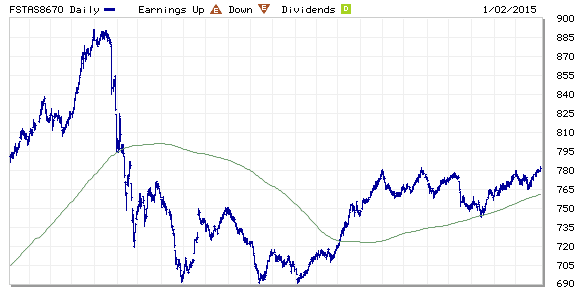
FTSE ST Real Estate Investment Trusts (FTSE ST REIT) Index changes from 774.40 to 781.16 compare to last post on Singapore REIT Fundamental Comparison Table on Dec 14, 2014. The index is currently testing the 52 weeks high resistance.  Long term trend for Singapore REIT is bullish base on the chart pattern of this ST REIT index as the 200D SMA is trending up. The index is currently range bound in consolidation mode and moving sideway until there is a breakout.

FTSE ST REIT Index Jan4-2015

  • Added Keppel DC REIT and updated Price/NAV high and low for some REITs.
  • Price/NAV no change at 1.04 (slightly over value now)
  • Distribution Yield decreases slightly from 6.59% to 6.57% (take note that this is lagging number, past DPU does not represent future DPU). Note: I did not color code the yield number because yield is relative to individual risk appetite. High Yield does NOT mean it is a good REIT. Low Yield does NOT mean it is a bad REIT. We have to analyse the Fundamental and do Risk Assessment of the REIT.
  • Gearing Ratio decreases slightly from 33.90% to 33.74%..

Singapore-REIT-Fundamental-Analysis-and-Comparison-Table-4-Jan-2015

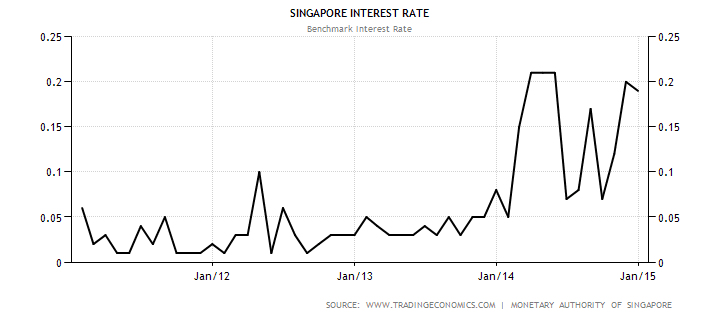
Singapore Interest Rate Jan4-2015

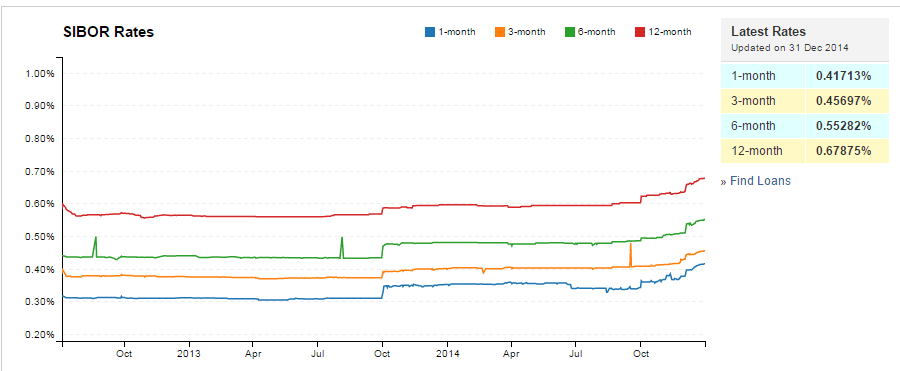
SIBOR Dec 31-2014

Keep a close eye on Singapore Interest Rate and SIBOR which is increasing quietly.

There are 37 Real Estate Investment Trust in Singapore as shown in the above table. Most people just purely choose the REIT with HIGH DIVIDEND and invest blindly without knowing what are the RISKS. If you want to learn how to pick the right REIT and invest to generate passive income safely, check out the very pragmatic and educational public seminar here “Investing in Singapore REIT“.

Grab an insight of the REIT class here 3 Tips To Increasing Returns On REITs Investments


Continue ReadingSingapore REIT Fundamental Analysis Comparison Table – 4 Jan 2015