Introduction
Interest rates, refinancing costs and balance sheet strength remain important considerations for investors evaluating Singapore-listed Office REITs. As borrowing costs directly affect distributable income, a REIT’s ability to manage debt obligations and protect itself against interest rate fluctuations can influence its financial resilience.
This article compares five Singapore-listed Office REITs with exposure to different geographical markets: Manulife US REIT, Keppel Pacific Oak US REIT, Keppel REIT, Elite UK REIT and Prime US REIT.
Using financial information as at 30 September 2026, the comparison examines gearing ratios, interest rate hedging, average borrowing costs, interest coverage ratios and weighted average debt maturity (WADM). It also considers which REITs may be better positioned if interest rates increase and which face greater refinancing risks.
Although these REITs operate in different property markets and currencies, comparing their capital management strategies provides useful insights into their financial flexibility and ability to manage changing interest rate conditions.
1. Overview of the Five Office REITs
The five REITs have different geographical exposures and capital structures. Manulife US REIT, Keppel Pacific Oak US REIT and Prime US REIT focus on the US office market, while Keppel REIT has a diversified Asia-Pacific office portfolio and Elite UK REIT focuses on UK government-leased properties.
The following table summarises their key financial indicators as at 30 September 2026.
| Financial Indicators | Manulife US REIT | Keppel Pacific Oak US REIT | Keppel REIT | Elite UK REIT | Prime US REIT |
|---|---|---|---|---|---|
| Gearing / Aggregate Leverage | 54.0% | 43.0% | 40.5% | 38.6% | 44.7% |
| WADM (years) | 1.8 | 1.4 | 2.5 | N/A | ~0.7* |
| Interest Coverage | 1.6x | 2.4x | 2.8x | 2.7x | 1.6x |
| Fixed / Hedged Interest Rate | 34.3% | 65.3% | 64.0% | 80.0% | N/A |
| Average Interest Cost | 5.89% | 4.92% | 3.32% | 4.70% | 5.80% |
| NAV per Unit | US$0.19 | N/A | N/A | £0.44 | US$0.52 |
Prime US REIT’s approximately 0.7-year WADM is an indicative calculation based on its disclosed September 2026 debt maturity schedule, rather than an officially reported WADM.
Data notes:
- Elite UK’s 38.6% represents regulatory aggregate leverage. Its net gearing ratio was 38.0%.
- Manulife US REIT’s 5.89% borrowing cost excludes the Sponsor-Lender Loan exit premium. Including the premium, the figure was 6.65%.
- Prime US REIT’s September 2026 presentation did not provide a confirmed updated fixed/hedged debt percentage.
- NAV figures are reported in their respective currencies. NAV per unit for KORE and Keppel REIT is not included because a comparable verified September figure has not been established here.
2. Capital Management Comparison
2.1 Gearing Ratio: Which REIT Has the Lowest Financial Leverage?
Gearing is an important measure of a REIT’s financial leverage and its reliance on debt financing. Generally, a higher gearing ratio indicates greater exposure to debt obligations and potentially less financial flexibility when property valuations decline or refinancing becomes more expensive.
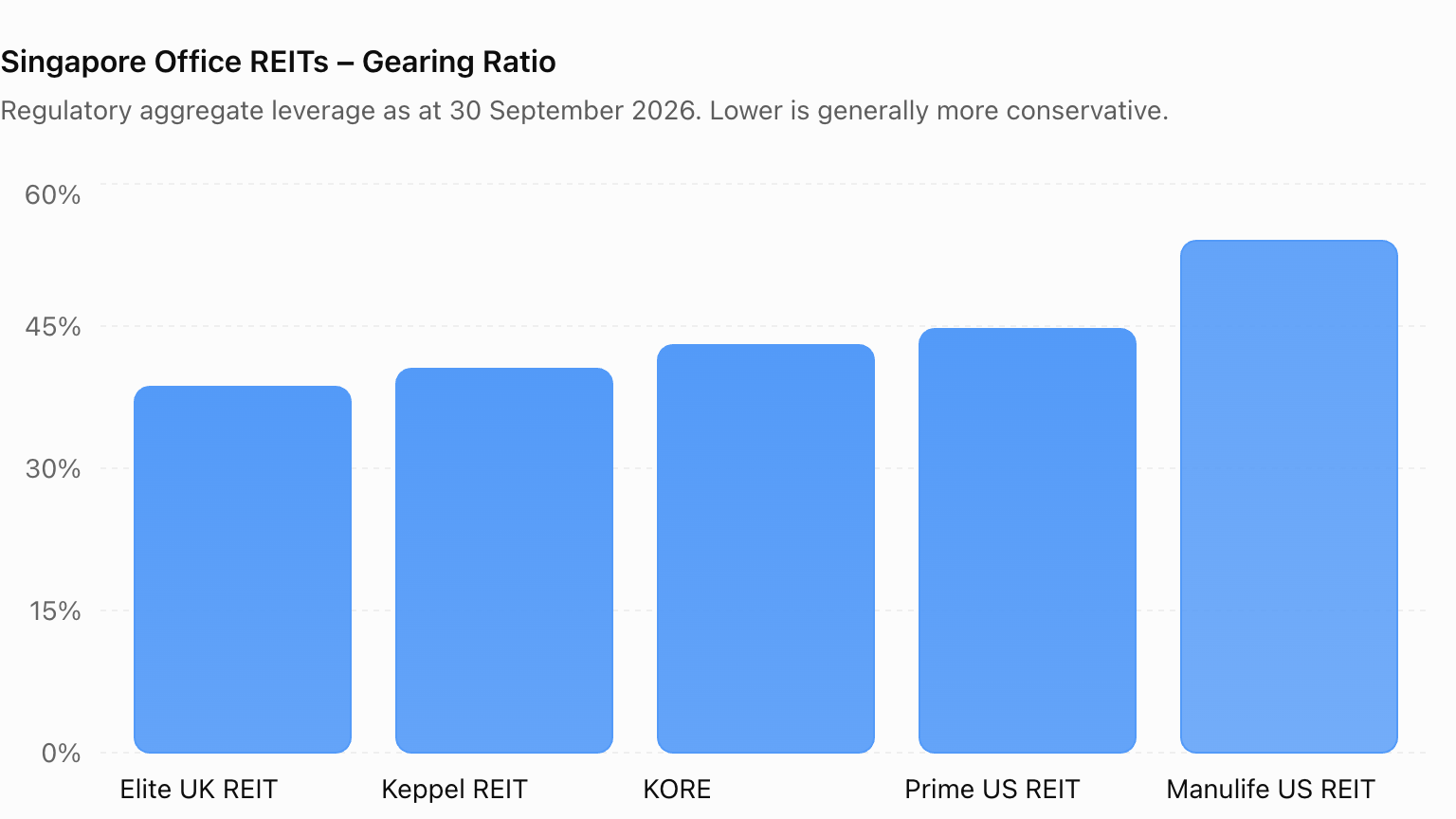
Gearing ratio comparison of five Singapore-listed Office REITs as at 30 September 2026.
Based on the September 2026 figures, Elite UK REIT has the lowest regulatory aggregate leverage at 38.6%, followed by Keppel REIT at 40.5%.
In contrast, Manulife US REIT has the highest gearing ratio at 54.0%, reflecting its comparatively greater reliance on debt financing.
This is particularly important for Manulife US REIT because higher gearing, combined with relatively low interest rate hedging, increases its sensitivity to changes in financing conditions.
Gearing ratio ranking (lowest to highest):
- Elite UK REIT – 38.6%
- Keppel REIT – 40.5%
- Keppel Pacific Oak US REIT – 43.0%
- Prime US REIT – 44.7%
- Manulife US REIT – 54.0%
Overall, Elite UK REIT and Keppel REIT have relatively conservative gearing positions, while Manulife US REIT has less financial flexibility compared with its peers.
2.2 Interest Rate Hedging: Which REIT Is Best Protected Against Rising Rates?
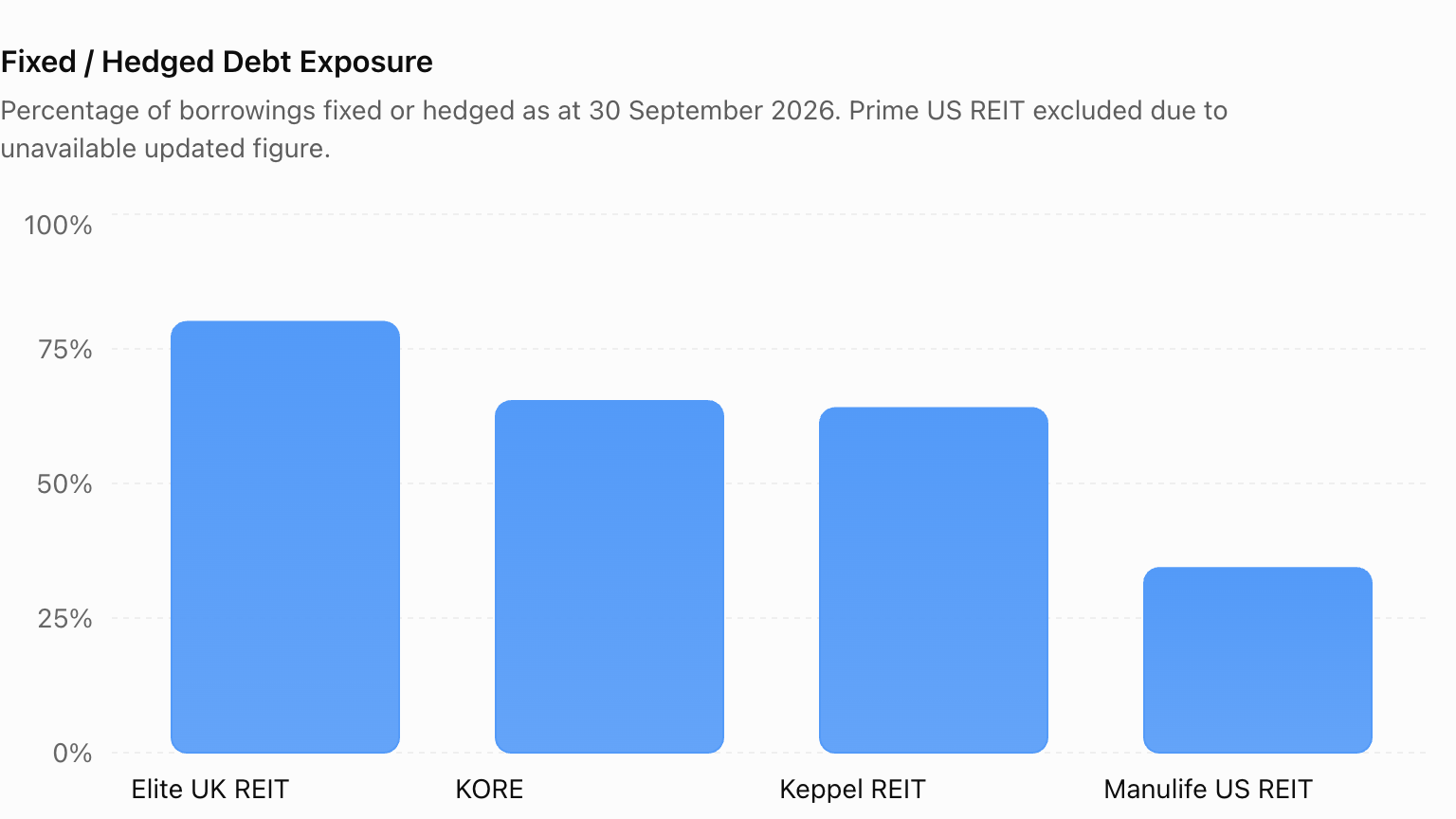
Interest rate hedging helps REITs manage fluctuations in borrowing costs. A higher proportion of fixed-rate or hedged borrowings generally reduces the immediate impact of rising interest rates on financing expenses.
Elite UK REIT has the highest disclosed fixed interest rate exposure at 80%, followed by Keppel Pacific Oak US REIT at 65.3% and Keppel REIT at 64%.
Manulife US REIT has the lowest hedged proportion at 34.3%, leaving approximately 65.7% of its borrowings exposed to floating interest rates.
This creates a greater risk of increasing interest expenses if US interest rates rise.
Prime US REIT’s latest September 2026 presentation does not provide a confirmed updated fixed/hedged percentage, so it is excluded from this particular ranking.
Fixed / hedged borrowings ranking (highest to lowest):
- Elite UK REIT – 80.0%
- Keppel Pacific Oak US REIT – 65.3%
- Keppel REIT – 64.0%
- Manulife US REIT – 34.3%
Elite UK REIT’s higher proportion of fixed-rate borrowings provides stronger protection against immediate interest rate fluctuations. Meanwhile, Manulife US REIT has greater exposure to floating-rate movements.
2.3 Average Interest Cost: Which REIT Has the Lowest Borrowing Cost?
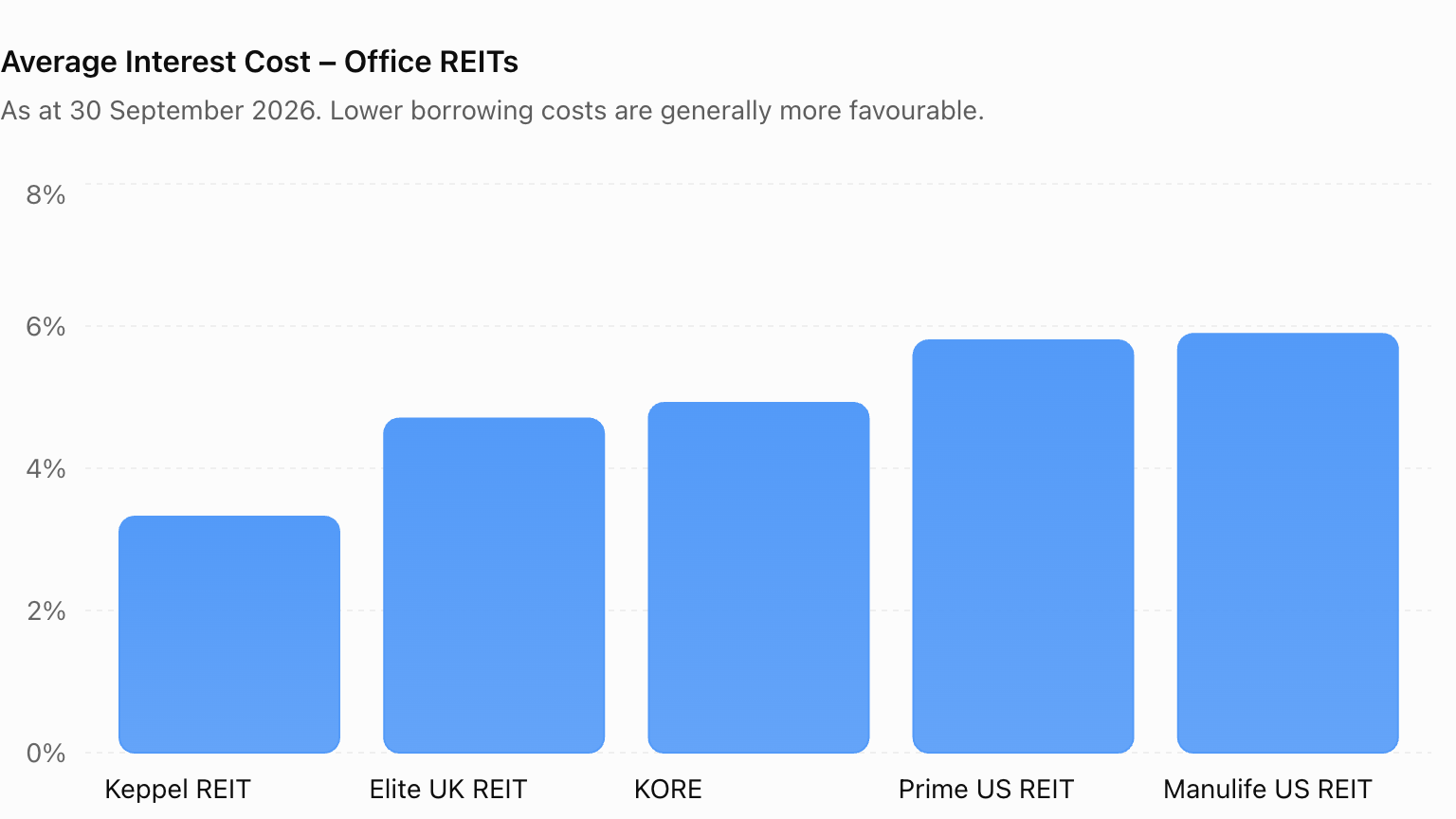
The average interest cost measures the borrowing expenses incurred by a REIT. Lower financing costs can support distributable income, while higher borrowing costs may place additional pressure on financial performance.
Keppel REIT has the lowest average borrowing cost at 3.32%, considerably below the other four REITs.
Elite UK REIT and Keppel Pacific Oak US REIT recorded borrowing costs of 4.70% and 4.92%, respectively. Meanwhile, Prime US REIT and Manulife US REIT reported higher borrowing costs of 5.80% and 5.89%.
Average interest cost ranking (lowest to highest):
- Keppel REIT – 3.32%
- Elite UK REIT – 4.70%
- Keppel Pacific Oak US REIT – 4.92%
- Prime US REIT – 5.80%
- Manulife US REIT – 5.89%
Manulife US REIT’s effective borrowing cost is even higher at 6.65% when its Sponsor-Lender Loan exit premium is included.
Keppel REIT’s lower borrowing cost provides a competitive advantage in managing financing expenses, although differences in currencies, loan structures and debt profiles should also be considered.
2.4 Interest Coverage Ratio: Which REIT Has the Strongest Ability to Service Debt?
The interest coverage ratio measures a REIT’s ability to meet its interest obligations using its earnings. A higher ratio generally indicates a greater capacity to service interest expenses.
Keppel REIT has the highest interest coverage ratio at 2.8 times, followed by Elite UK REIT at 2.7 times and Keppel Pacific Oak US REIT at 2.4 times.
Manulife US REIT and Prime US REIT have the lowest ratios at 1.6 times.
This suggests that the latter two REITs have relatively less financial flexibility if borrowing costs increase or operating earnings weaken.
Interest coverage ranking (highest to lowest):
- Keppel REIT – 2.8x
- Elite UK REIT – 2.7x
- Keppel Pacific Oak US REIT – 2.4x
- Manulife US REIT – 1.6x
- Prime US REIT – 1.6x
The results indicate that Keppel REIT and Elite UK REIT have stronger interest coverage positions, while Manulife US REIT and Prime US REIT may face greater pressure if financing expenses increase.
3. Debt Maturity Profile: Which REIT Has the Longest Debt Maturity?
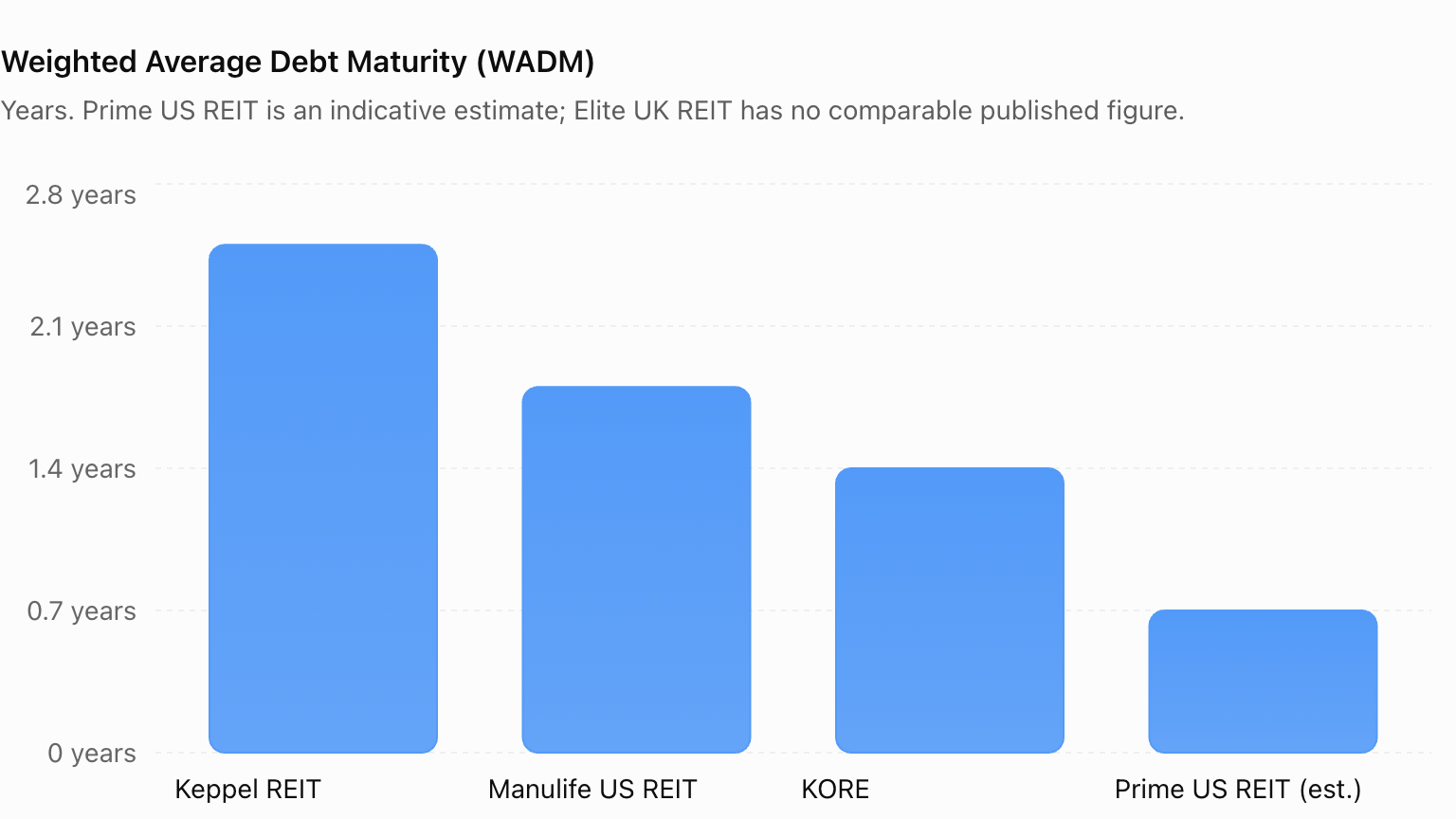
Weighted average debt maturity (WADM) measures the average remaining period before a REIT’s borrowings mature. A longer debt maturity profile generally provides more time to arrange refinancing and reduces immediate refinancing pressure.
Among the REITs with disclosed WADM figures, Keppel REIT has the longest debt maturity at 2.5 years, followed by Manulife US REIT at 1.8 years and Keppel Pacific Oak US REIT at 1.4 years.
Prime US REIT has an indicative maturity of approximately 0.7 years based on its September 2026 debt maturity schedule. Elite UK REIT’s official WADM was not separately identified in its third-quarter disclosure.
Disclosed and indicative WADM ranking:
- Keppel REIT – 2.5 years
- Manulife US REIT – 1.8 years
- Keppel Pacific Oak US REIT – 1.4 years
- Prime US REIT – approximately 0.7 years (indicative)
- Elite UK REIT – not disclosed
What happens if US interest rates increase?
If US interest rates increase, REITs with greater exposure to floating-rate debt may experience higher financing expenses. However, refinancing risk is also important because REITs with significant near-term debt maturities may need to refinance at less favourable rates.
Among the three US-focused REITs, Manulife US REIT has the longest disclosed WADM at 1.8 years. However, its relatively low hedging proportion of 34.3% means it remains exposed to floating interest rate movements.
KORE has a shorter WADM of 1.4 years, but its higher hedging proportion of 65.3% provides greater protection against immediate changes in interest rates.
Prime US REIT faces a different challenge. Its September 2026 debt maturity schedule shows US$558 million of borrowings due in December 2026, compared with US$105 million in 2029. This creates a significant near-term refinancing concentration.
Therefore, while Keppel REIT has the longest disclosed WADM overall, KORE has a more balanced interest rate protection position among the US-focused REITs. Prime US REIT faces the greatest immediate refinancing concentration based on its disclosed maturity schedule.
4. Individual REIT Capital Management Overview
Manulife US REIT
Manulife US REIT has the most challenging capital management position among the five REITs based on its gearing, interest rate exposure and borrowing costs.
Its gearing ratio of 54.0% is the highest in this comparison, while only 34.3% of its borrowings are fixed or hedged. Its average borrowing cost of 5.89% is also relatively high, increasing to 6.65% when the Sponsor-Lender Loan exit premium is included.
Although its WADM of 1.8 years is longer than KORE’s, it still faces refinancing requirements, including a US$133.4 million loan due in April 2027.
The Manager’s capital management priorities include property divestments, debt reduction, refinancing and maintaining lender support.
Overall, Manulife US REIT remains relatively vulnerable to rising financing costs due to its high gearing, low hedging proportion and relatively weak interest coverage ratio.
Keppel Pacific Oak US REIT
Keppel Pacific Oak US REIT has a relatively balanced capital structure.
Its gearing ratio of 43.0% is below Manulife US REIT and Prime US REIT, while 65.3% of its borrowings are fixed or hedged.
Its All-in Average Cost of Debt of 4.92% is also lower than the other two US-focused REITs in this comparison.
However, its WADM of 1.4 years indicates relatively shorter debt maturity, making refinancing an important management priority.
KORE has secured a US$120 million loan facility expected to refinance approximately 65% of its 2027 debt maturities. This proactive refinancing initiative helps address upcoming funding requirements.
Overall, KORE demonstrates a more balanced combination of gearing, hedging and borrowing costs, although its shorter debt maturity profile remains a consideration.
Keppel REIT
Keppel REIT demonstrates the strongest overall capital management position among the five REITs based on the indicators examined.
Its gearing ratio of 40.5% is relatively low, while its borrowing cost of 3.32% is the lowest in the comparison.
Furthermore, its interest coverage ratio of 2.8 times is the highest, indicating a stronger ability to service interest expenses.
Its WADM of 2.5 years is also the longest among the REITs with disclosed figures, providing greater flexibility in managing refinancing requirements.
The Manager continues to focus on maintaining a well-staggered debt maturity profile, managing financing costs and diversifying funding sources. Sustainability-focused financing represented 76% of total borrowings as at September 2026.
Overall, Keppel REIT has a relatively strong balance sheet and a favourable financing position compared with its peers.
Elite UK REIT
Elite UK REIT demonstrates a relatively conservative capital management position, supported by low gearing and a high proportion of fixed-rate borrowings.
Its regulatory aggregate leverage stood at 38.6%, while 80% of its interest rate exposure was fixed. Its average borrowing cost remained stable at 4.7%, and its interest coverage ratio improved to 2.7 times.
The REIT also strengthened its financial position through a £50 million sustainability-linked Murabaha facility in August 2026, which supports refinancing and general corporate purposes.
Its portfolio of UK government-leased properties provides relatively stable rental income, while its WALE increased to 6.8 years as at September 2026.
Overall, Elite UK REIT’s high fixed-rate exposure and relatively low gearing provide protection against interest rate volatility. However, upcoming debt maturities remain an important consideration.
Prime US REIT
Prime US REIT faces relatively greater refinancing pressure due to its concentrated debt maturity profile.
Its gearing ratio stood at 44.7%, while its average borrowing cost was 5.8%. Its interest coverage ratio of 1.6 times is also relatively low.
The REIT’s September 2026 presentation shows that US$558 million of borrowings were due in December 2026, following extensions of its existing credit facilities. A further US$105 million was due in 2029.
This concentration makes refinancing a key priority for the Manager.
Its capital management focus includes securing longer-term financing, maintaining access to committed credit facilities and managing its outstanding debt obligations.
Overall, Prime US REIT’s main capital management challenge is refinancing its concentrated near-term debt maturities while maintaining sufficient financial flexibility.
5. Overall Ranking of the Five Office REITs
Based on the financial indicators examined, the following table summarises the strongest REIT in each capital management category.
| Capital Management Indicator | Leading REIT | Key Figure |
|---|---|---|
| Lowest gearing | Elite UK REIT | 38.6% |
| Highest fixed interest exposure | Elite UK REIT | 80.0% |
| Lowest borrowing cost | Keppel REIT | 3.32% |
| Highest interest coverage | Keppel REIT | 2.8x |
| Longest disclosed WADM | Keppel REIT | 2.5 years |
| Lowest immediate refinancing concentration among US-focused REITs | KORE* | Subject to maturity schedule |
This is a qualitative assessment, not a formally calculated ranking of refinancing risk.
6. Conclusion: Which Office REIT Has the Strongest Capital Management Position?
The comparison highlights significant differences in the capital management strategies and financial resilience of the five Office REITs.
Keppel REIT demonstrates the strongest overall position, supported by relatively low gearing, the lowest borrowing cost, the highest interest coverage ratio and the longest disclosed WADM. Its well-staggered debt maturity profile also provides greater flexibility when managing refinancing requirements.
Elite UK REIT stands out for its conservative gearing and high fixed-rate exposure. Its 80% fixed interest rate proportion provides substantial protection against immediate interest rate fluctuations, while its government-backed rental income offers greater income visibility.
Among the US-focused REITs, Keppel Pacific Oak US REIT demonstrates a relatively balanced capital structure, with 65.3% of borrowings hedged and a borrowing cost of 4.92%. However, its shorter debt maturity profile means refinancing remains an important consideration.
Prime US REIT faces refinancing challenges due to its significant concentration of debt maturities in December 2026. Meanwhile, Manulife US REIT has the highest gearing ratio and lowest hedging proportion, making it more vulnerable to rising borrowing costs.
Ultimately, investors should not assess an Office REIT solely based on its gearing ratio or interest rate hedging percentage. Debt maturity, borrowing costs and interest coverage should also be considered together to understand its overall financial resilience.
The key takeaway is that Keppel REIT and Elite UK REIT demonstrate relatively stronger capital management positions, while KORE has a more balanced position among the US-focused REITs. Manulife US REIT and Prime US REIT face greater financing challenges, although for different reasons.
Disclaimer: This article is for educational and informational purposes only and does not constitute financial or investment advice. Financial figures are based on reported information as at 30 September 2026, with individual qualifications noted where applicable.
Kenny Loh is a distinguished Wealth Advisory Director with a specialisation in holistic investment planning and estate management. He excels in assisting clients to grow their investment capital and establish passive income streams for retirement. Kenny also facilitates tax-efficient portfolio transfers to beneficiaries, ensuring capital appreciation through risk mitigation approaches and optimised wealth transfer through strategic asset structuring.
In addition to his advisory role, Kenny is an esteemed SGX Academy trainer specializing in S-REIT investing and regularly shares his insights on MoneyFM 89.3. He holds the titles of Certified Estate & Legacy Planning Consultant and CERTIFIED FINANCIAL PLANNER (CFP).
With over a decade of experience in holistic estate planning, Kenny employs a unique “3-in-1 Will, LPA, and Standby Trust” solution to address clients’ social considerations, legal obligations, emotional needs, and family harmony. He holds double master’s degrees in Business Administration and Electrical Engineering, and is an Associate Estate Planning Practitioner (AEPP), a designation jointly awarded by The Society of Will Writers & Estate Planning Practitioners (SWWEPP) of the United Kingdom and Estate Planning Practitioner Limited (EPPL), the accreditation body for Asia.
For enquiries email: kennyloh@fapl.sg
You can join his Telegram channel #REITirement – SREIT Singapore REIT Market Update and Retirement related news. https://t.me/REITirement