Singapore REIT Fundamental Analysis Comparison Table – 6 September 2019

  • Post author:

Technical Analysis of FTSE ST REIT Index (FSTAS8670)

FTSE ST Real Estate Investment Trusts (FTSE ST REIT Index) continues its uptrend after finding support at the uptrend support at about 890-900, changing from 895.14  to 927.94 (+3.67%). Uptrend is still intact as long as the uptrend line support line holds.  Previous chart on FTSE ST REIT index can be found in the last post Singapore REIT Fundamental Comparison Table on Aug 19, 2019.
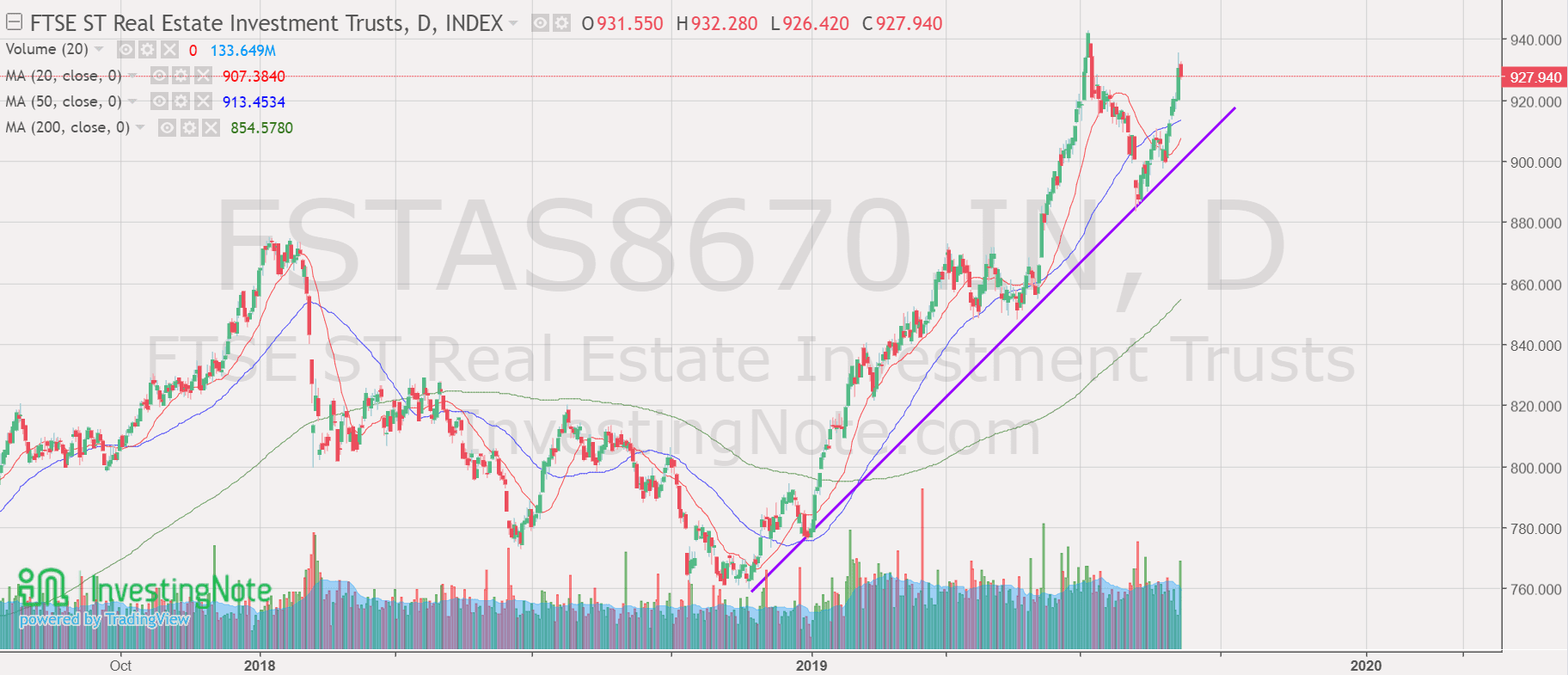
Based on the current chart pattern and and momentum,  the sentiment is BULLISH and the trend for Singapore REIT direction is still UP. The recent selling is a healthy correction before the REIT index can move higher.


Fundamental Analysis of 42 Singapore REITs

The following is the compilation of 42 REITs in Singapore with colour coding of the Distribution Yield, Gearing Ratio and Price to NAV Ratio. This gives investors a quick glance of which REITs are attractive enough to have an in-depth analysis. Added 3 new IPO (ARA US Hospitality Trust, Eagle Hospitality Trust and Prime US REIT) in this month table. Do take note that distribution yield for these 3 newly IPO are just a projection based on the IPO prospectus.

  • Price/NAV increases from 1.05  to 1.06 (Singapore Overall REIT sector is over value now).
  • Distribution Yield maintains at 6.37% (take note that this is lagging number). About 33.3% of Singapore REITs (14 out of 42) have Distribution Yield > 7%.
  • Gearing Ratio maintains at 34.7%. 24 out of 42 have Gearing Ratio more than 35%. In general, Singapore REITs sector gearing ratio is healthy. Note: The current limit of gearing ratio for REITs listed in Singapore Stock Exchange is 45% but there is a consultation paper by SGX to review the potential increase to 50-55% limit.
  • The most overvalue REIT is Keppel DC REIT (Price/NAV = 1.75), followed by Parkway Life (Price/NAV = 1.68), Ascendas REIT (Price/NAV = 1.53), Mapletree Industrial Trust (Price/NAV = 1.54), Mapletree Logistic Trust (Price/NAV = 1.33), Frasers Logistic & Industrial Trust (Price/NAV = 1.36), CapitaMall Trust (Price/NAV = 1.30) and Mapletree Commercial Trust (Price/NAV = 1.42)
  • The most undervalue (base on NAV) is Fortune REIT (Price/NAV = 0.52), followed by OUE Comm REIT (Price/NAV = 0.73), Far East Hospitality Trust (Price/NAV = 0.77) and Eagle Hospitality Trust (Price/NAV = 0.76)
  • The Highest Distribution Yield (TTM) is Eagle HT (9.54%), followed by SoilBuild BizREIT (9.22%), Sasseur REIT (8.67%), EC World REIT (8.48%), Lippo Mall Indonesia Retail Trust (8.43%),  First REIT (8.60%) ARA HT (8.28%).
  • The Highest Gearing Ratio are Far East HTrust (39.8%), ESR REIT (39%),  OUE Comm REIT (39.3%) and SoilBuild BizREIT  (39.4%)
  • Top 5 REITs with biggest market capitalisation are Ascendas REIT ($9.78B), CapitaMall Trust ($9.81B), Capitaland Commercial Trust ($7.99B), Mapletree Commercial Trust ($6.54B) and Mapletree Logistic Trust ($5.67B)
  • The bottom 3 REITs with smallest market capitalisation are BHG Retail REIT ($350M), Sabana REIT ($479M) and iREIT Global REIT ($477M)

Disclaimer: The above table is best used for “screening and shortlisting only”. It is NOT for investing (Buy / Sell) decision. To learn how to use the table and make investing decision, Sign up next REIT Investing Workshop here to learn how to choose a fundamentally strong REIT for long term investing for passive income generation
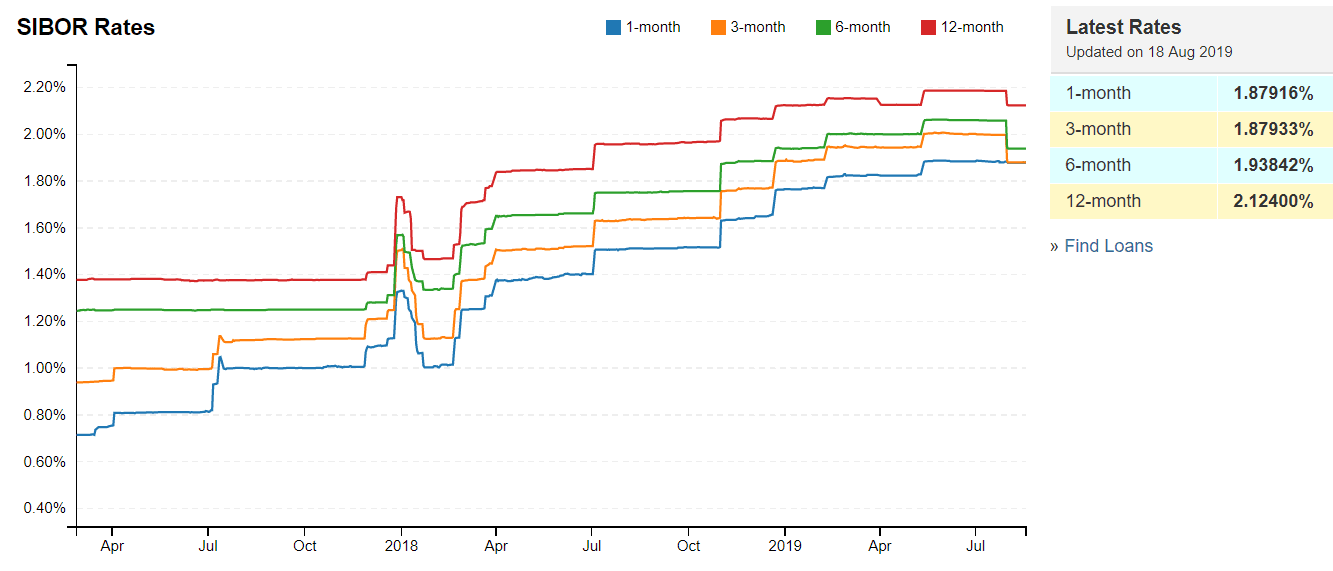
  • 1 month decreases from 1.88250% to 1.87916%
  • 3 month decreases from 1.99783% to 1.87933%
  • 6 month decreases from 2.05792% to 1.93842%
  • 12 month decreases from 2.18500% to 2.12400%


Summary

Fundamentally the whole Singapore REITs is over value now based on simple average on the Price/NAV. The big cap REITs are getting quite expensive and the distribution yield are still not attractive and most of the DPU yield for big cap REIT is below 5% now. Mapletree Commercial Trust has the lowest yield among the Singapore REITs is 4.08% now. The yield spread between big cap and small cap REIT remains wide. This indicates value picks only in small and medium cap REITs.

Yield spread (reference to 10 year Singapore government bond of 1.705%) has widened from 4.635% to 4.665%.  DPU yield for a number of small and mid-cap REITs remains very attractive  (>7%) after the recent minor correction. The risk premium for small cap REIT is attractive as compared to big cap REITs.
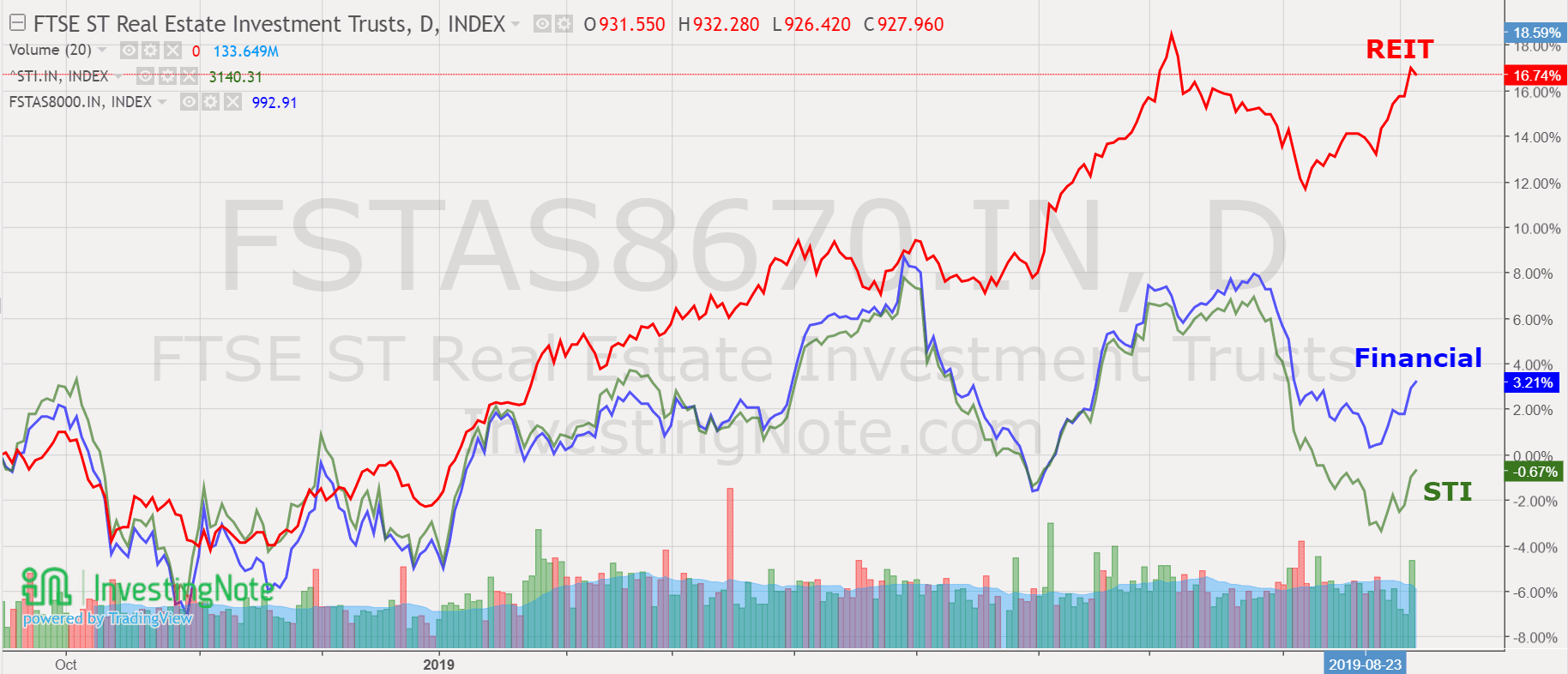
Technically, the REIT index continues the bullish uptrend after the recent retracement. REIT index continues to outperform STI and the financial sectors due to the following 3 macro factors (1) low interest rate environment (2) potential relax of gearing ratio to 50-55% limit (3) TINA (There Is No Alternative) for other high yield asset classes. The positive sentiment may entice Singapore REITs to take on more debt to grow the current portfolio.


My next Singapore REIT investing course is planned on Sept 21, 2019. Registration detail can be found at following link.


If you need an independent professional review on your current REIT portfolio and need any recommendation, you may engage me in the REIT portfolio Advisory. REITs Portfolio Advisory.  https://mystocksinvesting.com/course/private-portfolio-review/

Continue ReadingSingapore REIT Fundamental Analysis Comparison Table – 6 September 2019

5 Reasons Why you should include REIT in your retirement portfolio

  • Post author:

One of the common questions I always receive in my seminars is what type of asset classes are suitable in our retirement portfolio. Is it endowment, annuity, universal life, bonds, equities, physical properties, land banking, hedge funds, etc. Physical properties is one of the most favorite asset classes when come to investing in Singapore. However, there are some disadvantages on physical properties investing when we are entering into our retirement age.

REIT stands for Real Estate Investment Trust and can be served as alternative to physical property investing. I will share here 5 reasons to include REIT as alternative investment to physical real estate in your retirement portfolio.

  1. Liquidity – during our retirement age, we need liquidity to pay for our living expense and for any unforeseen medical expenses. The flexibility and easiness to liquidate our investment assets to cash is extremely important. For retirees who are holding many physical real estate may want to consider to REIT as alternate to physical real estate for their retirement years as it can be liquidated immediately and get the cash back within 5 working days.
  2. Tax free and Lower total cost – there are many tax advantages by investing in REIT because the dividends generated and capital gain from REIT are not taxable. However, there are BSD, ABSD, SSD, Property Tax, Rental Income Tax by investing in physical real estate. In addition, investors still have to pay for hefty legal fee and agent commission, fire insurance cost, repairs and maintenance cost. No legal fee is payable and the brokerage commission is much lower for investing in REIT.
  3. High yield – REIT offers 5-9% annual dividend compared to physical real estate which generate between 2-5% depends on the real estate types. The REIT manager always look for yield accretive acquisition and go through a series of AEI (Asset Enhancement Initiative) of the portfolio to increase the distribution payout every year.
  4. Diversification – REIT offers better diversification in terms of number of properties, property types, tenant based, geographical and sectors compared to landlord who can only own one or two residential properties with the resources available. Investors are able to have a well balanced and diversified portfolio with a little as a few thousands dollars of the investment capital for retirement.
  5. Hassle free – As the landlord of the investment properties, he or she has to deal with the sourcing of properties, negotiation of the Sales & Purchase Agreement, apply and service the bank loan, collecting rental, managing the tenants, dealing with the property maintenance, etc. However, there is no such hassles when investing in REIT as there are professional managers engaged to deal with all these tasks.

In summary, people should enjoy their retirement years by fully optimising their investment to generate the monthly passive income. Retirees should enjoy their retirement instead of getting worried about their investment and also deal with all such hassles. REIT is an asset class which retiree should include into their investment portfolio for their retirement.


Kenny Loh is a Senior Consultant from Singapore Largest Independent Financial Advisor helping clients in building an investment portfolio for retirement. He specialised in Singapore REIT and has been conducting REIT investing courses for past 7 years. 

He won the Top Investment Asset Under Advisory (AUA ) 2nd runner up in 2017 and currently managing million of AUA. He also won the Best Practice Consultant Award in 2017. He can be contacted through kennyloh@fapl.sg if you would like his help to personalise a REIT portfolio for your retirement.

Continue Reading5 Reasons Why you should include REIT in your retirement portfolio

3 Dividend Pitfalls for Dividend Seeking Investors

  • Post author:

There is nothing wrong with investing in dividend stocks to generate passive income for your retirement planning. However, it will cause a huge dent in your retirement portfolio if you are investing wrongly. The following are the 3 dividend pitfalls that you have to avoid.

Pitfall No 1: High Dividend Yield is Lagging

Everyone wants to invest in shares which give high dividend yield. It is a no-brainer to choose Share A with a 10% dividend yield over Share B with a 4% dividend yield. However, investors need to be very careful when investing in shares with high dividend yield because ‘dividend yield’ is a lagging number. The high yield could be caused by a sharp drop in the current stock price due to weakening of the fundamentals or poor forward-earning guidance. Investing in such shares may instead cause investors to lose part of the capital invested and receive reduced dividend in the future.

dividend yield - financial alliance

Pitfall No 2: Dividend Pay-out Ratio is Not Guaranteed

There is no guarantee that the underlying shares will continue to pay dividend. The management can change the dividend pay-out ratio due to the company’s profit & loss position, cash flow situation, future expansion considerations and other reasons. Thus, the dividend from Real Estate Investment Trust (“REIT”) is more predictable compared to normal shares, because a REIT must distribute at least 90% of its taxable income to shareholders.

Pitfall No 3: Dividend Pay-out from Capital

Most investors do not read the fine print in the fact sheet before signing the agreement. Quite a number of mutual funds or unit trusts have the flexibility to pay dividend from capital when there is a need to. Such a dividend-paying practice is akin to you paying yourself dividend from your own bank account.

Nowadays, there are many advertisements promoting various investment products which give high dividends to generate passive income for your retirement planning. However, it is very important to pay attention to the above 3 dividend traps before you invest your hard-earned money. Ensure that you consider the above 3 factors, ask questions and get a satisfactory answer before signing any agreement. Alternatively, get a qualified and experienced investment advisor’s help in building your investment portfolio to minimise costly mistakes that may plague you later on.


Kenny Loh is a Senior Consultant at Financial Alliance, the largest Independent Financial Advisor in Singapore. He has won 4 Awards in 2017, Financial Alliance Quality Class Merit Award, Top 5 Investment Asset Under Advice (AUA) Award, Rookie Consultant of the Year Award and Best Practice Consultant Award. Visit his personal profile here:https://fa.com.sg/kennyloh/

Continue Reading3 Dividend Pitfalls for Dividend Seeking Investors