Technical Analysis of FTSE ST REIT Index (FSTAS8670)
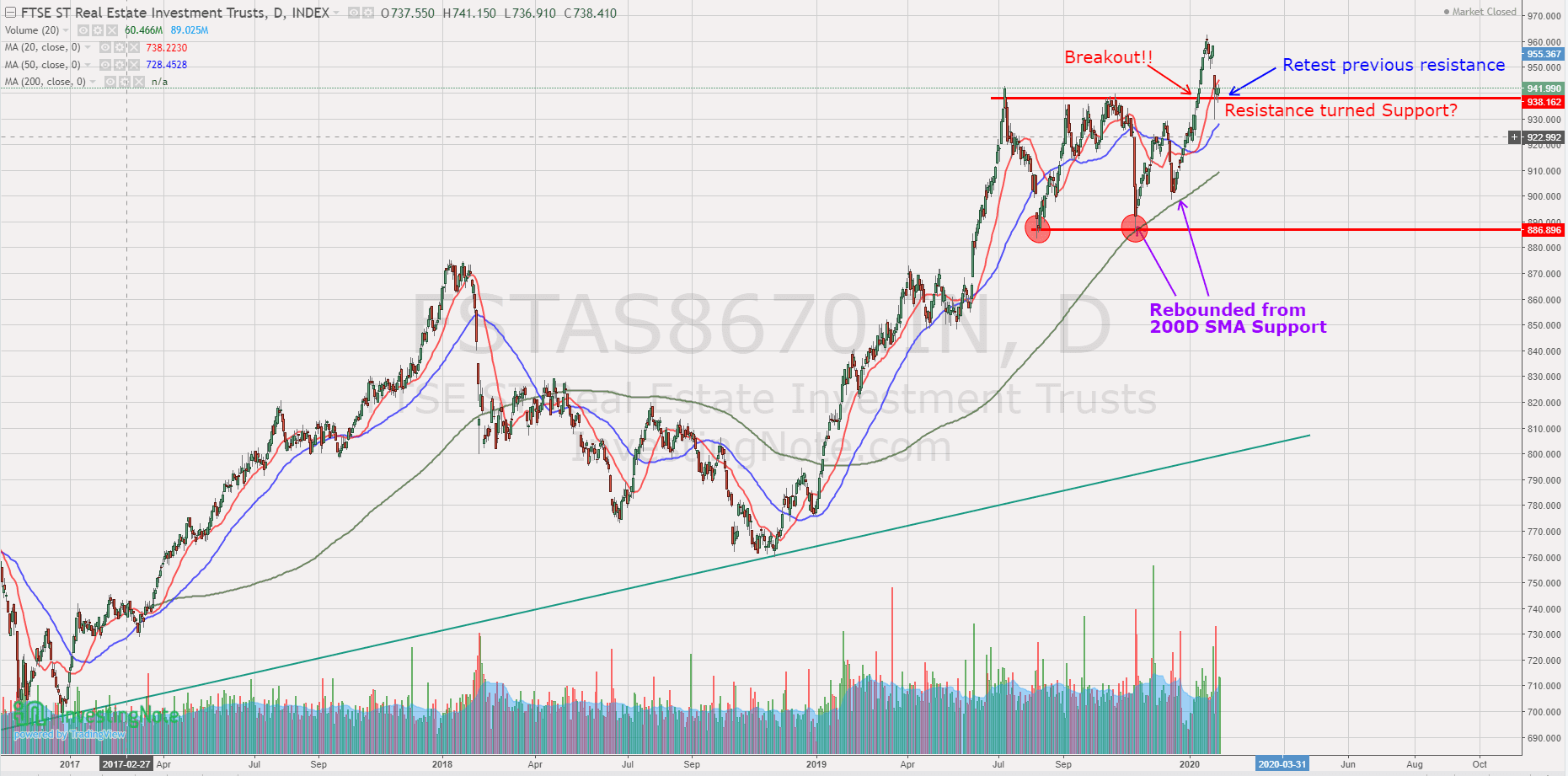
FTSE ST Real Estate Investment Trusts (FTSE ST REIT Index) broke out from the consolidation and hit historical high at 962.57. The REIT index has changed from 926.24 to 941.99 (+1.70%). Currently the REIT index retraced back to the the previous resistance at the breakout. If this resistance is turned to support, the REIT index is expected to continue to trade higher. Probable direction for REIT index: Up. Previous chart on FTSE ST REIT index can be found in the last post Singapore REIT Fundamental Comparison Table on Jan 2, 2020.
Fundamental Analysis of 40 Singapore REITs
The following is the compilation of 40 REITs in Singapore with colour coding of the Distribution Yield, Gearing Ratio and Price to NAV Ratio. This gives investors a quick glance of which REITs are attractive enough to have an in-depth analysis. DPU Yield for Eagle Hospitality Trust, Prime US REIT and Lendlease Global Commercial REIT are projection based on the IPO prospectus.
Note: The Financial Ratio are based on past data and there are lagging indicators.

- Price/NAV stays at 1.10 (Singapore Overall REIT sector is over value now).
- Distribution Yield increases from 6.19% to 6.24% (take note that this is lagging number). About 25% of Singapore REITs (9 out of 40) have Distribution Yield > 7%.
- Gearing Ratio increases from 35.2% to 35.4%. 25 out of 40 have Gearing Ratio more than 35%. In general, Singapore REITs sector gearing ratio is healthy. Note: The current limit of gearing ratio for REITs listed in Singapore Stock Exchange is 45% but there is a consultation paper by SGX to review the potential increase to 50-55% limit.
- The most overvalue REIT is Keppel DC REIT (Price/NAV = 1.98), followed by Parkway Life (Price/NAV = 1.86), Ascendas REIT (Price/NAV = 1.48), Mapletree Industrial Trust (Price/NAV = 1.76), Mapletree Logistic Trust (Price/NAV = 1.56) and Mapletree Commercial Trust (Price/NAV = 1.34).
- The most undervalue (base on NAV) is Eagle Hospitality Trust (Price/NAV =0.56), followed by Lippo Malls Indonesia Retail Trust (Price/NAV = 0.69) and Far East Hospitality Trust (Price/NAV = 0.79)
- The Highest Distribution Yield (TTM) is Eagle Hospitality Trust (12.79%) followed by SoilBuild BizREIT (9.40%), Lippo Mall Indonesia Retail Trust (9.35%), EC World REIT (8.48%), First REIT (8.51%) and Cache Logistic Trust (8.07%).
- The Highest Gearing Ratio are ESR REIT (41.5%), OUE Comm REIT (40.3%), Far East HTrust (39.6%), Cache Logistic Trust (40.1%) and EC World REIT (39.6%).
- Top 5 REITs with biggest market capitalisation are Ascendas REIT ($11.39B), CapitaMall Trust ($9.29B), Capitaland Commercial Trust ($7.95B), Mapletree Commercial Trust ($7.77B) and Mapletree Logistic Trust ($6.98B)
- The bottom 3 REITs with smallest market capitalisation are BHG Retail REIT ($333M), Sabana REIT ($490M) and iREIT Global REIT ($529M)
Disclaimer: The above table is best used for “screening and shortlisting only”. It is NOT for investing (Buy / Sell) decision. To learn how to use the table and make investing decision, Sign up next REIT Investing Workshop here to learn how to choose a fundamentally strong REIT for long term investing for passive income generation.

- 1 month increases from 1.74833% to 1.68717%
- 3 month increases from 1.77250% to 1.73862%
- 6 month decreases from 1.82763% to 1.82363%
- 12 month decreases from 1.96692% to 1.96338%
Summary
Fundamentally the whole Singapore REITs is over value now based on simple average on the Price/NAV. The big cap REITs are still quite expensive after the recent correction. Most of the DPU yield for big cap REIT is below 5% now such as CapitaCom Trust, CapitaMall Trust, Fraser Centerpoint Trust, Keppel DC REIT, Keppel REIT, Parkway Life REIT, Mapletree Com Trust, Mapletree Logistics Trust and Mapletree Industrial Trust. The distribution yield of ParkwayLife REIT, Keppel DC REIT and Mapletree Commercial Trust have dropped below 4%. However, the yield remains attractive compared to other fixed income asset classes like corporate bonds and government bonds. The yield spread between big cap and small cap REIT remains wide.
Yield spread (reference to 10 year Singapore government bond of 1.604%) has widened from 4.431%. to 4.636%. The risk premium for small cap REIT is very attractive as compared to big cap REITs. This indicates value picks only in small and medium cap REITs.
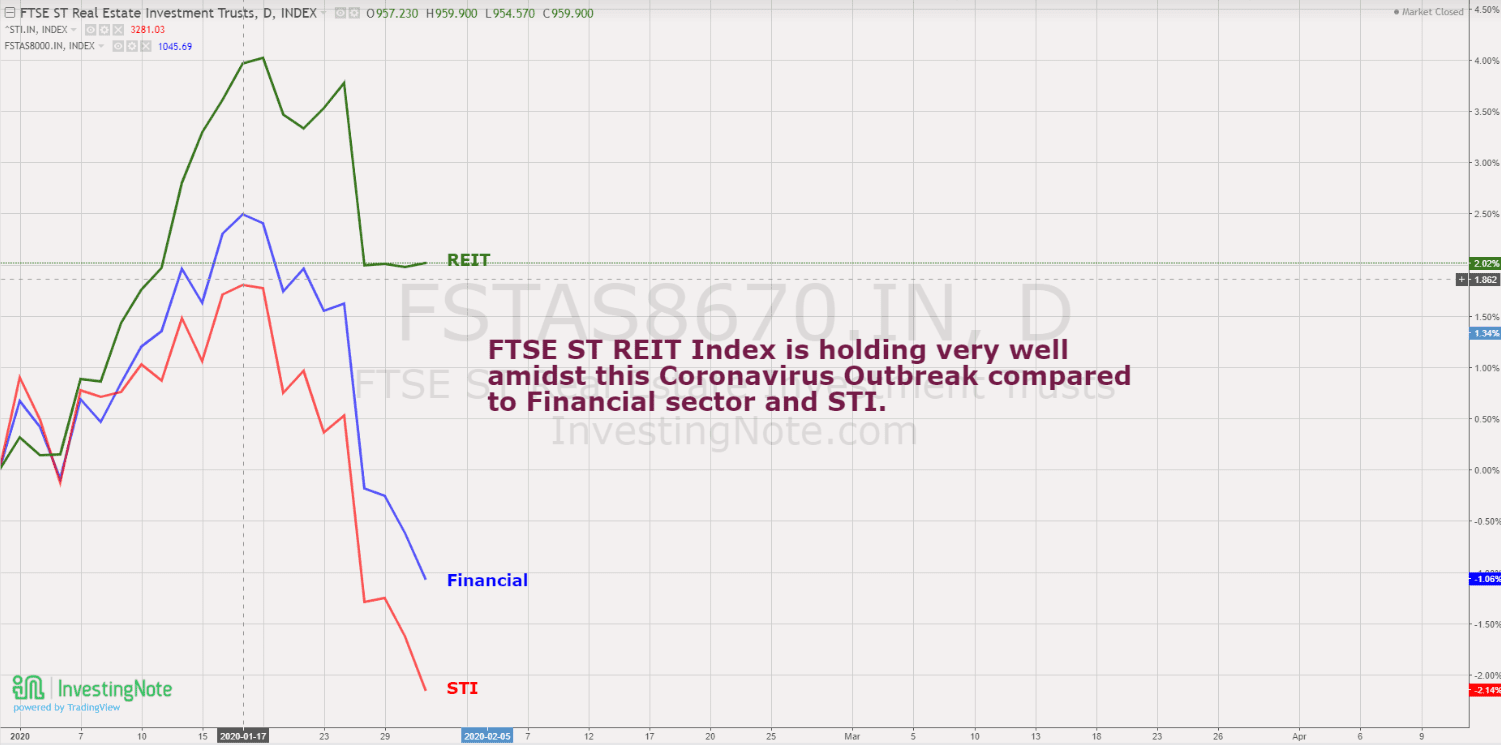
Below chart is the Year to Date (2020) comparison between FTSE ST REIT Index, FTSE ST Financial Index and Straits Time Index (STI). STI and Financial Sectors suffered losses due to the fear of coronavirus outbreak. However, Singapore REIT is holding very well and still trading in positive gain YTD due to its defensiveness.
Current macro factors are expected to continue to support the bull run of REIT index, there are: (1) low interest rate environment (2) potential relax of gearing ratio to 50-55% limit (3) TINA (There Is No Alternative) for other high yield asset classes. The positive sentiment may entice Singapore REITs to take on more debt to grow the current portfolio. Combining the above Macro & Technical Analysis, Singapore REIT is expected to continue to do well in 2020. I was invited by OTCS (Online Traders Club Singapore) to share my S-REIT 2020 Market outlook recently at SGX. Readers can refer to the summary page below.

Some photos at SGX Auditorium (Super Full House!) You can join the mailing list here if you want be informed on future events. https://mystocksinvesting.com/mailinglist/


If you want a “Sleep Well” Dividend Paying Portfolio to make your money works harder for you, Singapore REIT is one of the asset classes you must have in your investment portfolio. Of course, you have to learn more about the fundamental of REITs, the behaviors of the REITs, and pro/cons of the REITs.
My next Singapore REIT investing course is planned on April 18, 2020. You can register here. https://mystocksinvesting.com/course/singapore-reits-investing/
If you do not have time to learn all the basic, or you want to kick start your REIT portfolio within 1 month, I can help you to construct a REIT portfolio with a fee. You can just sit back, relax and wait for the dividend to come it as I will be doing all the job in managing your REIT portfolio. For REIT Portfolio Consultation, please drop me an email marubozu@mystocksinvesting.com