Backtesting Result on my REITs Selection Criteria

  • Post author:

I was very excited to learn the back-test result on my REITs Selection criteria by Christopher (blog owner of Growing your tree of prosperity). I will definitely catch up and learn from him his unique backtesting strategy. This will definitely help me to improve my REITs portfolio performance.

See my post on  3 Investing Mistakes for Singapore REITs at Investors Exchange by BIGScribe here.

I shared his backtest result here. You can find his original post below.

Deep REIT investing insights from Investors Exchange 2017

Sometimes, the good stuff needs to wait until after a seminar is over.

As speakers in BIGSCribe events are also investors, we are also part of the audience when someone else is speaking.

Kenny Loh or Marubozu gave a fantastic presentation on REITs investing and runs a course here. Here are the results of my back-testing to refine my own REIT investing strategy using the insights I learned from Kenny Loh’s Three Musketeers approach to REIT investing. Paying customers would already have some sort of quick tutorial on what semivariance is from my presentation.

a) Baseline – buying all REITs at one go

If you buy all 41 REITs in equal proportions, your returns would have been 8.5% with a semivariance of 13.67% for the past 10 years. This is our baseline and I recommend that every investor who might not want to go too deep into screening should just buy all the REITS in SGX in equal proportions.

b) Choosing REITs with the highest Yield 

As I have spoken in my own presentation, buying half of the higher yielding universe of REITs can outperform the strategy of buying all the REITs in the SGX universe. Last time I backtested 9.64% with a higher semivariance of 14.25%.

c) Choosing REITs with the lowest Gearing

Kenny spoke about looking for REITs with a lower gearing. I backtest a strategy that buys half of the REITs in SGX with a lowest debt to equity ratio. Once again, I was able to outperform at 9.56% with semivariance of 13.98%.

d) Choosing REITS with the lowest Price to Net Asset Value

Kenny spoke about being careful when looking for REITs with a high net asset value. I backtest a strategy that buys half of the REITs in SGX with a lowest pice to book ratio. This time I underperformed at 7.28% with semivariance of 15.08%.

Attempting to buy a dollar worth of real estate with 99 cents actually backfires on the investor with lower returns and higher risk.

e) Super-duper REIT screening strategy

So thanks to Kenny, there are at least two working strategies. Find REITs with a high yield and low gearing. I combined both screens, searching for the top 50% highest yielding REITs and then within that set, short-listing 50% of those with the lowest gearing.

This time I had a winning strategy in my hands. A final return of 13.16% with a semivariance of 14.49%. It has a fairly high Sharpe ratio of 0.54.  1 in 40 years, you may lose about 16% of your portfolio value, making this something which may be amenable to 200% leverage.

What is the moral of the story ?

When investors get together and mutually present seminars, our insights are silo-ed and we might not be able to extract the maximum benefit if we stick to our own investing approach. Even my 6-8% strategy returned only 10%.

Because I always make sure that I follow up on my learnings from other speakers, the blogosphere can benefit from a much sharper insight that combines the investment ideas of several speakers.

[ Note : The Singapore REITs universe is small, applying a screen to choose a quarter of sticks in the universe will only yield about 8-11 stocks. A diversified investor will need a few different strategies to build a portfolio that can withstand the test of the time. ]


Check out coming seminars at https://mystocksinvesting.com/events

REITs Portfolio Advisory

Singapore REITs Investing Course


Continue ReadingBacktesting Result on my REITs Selection Criteria

Singapore REIT Fundamental Analysis Comparison Table – 7 August 2017

  • Post author:

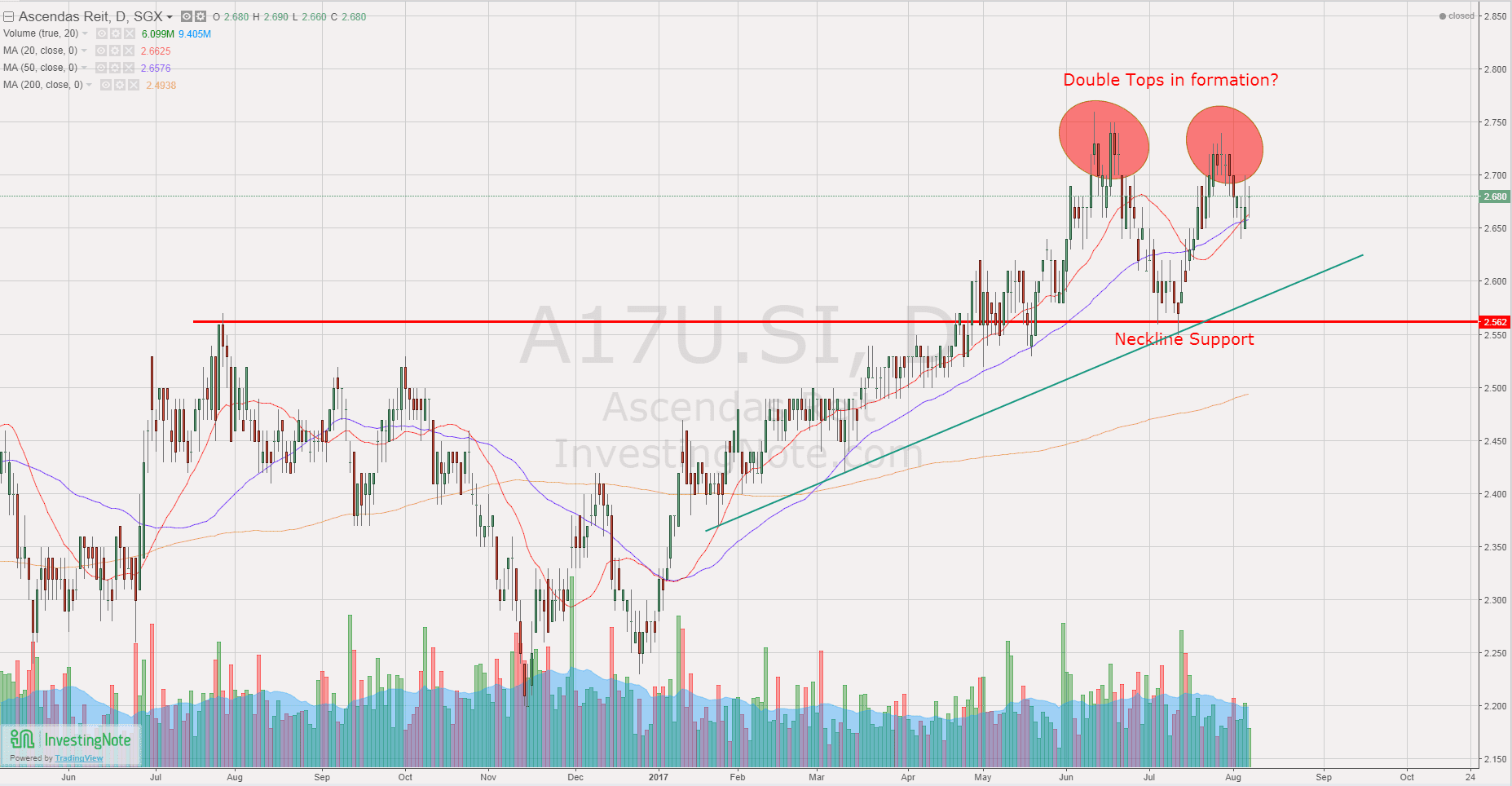
FTSE ST Real Estate Investment Trusts (FTSE ST REIT Index) increases from 796.88 to 802.25 (+0.67%) ( compare to last post on Singapore REIT Fundamental Comparison Table on July 9, 2017.  The index was rejected at a strong resistance is at about 820. See key level of support and resistances of FTSE REIT Index here.  Singapore REITs as a whole is still trading within a uptrend channel and still on a bullish up trend. However, keep a very close eye on the 20D / 50D SMA direction because Ascendas REIT is currently forming a Double Tops pattern.


Fundamental Analysis

  • Price/NAV increases from 1.03 to 1.05 (Singapore Overall REIT sector is slightly over value now).
  • Distribution Yield decreases from 6.52% to 6,48% (take note that this is lagging number). About one quarter number of Singapore REITs (10 out of 37) have Distribution Yield > 7%. This is a significant drop in numbers compare to a few months ago. This indicates there are lesser Singapore REITs with attractive yield to pick now.
  • Gearing Ratio reduced from 35.0% to 34.8%. 20 out of 37 have Gearing Ratio more than 35%. In general, Singapore REITs sector gearing ratio is healthy.
  • Most overvalue REIT is Parkway Life (Price/NAV = 1.63), followed by Keppel DC REIT (Price/NAV = 1.37), First REIT (Price/NAV = 1.34), Mapletree Industrial Trust (Price/NAV = 1.32) and Ascendas REIT (Price/NAV = 1.31)
  • Most undervalue (base on NAV) is Fortune REIT (Price/NAV = 0.72),  followed by Far East HTrust (Price/NAV = 0.75),  Sabana REIT (Price/NAV = 0.79) and Keppel REIT (Price/NAV = 0.83).
  • Highest Distribution Yield (TTM) is Sabana REIT (8.47%), followed by SoilBuild BizREIT (8.4%), Viva Industrial Trust (7.88%) and iREIT Global REIT (7.89%).
  • Highest Gearing Ratio is Cache Logistic Trust (43.4%), iREIT Global (42.1%).

Disclaimer: The above table is best used for “screening and shortlisting only”. It is NOT for investing (Buy / Sell) decision. To learn how to use the table and make investing decision, Sign up next REIT Investing Seminar here to learn how to choose a fundamentally strong REIT for long term investing for passive income generation.


Economy Analysis – Singapore


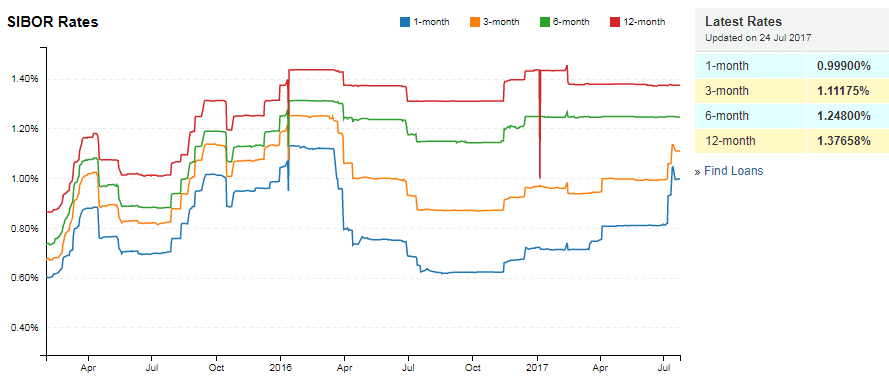
  • 1 month increases from  0.81225% to 0.99900%
  • 3 month increases from 0.99383% to 1.11175%
  • 6 month maintains at 1.24800%
  • 12 month increases from 1.37575% to 1.37658%


The Singapore Manufacturing PMI rose to 51 in July 2017 from 50.9 in the previous month. The reading pointed to the strongest pace of expansion in the manufacturing sector since April, boosted by growth in new orders, new exports and output. Also, the PMI for the electronics sector increased to 52.2 from 52.1 in June. Manufacturing PMI in Singapore averaged 50.14 from 2012 until 2017, reaching an all time high of 51.90 in October of 2014 and a record low of 48.30 in October of 2012.


The Gross Domestic Product (GDP) in Singapore expanded 0.40 percent in the second quarter of 2017 over the previous quarter. GDP Growth Rate in Singapore averaged 6.77 percent from 1975 until 2017, reaching an all time high of 37.20 percent in the first quarter of 2010 and a record low of -13.50 percent in the fourth quarter of 2008.


Summary

Fundamentally the whole Singapore REITs is slightly over value. Office and Hospitality sectors are still undervalue but have not seen any clear turnaround signs yet. Technically Singapore REITs is still on bullish up trend but facing the resistance of 820.

There are not many REITs left to pick at the present moment. If you have missed the boat to invest in REITs but have fear of selecting the wrong REITs. you may want to check out this Investing in Singapore REIT course here.


See all other relevant  Singapore REITs blog posts here.

Original post from https://mystocksinvesting.com

Check out coming seminars at https://mystocksinvesting.com/events

REITs Portfolio Advisory


Continue ReadingSingapore REIT Fundamental Analysis Comparison Table – 7 August 2017