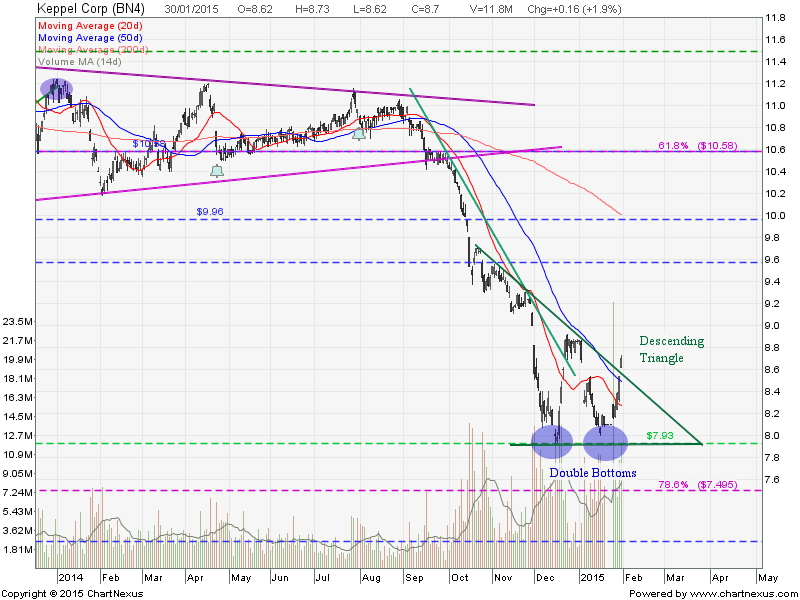
Keppel Corp: No Sight of Bottoming Yet

  • Post author:

Keppel Corp is currently on a clear down trend and have no sign of bottoming yet. Not the right time to do bottom fishing yet for this blue chip which is listed on Singapore Stock Exchange and one of the component stocks of Straits Time Index (STI)

Original post by Marubozu from My Stocks Investing Journey.


2014Dec14-KepCorp-800x600


Current P/E Ratio (ttm) 7.9490
Estimated P/E(12/2014) 9.4296
Relative P/E vs. FSSTI 0.5958
Earnings Per Share (SGD) (ttm) 1.0190
Est. EPS (SGD) (12/2014) 0.8590
Est. PEG Ratio 4.2380
Market Cap (M SGD) 14,713.87
Shares Outstanding (M) 1,816.53
30 Day Average Volume 5,960,867
Price/Book (mrq) 1.4635
Price/Sale (ttm) 1.1330
Dividend Indicated Gross Yield 5.19%
Cash Dividend (SGD) 0.1200
Dividend Ex-Date 07/31/2014
5 Year Dividend Growth 5.12%
Next Earnings Announcement 01/23/2015
Continue ReadingKeppel Corp: No Sight of Bottoming Yet

Singapore REIT Fundamental Analysis Comparison Table – 14 Dec 2014

  • Post author:

FTSE ST Real Estate Investment Trusts (FTSE ST REIT) Index changes from 763.85 to 774.40 compare to last post on Singapore REIT Fundamental Comparison Table on Nov 2, 2014. The index rebounded from the 200D SMA but currently facing the resistance at about 780.  The index is currently range bound in consolidation mode and moving sideway.

FTSE ST REIT Index Dec14-2014

  • Price/NAV increases from 1.03  to 1.04 (slightly over value now)
  • Distribution Yield increases from 6.53% to 6.59% (take note that this is lagging number, past DPU does not represent future DPU). Note: I did not color code the yield number because yield is relative to individual risk appetite. High Yield does NOT mean it is a good REIT. Low Yield does NOT mean it is a bad REIT. We have to analyse the Fundamental and do Risk Assessment of the REIT.
  • Gearing Ratio increases from 33.81% to 33.90%.

Singapore-REIT-Fundamental-Analysis-and-Comparison-Table-13-Dec-2014

Singapore Interest Rate Dec14-2014

There are 35 Real Estate Investment Trust in Singapore as shown in the above table. Most people just purely choose the REIT with HIGH DIVIDEND and invest blindly without knowing what are the RISKS. If you want to learn how to pick the right REIT and invest to generate passive income safely, check out the very pragmatic and educational public seminar here “Investing in Singapore REIT“.

Grab an insight of the REIT class here 3 Tips To Increasing Returns On REITs Investments

Continue ReadingSingapore REIT Fundamental Analysis Comparison Table – 14 Dec 2014

The Growth of the Singapore Economy: A Shift in the Forex Market

  • Post author:

Guest Post

There have been several shifts in the forex market recently, with the Australian Dollar (AUD) experiencing rapid and sudden decline. This has been sharply contrasted by the rise of the Singapore Dollar (SGD), which has evolved steadily on the back of concerted commercial growth and a positive outlook in the Economic Development Board’s Industrial Production statement. This is creating a new and interesting dimension for forex traders, who may be able to capitalise at least in the quest for short-term gains.


The SGD and the Singapore Economy: Consistent Growth in 2014

In terms of specific performance figures, Singapore’s industrial production sector expanded by 0.2% in October, with year-on-year growth only just falling slightly short of the analysts’ forecast of 0.6%.  Despite brief periods of fluctuation, the biomedical manufacturing sector in Singapore recorded annual growth of 22.5%, while pharmaceutical segments also rose by a healthy rate of 24.3%. Alongside significant expansion in the technology sector, this has created a strong economic proposition that has driven a significant rise in the value of the SGD.

This can be contrasted sharply with the performance of the AUD, which is often traded as part of a pair with the Singapore Dollar. While it is fair to say the SGD has held a significant advantage over the AUD since the final embers of 2012, however, in recent times the distance between the two has widened with the latter falling to depressing four year lows recently. This at least provides clarity for traders in the forex market, who can capitalise on the falling demand for Australian commodities and the sense of global economic uncertainly to back the often unheralded SGD.

In Summary: The Big Picture for Forex Traders

With this in mind, we are likely to see a growing number of traders back the SGD in the near future, especially with the trend for Singapore economic growth likely to remain prominent during the first financial quarter of 2015 at least. Alongside a declining AUD, this offers a transparent vehicle for short-term gains and relatively secure trades.

Going forward, however, it will be interesting to see whether the Australian economy can recover and gain a position of strength among its Asian trading partners such as China, India and to a lesser extent Japan. Without this, the SGD is likely to remain the Asia-Pacific currency of choice for forex traders who are looking to maximise their income in the current marketplace.

Continue ReadingThe Growth of the Singapore Economy: A Shift in the Forex Market