Follow My Trades at TradeHero @marubozu1688

  • Post author:

Participating in stock trading may be intimidating for most casual investors and deciding on the right trades to make can be an impossible task. Experienced traders have the knowledge and expertise, but without any incentive there is no reason to share information with other investors. TradeHero aims to bridge the gap by providing a platform where anyone can make money from the financial markets, by subscribing to the expert trade feeds of top traders as guidelines for your real-life trades, or becoming a top trader and earning monthly subscription fees from other users who follow your trade feeds.

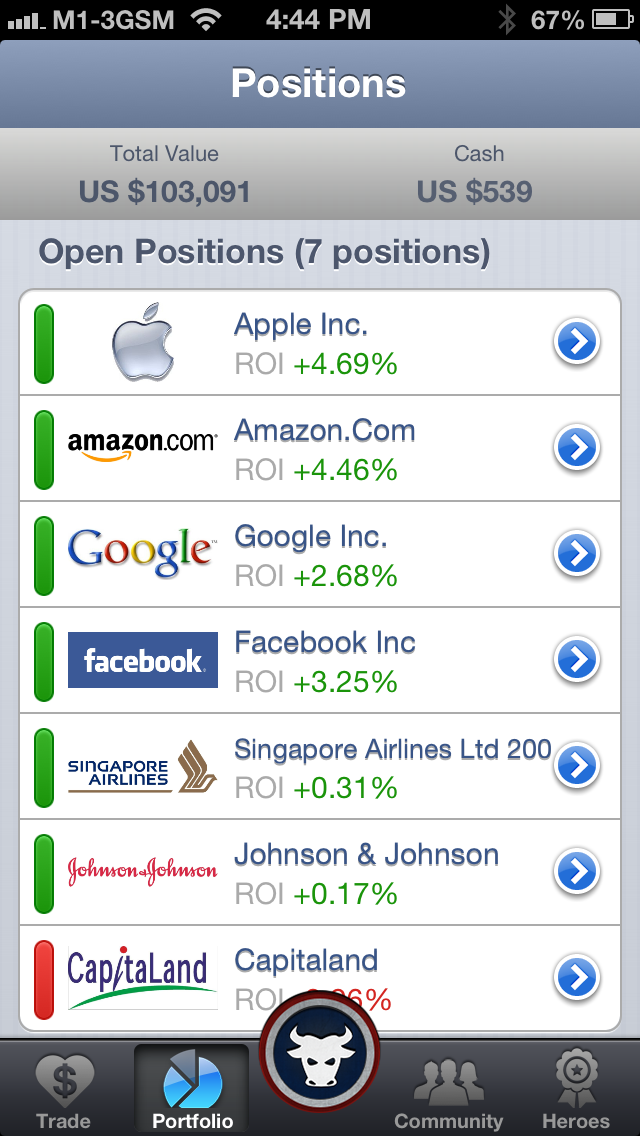
TradeHero is a stock market simulation mobile app that draws real-time data from 14 stock exchanges. Users are credited with a $100,000 starting portfolio and can make trades to create their own virtual portfolio. The app’s Leaderboards identify the most successful traders (known as ‘Heroes’) by their returns, and they are ranked by Exchange, Sector, Monthly or Quarterly returns, as well as overall returns.

Followers can subscribe, for a small monthly fee, to follow and receive trade feeds from their chosen Heroes via push notifications on their mobile device. These push notifications detail each Buy and Sell action of the Hero, allowing followers to receive expert trading tips and personal insight into successful investment strategies. TradeHero will share subscription revenue from followers equally with Heroes, thus allowing Heroes to monetize their trading expertise.
Visit www.TradeHero.mobi for more information.

Follow me marubozu1688 @ TradeHero.

Continue ReadingFollow My Trades at TradeHero @marubozu1688

Benefits of a balanced stock portfolio and how to achieve it

  • Post author:

In the first three sessions of 2013 the Straits Times Index (STI) firmed +1.84%. This morning’s open extended the 2013 gain to +2.11%. The strongest sector index over the last three sessions has been Basic Materials, followed by Consumer Goods. While all Sector Indices provided by FTSE Group are in the green over the first three sessions of 2013, all have performed differently. The REIT index gained the least over the three sessions.
 
Dividing investments over different sectors is common practice for investors that seek to diversify risk and return. Consider the recent different performances and constituents of the FTSE ST Oil & Gas Index and FTSE ST Telecommunications Index. The FTSE ST Oil & Gas Index is made up of 12 stocks versus the FTSE ST Telecommunications Index which is made up of 3 stocks.
 
On Friday, the FTSE ST Oil & Gas Index declined -0.24% while the FTSE ST Telecommunications Index gained +0.24%. This brought the 2013 to date gain for the Oil & Gas and Telecommunications Sector indices to similar levels of +1.45% and +1.53% respectively.  
 
Taking more time into consideration, the difference between sectoral performances has been more pronounced. Last year the FTSE ST Oil & Gas Index outperformed the STI by rising +23.8%. Taking reinvested dividends into consideration, the Oil & Gas Index return was boost to +27.9%. Meanwhile, the FTSE ST Telecommunications Index gained +8.6% over 2012 with dividends boosting the return to +13.8%. The simple average return of the two indices combined came to 20.9% including dividend distributions. By placing equal investment emphasis in the two sector indices, returns were smoothed across two sectors that performed differently.
 
The relative performance of the two indices was reversed in 2011. In 2011, the FTSE ST Oil & Gas Index declined -17.4%, while the Telecommunications Index gained +5.0%. Dividend distributions in 2011 meant the total return of the indices was boost to a -14.9% decline for Oil & Gas and a gain of +10.6% for Telecommunications. The simple average return of the two indices combined came to a decline of -2.2% including dividend distributions. Placing equal investment emphasis in the two sector indices reduced the risk of having all the eggs in an underperforming sector.
 
Both sector Indices have performed differently in the past with the Oil & Gas sector more cyclical than the Telecommunications Index. The past tendency for the Oil & Gas Index to swing more than Telecommunications is best exemplified through the volatility gauge for Telecommunications at 13.5%, less than half the same measure for Oil & Gas Index at 28.2% over a three year period ending December 31.
 
The five largest Oil & Gas stocks as categorised by Industry Classification Benchmark (ICB) and respective 2012 price performances are:

  • Keppel Corp (BN4, + 18.3%),
  • Sembcorp Marine (S51, +20.4%)
  • Sembcorp Industries (U96, +29.6%)
  • STX OSV Holdings (MS7, +12.1%)
  • Ezion Holdings (5ME, +156.1%)

 
The five largest telecommunication stocks as categorised by ICB and respective 2012 price performances are:

  • Singtel (Z74, +6.8%)
  • Total Access Communications USD (B2W, +14.8%)
  • Starhub (CC3, +30.2%)
  • M1 (B2F, +8.4%)
  • Keppel T & T (K11, +22.5%)  

 
Investors who wish to learn more about these stocks are encouraged to participate in the education events list below. Please note that two of the aforementioned Telco stocks, Total Access Communications and Keppel Telecommunications & Transportation are not highly active thus providing an element of liquidity risk.


Source: SGX MyGateWay

Continue ReadingBenefits of a balanced stock portfolio and how to achieve it