Today’s economy is one marked by heightened uncertainty. As the world recovers from a pandemic that underscored persistent and recurring issues, the World Bank reports that global conflicts like the Russian invasion of Ukraine have worsened economic conditions. Ultimately, we might be seeing an extended period of slow growth and aggravated inflation.
For investors, making crucial decisions is critical to ensuring financial security under such turbulent conditions. With everything going on, it’s important to build a strong portfolio to see you through what could be a prolonged period of uncertainty.
Here are some things that you can do to your portfolio in the current economic climate.
Diversify your Portfolio
Investments are inherently risky, so it’s important to build resilience in your portfolio that can offset losses you might incur in certain markets. This is why you should invest in different asset classes, from stocks to ETFs. Even if you have investments that have performed well for you, it’s important not to pin it all on very few assets. You should also hedge by investing in markets that move in the opposite direction to your most volatile assets. Say, if you have stocks that are known to be volatile, you would also want to invest in bonds or investment funds.
Consider spread betting
Spread betting is a derivative strategy where you can speculate on both rising and falling financial markets, without owning the underlying asset that you’re betting on. Depending on your bet, you would either buy the market to go long, or sell it to go short, and the profitability of your spread would be determined by the accuracy of your bets. FXCM explains that spread betting’s advantages include flexibility, available leverage, market diversity, and ease of trade. As with any form of trading, spread betting necessitates carefully thought out strategies such as breakout, news-based, reversal, or trend market spread betting. If properly executed, aside from being lucrative, spread betting also has the added benefit of being tax-free and commission-free.
Invest in energy
Investing in energy is practically non-negotiable. Since oil is a commodity, it has value as an asset and can be traded as an investment derivative. Even though the oil and gas sector has a tendency to be cyclical, and can be volatile due to external factors that influence its distribution, its prices are always bound to go up. Timing is a critical factor in the successful turnout of your energy investments. But especially these days, the war that Russia waged on Ukraine has caused the stock prices of oil to soar, following its collapse during the pandemic. UBS analyst Giovanni Staunovo states oil will continue to garner demand, and it is only expected to improve further as China reopens and summer travel in the northern hemisphere begins to rise.
Putting money into what you believe in
Real estate investment trusts (REITs) are companies that own real estate that produce income. REIT investments are perfect for diversifying your portfolio and are a good choice in uncertain times since they provide high yields, good values, great profitability, and strong growth rates. REIT specialist Kenny Loh has stated that since the reopening of borders has been normalised, it has not had any adverse effects on healthcare and office REITS, while hospitality REITs look promising. In today’s economic state, the profitability of REITs may be largely beneficial for investors.
Uncertainty can hit any time, but there are always ways to protect yourself from these occurrences. So if you’re aiming for financial security, then it’s important to start making the proper investments now.
Technical Analysis of FTSE ST REIT Index (FSTAS351020)
FTSE ST Real Estate Investment Trusts (FTSE ST REIT Index) decreased from 820.69 to 807.47(-1.61%)compared to last month’s update. The REIT Index is currently in a downward Parallel Channel, having broke the 800 support (false broke out last time) between June 14th and June 21st, but rebounded from the 800 support (which tested for 3 occasions).
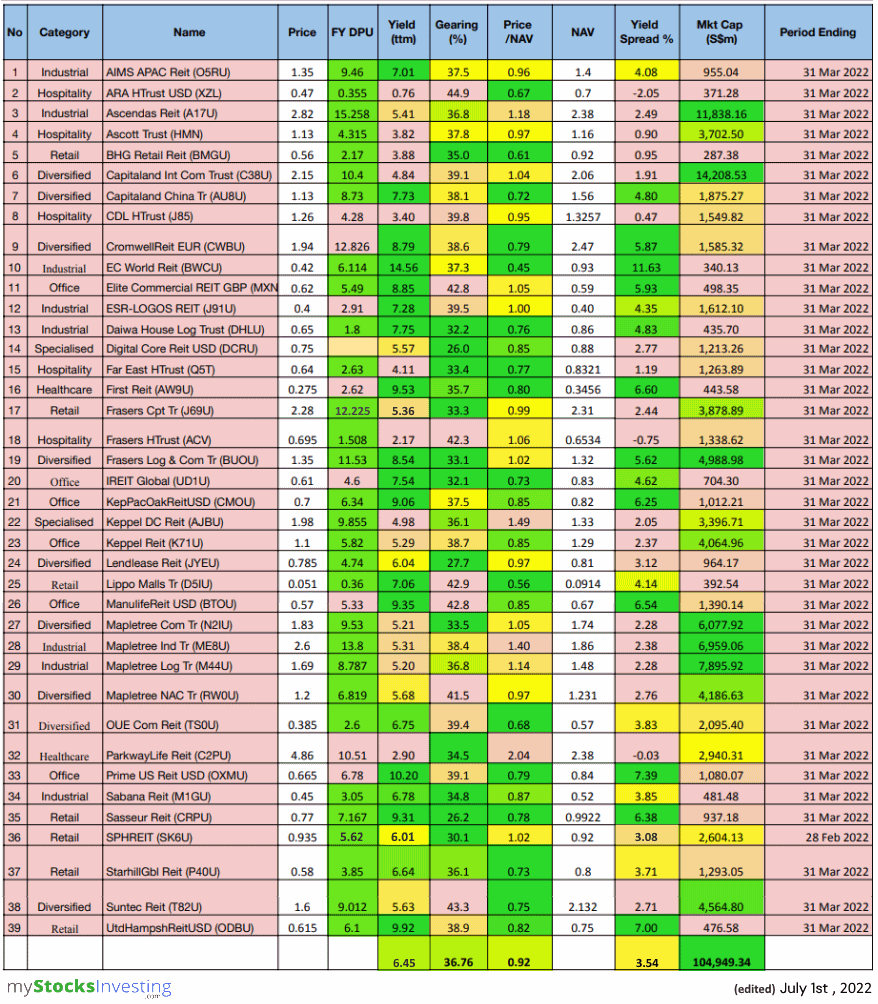
The following is the compilation of 39 Singapore REITs with colour-coding of the Distribution Yield, Gearing Ratio and Price to NAV Ratio.
The Financial Ratios are based on past data and there are lagging indicators.
This REIT table takes into account the dividend cuts due to the COVID-19 outbreak. Yield is calculated trailing twelve months (ttm), therefore REITs with delayed payouts might have lower displayed yields, thus yield displayed might be lower for more affected REITs.
All REITs are updated with the latest Q1 2022 business updates/earnings.
Digital Core REIT’s yield is extracted from the IPO Prospectus, calculated based on *Estimated DPU (calculated from the Prospectus) / Current Price.
ESR REIT and ARA LOGOS Logistics Trust has merged to form ESR-LOGOS REIT. ALOG REIT is no longer shown, shown values are for ESR REIT.
(There previously was an error in the FCT and SPHREIT DPU values. The above table and following values have now been corrected. This happened due to backend issues arising from the quarterly to semiannual DPU switching.)
What does each Column mean?
FY DPU: If Green, FY DPU for the recent 4 Quarters is higher than that of the preceding 4 Quarters.If Lower, it isRed.
Most REITs are green since it is compared to FY20/21 as the base (during the pandemic)
Yield (ttm): Yield, calculated by DPU (trailing twelve months) and Current Price as of July 1st, 2022
Digital Core REIT: Yield calculated from IPO Prospectus.
Gearing (%): Leverage Ratio.
Price/NAV: Price to Book Value. Formula: Current Price (as of July 1st, 2022) over Net Asset Value per Unit.
Yield Spread (%): REIT yield (ttm) reference to Gov Bond Yields. REITs trading in USD is referenced to US Gov Bond Yield, everything else is referenced to SG Gov Bond Yield.
Price/NAV Ratios Overview
Price/NAV decreased to 0.92.
Decreased from 0.95 from June 2022.
Singapore Overall REIT sector is undervalued now.
Take note that NAV is adjusted upwards for some REITs due to pandemic recovery.
Most overvalued REITs (based on Price/NAV)
Parkway Life REIT (Price/NAV = 2.04)
Keppel DC REIT (Price/NAV = 1.49)
Mapletree Industrial Trust (Price/NAV = 1.40)
Ascendas REIT (Price/NAV = 1.18)
Mapletree Logistics Trust (Price/NAV = 1.14)
Frasers Hospitality Trust (Price/NAV = 1.06)
No change to the Top 3 compared to the March to May updates.
Most undervalued REITs (based on Price/NAV)
EC World REIT (Price/NAV=0.45)
Lippo Malls Indonesia Retail Trust (Price/NAV = 0.56)
BHG Retail REIT (Price/NAV = 0.61)
ARA Hospitality Trust (Price/NAV = 0.67)
OUE Commercial REIT (Price/NAV = 0.68)
Capitaland China Trust (Price/NAV = 0.72)
Distribution Yields Overview
TTM Distribution Yield increased to 6.45%
Increased from 6.30% in June 2022.
16 of 40 Singapore REITs have distribution yields of above 7%. (2 more than last month’s update)
Do take note that these yield numbers are based on current prices taking into account the delayed distribution/dividend cuts due to COVID-19, and economic recovery.
Highest Distribution Yield REITs (ttm)
EC World REIT (14.56%)
Prime US REIT (10.20%)
United Hampshire REIT (9.92%)
First REIT (9.53%)
Manulife US REIT (9.35%)
Sasseur REIT (9.31%)
Reminder that these yield numbers are based on current prices taking into account delayed distribution/dividend cuts due to COVID-19.
Some REITs opted for semi-annual reporting and thus no quarterly DPU was announced.
A High Yield should not be the sole ratio to look for when choosing a REIT to invest in.
Yield Spread increased to 3.54%.
Increased from 3.47% in June 2022.
Gearing Ratios Overview
Gearing Ratio remained at 36.83%.
Remained at 36.83% in June 2022.
Gearing Ratios are updated quarterly. Therefore none of the following REITs have updated gearing ratio compared to last month (all are based on Q1 2022 updates)
Highest Gearing Ratio REITs
ARA Hospitality Trust (44.9%)
Suntec REIT (43.3%)
Lippo Malls Indonesia Retail Trust (42.9%)
Manulife US REIT (42.8%)
Elite Commercial REIT (42.8%)
Frasers Hospitality Trust (42.3%)
No change to the Top 3 compared to the April, May and June updates.
Market Capitalisation Overview
Total Singapore REIT Market Capitalisation decreased by 3.85% to S$104.95 Billion.
Decreased from S$109.16 Billion in June 2022.
Biggest Market Capitalisation REITs:
Capitaland Integrated Commercial Trust ($14.21B)
Ascendas REIT ($11.84B)
Mapletree Logistics Trust ($7.86B)
Mapletree Industrial Trust ($6.96B)
Mapletree Commercial Trust ($6.08B)
Frasers Logistics & Commercial Trust ($4.99B)
No change in Top 5 rankings since August 2021.
Smallest Market Capitalisation REITs:
BHG Retail REIT ($287M)
EC World REIT ($340M)
ARA US Hospitality Trust ($371M)
Lippo Malls Indonesia Retail Trust ($393M)
Daiwa House Logistics Trust ($436M)
First REIT ($444M)
EC World REIT was 5th smallest market cap last month, now it is 2nd.
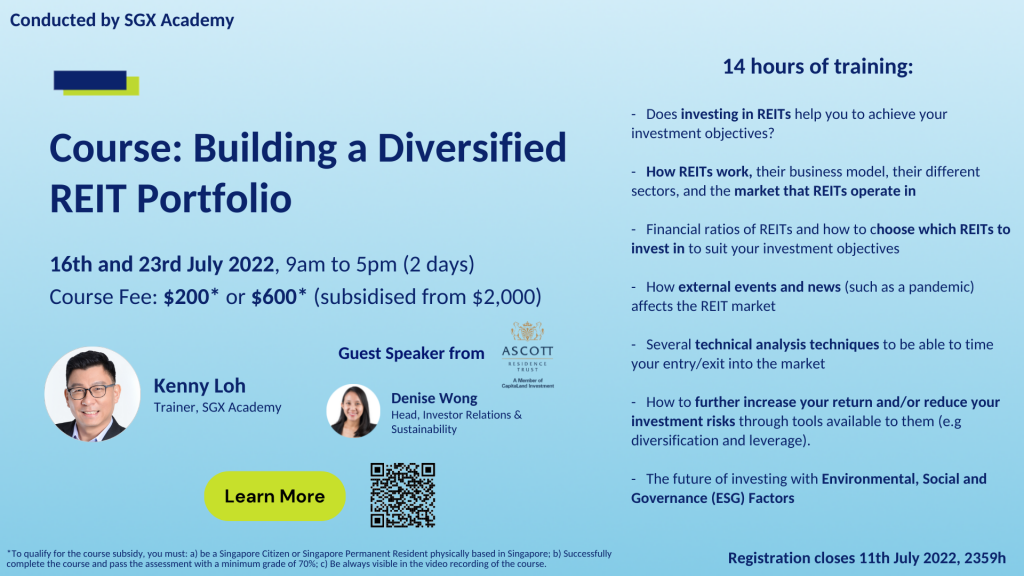
Disclaimer: The above table is best used for “screening and shortlisting only”. It is NOT for investing (Buy / Sell) decision. If you want to know more about investing in REITs, here’s a subsidised 2-day course with all you need to know about REITs and how to start investing in them.
THE BUSINESS TIMES: THE chain offer for SPH Reit : SK6U +0.53% has closed with valid acceptances in respect of 402.9 million units, representing about 14.36 per cent of total issued units, according to a bourse filing on Thursday (Jun 30) night.
This will bring the Cuscaden Peak and its concert parties’ stake in the real estate investment trust (Reit) to 61.68 per cent, or about 1.73 billion units.
The offer had previously turned unconditional on Jun 1 after it received valid acceptances representing about 4.64 per cent of total issued SPH Reit units. Read More
EC World REIT’s Refinancing Woes
THE EDGE: What’s wrong with EC World REIT? Probably a dose of déjà vu, that is master leases, and capital management. The net asset value of EC World REIT as at end-2021 stood at 93 cents. Its unit price closed at 48 cents on June 30, 2022. That values EC World REIT at 0.51x NAV. The market capitalisation as at June 29 was $388 million based on units in issue of 809.49 million as stated in the 2021 annual report, The secured debt outstanding stood at $725 million as at Dec 31, 2021.
On June 29, the Singapore Exchange, questioned the REIT’s refinancing efforts following the latter’s announcements on June 1 and June 13. Why were the loan extensions for less than 12 months? Why are the lenders not financing beyond April 2023? Are there difficulties in obtaining onshore facilities? Read More
This represents a further drop from RHB’s report in May, where it had previously lowered the target price for EC World Reit to S$0.65 from S$0.76.
EC World Reit has currently secured onshore borrowing facilities of S$300 million and US$87 million, which were due in June. While it was granted a temporary loan extension to Apr 30 next year, this is conditional to a 25 per cent (approximately S$100 million) repayment of loans by the end of 2022. Read More
Digital Core REIT’s big short: It is currently down 35% YTD
THE EDGE: Jim Chanos’ latest big short: data centre REITs According to the Financial Times, short seller Jim Chanos believes that data centres in REITs and that are not owned by Alphabet, Microsoft and Amazon are going to be behind the curve so to speak. The web service arms of the trio, Google Cloud, Amazon Web Services and Microsoft Azure have their cloud services housed in their own leading edge data centres. For instance Google has a state-of-the-art data centre in Jurong.
Chanos is quoted to have said the cloud is growing but “the cloud is their (the REITs’) enemy, not their business. Value is accruing to the cloud companies, not the bricks-and-mortar legacy data centres.”
In fact, Alphabet, Amazon and Microsoft are likely to be the REITs’ biggest competitors, not their biggest customers. When your biggest competitors are the three most vicious competitors in the world you have a problem, Chanos is reported to have said. Read More
Summary
Fundamentally, the whole Singapore REITs landscape is undervalued based on the average Price/NAV value of the S-REITs. Below is the market cap heat map for the past 1 month. Generally, S-REITs in the past month have decreased in market cap.
2 REITs stand out with a large portion of market cap wiped out in the past month: EC World REIT(-33.33%)and Digital Core REIT (-22.28%).Digital Core REIT’s performance can be attributed to short-selling, while EC World REIT’s performance can be attributed to its recent refinancing woes. All 4 Mapletree REITs are strong performers this month.
Yield spread (in reference to the 10 year Singapore government bond of 2.92% as of 1st July 2022) widened from 3.47% to 3.54%.The S-REIT Average Yield increased from 6.30% to 6.45%. The yield of the REITs sector needs to increase to maintain the average yield spread of 4%. Amid all the negative news, S-REITs have been resilient and have one of the highest risk-adjusted dividend yields compared to other stock exchanges.
The risk premium has dropped, but still remains attractive (compared to other asset classes) to accumulate Singapore REITs in stages to lock in the current price (current average distribution yield is 6.45%!) and to benefit from long-term yield after the recovery, especially since the S-REIT Market is slightly undervalued now. Moving forward, it is expected that DPU will continue to increase due to the recovery of the global economy, as seen in the previous few earning updates, especially for Hospitality and Retail sectors. NAV is expected to be adjusted upward due to revaluation of the portfolio.
Upcoming REIT Course
I will be conducting my next REIT course on the 16th and 23rd July 2022. It is a 2-day course where you will learn everything you need to learn about REITs for investing. I only conduct this course every quarter, so do take a look below. For a limited time only, the course fee is subsidized to cost $200 (above 40y/o) or$600 (below 40y/o)*. Take advantage of the IBF subsidy while it is still available.
Note: This above analysis is for my own personal research and it is NOT a buy or sell recommendation. Investors who would like to leverage my extensive research and years of Singapore REIT investing experience can approach me separately for a REIT Portfolio Consultation.
Kenny Loh is an Associate Wealth Advisory Director and REITs Specialist of Singapore’s top Independent Financial Advisor. He helps clients construct diversified portfolios consisting of different asset classes from REITs, Equities, Bonds, ETFs, Unit Trusts, Private Equity, Alternative Investments, Digital Assets and Fixed Maturity Funds to achieve an optimal risk adjusted return. Kenny is also a CERTIFIED FINANCIAL PLANNER, SGX Academy REIT Trainer, Certified IBF Trainer of Associate REIT Investment Advisor (ARIA) and also invited speaker of REITs Symposium and Invest Fair. You can join my Telegram channel #REITirement – SREIT Singapore REIT Market Update and Retirement related news. https://t.me/REITirement
On 25th June 2022, I conducted a Physical Seminar where I shared the following:
1H2022 Market Recap
S-REIT Index currently moving sideways
The economy is doing well, therefore Interest Rate Hike
Interest Rate is historically still at a low (especially compared to past GFCs)
How Interest Rate Hikes will affect S-REITs
Rental Income
Is generally increasing, can lead to increased distribution
Cost of Debt
REITs with high gearing ratios and short WADM more affected, REITs have to refinance at higher rates
Compression of Yield Spread
Notable increase in Government Bond Yields (close to 3% currently), minimal increase in REIT yields
Share Prices, REIT Index
During the previous rate hike, the REIT Index continued to do well
4 Pains for REITs Investors
Dealing with Rights Issues
Either fork out cash, or your holdings will dilute
Inability to Participate in Private Placements
Dilution of shares
Odd Lots when participating in DRPs
Trading commissions and spread are very high for odd lots
Monthly RSP not feasible with small amounts
Brokerage Fee is nearly consistent, regardless of trading amount
How to overcome the 4 Pains of REIT Investing
S-REITs 2H2022 Investing Strategy
What are your Personal Objectives?
Focus on fundamentals
Investment solutions
If you want to have a peace of mind while you invest (in REITs, or in other asset classes), and do not want to deal with the 4 pains, I can help you to manage your investment portfolio. Contact me here!
Kenny Loh is a Associate Wealth Advisory Director and REITs Specialist of Singapore’s top Independent Financial Advisor. He helps clients construct diversified portfolios consisting of different asset classes from REITs, Equities, Bonds, ETFs, Unit Trusts, Private Equity, Alternative Investments, Digital Assets and Fixed Maturity Funds to achieve an optimal risk adjusted return. Kenny is also a CERTIFIED FINANCIAL PLANNER, SGX Academy REIT Trainer, Certified IBF Trainer of Associate REIT Investment Advisor (ARIA) and also invited speaker of REITs Symposium and Invest Fair. You can join my Telegram channel #REITirement – SREIT Singapore REIT Market Update and Retirement related news. https://t.me/REITirement