Money FM89.3: Money and Me: What REITs To Look Out for

  • Post author:

After Episode 1 of Crazy REITs Sales, we have entered into Episode 2 of Crazy REITs Rally!

Catch Kenny Loh on MoneyFM 89.3 with Michelle Martin on how to navigate your REITs investment in this challenging period and what are the risks & opportunities out there!

https://omny.fm/shows/money-fm-893/money-and-me-reits-to-look-out-for


Measures unveiled to help Reits through ‘challenging’ Covid-19 period

Summary:

(1) Gearing increases from 45% to 50% with immediate effect

(2) Extend the timeline for S-Reits to distribute at least 90 per cent of their taxable income from three months to 12 months (after the end of FY2020) to qualify for tax transparency.

Listen to this morning Radio Interview on the impacts on REITs and Investors due to the new measures.

https://omny.fm/shows/money-fm-893/new-measures-for-reits-to-manage-cash-flow


Listen to previous Radio Interview “Crazy REITs Sales” here.


Kenny Loh can be contacted through email kennyloh@fapl.sg if investors need any help in building a diversified REIT portfolio during this volatile period. Advisory Fee applied.


Kenny Loh is a Senior Consultant and REITs Specialist of Singapore’s top Independent Financial Advisor. He helps clients construct diversified portfolios consisting of different asset classes from REITs, Equities, Bonds, ETFs, Unit Trusts, Private Equity, Alternative Investments and Fixed Maturity Funds to achieve an optimal risk adjusted return. Kenny is also a CERTIFIED FINANCIAL PLANNER, SGX Academy REIT Trainer, Certified IBF Trainer of Associate REIT Investment Advisor (ARIA) and also invited speaker of REITs Sympsosium and Invest Fair. https://fa.com.sg/kennyloh/

You can join my Telegram channel #REITirement – SREIT Singapore REIT Market Update and Retirement related news. https://t.me/REITirement

No photo description available.

Continue ReadingMoney FM89.3: Money and Me: What REITs To Look Out for

Singapore REIT Fundamental Analysis Comparison Table Apr 8 – 2020

  • Post author:

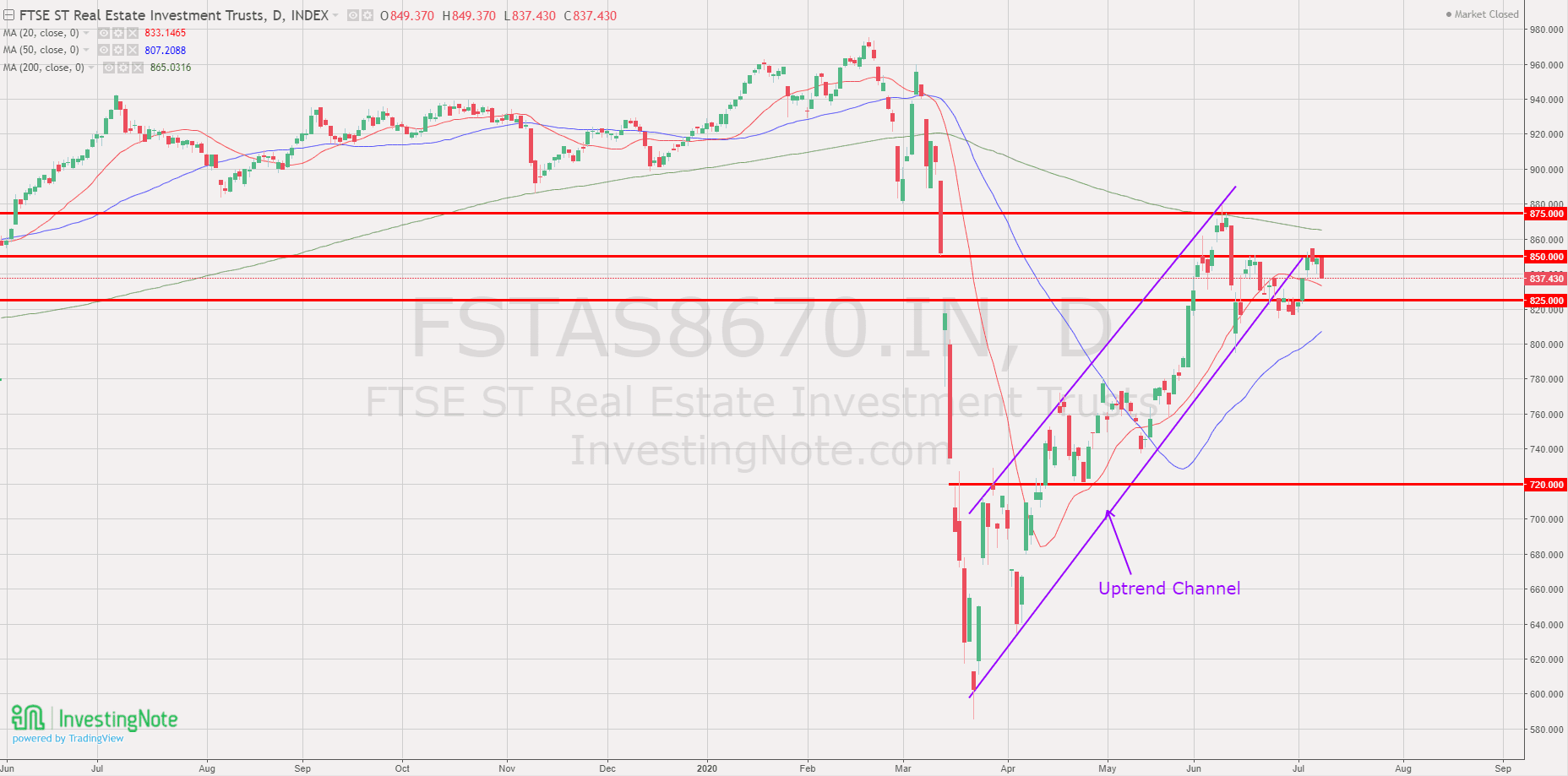
Technical Analysis of FTSE ST REIT Index (FSTAS8670)

FTSE ST Real Estate Investment Trusts (FTSE ST REIT Index) went through the a historical event of Singapore REIT Black Monday Market Crash.  You may view the Webinar here if you need to under the WHY it happened. COVID-19 Crash: Risk or Opportunity to hold REIT?

The REIT index has crashed from 941.89 to 698.05 (-25.89%) compared to last month update. The REIT index has dropped from the peak (976.419) and rebounded from 584.384, which translates about 40.12% sell of.

Based on the current chart patter, the REIT index may have found the bottom as Exhaustion Gap (if this is true) is formed after the Breakaway gap and Running Gap. Currently the index is trading in a Symmetrical Triangle consolidation pattern in a down trend.

Immediate support at 600 and Immediate Resistance at 734 (38.2% Fibonacci Retracement Level and also a Runaway Gap Resistance). Probable direction for REIT index: Range Bound between 600 and 734. Previous chart on FTSE ST REIT index can be found in the last post Singapore REIT Fundamental Comparison Table on Mar 8, 2020.


Fundamental Analysis of 40 Singapore REITs

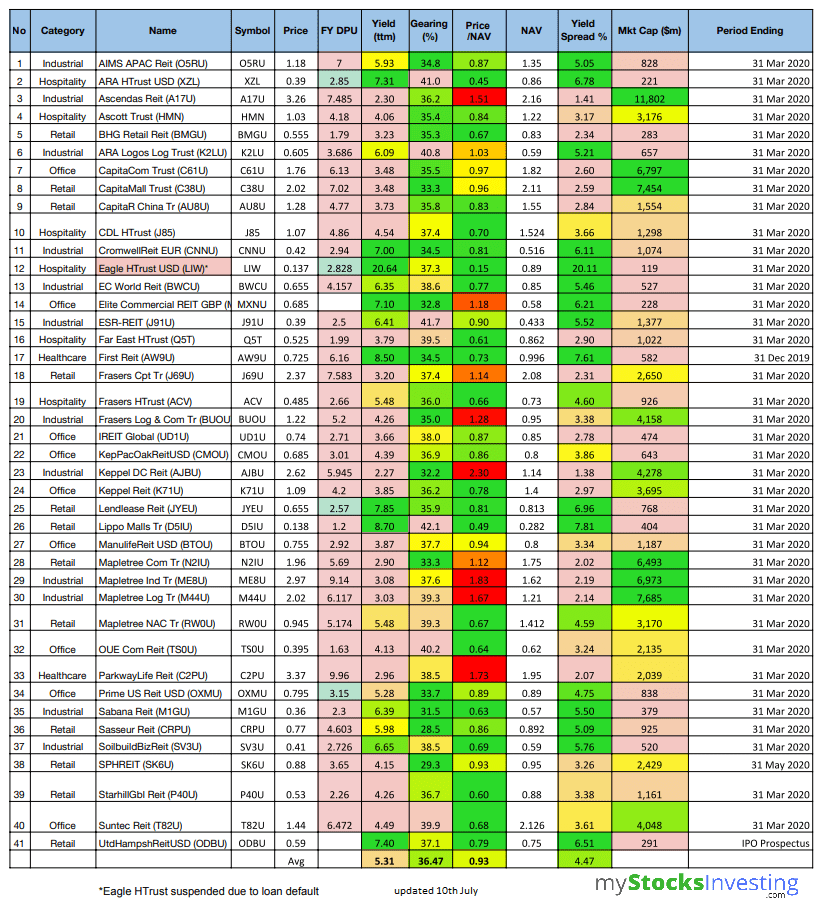
The following is the compilation of 42 REITs in Singapore with colour coding of the Distribution Yield, Gearing Ratio and Price to NAV Ratio. This gives investors a quick glance of which REITs are attractive enough to have an in-depth analysis. DPU Yield for Elite Commercial REIT, United Hampshire REIT and Lendlease Global Commercial REIT are projection based on the IPO prospectus.


  • Note 1: The Financial Ratio are based on past data and there are lagging indicators.
  • Note 2: This REIT table would be the last “Normal” table (with last financial data) before impacted by the future dividend cut due to COVID-19 outbreak.
  • Noted 3: Distribution Yield, NAV, Gearing Ratio would probably be adjusted moving forward.
  • Note 4:  Historical Price/NAV High and Low information is available here.


  • Price/NAV decreases from 1.07 to 0.80 (Singapore Overall REIT sector is undervalued now).
  • Distribution Yield increases from 6.64% to 9.64% (take note that this is lagging number). About 80% of Singapore REITs (32 out of 42) have Distribution Yield > 7%. Do note that these yield numbers are based on current prices with historical (pre Covid-19) yields.
  • Gearing Ratio stays at 35.39%.  26 out of 42 have Gearing Ratio more than 35%. In general, Singapore REITs sector gearing ratio is healthy. Note: Gearing may be affected (ie. potential increase) as the valuation pf the portfolio would be reduced.
  • The most overvalue REIT is Keppel DC REIT (Price/NAV = 2.04), followed by Parkway Life (Price/NAV = 1.61), Mapletree Industrial Trust (Price/NAV = 1.34), Mapletree Logistic Trust (Price/NAV = 1.27) and Ascendas REIT (Price/NAV = 1.18).
  • The most undervalue (base on NAV) is Eagle Hospitality Trust* (Price/NAV =0.15), followed by Lippo Malls Indonesia Retail Trust (Price/NAV = 0.38), ARA Hospitality Trust (Price/NAV = 0.36),CDL HT (Price/NAV = 0.47) and Starhill Global (Price/NAV = 0.45)
  • The Highest Distribution Yield (TTM) is Eagle Hospitality Trust* (33.85%) followed by Lippo Malls Indonesia Retail Trust (21.24%), ARA Hospitality Trust (17.82%) and ESR REIT (16.04%). Reminder that these yield numbers are based on current prices with historical (pre Covid-19) yields. Dividend would be cut in next 2-3 quarters.
  • The Highest Gearing Ratio are ESR REIT (41.5%), OUE Comm REIT (40.3%), Far East HTrust (39.2%), Cache Logistic Trust (40.1%) and IREIT Global (39.3%).
  • Top 5 REITs with biggest market capitalisation are Ascendas REIT ($9.65B), CapitaMall Trust ($5.98B), Capitaland Commercial Trust ($5.40B), Mapletree Commercial Trust ($5.22B), Mapletree Logistic Trust ($5.89B)
  • The bottom 3 REITs with smallest market capitalisation are Eagle Hospitality Trust ($171M), ARA Hospitality Trust ($260M) and BHG Retail REIT ($259M)

Disclaimer: The above table is best used for “screening and shortlisting only”. It is NOT for investing (Buy / Sell) decision. To learn how to use the table and make investing decision, Sign up next REIT Investing Workshop here to learn how to choose a fundamentally strong REIT for long term investing for passive income generation.

*Eagle Hospitality Trust is currently suspended


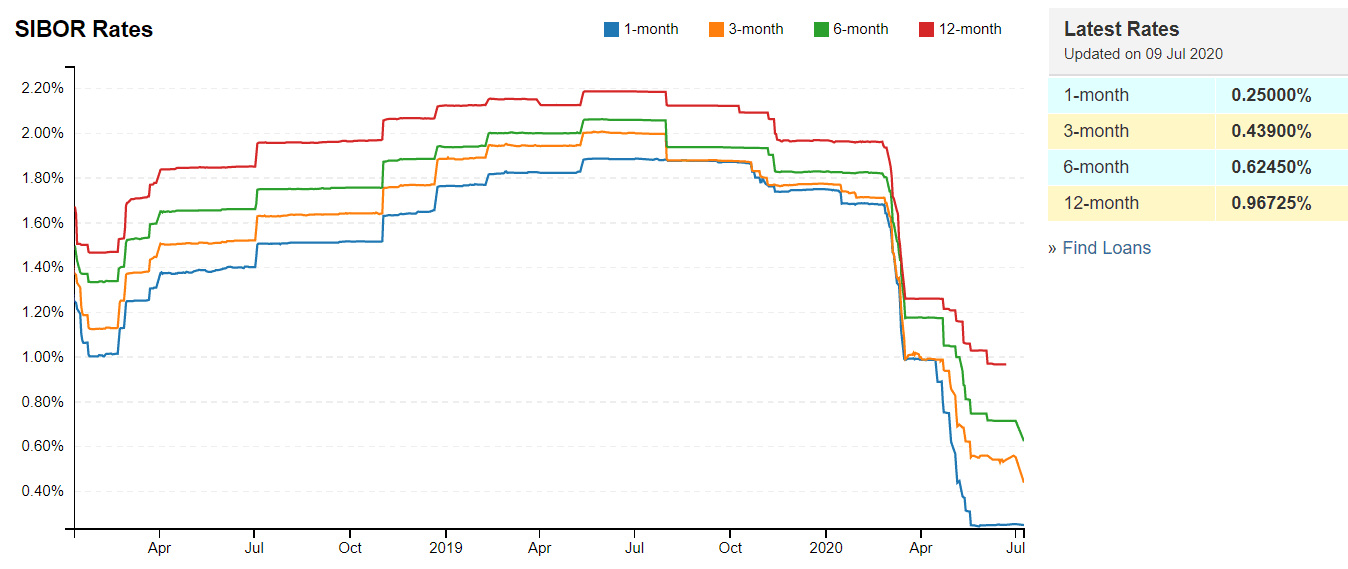
Interest Rate Watch


  • 1 month decreases from 1.46701% to 0.99000%
  • 3 month decreases from 1.47101% to 1.01000%
  • 6 month increases from 1.60431% to 1.77000%
  • 12 month decreases from 1.93600% to 1.43887%


Summary

Fundamentally the whole Singapore REITs is undervalued now based on simple average on the Price/NAV. The big cap REITs rebounded quickly after the huge REIT crash. Valuation are very attractive across all the REITs but do take note that NAV is lagging. NAV would probably be reduced caused by the devaluation of property value caused by the COVID-19 lock down.

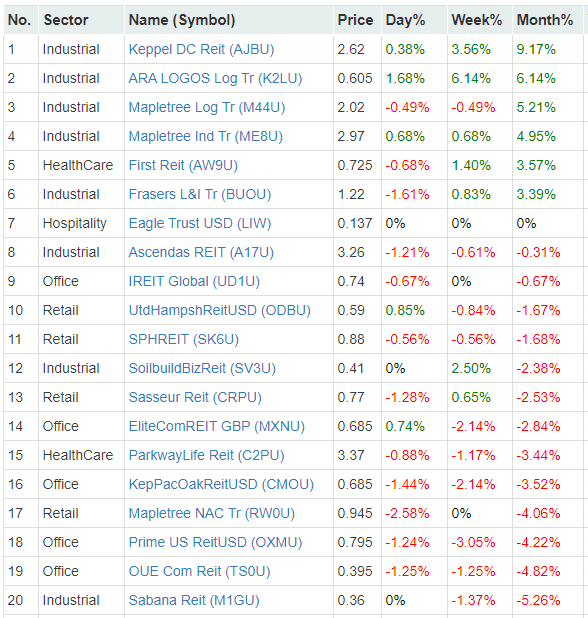
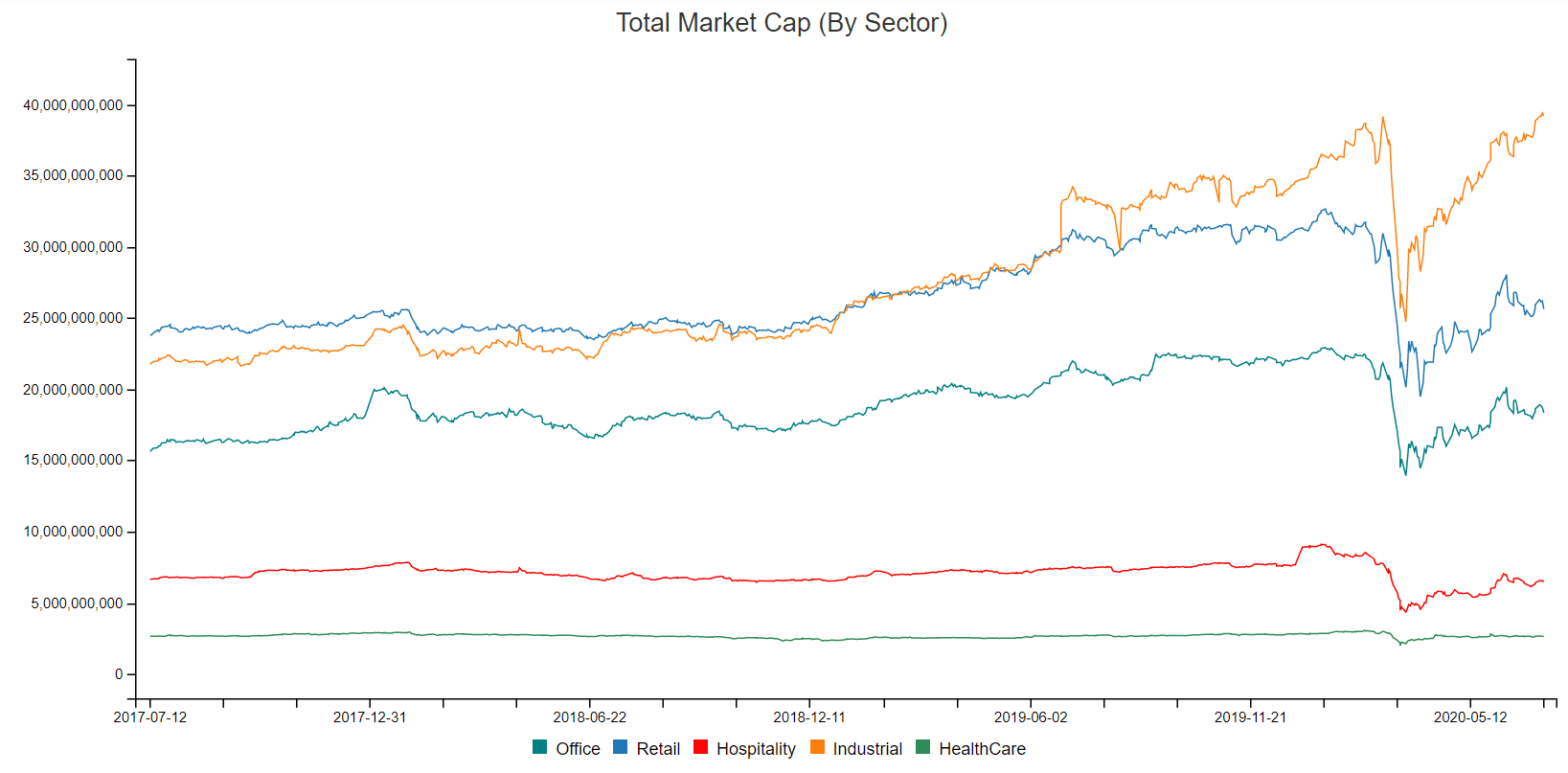
The most impacted sectors are Hospitality and Retail Malls and we see huge sell down over the past few weeks. Keppel DC REIT, Parkway Life REIT, Ascendas REIT, Mapletree Logistic Trust and Mapletree Industrial Trust are holding well during this sell off.

Yield spread (reference to 10 year Singapore government bond of 1.095%) has widened greatly from 5.42% to 8.54%. The risk premium are very attractive to accumulate slowly in stages to lock in the current valuation and long term yield after the recovery.

The market would be very volatile during this period because it is a huge fight between the bull and bear.


Investors should LOOK BEYOND COVID-19 when comes to investing in REITs with an eye wide opens that there will be dividend cut in the near term.

You can view the REIT Market Update Webinar here or listen to MoneyFM89.3 Radio Interview here for more detail explanation.


STAY HOME and INVEST SAFELY!


If you want to capture the current market opportunity but do not have the knowledge, you can attend My next Singapore REIT investing course (Webinar training) is planned on April 18, 2020. You can register here. https://mystocksinvesting.com/course/singapore-reits-investing/

If you do not have time to learn all the basic, or you want to kick start your REIT portfolio within 1 month, I can help you to construct a REIT portfolio with a fee.  You can just sit back, relax and wait for the dividend to come it as I will be doing all the job in managing your REIT portfolio. For REIT Portfolio Consultation, please drop me an email marubozu@mystocksinvesting.com

You can join my Telegram channel #REITirement – SREIT Singapore REIT Market Update and Retirement related news. https://t.me/REITirement

No photo description available.

Continue ReadingSingapore REIT Fundamental Analysis Comparison Table Apr 8 – 2020

Derivatives Trading in Bear Markets

  • Post author:

James Blawn

How can CFD trading techniques assist when markets are getting ‘bear-mauled’ from every direction? Find out which trading strategies can assist in down markets.

Maximizing Downside Trends with Effective Trading Strategies

Source: Pixabay No Attribution Required


Preface: Global stock markets are in a pitiful state. The Dow Jones Industrial Average, the S&P 500 Index, the NASDAQ Composite Index, the New York Stock Exchange Composite Index, and the S&P/TSX Composite Index are all markedly down for 2020. From multigenerational highs, the Dow Jones has sunk to the 20,900 level, the NASDAQ to 7300, and the S&P 500 index to 2470 and thereabouts. These levels are double-digit points down for Q1 2020, and the prognosis heading into Q2 2020 is equally grim.


CNN reported a 3000% jump in jobless claims to date this year. Dubbed ‘…one of the most devastating periods in the history of the country,’ businesses in every major industry are shedding workers at a furious pace. For the week ending March 28, 2020, some 6.648 million workers filed for unemployment benefits (Dept. of Labor), accelerating rampant declines in demand, discretionary spending, productivity, and general economic activity.

The last 14 days of March resulted in some 10 million Americans out of jobs, or 6% of the workforce. This has pushed the unemployment rate towards 10%, and rising fast. With such a grim prognosis, it’s only natural to ask how traders and investors are working the markets to prevent further degradation of their financial holdings, investments, and retirement funds.


Source: US Dept of Labor graphic by CNN (Annalyn Kurtz and Tal Yellin)


These figures paint a dark picture of what the economy is likely to endure as the pandemic worsens. While New York bears the brunt of the coronavirus, with thousands dead and countless others infected, each of the other states is readying for an Armageddon-style scenario as the virus sweeps across the nation. Companies across the country are shuttering operations, either by way of governors’ decrees, or national lockdown orders.


Economic activity has cratered. The oil price has collapsed to $20 per barrel for WTI crude oil and $25 per barrel for Brent crude oil, with no end in sight. The Fed has injected a $2 trillion plus stimulus into the economy, hoping to reignite economic activity, but this will take a substantial amount of time to get going. For now, the short-term focus is on salvaging whatever is left of financial portfolios, preventing further degradation thereof, and making smart decisions via effective trading strategies.


Short-Selling as a Viable Trading Strategy?


When markets start tanking, short sellers start cashing in. Falling prices are just as common as rising prices vis-a-vis financial instruments like stocks, commodities, indices, currencies, and contrarian asset categories. Bear markets now characterize the trading landscape. A bear market is official when there has been a 20% + decline from a previous high, lasting for a period of 2+ months. While the coronavirus has not impacted global financial markets for much more than 2 months to date, the fallout from the pandemic will last many months more than that. We are already 30% down from the Dow’s high in 2020, and a few more weeks of the status quo will validate the definition of a bear market.


It is clear that sellers outweigh buyers by a long margin. Only the institutional buyers and a handful of savvy investors are buying on the dip, everyone else is too scared to move. The current state of the market is significantly different to a correction, a reversal, or a pullback. What we are seeing now is a global short-to-medium-term selloff. It is a collapse in supply and a collapse in demand. Companies are closing up their doors from China to Hawaii, from Australia to South Africa, as government lockdowns take effect. These short-term initiatives are designed to slow the spread of the pandemic, but the effect on economic activity will linger for a long time. In fact, there are real concerns that COVID-19 will lead to recession or depression.


Trading experts advise against following the herd. When everybody is selling, there is little to be gained by selling along with them. Investors believe that if they don’t sell when everyone else is selling, the price of their investments will drop further. This results in an accelerated sell-off of equities, indices, commodities, and even currencies, much to the detriment of the seller. Then there are the buy and hold investors who are not perturbed by the sudden and dramatic turbulence that hits the markets. Fortunately, there are trading strategies to employ that can mitigate the effects. These include diversifying your portfolio away from high-risk, high volatile stocks towards low-risk, low volatility asset holdings.


It Is Possible To Profit When Markets Are Upside down

Source: Dow Jones Industrial Average


During a bear market, there are a variety of tools at your disposal to lessen the overall risk to your portfolio. These include shifting from stocks to safe-haven assets such as gold. It should be borne in mind that there isn’t necessarily a direct correlation between a poorly performing stock market, and a rampant run on gold. Gold stocks such as SPDR are managed by companies, notably big banks, whose interest is maximizing their own profitability and not those of investors. SPDR is the world’s largest exchange traded gold fund with massive holdings of physical gold bullion. A switch to an alternative asset class with the express objective of mitigating downside risk is known as hedging. SPDR has risen much more conservatively than the general stock market has plunged.


Most of the strategies that traders use during bear markets are short-sell orders. There are short ETFs, short-selling of financial instruments, and buying on the dip. These and many other strategies are employed to great effect by strategic traders around the world. While every trader seeks that panacea to the ill-fated bear market, there really is no effective strategy to guarantee favorable returns in any market. Some of the best strategies employed by traders are simply known as risk-mitigation or damage control.


Traders understand that markets cannot rise indefinitely; upturns and downturns are part of the free market system. Even in a market downturn, the path is never linear – there are upswings and downswings in bear markets too. By analyzing the market, it is possible to implement bear market plans. Short-selling is a powerful tool in your arsenal when combating bear markets. Contracts for difference, or CFDs, allow you to trade assets based on price movements alone – without taking ownership of the underlying asset. Since leverage is a play, it is possible to bet against a financial instrument and profit to the upside, even in a down-market.


Continue ReadingDerivatives Trading in Bear Markets