Singapore REIT Fundamental Analysis Comparison Table – 5 Nov 2017

  • Post author:

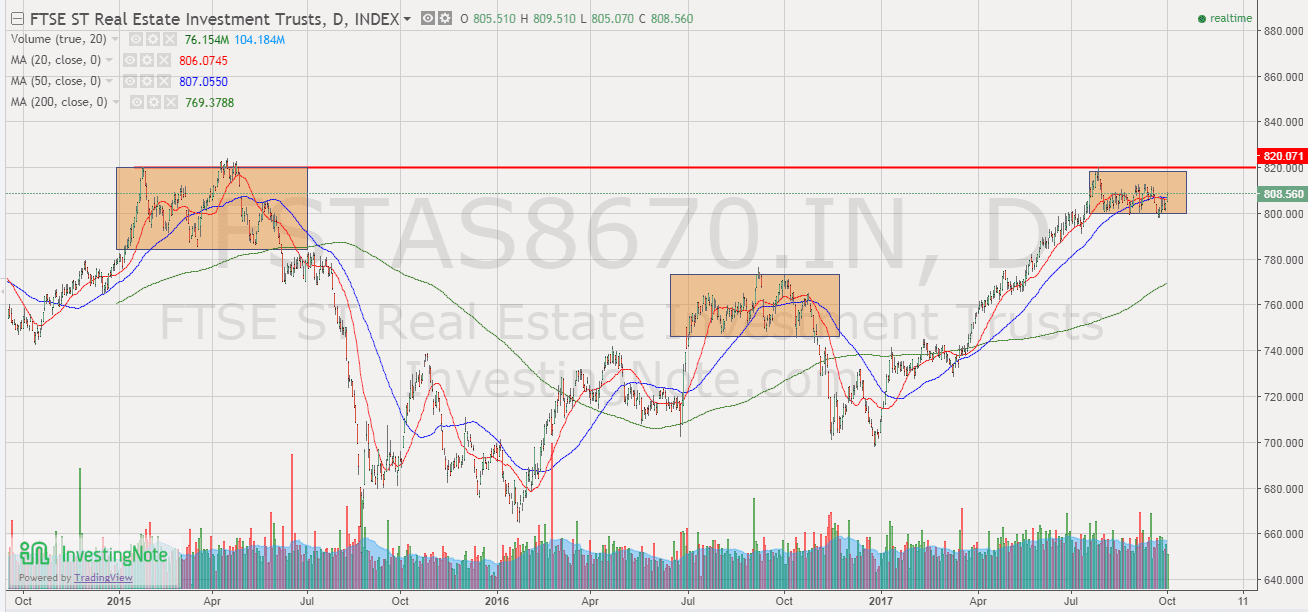
FTSE ST Real Estate Investment Trusts (FTSE ST REIT Index) increases from 806.78 to 826.94 (+2.50%) compare to last post on Singapore REIT Fundamental Comparison Table on Oct 3, 2017.  The index has broken the resistance of 820 and continue the uptrend after retested the 820 resistance turned support . The 20D and 50D SMA are also start trending upwards.


Fundamental Analysis


  • Price/NAV increases from 1.04 to at 1.06 (Singapore Overall REIT sector is over value now).
  • Distribution Yield decreases from 6.53% t0 6.36% (take note that this is lagging number). About one third number of Singapore REITs (12 out of 37) have Distribution Yield > 7%.
  • Gearing Ratio reduces from 34.7% to 34.3%.  17 out of 37 have Gearing Ratio more than 35%. In general, Singapore REITs sector gearing ratio is healthy.
  • Most overvalue REIT is Parkway Life (Price/NAV = 1.73), followed by Keppel DC REIT (Price/NAV = 1.48), First REIT (Price/NAV = 1.37), Mapletree Industrial Trust (Price/NAV = 1.39) and Ascendas REIT (Price/NAV = 1.31)
  • Most undervalue (base on NAV) is Fortune REIT (Price/NAV = 0.71),  followed by Far East HTrust (Price/NAV = 0.79) and Sabana REIT (Price/NAV = 0.79).
  • Highest Distribution Yield (TTM) is SoilBuild BizREIT (8.94%), followed by Cache Logistic Trust (8.08%), Lippo Mall Indonesia Retail Trust (8.00%) and iREIT Global REIT (7.90%).
  • Highest Gearing Ratio is Cache Logistic Trust (43.6%), iREIT Global (41.3%).

Disclaimer: The above table is best used for “screening and shortlisting only”. It is NOT for investing (Buy / Sell) decision. To learn how to use the table and make investing decision, Sign up next REIT Investing Seminar here to learn how to choose a fundamentally strong REIT for long term investing for passive income generation.


Economy Analysis – Singapore

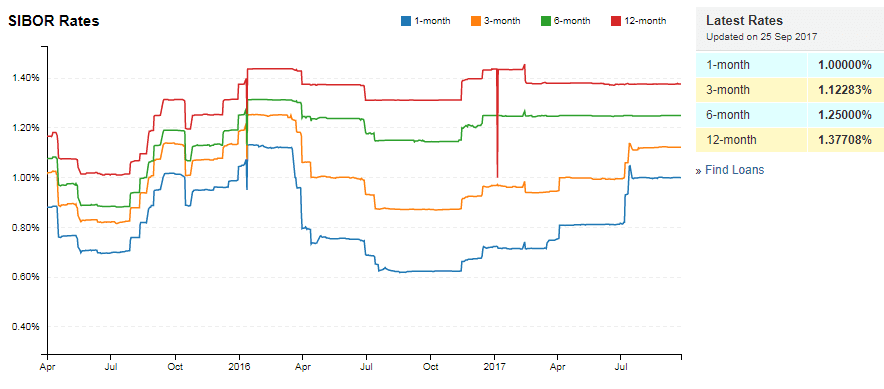
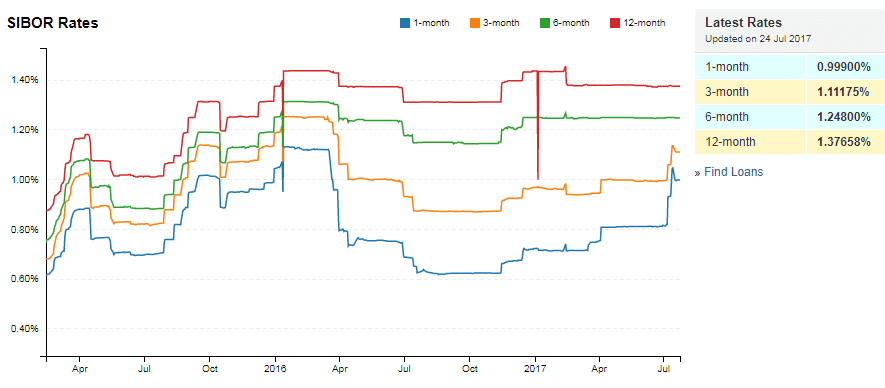
  • 1 month increases from 1.00000% to 1.00413%
  • 3 month increases from 1.12283% to 1.12583%
  • 6 month maintains at 1.25000%
  • 12 month increases from 1.37708% to 1.37758%


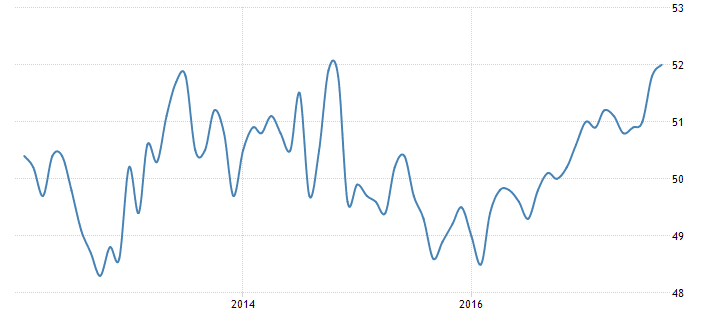
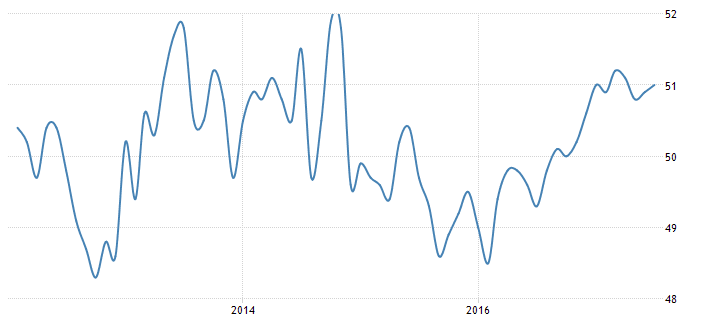
The Singapore Manufacturing PMI increased to 52.6 in October 2017 up from 52 in the previous month. The reading pointed to the fastest pace of expansion in the manufacturing sector since December 2009, boosted by a strong performance of new orders and new exports orders, growing employment and a positive overall outlook for manufacturing. The PMI for the electronics sector came in at 53.3, slightly down from 53.6 in September, but still expansionary. Manufacturing PMI in Singapore averaged 50.23 from 2012 until 2017, reaching an all time high of 52.60 in October of 2017 and a record low of 48.30 in October of 2012.

Manufacturing PMI in Singapore is expected to be 53.00 by the end of this quarter, according to Trading Economics global macro models and analysts expectations. Looking forward, we estimate Manufacturing PMI in Singapore to stand at 51.40 in 12 months time. In the long-term, the Singapore Manufacturing PMI is projected to trend around 50.20 in 2020, according to our econometric models.


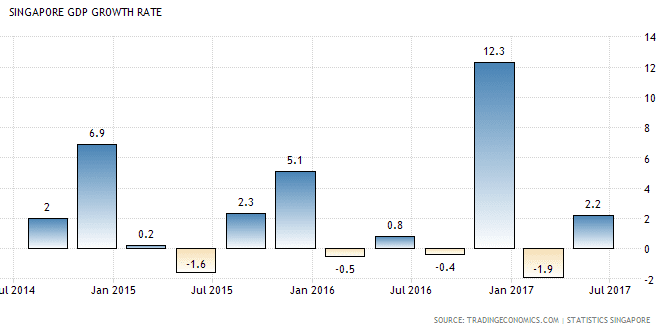
The Singaporean economy expanded 4.6 percent year-on-year in the third quarter of 2017, up from 2.9 percent in the prior quarter and stronger than market expectations of a 3.8 percent expansion, led by a sharp acceleration in manufacturing. On a quarterly basis, the advanced estimate showed that the GDP grew an annualized 6.3 percent in Q3, sharply surpassing the 2.4 percent growth of the previous quarter and the 3.2 percent expansion expected by consensus. GDP Annual Growth Rate in Singapore averaged 6.66 percent from 1976 until 2017, reaching an all time high of 19 percent in the second quarter of 2010 and a record low of -8.80 percent in the first quarter of 2009.

GDP Annual Growth Rate in Singapore is expected to be 2.80 percent by the end of this quarter, according to Trading Economics global macro models and analysts expectations. Looking forward, we estimate GDP Annual Growth Rate in Singapore to stand at 2.20 in 12 months time. In the long-term, the Singapore GDP Annual Growth Rate is projected to trend around 1.80 percent in 2020, according to our econometric models.


Summary

Fundamentally the whole Singapore REITs is over value now. Office and Hospitality sectors are still undervalue but have not seen any clear turnaround signs yet based on the latest earning release. Technically Singapore REITs continues the bullish uptrend after the Singapore REITs Index broke the 820 resistance. It is expected the bullish sentiment to continue as Singapore economy fundamental is strengthening based on improved PMI and stronger GDP numbers.

Big cap REITs continue to do well but upside is limited as distribution yield has become less attractive. Opportunities lie with small and medium cap REITs where the valuation and yield are still quite attractive. However, we need to study in depth the fundamental of the REITs before trigger the buy button.

Safe hunting!


See all other relevant  Singapore REITs blog posts here.

Check out coming seminars at https://mystocksinvesting.com/events


Continue ReadingSingapore REIT Fundamental Analysis Comparison Table – 5 Nov 2017

Singapore REIT Fundamental Analysis Comparison Table – 3 Oct 2017

  • Post author:

FTSE ST Real Estate Investment Trusts (FTSE ST REIT Index) decreases from 810.27 to 806.78 (-0.43%) ( compare to last post on Singapore REIT Fundamental Comparison Table on Sept 3, 2017.  The index is currently facing resistance of 820 and currently trading sideway. We have to watch for the potential reversal as currently 20D and 50D are trending horizontally. Breaking the critical support of 800 will kick start the correction of Singapore REITs index.


Fundamental Analysis

  • Price/NAV decreases from 1.05 to at 1.04 (Singapore Overall REIT sector is slightly over value now).
  • Distribution Yield increases from 6.51% to 6.53% (take note that this is lagging number). About one third number of Singapore REITs (11 out of 37) have Distribution Yield > 7%. This is a significant drop in numbers compare to a few months ago. This indicates there are lesser Singapore REITs with attractive yield to pick now.
  • Gearing Ratio remains at 34.7%.  20 out of 37 have Gearing Ratio more than 35%. In general, Singapore REITs sector gearing ratio is healthy.
  • Most overvalue REIT is Parkway Life (Price/NAV = 1.62), followed by Keppel DC REIT (Price/NAV = 1.43), First REIT (Price/NAV = 1.33), Mapletree Industrial Trust (Price/NAV = 1.34) and Ascendas REIT (Price/NAV = 1.31)
  • Most undervalue (base on NAV) is Fortune REIT (Price/NAV = 0.68),  followed by Far East HTrust (Price/NAV = 0.75) and Keppel REIT (Price/NAV = 0.84) and OUE Com REIT (Price/NAV = 0.83).
  • Highest Distribution Yield (TTM) is Cache Logistic Trust (8.74%), followed by SoilBuild BizREIT (8.46%), Lippo Mall Indonesia Retail Trust (8.19%) and iREIT Global REIT (7.95%).
  • Highest Gearing Ratio is Cache Logistic Trust (43.4%), iREIT Global (41.3%).

Disclaimer: The above table is best used for “screening and shortlisting only”. It is NOT for investing (Buy / Sell) decision. To learn how to use the table and make investing decision, Sign up next REIT Investing Seminar here to learn how to choose a fundamentally strong REIT for long term investing for passive income generation.


Economy Analysis – Singapore

  • 1 month increases from 0.99900% to 1.00000%
  • 3 month increases from 1.11175% to 1.12283%
  • 6 month increases from 1.24800% to 1.25000%
  • 12 month increases from 1.37658% to 1.37708%


The Singapore Manufacturing PMI increased to 52 in September 2017 from 51.8 in the previous month. The reading pointed to the fastest pace of expansion in the manufacturing sector since April 2011, boosted by growth in new orders, new exports, output and employment. The PMI for the electronics sector rose 0.4 points to 53.6 in September, also the highest in more than six years. Manufacturing PMI in Singapore averaged 50.19 from 2012 until 2017, reaching an all time high of 52 in September of 2017 and a record low of 48.30 in October of 2012.


The Gross Domestic Product (GDP) in Singapore expanded 2.20 percent in the second quarter of 2017 over the previous quarter. GDP Growth Rate in Singapore averaged 6.78 percent from 1975 until 2017, reaching an all time high of 37.20 percent in the first quarter of 2010 and a record low of -13.50 percent in the fourth quarter of 2008.


Summary

Fundamentally the whole Singapore REITs is slightly over value. Office and Hospitality sectors are still undervalue but have not seen any clear turnaround signs yet. Technically Singapore REITs is currently facing the resistance of 820 and will turn to medium term bearish if 800 support is broken. This correction may present a great opportunity to accumulate REITs as the Singapore economy fundamental is strengthening.

This is the time we have to start to do homework and wait for the correction to plan the entry.  I will be sharing how to find the fundamental strong REITs and how to time the entry in my Investing in Singapore REIT course here.

If you do not have time to do all the analysis and monitor the stock market, there is a solution for you … REITs Portfolio Advisory. I will help you to build a Diversified REITs portfolio for you. I will do all the work by selecting fundamental strong REIT, time the entry, monitor the quarterly earning performance, sell the weak REITs, etc.  https://mystocksinvesting.com/course/private-portfolio-review/

See all other relevant  Singapore REITs blog posts here.

Check out coming seminars at https://mystocksinvesting.com/events


Continue ReadingSingapore REIT Fundamental Analysis Comparison Table – 3 Oct 2017

Singapore REIT Fundamental Analysis Comparison Table – 3 Sept 2017

  • Post author:

FTSE ST Real Estate Investment Trusts (FTSE ST REIT Index) increases from 802.25 to 810.27 (+1.00%) ( compare to last post on Singapore REIT Fundamental Comparison Table on Aug 7, 2017.  The index rebounded from the uptrend channel support and 50D SMA, and continue its bullish uptrend. See key level of support and resistances of FTSE REIT Index here.


Fundamental Analysis

  • Price/NAV stays at 1.05 (Singapore Overall REIT sector is slightly over value now).
  • Distribution Yield increases from 6.48% to 6.51% (take note that this is lagging number). About one third number of Singapore REITs (12 out of 37) have Distribution Yield > 7%. This is a significant drop in numbers compare to a few months ago. This indicates there are lesser Singapore REITs with attractive yield to pick now.
  • Gearing Ratio reduced from 34.8% to 34.7%.  20 out of 37 have Gearing Ratio more than 35%. In general, Singapore REITs sector gearing ratio is healthy.
  • Most overvalue REIT is Parkway Life (Price/NAV = 1.60), followed by Keppel DC REIT (Price/NAV = 1.38), First REIT (Price/NAV = 1.32), Mapletree Industrial Trust (Price/NAV = 1.33) and Ascendas REIT (Price/NAV = 1.30)
  • Most undervalue (base on NAV) is Fortune REIT (Price/NAV = 0.69),  followed by Far East HTrust (Price/NAV = 0.74) and Keppel REIT (Price/NAV = 0.83) and OUE Com REIT (Price/NAV = 0.83).
  • Highest Distribution Yield (TTM) is Cache Logistic Trust (8.34%), followed by SoilBuild BizREIT (8.12%), Lippo Mall Indonesia Retail Trust (8.09%) and iREIT Global REIT (7.9%).
  • Highest Gearing Ratio is Cache Logistic Trust (43.4%), iREIT Global (41.3%).

Disclaimer: The above table is best used for “screening and shortlisting only”. It is NOT for investing (Buy / Sell) decision. To learn how to use the table and make investing decision, Sign up next REIT Investing Seminar here to learn how to choose a fundamentally strong REIT for long term investing for passive income generation.


Economy Analysis – Singapore


  • 1 month  at 0.99900%
  • 3 month at 1.11175%
  • 6 month at 1.24800%
  • 12 month at 1.37658%


The Singapore Manufacturing PMI rose to 51 in July 2017 from 50.9 in the previous month. The reading pointed to the strongest pace of expansion in the manufacturing sector since April, boosted by growth in new orders, new exports and output. Also, the PMI for the electronics sector increased to 52.2 from 52.1 in June. Manufacturing PMI in Singapore averaged 50.14 from 2012 until 2017, reaching an all time high of 51.90 in October of 2014 and a record low of 48.30 in October of 2012.


The Gross Domestic Product (GDP) in Singapore expanded 2.20 percent in the second quarter of 2017 over the previous quarter. GDP Growth Rate in Singapore averaged 6.78 percent from 1975 until 2017, reaching an all time high of 37.20 percent in the first quarter of 2010 and a record low of -13.50 percent in the fourth quarter of 2008.


Summary

Fundamentally the whole Singapore REITs is slightly over value. Office and Hospitality sectors are still undervalue but have not seen any clear turnaround signs yet. Technically Singapore REITs is still on bullish up trend but facing the resistance of 820.

There are not many REITs left to pick at the present moment. If you have missed the boat to invest in REITs but have fear of selecting the wrong REITs. you may want to check out this Investing in Singapore REIT course here.

If you do not have time to do all the analysis and monitor the stock market, there is a solution for you … REITs Portfolio Advisory. I will help you to build a Diversified REITs portfolio for you. I will do all the work by selecting fundamental strong REIT, time the entry, monitor the quarterly earning performance, sell the weak REITs, etc.  https://mystocksinvesting.com/course/private-portfolio-review/

See all other relevant  Singapore REITs blog posts here.

Check out coming seminars at https://mystocksinvesting.com/events


Continue ReadingSingapore REIT Fundamental Analysis Comparison Table – 3 Sept 2017