FTSE ST Real Estate Investment Trusts (FTSE ST REIT Index) increases from 709.49 to 732.7 (+3.19%) compare to last post on Singapore REIT Fundamental Comparison Table on Jan 2, 2017. The index is still trading below the 200D SMA after the recent rebound. FTSE ST Real Estate Investment Trust Index is currently trading within a Rectangle and expected to move within the range between 740 and 700. SGX S-REIT (REIT.SI) Index increases from 1092.36 to 1127.74 (+3.24%).


- Added EC World REIT into the table.
- Price/NAV increases from 0.942 to 0.962 (Singapore Overall REIT sector is slightly under value now).
- Distribution Yield decreases from 7.32% to 7.13% (take note that this is lagging number). More than half of Singapore REITs (23 out of 40) have Distribution Yield > 7%. High yield REITs mainly from Hospitality Trust and small cap Industrial REIT, but we must understand the risks while chasing for the high yield. Check out How to spot those Fundamentally strong REIT with attractive yield to build up a Passive Income Portfolio?
- Gearing Ratio decreases from 35.11% to 34.87%. 22 out of 40 have Gearing Ratio more than 35%.
- Most overvalue is Ascendas iTrust (Price/NAV = 1.535), followed by Parkway Life (Price/NAV = 1.441), FIRST REIT (Price/NAV = 1.282) and Keppel DC REIT (Price/NAV = 1.28)
- Most undervalue (base on NAV) is Sabana REIT (Price/NAV = 0.574), followed by Far East HTrust (Price/NAV = 0.64) and Fortune REIT (Price/NAV = 0.698).
- Highest Distribution Yield is SoilBuild BizREIT (9.89%), followed by Cache Logistic Trust (9.25%) and Viva Industrial Trust (9.09%). All these 3 are small Cap Industrial REITs.
- Highest Gearing Ratio is Croesus Retail Trust (45.3%), iREIT Global (42.5%), Sabana REIT (43.2%) and Cache Logistic Trust (43.1%).

Disclaimer: The above table is best used for “screening and shortlisting only”. It is NOT for investing (Buy / Sell) decision. To learn how to use the table and make investing decision, Sign up next REIT Investing Seminar here to learn how to choose a fundamentally strong REIT for long term investing for passive income generation.
- Singapore Interest Rate increases from 0.06% to 0.46%.
- Take note of the past historical interest rate and how high the rate can go. This is an important factor to keep a close eye for Singapore REIT investing because REIT leverages on debt to generate DPU. Current Singapore interest rate is abnormally low and will not stay low forever.


- 1 month decreases from 0.71638% to 0.71463%
- 3 month decreases from 0.96271% to 0.96188%
- 6 month decreases from 1.25050% to 1.24700%
- 12 month increases from 1.43317% to 1.43517%
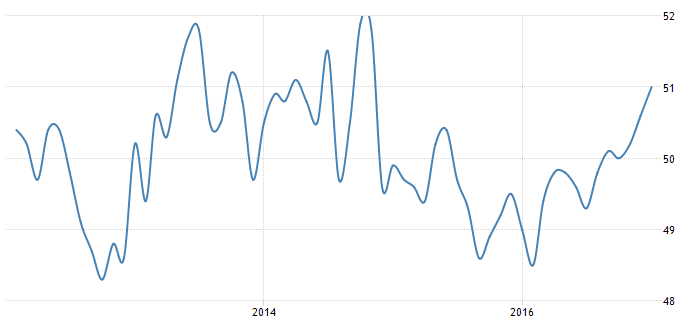
The Singapore Manufacturing PMI increased to 51 in January of 2017 from 50.6 in the previous month. The reading pointed to the strongest expansion in the factory activity since November 2014, led by increases in new orders, new exports, industrial output and inventory holding. Employment reverted to a marginal increase after recording contractions since November 2014. Also, the PMI for electronics sector rose to 51.8 from 51.2 in December. Manufacturing PMI in Singapore averaged 50.03 from 2012 until 2016, reaching an all time high of 51.90 in October of 2014 and a record low of 48.30 in October of 2012.
 Singapore’s economy grew a seasonally adjusted annualized 9.1 percent on quarter in the three months to December of 2016, following a downwardly revised 1.9 percent contraction in the previous period and beating market expectations of a 3.7 percent expansion, the preliminary estimate showed. It was the strongest growth rate since the second quarter of 2013, mainly due to a rebound in manufacturing (+14.6 percent from -8.1 percent in Q3) and services (+9.4 percent from -0.4 percent) while construction continued to fall (-4.7 percent from -14.8 percent). GDP Growth Rate in Singapore averaged 6.84 percent from 1975 until 2016, reaching an all time high of 37.20 percent in the first quarter of 2010 and a record low of -13.50 percent in the fourth quarter of 2008.
Singapore REITs sector is currently range bound and FTSE ST REIT index is expected to trade within a range between 700 to 740. 700 support level could be a good level to accumulate some fundamental strong REITs as the valuation base on Price/NAV and Distribution yield can become attractive again. Two questions may interest all the retail investors: WHEN is the right and safe time and WHAT REIT to pick? Check out the next Investing in Singapore REIT course here.
See my Singapore REIT 2017 Market Outlook here.
Original post from https://mystocksinvesting.com
Check out coming seminars at https://mystocksinvesting.com/events


