REITs Symposium is into its 7th edition and across 2 days, we will unveil the developments and opportunities in the REITs Industry.
Organised by ShareInvestor and REIT Association of Singapore, supported by Singapore Exchange, the virtual edition of the event on both 15th and 22nd May will encompass a variety of formats for retail investors to reach out to the C-levels of our participating REITs.
The formats include: – Live Presentation by REITs’ CEO – Live Interviews with Financial Bloggers – Live Chat – private chat room to interact with the C-level of each REIT
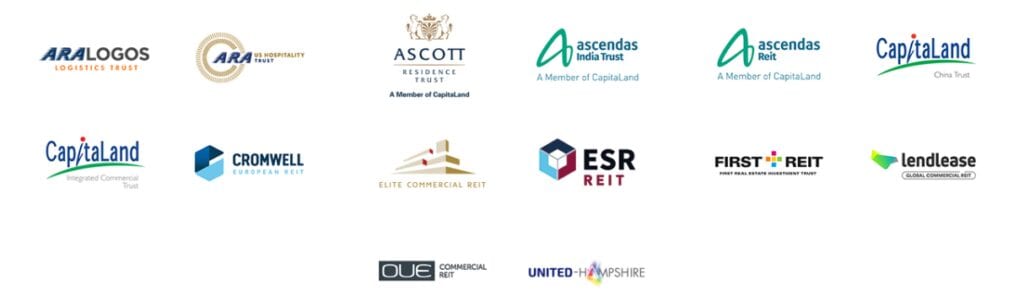
List of Participating REITs:
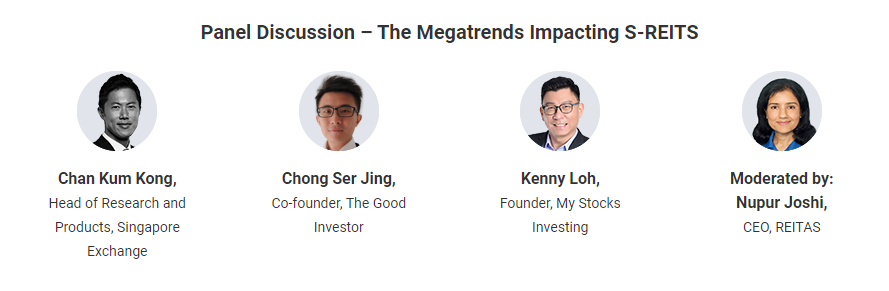
Panel Discussions:
The programme will also feature 2 panel discussions with our invited guests that aim to give an overview of the current REITs landscape. Both panels will be moderated by Nupur Joshi, CEO of REITAS.
Panel 1: 15 May 2021, 12pm
Panel 2: 22 May 2021, 12pm
Attendees of REITs Symposium 2021 can also take part in our 60 seconds REITs quiz and stand a chance to win 10 x $88 cash.
Kenny Loh is a Senior Consultant and REITs Specialist of Singapore’s top Independent Financial Advisor. He helps clients construct diversified portfolios consisting of different asset classes from REITs, Equities, Bonds, ETFs, Unit Trusts, Private Equity, Alternative Investments and Fixed Maturity Funds to achieve an optimal risk adjusted return. Kenny is also a CERTIFIED FINANCIAL PLANNER, SGX Academy REIT Trainer, Certified IBF Trainer of Associate REIT Investment Advisor (ARIA) and also invited speaker of REITs Sympsosium and Invest Fair.
Despite the Covid-19 pandemic significantly impacting REIT prices, some REITs have rebounded to close to their 5 years Price/NAV high. In this article we will be discussing the 5 S-REITs trading at close to their 5 years high, in terms of Price/NAV, at the time of writing (14 April 2021).
Do note that despite being at their 5 years high (in terms of Price/NAV) this does not mean that the REIT is overvalued. A REIT can be undervalued (<1 Price/NAV) but still be trading at an all-time high. All data is taken from the StocksCafe REIT screener at the time of writing.
5 REITs at their 5 years Price/NAV high
Below are the 5 REITs trading at their 5 years high.
Top 5 S-REITs trading at their 5 years high in terms of Price/NAV. Data as of 14th April 2021. Eagle Hospitality Trust values not meaningful due to its NAV drop from 80.87 US cents in Q2 2020 to 17.06 US cents in Q3 2020.
REIT Price/NAV Graph and Portfolio Overview
Below are the overview of the REITs. Do note that the NAV value changes every quarter/semi-annually, depending on the data provided by the individual REITs in their results release.
ARA Logos Logistics Trust is a REIT comprising of 100% Industrial and Logistics Properties. It has 27 logistics warehouse properties, with 10 in Singapore and the remaining 17 in Australia. It has a total portfolio valuation of S$1,281 million.
Keppel REIT comprises of interests in ten Grade A commercial office assets with 3 located in Singapore (4 after Keppel Bay Tower acquisition), 6 in Australia (Sydney, Melbourne, Brisbane and Perth) and 1 in Seoul, South Korea. It has a total portfolio valuation of S$8,861 million, the largest in this comparison.
Lendlease Global Commercial REIT comprises of a leasehold interest in one retail property in Singapore (313 Somerset) and three freehold office properties located in Milan, Italy. It has a total portfolio valuation of S$1,452 million.
Sabana REIT has a portfolio of 18 industrial buildings located entirely in Singapore. They are divided into 4 categories, namely high-tech industrial, chemical warehouse & logistics, warehouse & logistics, and general industrial. It has a total portfolio valuation of S$840.1 million, the smallest in this comparison.
ParkwayLife REIT is Asia’s largest listed healthcare REIT, with 53 properties. It comprises of 3 Hospitals in Singapore, 1 Medical Office Building in Kuala Lumpur, Malaysia, and the remaining in Japan as Nursing Homes. has a total portfolio valuation of S$2,002 million.
Fundamental Ratios
Funamental Ratio comparison between the 5 REITs. Information taken from the StocksCafe REIT screener, using its comparison feature. Values taken on 14th April 2021.
The above table shows the corresponding fundamental ratios of the 5 REITs. Some observations that can be made are shown below:
Yield (ttm): The yield of the 5 REITs are diverse, ranging from 3.33% up to 7.05%.
Gearing: The Gearing ratios of the REITs range from 33.5% to 39%. One thing that is worth observing is that these 5 REITs, that are trading at close to their 5 years high, none of them have gearing ratios of above 39%.
Price/NAV: Despite trading at close to their 5 years high, Keppel REIT, Lendlease REIT and Sabana REIT are slightly undervalued.
Some of you might wonder how is Sabana REIT trading at close to its 5 years high in Price/NAV, despite it dropping in price over the past 5 years. The chart below shows Sabana REIT’s price over 5 years.
This is because the Net Asset Value (NAV) of Sabana REIT has been dropping over the past 5 years as well. In layman terms, NAV = (Assets – Liabilities) / Total no. of shares. In Q1 2015, each share’s net asset value is S$1.06, but in Q4 2020, it is only S$0.51.
Lease Management
Lease Management comparison between the 5 REITs. Information taken from the StocksCafe REIT screener. Values taken on 14th April 2021.
The above table shows the corresponding lease management values of the 5 REITs. Some observations that can be made are shown below:
No. of Properties: ParkwayLife REIT has the most no. of properties, with 54. Sabana REIT is the only REIT in this comparison with a portfolio wholly in Singapore.
Occupancy Rate: Sabana REIT has noticeably a lower occupancy rate than the other 4 REITs, at 76.5%.
Weighted Average Lease Expiry (WALE): The 2 Industrial/Logistics REITs have lower WALEs at 2.8 years and 3.1 years respectively. The other 3 REITs in the other sectors have WALEs all above 4.9 years.
Property Portfolio Value: Keppel REIT has the largest Portfolio value by a large margin at S$8.86 billion.
Debt Management
Debt Management comparison between the 5 REITs. Information taken from the StocksCafe REIT screener. Values taken on 14th April 2021.
The above table shows the corresponding lease management values of the 5 REITs. Some observations that can be made are shown below:
Weighted Average Debt Maturity (WADM): Sabana REIT has the lowest WADM of only 1.2 years, while the other 4 REITs have a WADM of about 3 years.
Interest Cost/Cost of Debt: Lendlease REIT and ParkwayLife REIT have a very low Cost of Debt of less than 0.9%. The other 3 REITs have Cost of Debts hovering around 2 to 3%.
Interest Coverage Ratio: Lendlease REIT and ParkwayLife REIT have considerably higher ICRs with 8.5 and 18.1 respectively. The other 3 REITs have an ICR of around 3 to 4.
Unsecured Borrowings: All of Sabana REITs borrowings are secured.
Want to invest in Singapore REITs but don’t know how to start? Or not happy with your current investment portfolio? Contact Kenny here at kennyloh@fapl.sg.
Kenny Loh is a Senior Consultant and REITs Specialist of Singapore’s top Independent Financial Advisor. He helps clients construct diversified portfolios consisting of different asset classes from REITs, Equities, Bonds, ETFs, Unit Trusts, Private Equity, Alternative Investments, Digital Assets and Fixed Maturity Funds to achieve an optimal risk adjusted return. Kenny is also a CERTIFIED FINANCIAL PLANNER, SGX Academy REIT Trainer, Certified IBF Trainer of Associate REIT Investment Advisor (ARIA) and also an invited speaker of REITs Symposium and Invest Fair. Kenny Loh also offers REIT Portfolio Advisory for a fee. Do contact him at kennyloh@fapl.sg
Are Singapore Hospitality REITs a good buy today? The IATA expects that personal and leisure travel will return from 2nd half of 2021, as travel bubbles form and vaccination continues. In this article we’ll be covering the 5 Hospitality REITs in Singapore (excl Eagle Hospitality Trust) in greater detail, comparing their portfolio information, financial ratios, etc. The 5 REITs are namely ARA Hospitality Trust, Ascott Residence Trust, CDL Hospitality Trust, Far East Hospitality Trust and Frasers Hospitality Trust.
REIT Portfolio Overview
ARA Hospitality Trust has a 100% US portfolio consisting of 41 upscale hotels across 22 states, which consists of Hyatt-branded and Mariott-branded hotels. It has a total portfolio valuation of approximately US$700 million.
The largest of the 5 REITs listed here, Ascott Residence Trust has a total portfolio valuation of about S$7.2 billion. It is the most globally diversified REIT in this list, with 86 properties in 15 countries, including China, Japan, Australia, France, Germany and the United States. Its properties in Singapore comprises 16% of the total portfolio valuation with 5 properties.
CDL Hospitality Trusts has 18 properties across 8 countries including Japan, United Kingdom, New Zealand, the Maldives, Australia, Germany and Italy. It has a portfolio valuation of S$2.597 billion. Its properties in Singapore comprises 66% of the total portfolio valuation with 7 properties.
Far East Hospitality Trust is the only REIT in this list with all its 9 Hotels and 4 Serviced Residences in Singapore. It has 3 in-house brands, namely Quincy, Village Hotels and Oasia Hotel, and has a total portfolio valuation of S$2.65 billion (which is similar to that of CDL Hospitality Trusts).
Frasers Hospitality Trust has 15 properties across Australia, Singapore, Japan, United Kingdom, Malaysia and Germany. It has a total portfolio valuation of S$2.25 billion. Its properties in Singapore comprises 35% of the total portfolio valuation with 2 properties.
Portfolio Distribution (Singapore)
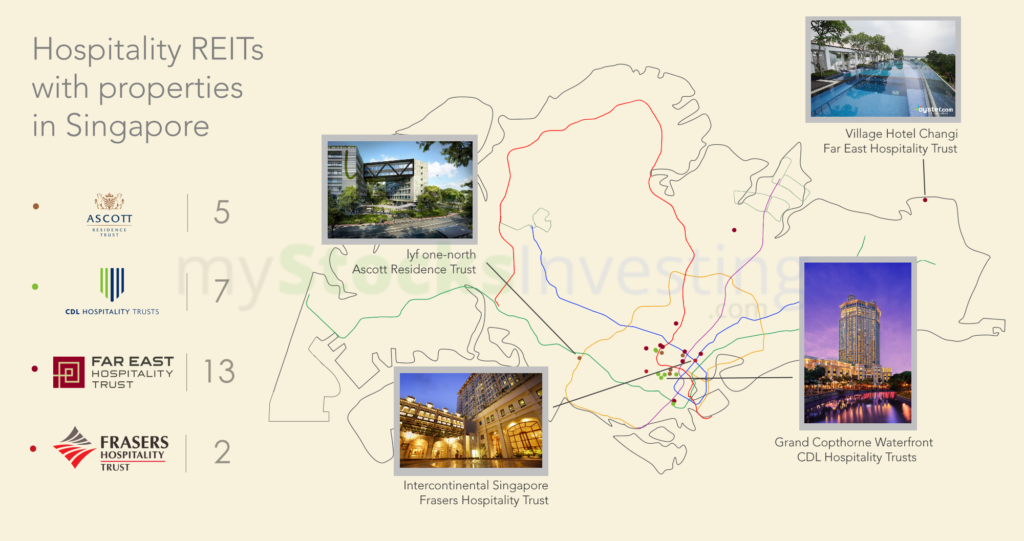
Geographical distribution of the Hospitality REITs properties (in Singapore)
Some observations that can be drawn out include:
Most hospitality properties are located in and around the Central area.
Only 3 properties are located outside of Singapore’s Central. They are:
lyf one-north, a co-living property in development, with estimated completion in 2021 (Ascott Trust)
Village Residence Hougang and Village Hotel Changi (Far East Hospitality Trust)
Portfolio Distribution (World)
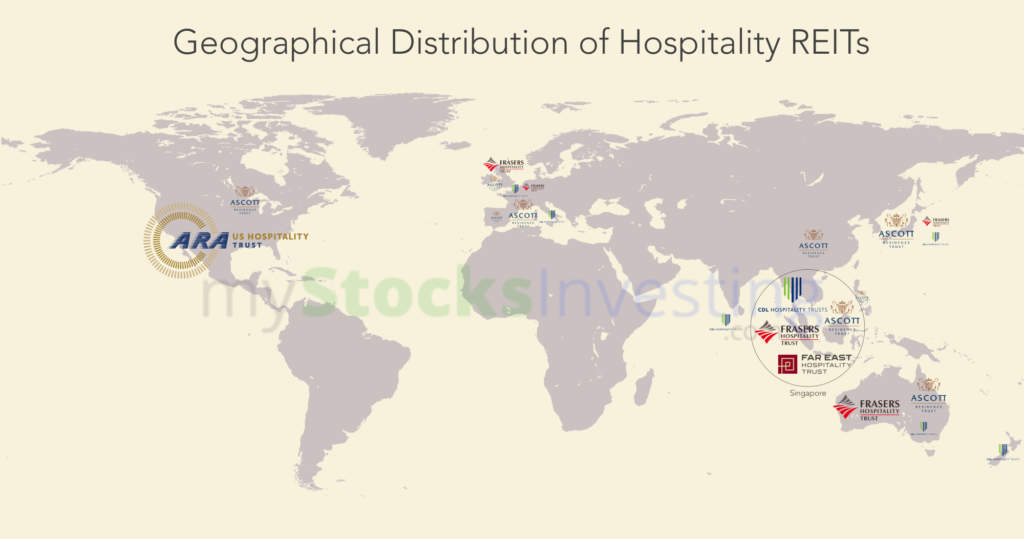
Geographical distribution of the Hospitality REITs properties globally. The size of the logo loosely reflects the percentage of the portfolio’s presence in the area.
One observation that can be drawn out is that Ascott Residence Trust, Frasers Hospitality Trust and CDL Hospitality Trusts are quite geographically diversified. Below, we will be comparing the REITs in-depth, using the latest values taken from the StocksCafe REIT screener, which values are taken from each REIT’s Q4 2020 business updates.
Fundamental Ratios
Funamental Ratio comparison between the 5 REITs. Information taken from the StocksCafe REIT screener. Values taken on 8th April 2021.
The above table shows the corresponding fundamental ratios of the 5 REITs. Some observations that can be made are shown below:
Yield (ttm): As expected, due to the Covid-19 pandemic stemming almost all international travel, yield (ttm) for all 5 hospitality REITs are low, at below 4% for all REITs.
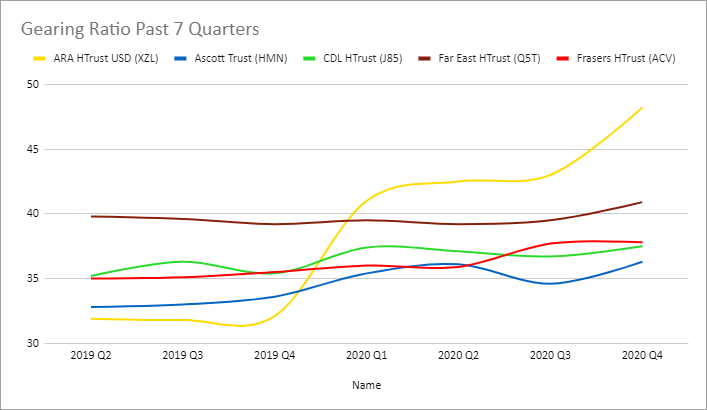
Gearing: The gearing ratios for all 5 hospitality REITs have generally increased in the past 4 quarters largely due to the reduced revenue caused by the global pandemic. The gearing ratio trends for all 5 REITs are shown below for reference.
Price/NAV: All 5 Hospitality REITs are relatively undervalued, with the exception of Ascott Trust and CDL Hospitality Trusts which are almost at book value with P/NAV values of about 0.95-0.98.
NAV: Net Asset Value of each REIT
TTM DPU: ARA Hospitality Trust has not had any dividend payouts for the past 4 quarters.
Lease Management
Lease Management comparison between the 5 REITs. Information taken from the StocksCafe REIT screener. Values taken on 8th April 2021.
The above table shows the corresponding lease management values of the 5 REITs. Some observations that can be made are shown below:
No. of Properties: Ascott Trust is the largest with 86 properties, followed by ARA Hospitality Trust. However do note that ARAHT has the lowest total portfolio valuation, despite having the 2nd most no. of properties.
Occupancy Rate: N/A for Hospitality REITs, although ARAHT provided a 41% occupancy rate.
Weighted Average Lease Expiry (WALE): N/A for Hospitality REITs
Property Yield: Property Yields are low, but that is to be expected. 5 of the 8 S-REITs with the lowest Property Yield are Hospitality REITs (excl Eagle HT), shown below:
Property Portfolio Value: ARAHT has the lowest total portfolio value, and Ascott Trust has the highest portfolio value. The rest have portfolio values of about $2-3B.
Debt Management
Debt Management comparison between the 5 REITs. Information taken from the StocksCafe REIT screener. Values taken on 8th April 2021.
The above table shows the corresponding lease management values of the 5 REITs. Some observations that can be made are shown below:
Weighted Average Debt Maturity (WADM): The WADM for all 5 REITs are between 2.3 and 3 years.
Interest Cost/Cost of Debt: ARAHT has a higher cost of debt compared to the other REITs, at 3.4%.
Interest Coverage Ratio: Interest Coverage Ratio is at or below 2.4 for all 5 REITs. This is expected due to the decreased revenue.
Unsecured Borrowings: Most of the borrowings made by the 5 REITs are unsecured, with the exception of ARAHT, with 29.2% unsecured borrowings.
Want to invest in Singapore REITs but don’t know how to start? Or not happy with your current investment portfolio? Contact Kenny here at kennyloh@fapl.sg.
Kenny Loh is a Senior Consultant and REITs Specialist of Singapore’s top Independent Financial Advisor. He helps clients construct diversified portfolios consisting of different asset classes from REITs, Equities, Bonds, ETFs, Unit Trusts, Private Equity, Alternative Investments, Digital Assets and Fixed Maturity Funds to achieve an optimal risk adjusted return. Kenny is also a CERTIFIED FINANCIAL PLANNER, SGX Academy REIT Trainer, Certified IBF Trainer of Associate REIT Investment Advisor (ARIA) and also an invited speaker of REITs Symposium and Invest Fair. Kenny Loh also offers REIT Portfolio Advisory for a fee. Do contact him at kennyloh@fapl.sg