FSTAS8670 has retired. The new FTSE ST REIT index now is FSTAS351020.
Currently the REIT index is trading within a range between 820 and 880. These 2 levels are supported by strong resistance turned support level at 820 and strong resistance at 880.
Direction: Sideway Range Bound until breakout or breakdown from these 2 key levels.
Kenny Loh is a Senior Consultant and REITs Specialist of Singapore’s top Independent Financial Advisor. He helps clients construct diversified portfolios consisting of different asset classes from REITs, Equities, Bonds, ETFs, Unit Trusts, Private Equity, Alternative Investments, Digital Assets and Fixed Maturity Funds to achieve an optimal risk adjusted return. Kenny is also a CERTIFIED FINANCIAL PLANNER, SGX Academy REIT Trainer, Certified IBF Trainer of Associate REIT Investment Advisor (ARIA) and also invited speaker of REITs Symposium and Invest Fair. You can join my Telegram channel #REITirement – SREIT Singapore REIT Market Update and Retirement related news. https://t.me/REITirement
Happening on the 15th and 22nd May 2021, REITs Symposium is into its 7th edition. Across 2 days, we will unveil the developments and opportunities in the REITs Industry. Gain insights into Singapore REITs, and engage with a panel of speakers which include REIT CEOs. Register for free now!
Technical Analysis of FTSE ST REIT Index (FSTAS8670)
At the point of writing, the chart of FSTAS8670 is not available on multiple charting platforms. However I am able to find another ticker (FSTRE2000) from MarketWatch.
FTSE ST Real Estate Investment Trusts (FTSE ST REIT Index) increased slightly from 859.68 to 865.91 (+0.72%) compared to last month update. Currently the Singapore REIT index is still trading with a range between 816 and 874.
The following is the compilation of 40 Singapore REITs with colour coding of the Distribution Yield, Gearing Ratio and Price to NAV Ratio.
Note 1: The Financial Ratio are based on past data and there are lagging indicators.
Note 2: This REIT table takes into account the dividend cuts due to the COVID-19 outbreak. Yield is calculated trailing twelve months (ttm), therefore REITs with delayed payouts might have lower displayed yields, thus yield displayed might be lower.
Note 3: REITs highlighted in blue have been updated with the latest Q1 2021 business updates.
Do sign up for the REIT screener at only ~$8.33 per month! (limited time only). Normal price $120 per year.
Price/NAV increased at 1.04
Was 1.01 in April 2021.
Singapore Overall REIT sector is at about fair value now.
Take note that NAV is adjusted downward for most REITs due to drop in rental income (Property valuation is done using DCF model or comparative model)
TTM Distribution Yield decreased to 5.36%
Decreased from 5.47% in April 2021.
23% of Singapore REITs (9 out of 39) have distribution yields of above 7%.
Do take note that these yield numbers are based on current prices taking into account the delayed distribution/dividend cuts due to COVID-19, and post circuit breaker recovery.
Excluded Eagle Hospitality Trust due to suspension.
Gearing Ratio at 37.53%.
Remained almost the same at 37.44% in April 2021.
Gearing Ratios are updated quarterly.
In general, Singapore REITs sector gearing ratio is healthy but started to increase due to the reduction of the valuation of portfolios and increase in borrowing due to Covid-19.
Most overvalued REITs (based on Price/NAV)
Keppel DC REIT (Price/NAV = 2.28)
Parkway Life REIT (Price/NAV = 2.14)
Mapletree Industrial Trust (Price/NAV = 1.70)
Mapletree Logistics Trust (Price/NAV = 1.53)
Ascendas REIT (Price/NAV = 1.41)
No change from January – April 2021 for top 5 overvalued REITs ranking
Most undervalued REITs (based on Price/NAV)
First REIT (Price/NAV = 0.52)
BHG REIT (Price/NAV = 0.64)
OUE Commercial REIT (Price/NAV = 0.69)
Starhill Global REIT (Price/NAV = 0.69)
Lippo Malls Indonesia Retail Trust (Price/NAV = 0.69)
Suntec REIT (Price/NAV = 0.74)
All 6 REITs were also the top 6 undervalued REITs of April 2021
Highest Distribution Yield REITs (ttm)
First REIT (15.96%)
Prime US REIT (8.02%)
IREIT Global (7.80%)
Manulife REIT (7.42%)
Cromwell European REIT (7.33%)
Soilbuild Business Space REIT (7.33%)
Reminder that these yield numbers are based on current prices taking into account delayed distribution/dividend cuts due to COVID-19.
Some REITs opted for semi-annual reporting and thus no quarterly DPU was announced.
Total Singapore REIT Market Capitalisation = S$108.8 Billion.
Increased from S$107.9 Billion in January 2021.
Biggest Market Capitalisation REITs:
Capitaland Integrated Commercial Trust ($14.18B)
Ascendas REIT ($12.38B)
Mapletree Logistics Trust ($8.48B)
Mapletree Commercial Trust ($7.06B)
Mapletree Industrial Trust ($6.65B)
No change in ranking compared to March and April 2021 update.
Smallest Market Capitalisation REITs:
BHG Retail REIT ($284M)
United Hamsphire REIT ($327M)
First REIT ($392M)
ARA Hospitality Trust ($393M)
Sabana REIT ($442M)
No change in ranking compared to March and April 2021 update.
Eagle Hospitality Trust is currently suspended
Disclaimer: The above table is best used for “screening and shortlisting only”. It is NOT for investing (Buy / Sell) decision. To learn how to use the table and make appropriate investment decisions, sign up for the next REIT Investing Workshop here to learn how to choose fundamentally strong Singapore REITs for long-term investing and passive income generation.
Fundamentally the whole Singapore REITs is slightly overvalued now based on the average Price/NAV value of the S-REITs.. Below is the market cap heat map for the past 1 month.
Yield spread (in reference to 10 year Singapore government bond of 1.551%) continues to tighten from 4.08% to 3.809%. However, the risk premium is still attractive to accumulate Singapore REITs in stages to lock in the current price and to benefit from long-term yield after the recovery. Moving forward, it is expected that DPU will increase due to the recovery of global economy.
Technically the REIT Index is still trading in a sideways consolidation waiting for a breakout (upside bias). Current macro factors such as a low-interest rate environment, aggressive M&A for future DPU growth, and recovery of global economic support the bullish breakout.
Note: This above analysis is for my own personal research and it is NOT a buy or sell recommendation. Investors who would like to leverage my extensive research and years of Singapore REIT investing experience can approach me separately for a REIT Portfolio Consultation.
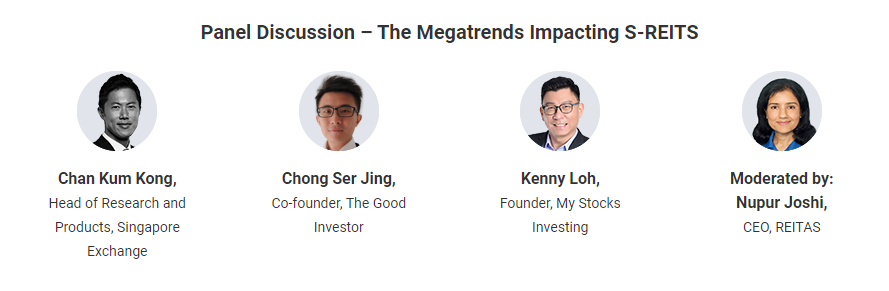
I have been invited as one of the panelists of the upcoming REITs Symposium 2021 event to share about “The Megatrends Impacting S-REITs” on May 22, 2021. You can check the rest of the program of REITs Symposium here.
Kenny Loh is a Senior Consultant and REITs Specialist of Singapore’s top Independent Financial Advisor. He helps clients construct diversified portfolios consisting of different asset classes from REITs, Equities, Bonds, ETFs, Unit Trusts, Private Equity, Alternative Investments, Digital Assets and Fixed Maturity Funds to achieve an optimal risk adjusted return. Kenny is also a CERTIFIED FINANCIAL PLANNER, SGX Academy REIT Trainer, Certified IBF Trainer of Associate REIT Investment Advisor (ARIA) and also invited speaker of REITs Symposium and Invest Fair. You can join my Telegram channel #REITirement – SREIT Singapore REIT Market Update and Retirement related news. https://t.me/REITirement
ESG, or ethical, social, and governance, investing is increasingly important to many investors who want to fund businesses that match their values and also have growth potential. ESG investing can mean different things, such as avoiding businesses that produce or sell weapons; adult entertainment or gambling companies; or those that take part in human rights oppression. For many ESG investors, improving the environment is another important principle.
Clean energy ETFs offer a way to potentially increase your assets while encouraging the development of clean fuel that minimizes damage to the environment and reduces pollution. Now hydrogen fuel ETFs are joining them. Here’s why a hydrogen ETF may deserve a place in your portfolio.
Public opinion supports clean energy
All around the world, people are seeing the effects of climate change. In 2020, 22 natural disasters costing over $1 billion occurred in the US alone, compared with 6 per year from 2002 to 2010. Extreme weather events like avalanches, heatwaves, drought, and hurricanes are killing more people every year, pushing public support for zero-carbon initiatives and clean energy.
Consumers are also experiencing power failures more often, like the recent massive outage in Texas. Back in 2014, scientists were already warning that outdated power grids and rising electricity use would make blackouts more frequent.
The US has more power outages that any other developed country (with an annual average of nearly 5 hours in 2019), while China, Brazil, Europe, India, Turkey, and more have suffered serious power failures over the past 15 years. People see the need for more reliable microgrids that use alternative energy like hydrogen, so essential services can continue even during a power failure.
Governments and businesses need hydrogen fuel
87 signatories to the Paris climate agreement committed to keeping global warming under 2℃ by 2030, and many countries, cities, and corporations set zero-carbon targets. Planting trees and reducing energy consumption are praiseworthy, but only the adoption of clean energy like green hydrogen can meet these goals, and that means significantly expanding production. We’re going to need another 826 gigawatts of green power production over the next 10 years, requiring an average of $100 billion dollars of investment each year for the next decade, so the sector appears set to grow significantly.
Green hydrogen power is ideal for these purposes. It’s very energy-dense and has a long-duration discharge cycle, which enables it to store excess energy and release it later at times and places of peak demand. This helps bring down energy volatility, one of the main causes of power failures. Unlike other green fuels, hydrogen is molecule-based, so it can be applied to industrial use cases that aren’t suitable for green electricity.
Hydrogen is the most common element on the planet, so there’s plenty of supply. Converting hydrogen into fuel requires electrolyzers to separate and harvest hydrogen molecules, storing the hydrogen in durable, pressurized containers, and then transferring it to fuel cells for release as energy. The only waste product is harmless water, so when energy from renewable sources is used for the electrolysis, hydrogen fuel causes close to zero emissions or pollution. This is why its called “green” hydrogen.
International investment in hydrogen fuel is high
Governments are leading the way to invest in hydrogen fuel. The Biden administration announced a $400 billion investment in clean energy development over the next 10 years (of which hydrogen is a part), including subsidizing infrastructure construction and initial rollout
costs. Nations across Asia and Europe are investing over $2 billion per year in hydrogen energy, and China announced more than $17 billion of investments in hydrogen transport between now and 2023. Politicians are also offering incentives for businesses and industries to cut carbon emissions, and tax breaks for the cost of purchasing and installing green energy equipment.
Top global investors managing close to $7 trillion of assets are expected to more than double their investment in renewable energy infrastructure over the next 10 years, to approximately $742.5 billion. Investment in hydrogen refueling stations and electrolysis plants rose to $272 million and $189 million respectively in 2020, despite the impact of COVID-19 on the economy.
Hydrogen fuel is already a reality
Green hydrogen fuel isn’t just a theory. The US already has 43 retail hydrogen stations and the UK hosts 7 active hydrogen refueling stations, with more under construction in both countries. The cost of hydrogen electrolyzers has dropped by up to 50% since 2015, and it’s expected to fall by another 40-60% by 2030, helping hydrogen fuel to become commercially viable.
As the cost drops, we see the implementation of hydrogen in a number of use cases, including microgrids for essential services, transportation, residential heating, aerospace, and industrial fuel and feedstock. Hydrogen-powered forklifts are in use in warehouses owned by Home Depot, Amazon, Walmart, and BMW; almost 7,000 fuel cell elective vehicles (FCEVs) are on the roads in California, and hydrogen fuel-cell bus fleets and trains are rolling out in Europe and China.
A hydrogen ETF can be a savvy investment decision
If you’re interested in investing in this growing new energy sector, but nervous about the risk of placing all your eggs in a single new company, a hydrogen ETF may offer a great way to proceed.
Like other ETFs, a hydrogen ETF would give you broad exposure to a number of companies in the field, thereby mitigating some of your single stock risk. They generally have holdings in a range of companies in the sector, including power producers, fuel cell manufacturers, fuel cell tech developers, and hydrogen fuel distributors.
Bear in mind that we believe hydrogen investments should be for the long term, helping to balance short-term, high-growth funds and stocks. A hydrogen ETF adds exposure to what we think could be a strong, long-term trend and rising disruptive sector in the energy market. In our opinion, it represents a long term, steady growth sector, which can be a lucrative part of a diversified investment portfolio.
Investing involves risk. Principal loss is possible. As an ETF, HDRO (the “Fund”) may trade at a premium or discount to NAV. Shares of any ETF are bought and sold at market price (not NAV) and are not individually redeemed from the Fund. Brokerage commissions will reduce returns. The Fund is not actively managed and would not sell a security due to current or projected under performance unless that security is removed from the Index or is required upon a reconstitution of the Index. A portfolio concentrated in a single industry or country, may be subject to a higher degree of risk. Specifically, the Index (and as a result, the Fund) is expected to be concentrated in hydrogen and fuel cell companies. Such companies may depend largely on the availability of hydrogen gas, certain third-party key suppliers for components in their products, and a small number of customers for a significant portion of their business. The Fund is considered to be non-diversified, so it may invest more of its assets in the securities of a single issuer or a smaller number of issuers. Investments in foreign securities involve certain risks including risk of loss due to foreign currency fluctuations or to political or economic instability. This risk is magnified in emerging markets. Small and mid-cap companies are subject to greater and more unpredictable price changes than securities of large-cap companies.
The Fund is new with a limited operating history.
Fund holdings and sector allocations are subject to change at any time and should not be considered recommendations to buy or sell any security. Click here for current holdings information.
Opinions expressed are subject to change at any time, are not guaranteed, and should not be considered investment advice.
Sylvia Jablonski, Chief Investment Officer of Defiance ETFs, manages Defiance’s retail and institutional investment research, capital markets and thematic ETF model portfolios. Acknowledged as a top expert in the ETF space, Sylvia is frequently featured on CNBC, Bloomberg and the Wall Street Journal.