Singapore REITs 2026 Market Outlook

  • Post author:

(1) Review of 2025 Singapore REITs Performance (The Wrap-Up)

Key Takeaway: A Strong Rebound driven by rate stabilization and the start of SORA decline.

  • Overall Performance: 2025 is shaping up to be the best year for S-REITs since 2019, with total returns (price gain + dividend) projected to be around 12-15% YTD (as of Dec 2025). This marks a significant rebound from the challenging high-rate environment of 2023/2024.

  • Driver: The primary catalyst has been the stabilisation and decline of borrowing costs. The 3-month Compounded SORA in Singapore has trended down (e.g., from a peak near 4.5% to around $1.28% by late 2025), significantly easing the refinancing burden.

  • Fundamental Stability: Most S-REITs demonstrated stable operating performance in 2025, with resilient occupancy rates and positive rental reversions across Retail, Industrial, and Office sectors.
  • Valuation: Despite the price recovery, the sector is generally still trading at an attractive valuation, with the average P/NAV (Price-to-Net Asset Value) around 0.85 (simple average) and a trailing 12-month yield around 5.5%.

(2) Projected US and Singapore Interest Rates

Key Takeaway: The “Lower-for-Longer” narrative is shifting to a rate-cutting cycle, providing a strong tailwind for 2026.

Rate Benchmark2025 Year-End Estimate2026 Outlook (Consensus)Impact on S-REITs
US Fed Funds Rate3.50% – 3.75% (Following cuts in late 2025)Further cuts expected in H1 2026, reaching a terminal rate potentially in the 3.00% – 3.25% range end of 2026.Drives global capital flows and sentiment. Lower US rates support global growth and ease the cost of capital for S-REITs with US/overseas assets.
Singapore Interest Rate (SORA)1.25% – 1.50% (3-months)Expected to remain low and stable or track further down as US rates ease and global liquidity improves.Directly lowers the cost of debt for S-REITs, which directly translates to DPU savings. Will benefit S-REITs with borrowing in SGD.

(3) How the Interest Rate Shift Will Affect REIT DPU and Valuation

Key Takeaway: Lower rates are the most significant positive catalyst for DPU and valuation compression in 2026.

  • Direct Impact on DPU (Distribution Per Unit):
    • Lower SORA/cost of debt directly reduces interest expense for REITs with floating-rate debt or upcoming refinancing. This saving is immediately accretive to Distributable Income and, thus, DPU.
    • Analysts have noted that even a 25-50 basis point decline in debt cost can visibly improve DPU for REITs with shorter debt maturity profiles.
    • Unlikely for all the REITs to benefit fully from the interest rate cut as majority of the REITs have extend the debt maturity profile with higher fixed rate previously. Only REITs with shorter WADM (Weighted Debt Maturity Profile) and low percentage of fixed rate will benefit the most.
  • Indirect Impact on Valuation (NAV):
    • Yield Compression: As bond yields fall, the required yield on S-REITs becomes less competitive. Investors shift from lower-risk bonds to REITs for yield, driving up REIT prices. This narrows the Yield Spread (REIT Yield minus Government Bond Yield).
    • Capitalisation Rates: Lower borrowing costs are expected to lead to a compression of cap rates in the private real estate market, driving up the valuation of the physical properties (Net Asset Value – NAV), especially for prime assets. This will support the REIT’s share price and P/NAV ratio.
  • Historical Parallel: Historically, REITs have often performed strongly in the 12 months following the commencement of an easing cycle, as lower rates enhance their appeal as an income-generating asset.

(4) Key Financial Ratios for REIT Selection in 2026

Given the shift in the interest rate cycle, investors should focus on ratios that signal stability and capacity for growth.

RatioRationale for 2026 SelectionCurrent MAS Guideline/Target
Gearing Ratio (Aggregate Leverage)Indicates debt capacity for accretive acquisitions. Lower is safer in a volatile market.<50% (Regulatory Limit)
Interest Coverage Ratio (ICR)Measures the ability to service interest payments from earnings. Must be high enough to satisfy MAS requirements if gearing is close to the limit.>1.5x (New MAS threshold)
Weighted Average Lease Expiry (WALE)Predictability of income stream. Longer WALE (e.g., >3.5$ years) signals stable cash flow, favoured in a transition period.N/A
Price-to-NAV (P/NAV)Valuation metric. REITs trading at a significant discount (P/NAV < 1.0) with strong fundamentals may offer the greatest capital upside as valuations recover. However, some REITS always traded at premium or discount. Thus, it is important to compare the current P/NAV with the historical P/NAV range.N/A
Distribution Yield SpreadMeasures REIT yield relative to the Singapore 10Y Government Bond. Wider spread suggests better value proposition compared to risk-free assets.N/A

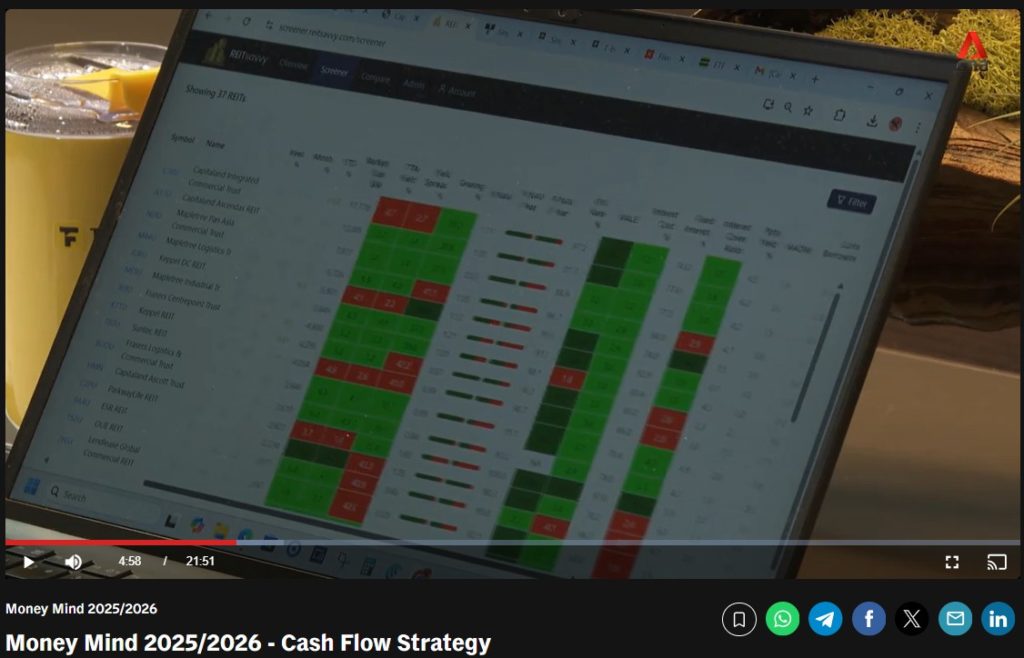
REITs ranked by the highest WALE (Source: REITsavvy.com)

REITs ranked by the highest Interest Coverage Ratio (Source: REITsavvy)

Expect Improvement in Gearing (decreased) and ICR (increase) for S-REITs in 2026 (Source: REITSavvy Overview)

(5) Sector Outlook

Key Takeaway: Industrial (Data Centre/Logistics) and Suburban Retail are positioned for continued strength, while Hospitality sees growth from tourism.

SectorOutlook for 2026Key Drivers / Headwinds
Industrial (Logistics/Data Centre)Strongest Outlook. Structural growth and positive rental reversions.Driven by e-commerce, AI adoption, and resilient demand for logistics. Data Centres are favoured for long-duration leases and secular growth.
Retail (Suburban)Resilient. Positive rental reversions and strong footfall.Supported by necessity spending, resilient domestic consumption, and limited new supply.
OfficeStable but Divergent. Prime CBD assets in Singapore remain resilient. US Commercial Office may see bottom and rebound with lower interest rate.Flight to quality: High occupancy for modern, premium assets in core areas. Pressure on older, non-core assets. May see re-rating of the valuation of US commercial office. Probable resumption of dividend for US Office REITs.
HospitalityGrowth Recovery. Benefits from continued post-pandemic tourism boom.Strong RevPAR (Revenue Per Available Room) growth driven by recovering international visitor arrivals.
HealthcareDefensive/Stable. Long-term leases with rent escalations provide DPU stability.Driven by aging demographics and defensive nature of the assets. Lower yields reflect lower risk profile.

(6) Wrap Up: Summary of Outlook 2026

  • The Pivot Year: 2026 is expected to be a pivotal recovery year for S-REITs, transitioning from a survival phase to a growth phase, primarily driven by a more accommodative lower interest rate environment.
  • DPU Inflection: We expect DPU growth to inflect upwards for the sector as lower interest expenses translate directly to distributable income.
  • The New Mantra: Investors should focus on Quality, Balance Sheet Strength, and Sector Exposure to secular growth trends (Data Centres, Logistics, Suburban Retail).
  • Actionable Strategy: S-REITs are poised to be an attractive income play, with a potential to deliver both stable yield and capital appreciation as market valuations converge with private asset values.

Kenny Loh is a distinguished Wealth Advisory Director with a specialization in holistic investment planning and estate management. He excels in assisting clients to grow their investment capital and establish passive income streams for retirement. Kenny also facilitates tax-efficient portfolio transfers to beneficiaries, ensuring tax-efficient capital appreciation through risk mitigation approaches and optimized wealth transfer through strategic asset structuring.

In addition to his advisory role, Kenny is an esteemed SGX Academy trainer specializing in S-REIT investing and regularly shares his insights on MoneyFM 89.3. He holds the titles of Certified Estate & Legacy Planning Consultant and CERTIFIED FINANCIAL PLANNER (CFP).

With over a decade of experience in holistic estate planning, Kenny employs a unique “3-in-1 Will, LPA, and Standby Trust” solution to address clients’ social considerations, legal obligations, emotional needs, and family harmony. He holds double master’s degrees in Business Administration and Electrical Engineering, and is an Associate Estate Planning Practitioner (AEPP), a designation jointly awarded by The Society of Will Writers & Estate Planning Practitioners (SWWEPP) of the United Kingdom and Estate Planning Practitioner Limited (EPPL), the accreditation body for Asia.

You can join his Telegram channel #REITirement – SREIT Singapore REIT Market Update and Retirement related news. https://t.me/REITirement

Continue ReadingSingapore REITs 2026 Market Outlook

Money and Me: S-REITs at the Turning Point – Income, Opportunity and the New Owners of Property

  • Post author:

S-REIT Dec-2025: Navigating the Recovery and Spotting the Winners

The tide is finally turning for Singapore Real Estate Investment Trusts (S-REITs). After a challenging period, the combination of falling interest rates and resilient operational fundamentals has breathed new life into the sector. As we look toward 2026, the focus for investors is shifting from “surviving” to “thriving.”

1. 2025 Performance Review: The Standout Performers

  • In 2025, REITs with predominantly Singapore-based assets have led the charge. Performance has been particularly strong in the industrial and diversified commercial sub-sectors

Key Highlights:

  • Industrial Strength: Small and mid-cap industrial REITs like Alpha Integrated and ESR REIT have seen resilient DPU (Distribution Per Unit) growth.
  • Retail Resilience: In the suburban retail space, Frasers Centrepoint Trust (FCT) has leveraged high occupancy and positive rental reversions in necessity-based malls.
  • Prime Rebounds: CapitaLand Integrated Commercial Trust (CICT) and Mapletree Pan Asia Commercial Trust (MPACT) have rebounded strongly through active capital management of their prime assets.
REITSub SectorYTD Price ReturnTTM DPU Yield2025 Total Return
Alpha Integrated REITIndustrial30.6%6.9%37.5%
ESR REITIndustrial23.1%7.8%30.9%
AIMS APAC REITIndustrial15.7%6.5%22.2%
Capitaland Integrated Commercial TrustDiversified19.5%5.9%25.4%
OUE REITDiversified22.4%4.8%27.2%
Mapletree Pan Asia Commercial TrustDiversified18%5.5%23.5%
Suntec REITDiversified16.7%4.5%21.2%
Frasers Centrepoint TrustRetail7%5.3%12.3%
Starhill Global REITRetail12.7%6.3%19%
Lendlease Global Commercial REITRetail9.8%5.9%15.7%

Source: REITsavvy.com Screener Nov 18-2025


2. Strategic Investing in a Falling Rate Environment

While lower rates provide a tailwind, investors must be selective. A realistic time horizon for a full recovery is 3 to 5 years, as it takes time to refinance high-cost debt and for valuation caps to compress.

Two Winning Strategies:

  1. Focus on High-Quality Cash Flows: Target sectors like suburban retail, healthcare, and prime logistics.
  2. Identify Value: Look for REITs trading at attractive Price-to-NAV (Net Asset Value) discounts that have been oversold.

Pro-Tip: Avoid the “Yield Trap.” Do not chase the highest headline yield without checking the balance sheet. Prioritize low gearing ratios and high interest coverage ratios (ICR), which provide the “dry powder” needed for future acquisitions.

3. A Shift in Prime Ownership: The Private Fund Threat

A defining trend is emerging: prime assets are increasingly moving away from listed S-REITs toward private fund structures.

  • The Problem: Many S-REITs with Singapore office exposure trade at significant discounts to book value (e.g., Suntec at 0.7x P/NAV and OUE REIT at 0.62x P/NAV).
  • The Constraint: Listed REITs often struggle to make DPU-accretive deals because raising equity at discounted prices dilutes unitholders.
  • The Private Advantage: Private funds, backed by patient institutional capital, can bid more aggressively for “trophy assets” without the pressure of short-term public market volatility.

This suggests listed S-REITs may increasingly focus on smaller assets or projects requiring intensive redevelopment.

4. What’s on the Radar for 2026?

As we move into 2026, the market will differentiate between managers who can deliver and those who cannot. No longer can managers hide behind the excuse of high interest costs.

  • Healthcare REITs: Parkway Life REIT (PLife) is a top pick due to its defensive nature and rental escalation formula tied to inflation. First REIT is also under watch regarding its strategic review and potential offloading of Indonesian assets.
  • New Economy Industrial: Demand for data centers, high-spec logistics, and business parks is expected to outpace supply as the economy digitizes. These sectors represent a unique intersection of property and technology growth.

Final Remark

2026 will be the year to separate the winners from the losers. With interest rates on a downward trajectory, the stage is set for REITs to grow DPUs through acquisitions and portfolio restructuring.

Kenny Loh is a distinguished Wealth Advisory Director with a specialization in holistic investment planning and estate management. He excels in assisting clients to grow their investment capital and establish passive income streams for retirement. Kenny also facilitates tax-efficient portfolio transfers to beneficiaries, ensuring tax-efficient capital appreciation through risk mitigation approaches and optimized wealth transfer through strategic asset structuring.

In addition to his advisory role, Kenny is an esteemed SGX Academy trainer specializing in S-REIT investing and regularly shares his insights on MoneyFM 89.3. He holds the titles of Certified Estate & Legacy Planning Consultant and CERTIFIED FINANCIAL PLANNER (CFP).

With over a decade of experience in holistic estate planning, Kenny employs a unique “3-in-1 Will, LPA, and Standby Trust” solution to address clients’ social considerations, legal obligations, emotional needs, and family harmony. He holds double master’s degrees in Business Administration and Electrical Engineering, and is an Associate Estate Planning Practitioner (AEPP), a designation jointly awarded by The Society of Will Writers & Estate Planning Practitioners (SWWEPP) of the United Kingdom and Estate Planning Practitioner Limited (EPPL), the accreditation body for Asia.

If you need any financial advice, please contact kennyloh@fapl.sg

You can join his Telegram channel #REITirement – SREIT Singapore REIT Market Update and Retirement related news. https://t.me/REITirement
Listen to his previous market outlook interviews here:

2025

2024

2023

2022

2021

2020

Continue ReadingMoney and Me: S-REITs at the Turning Point – Income, Opportunity and the New Owners of Property

The Money Ladder: How to Build Consistent Income That Pays You Every Month

  • Post author:

Are you a retiree looking for dependable passive income? Or an investor who wants your investments to generate cash flow to cover monthly expenses? The “money laddering” strategy is a simple, structured way to achieve this goal by creating predictable, repeating cash flow.

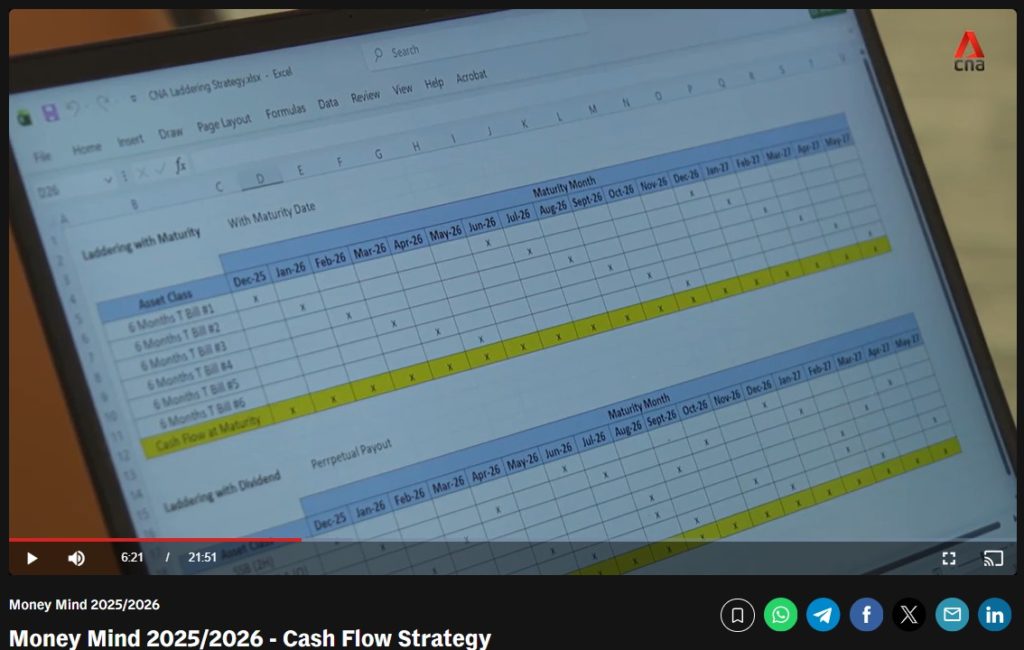
View the CNA Money Mind: Cash Flow Generation using Laddering Strategy.

What is a Money Laddering Strategy?

Laddering is the process of splitting your total investment capital into smaller parts (or “rungs”). Instead of putting all your money into one asset that pays out once a year, you invest in multiple assets that mature or pay out at different, staggered times.

The Key Benefit: This ensures money flows into your bank account regularly, often monthly or quarterly, instead of waiting a full year or more for returns. This stable cash flow is valuable even when the market is flat or interest rates are falling.

You can build ladders using a mix of assets, including short-term bills, government bonds, Dividend ETFs, and REITs (Real Estate Investment Trusts). The goal is to choose your own risk level, from safe and slow to higher yielding options.

Case Study 1: The Retiree’s Safe Ladder (Lowest Risk)

This strategy prioritizes safety and liquidity above all else. It’s perfect for retirees or cautious investors whose primary goal is preserving capital while ensuring a fixed income stream.

The Strategy: Singapore Savings Bonds (SSBs) Mini-Ladder

A practical way to start small is to build a mini-ladder using Singapore Savings Bonds (SSBs).

  • How it works: SSBs pay interest every six months. By splitting a modest sum (e.g., S$1,000) and investing it across 12 different SSB issues over 12 consecutive months, you create an effective monthly payout schedule.
  • Payout Start: You start receiving your first payout in Month 7. After that, a payout will arrive every month as the interest from each bond issue kicks in.
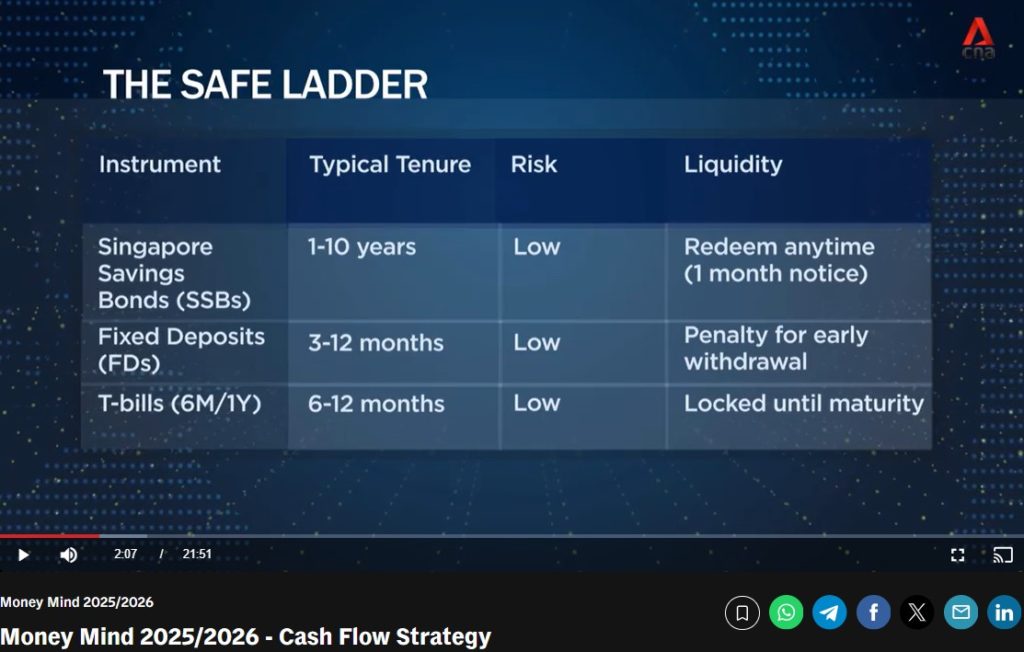
  • Instruments & Risk: This ladder uses instruments with low risk and high liquidity:
    • SSBs: Low risk, redeemable anytime with one month’s notice.
    • Fixed Deposits (FDs): Low risk, but penalizes early withdrawal.
    • T-bills (6M/1Y): Low risk, locked until maturity.
  • Trade-off: The investment is simple, low maintenance, and government-backed, but the yield is generally low (e.g., around 1.33% for a recent 1-year rate).

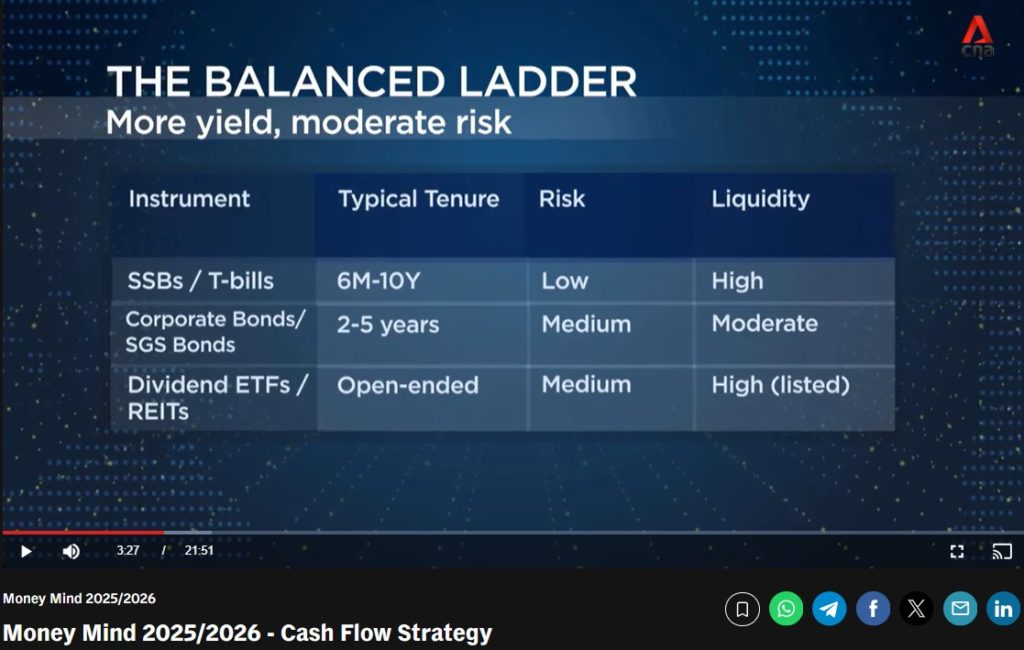
Case Study 2: The Business Owner’s Balanced Ladder (Moderate Risk)

This strategy is suitable for investors or business owners who want to beat low fixed deposit rates and are comfortable taking on a little more market movement to potentially triple their yield.

The Strategy: Blending Stability with Market Exposure

The Balanced Ladder blends the stability of low-risk instruments with moderate exposure to income-paying listed assets.

  • How it works: It combines fixed-income assets with growth assets to achieve a higher, but still stable, return. A typical 60/40 allocation (60% fixed income, 40% growth) can yield around 3.5%.
  • Instruments & Risk:
    • Low Risk (For Stability): SSBs and T-bills (6 months to 10 years).
    • Medium Risk (For Moderate Yield): Corporate Bonds (2-5 years) and SGS Bonds (Singapore Government Securities).
    • Medium Risk (For Income/Growth): Dividend ETFs and REITs (listed, open-ended).
  • Purpose: Short-term bills ensure steady cash flow and liquidity; bond funds provide stability; and REITs/ETFs offer potential capital growth and higher income. The idea is to balance safety and growth.

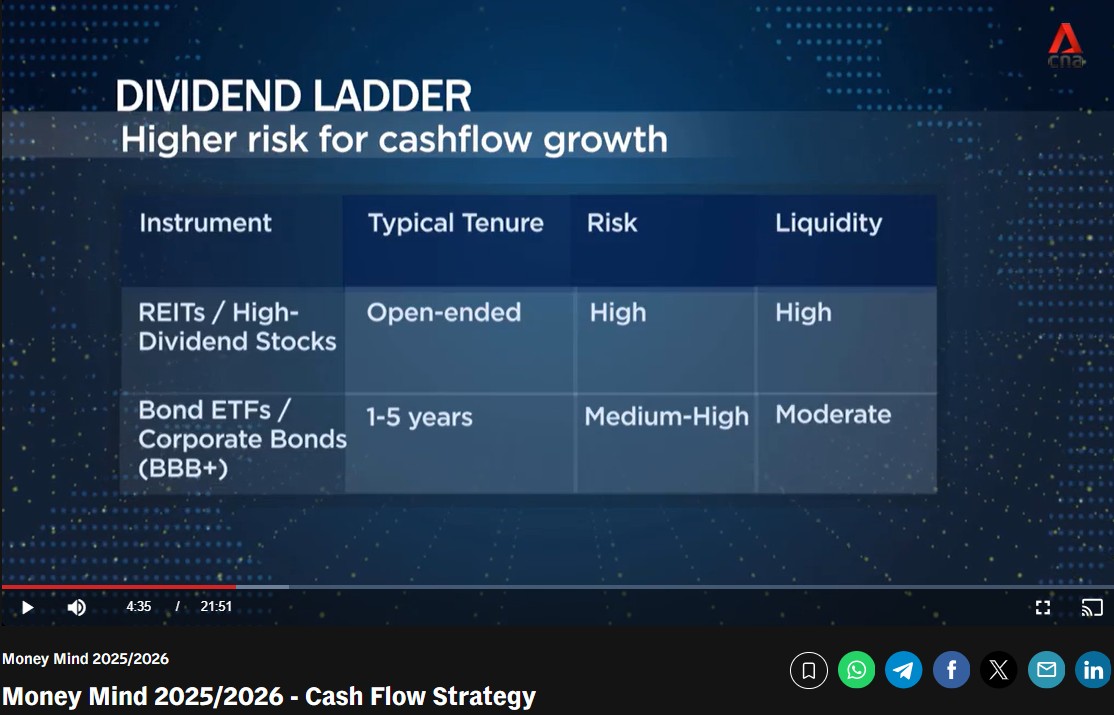
Case Study 3: The Active Investor’s Dividend Ladder (Higher Income)

This strategy is for investors who are comfortable with volatility and want to maximize monthly cash flow from their portfolio to pay for monthly expenses.

The Strategy: Targeting High-Yield Payouts

This ladder uses high-yielding, income-focused assets that are planned to pay out at different times throughout the year.

  • How it works: By tracking the payout dates of different assets, you can set up a rhythm to receive cash flow almost every month. A 5% yield on a S$50,000 portfolio can generate about S$2,500 a year.
  • Instruments & Risk:
    • High Risk (For Yield): REITs and High-Dividend Stocks (open-ended).
    • Medium-High Risk (For Support): Bond ETFs and higher-rated Corporate Bonds (1-5 years).
  • Important Note: While payouts can grow as companies raise dividends, you must remember that companies can pause or cut dividends. Consistency and stability of the underlying business matter as much as the headline yield.

🔑 The Discipline of Laddering

No matter which ladder you choose, discipline is key.

  • Reinvesting is Crucial: When an asset matures (e.g., a 6-month T-bill), you must roll it over (reinvest it) into the next cycle. Skipping this step breaks the rhythm of your cash flow.
  • Tracking: Many investors automate this process by setting up a spreadsheet or using reminders to track maturity dates and reapplication windows.
  • Market Opportunity: The continuous cash flow provides a major advantage: when there is a market correction, you have cash available to invest immediately at lower prices, helping you capture the upside later.

The goal of any money ladder is simple: to create a dependable, steady cash flow that you can count on, all while your money keeps working.

Kenny Loh is a distinguished Wealth Advisory Director with a specialization in holistic investment planning and estate management. He excels in assisting clients to grow their investment capital and establish passive income streams for retirement. Kenny also facilitates tax-efficient portfolio transfers to beneficiaries, ensuring tax-efficient capital appreciation through risk mitigation approaches and optimized wealth transfer through strategic asset structuring.

In addition to his advisory role, Kenny is an esteemed SGX Academy trainer specializing in S-REIT investing and regularly shares his insights on MoneyFM 89.3. He holds the titles of Certified Estate & Legacy Planning Consultant and CERTIFIED FINANCIAL PLANNER (CFP).

With over a decade of experience in holistic estate planning, Kenny employs a unique “3-in-1 Will, LPA, and Standby Trust” solution to address clients’ social considerations, legal obligations, emotional needs, and family harmony. He holds double master’s degrees in Business Administration and Electrical Engineering, and is an Associate Estate Planning Practitioner (AEPP), a designation jointly awarded by The Society of Will Writers & Estate Planning Practitioners (SWWEPP) of the United Kingdom and Estate Planning Practitioner Limited (EPPL), the accreditation body for Asia.

If you need any financial advice, please contact kennyloh@fapl.sg

You can join his Telegram channel #REITirement – SREIT Singapore REIT Market Update and Retirement related news. https://t.me/REITirement
Continue ReadingThe Money Ladder: How to Build Consistent Income That Pays You Every Month