Money and Me: Is 2023 the year of recovery for S-REITs?

  • Post author:

13 December 2022

Money and Me: Is 2023 the year of recovery for S-REITs?

As we wrap up 2022, who are the S-REITs winners and losers coming out of this year’s market turbulence? Find out the answers with Dan Koh and Zia-ul Raushan as they invite Kenny Loh, REIT Specialist and Independent Financial Advisor to share how he thinks S-REITs have performed so far. 

They also discuss the opportunities and risks that 2023 presents for this industry and the sectors that stand to benefit the most from China’s reopening of its economy. 


Timestamps

0:17 Intro

1:25 Wrap up of the S-REIT performance in 2022 and Kenny’s thoughts of the market now

  • REITs still fared better than other asset classes, at -10%, compared to for example the S&P 500 and bonds


2:35 Winners & Losers of this year S-REITs

  • No clear winner, but Hospitality Trusts fared better than the other sectors
  • Most REITs suffered losses, except CDL and Far East Hospitality Trusts with single digit gains.
  • Manulife US REIT dropped -50%, Digital Core REIT -47% and Prime US REIT -45%. Worst performing sector this year is the US Commercial Office sector.


3:27 S-REIT market outlook in 2023. With recession looming, what does a recession mean for S-REITs?

  • A US Recession does not mean a recession in Singapore.
  • S-REITs may not be impacted as a whole. It depends on S-REITs with portfolio presence in affected countries (e.g. a US recession will affect S-REITs with US presence).
  • Also dependent on the sector


5:09 Fed Fund rates poised to reach 5% next year. Is the slowing down of the rate hike good for S-REITs?

  • Good for S-REITs. The rapid rate hikes this year are too uncertain. A slowing down gives more predictability and visibility for REITs.


6:41 Do you think S-REITs factored in additional rate hikes in their share price valuation?

  • Yes, looks like it has factored in a Fed Fund 5% rate. The recent lowering of government bond yields has increased yield spread.


7:25 Any indication of how S-REITs are to perform next year?

  • Most REITs are healthy, but some REITs have ‘warning signs’, for example high gearing ratio REITs like ARA Hospitality Trust or low ICR.


8:31 8% GST Rate Hike: What impact will it have on S-REITs?

  • There should be low/minimal impact. Mainly affects local consumption in Singapore. Especially for S-REITs with overseas exposure, they will not be impacted.


9:05 Which S-REITs can tide us through a potential recession in 2023?

3 Criteria for me:

  • Track Record of increasing NAV/Unit and DPU growth
  • Low Gearing Ratio and healthy ICR
  • Has a well-diversified portfolio


10:24 What should we watch out for? Any sectors to avoid?

  • No sectors to avoid, individual REITs’ performance is much more important
  • Poor performing REITs (especially even in good economic conditions) may perform even worse
  • High Gearing Ratio and low ICR can cause debt refinancing issues for REITs


11:54 China has announced the easing of COVID-zero measures. What effect will this have on S-REITs?

  • Expect ‘revenge travelling and spending’ of Chinese Tourists
  • Mainland China occupied No.1 spot in Tourism Receipts in Singapore in 2019
  • 54% of their budget goes to shopping and 15% in accommodation
  • Benefits the Retail and Hospitality Sector


13:26 To what extent will China’s reopening offset the global slowdown and on Singapore’s economy?


14:37 What should we be aware of when adding S-REITs with China exposure to their portfolios?

  • China has gone through debt crises in the past 2 years, giving REITs headwinds when refinancing due to increased difficulty in acquiring favorable loans 
  • Healthy Balance Sheets are very important


15:57 Will 2023 be the year of recovery for S-REITs?

  • Yes, Interest Rates should be peaking in the next year.
  • However, 2 Risks:
    • Further increases in Interest Rates (maybe above 6-7% and beyond) may cause another S-REIT market crash due to reasons
    • S-REITs may perform badly if there were to be a severe recession


17:00 What is your approach when investing in S-REITs and any tips?

  • No one can predict the market and the macro-environment. Don’t worry about what we cannot control.
  • Focus on your own Financial Objectives.
  • Accumulate in stages
  • Ensure a Diversified Portfolio!


17:58 Outro

Note: The above analysis are my own personal views and are NOT buy or sell recommendations. Investors who would like to leverage my extensive research and years of Singapore REIT investing experience can approach me separately for a REIT Portfolio Consultation.


Listen to his previous market outlook interviews here:

2022

2021

2020

Kenny Loh is an Associate Wealth Advisory Director and REITs Specialist of Singapore’s top Independent Financial Advisor. He helps clients construct diversified portfolios consisting of different asset classes from REITs, Equities, Bonds, ETFs, Unit Trusts, Private Equity, Alternative Investments, Digital Assets and Fixed Maturity Funds to achieve an optimal risk adjusted return. Kenny is also a CERTIFIED FINANCIAL PLANNER, SGX Academy REIT Trainer, Certified IBF Trainer of Associate REIT Investment Advisor (ARIA) and also invited speaker of REITs Symposium and Invest Fair.  

You can join my Telegram channel #REITirement – SREIT Singapore REIT Market Update and Retirement related news. https://t.me/REITirement

Continue ReadingMoney and Me: Is 2023 the year of recovery for S-REITs?

Singapore REIT Monthly Update (December 4th 2022)

  • Post author:

It’s the festive season again! Wishing everyone a very Merry Christmas and a Happy New Year. I have a short 13-minute-long video interview with Phillip Capital, touching on the current REIT market and what can investors do to take advantage of it. Why is it currently a great time to go REITs shopping? You can view the video ‘Teatime Tuesday: Get A Slice Of Property Action With REITs’ in at the bottom of this article.


Technical Analysis of FTSE ST REIT Index (FSTAS351020)


FTSE ST Real Estate Investment Trusts (FTSE ST REIT Index) decreased from 737.39 to 723.18 (-1.91%) compared to last month’s update. The REIT Index is rebounding and trading in an upward parallel channel. The 20D SMA has just crossing up the 50D SMA indicate a short-term bullish up trend. 

  • Short-term direction: Up (Parallel Channel, 20D SMA is sloping up)
  • Medium-term direction: Down (50D SMA is sloping down)
  • Long-term direction Down (200D SMA is sloping down)
  • Immediate Support at 720 (Parallel Channel, 20D SMA)
  • Immediate Resistance at 747

2 years FTSE REIT Index Chart


Previous chart on FTSE ST REIT index can be found in the last post: Singapore REIT Fundamental Comparison Table on November 13rd, 2022.


Fundamental Analysis of 38 Singapore REITs


The following is the compilation of 38 Singapore REITs with colour-coding of the Distribution Yield, Gearing Ratio and Price to NAV Ratio.

  • The Financial Ratios are based on past data and there are lagging indicators.
  • This REIT table takes into account the dividend cuts due to the COVID-19 outbreak. Yield is calculated trailing twelve months (ttm), therefore REITs with delayed payouts might have lower displayed yields, thus yield displayed might be lower for more affected REITs.
  • All REITs highlighted are now updated with the latest Q3 2022 business updates/earnings.
  • Ascott Residence Trust has been renamed to Capitaland Ascott Trust. Ascendas REIT has been renamed to Capitaland Ascendas REIT.

Data from StocksCafe REIT Screener. https://stocks.cafe/kenny/advanced


What does each Column mean?

  • FY DPU: If Green, FY DPU for the recent 4 Quarters is higher than that of the preceding 4 Quarters. If Lower, it is Red.
  • Yield (ttm): Yield, calculated by DPU (trailing twelve months) and Current Price as of December 2nd 2022.
    • Digital Core REIT and Daiwa House Logistics Trust: Yield calculated from trailing six months distribution, TTM yield is annualised.
  • Gearing (%): Leverage Ratio.
  • Price/NAV: Price to Book Value. Formula: Current Price over Net Asset Value per Unit.
  • Yield Spread (%): REIT yield (ttm) reference to Gov Bond Yields. REITs trading in USD is referenced to US Gov Bond Yield, everything else is referenced to SG Gov Bond Yield.
  •  

Price/NAV Ratios Overview

  • Price/NAV decreased slightly to 0.80.
    • Decreased from 0.81 from November 2022.
    • There has been a recent sell-off in September-October period.
    • Singapore Overall REIT sector is undervalued now.
    • Take note that NAV is adjusted upwards for some REITs due to pandemic recovery.
  • Most overvalued REITs (based on Price/NAV)
    • Parkway Life REIT (Price/NAV = 1.61)
    • Keppel DC REIT (Price/NAV = 1.33)
    • Capitaland Ascendas REIT (Price/NAV = 1.15)
    • Mapletree Industrial Trust (Price/NAV = 1.14)
    • Mapletree Logistics Trust (Price/NAV = 1.10)
    • SPH REIT (Price/NAV = 0.98)
    • Only 5 REITs are overvalued now based on Price/NAV value.
    • No change in the Top 2 compared to last month.
  • Most undervalued REITs (based on Price/NAV)
    • Lippo Malls Indonesia Retail Trust (Price/NAV=0.34)
    • ARA Hospitality Trust (Price/NAV = 0.53)
    • Manulife US REIT (Price/NAV = 0.54)
    • Prime US REIT (Price/NAV = 0.55)
    • EC World REIT (Price/NAV = 0.56)
    • BHG Retail REIT (Price/NAV = 0.57)
    • No change in the Top 3 compared to last month.

Distribution Yields Overview

  • TTM Distribution Yield increased to 7.67%.
    • Increased from 7.58% in November 2022.
    • 18 of 40 Singapore REITs have distribution yields of above 7%. (same as last 2 months’ update)
    • Do take note that these yield numbers are based on current prices taking into account the delayed distribution/dividend cuts due to COVID-19, and economic recovery. The recent sell-off contributed to the increase in average yield.
    • 9 REITs have a ttm yield of over 10%!
  • Highest Distribution Yield REITs (ttm)
    • Prime US REIT (14.67%)
    • Manulife US REIT (13.97%)
    • EC World REIT (12.60%)
    • United Hampshire US REIT (12.16%)
    • Lippo Malls Indonesia Retail Trust (12.00%)
    • Keppel Pacific Oak US REIT (11.38%)
    • Reminder that these yield numbers are based on current prices taking into account delayed distribution/dividend cuts due to COVID-19.
    • Some REITs opted for semi-annual reporting and thus no quarterly DPU was announced.
    • A High Yield should not be the sole ratio to look for when choosing a REIT to invest in.
  • Yield Spread widened to 4.61%.
    • Widened from 4.17% in November 2022.

Gearing Ratios Overview

  • Gearing Ratio remained at 37.03%. 
    • Remained at 37.03% in November 2022.
    • Gearing Ratios are updated quarterly. Therefore, no REITs have updated their gearing ratios in the past month.
  • Highest Gearing Ratio REITs
    • Lippo Malls Indonesia Retail Trust (43.7%)
    • ARA Hospitality Trust (43.3%)
    • Suntec REIT (43.1%)
    • Manulife US REIT (42.5%)
    • United Hampshire US REIT (42.1%)
    • Elite Commercial REIT (41.9%)

Market Capitalisation Overview

  • Total Singapore REIT Market Capitalisation decreased by 1.16% to S$95.11 Billion.
    • Decreased from S$96.23 Billion in November 2022.
  • Biggest Market Capitalisation REITs:
    • Capitaland Integrated Commercial Trust ($13.39B)
    • Capitaland Ascendas REIT ($11.55B)
    • Mapletree Pan Asia Commercial Trust ($8.64B)
    • Mapletree Logistics Trust ($7.68B)
    • Mapletree Industrial Trust ($5.95B)
    • Frasers Logistics & Commercial Trust ($4.18B)
    • No change in the rankings since September 2022.
  • Smallest Market Capitalisation REITs:
    • Lippo Malls Indonesia Retail Trust ($231M)
    • BHG Retail REIT ($257M)
    • ARA Hospitality Trust ($289M)
    • EC World REIT ($364M)
    • United Hampshire US REIT ($371M)
    • Elite Commercial REIT ($394M)
    • No change in the rankings from last month’s update.

Disclaimer: The above table is best used for “screening and shortlisting only”. It is NOT for investing (Buy / Sell) decision. If you want to know more about investing in REITs, here’s a subsidised 2-day course with all you need to know about REITs and how to start investing in them.


Top 20 Best Performers of the Month in November 2022


 (Source: https://stocks.cafe/kenny/advanced)


SG 10 Year & US 10 Year Government Bond Yield

  • SG 10 Year: 3.00% (decreased from 3.48%)
  • US 10 Year: 3.49% (decreased from 3.82%)


Major REIT News in November 2022


There are no major REIT happenings for the month of November 2022.


Summary


Fundamentally, the whole Singapore REITs landscape is very undervalued based on the average Price/NAV (at 0.80) value of the S-REITs, which is quite rare that S-REIT is trading at such huge discount with a very attractive DPU yield of 7.67%! This is even higher than that of last month. Below is the market cap heat map for the past 1 month. The performance of REITs are evenly split. 18 REITs have been bullish while 15 REITs have been bearish the last 30 days. There is no clear correlation with market cap in terms of performance.


(Source: https://stocks.cafe/kenny/overview)

Yield spread (in reference to the 10-year Singapore government bond yield of 3.00% as of 3rd December 2022) widened from 4.17% to 4.61%. This is a huge increase of 0.44%. This is due to the large decrease in Government Bond Yields (about 0.40%), while the S-REIT Average Yield increased from 7.58% to 7.67%. This resulted in the widening of the yield spread. 

Technically, FTSE ST REIT Index is trading in a bearish territory but rebounded strongly from the support level. Based on the past chart patterns, REIT Index used to have a strong V-shaped rebound when there was a huge sell off with a very attractive valuation & DPU yield. Is this a bull trap or dead cat bounce? Is this the time to do bottom fishing to lock in the current attractive valuation and yield? Or is it better to wait for a very clear bull signal first before investing in Singapore REITs? No one will know the exact answer but more importantly investors should focus on their own financial objective, time horizon and risk appetite. 


Interview with Phillip Capital: Get A Slice of Property Action with REITs


Recently I had an interview with PYTCH Media by Phillip Capital. You can view the video below. Questions that I answered include:

  • About Kenny Loh (0:50)
  • Short to mid-term outlook for global markets (1:11)
  • Current Investment Sentiments (1:54)
  • What is the best time to invest? Why invest during the bear market (3:15)
  • What sectors/asset classes should I invest in? (3:43) REITs’ valuation per unit has reached lower than during the 2020 COVID Crash.
  • Why REITs are very attractive now & market outlook (4:40)
  • What is a REIT? (6:48)
  • Pros and Cons of investing in REITs. Are REITs the right investment instrument for you? (7:55)
  • What are Thematic Portfolios? (Portfolio Themes) (9:17)
    • Technology Disruption
    • China’s Economic Growth
    • Decarbonisation
  • Advice on weathering the current grim investment outlook (11:36)


Note: This above analysis is for my own personal research and it is NOT a buy or sell recommendation. Investors who would like to leverage my extensive research and years of Singapore REIT investing experience can approach me separately for a REIT Portfolio Consultation.

Kenny Loh is an Associate Wealth Advisory Director and REITs Specialist of Singapore’s top Independent Financial Advisor. He helps clients construct diversified portfolios consisting of different asset classes from REITs, Equities, Bonds, ETFs, Unit Trusts, Private Equity, Alternative Investments, Digital Assets and Fixed Maturity Funds to achieve an optimal risk adjusted return. Kenny is also a CERTIFIED FINANCIAL PLANNER, SGX Academy REIT Trainer, Certified IBF Trainer of Associate REIT Investment Advisor (ARIA) and also invited speaker of REITs Symposium and Invest Fair.  You can join my Telegram channel #REITirement – SREIT Singapore REIT Market Update and Retirement related news. https://t.me/REITirement

Continue ReadingSingapore REIT Monthly Update (December 4th 2022)

Money and Me: What happens after the recent S-REIT crash?

  • Post author:

15 November 2022

Money and Me: Money and Me: S-REITs vs T-bills & SSBs. Who trumps?

Just recently, Singapore REITs experienced one of its biggest sell off in 20 years. In fact, latest numbers from the iEdge S-Reit Index also revealed more than 15% decline in total returns year-to-date! 

But fret not, because on this episode of Money and Me, Dan Koh and Zia-ul Raushan invite Kenny Loh, REIT Specialist and Independent Financial Advisor who will be sharing more about what investors should be doing amid the S-REIT sell off and where he sees value in the real estate investment space. 


Transcription:

Introduction

Singapore’s REITs and Property Trusts S-REITs Sector declined 7% in total returns. Latest numbers from the iEdge SREIT index also revealed that more than 15% decline in total returns year to date. S-REITs, which are traditionally seen as reliable income instruments, are starting to lose their appeal to investors. So against the backdrop of the recent SREIT sell-off, what should investors be doing? Today we ask Kenny Loh, REITs Specialist and Financial Advisor.

Q: Give us an overview of the current S-REIT market and how it has performed so far. (1:32)

It has been a rollercoaster for the past one or two months. Basically, if you look at the REIT Index itself, actually the capital it with a huge sell off of, 70% in September after breaking the support. If you look at index itself, the support level is about 790 – 800 level, and which has been holding very well for the past two years. Right after the sell off the REIT index itself reached the two year low of 660 points.

And after that the REIT index rebounded strongly with a gap out for the past two weeks of about 11%. That’s why you can see that more and less there is more or less V-shaped recovery. And today, uh, this morning, and when I look at the REIT index itself, basically the rebound momentum should continue.

Q: The US Fed’s recent delivery of its fourth consecutive 75 basis point rate hike and likely to further rate hikes in December by probably 0.5%, but we are still looking at that now. What do you make of this and how much of a pullback in share prices of as rates are you expecting? I mean, how do you see them responding to this news? (2:28)

I think at the present moment the REIT sector in Singapore has already priced in this rate hike. Based on last Friday, if you look at the inflation, inflation came in lower than expected, right?
That cause the huge rally on the US stocks itself. That’s why Monday the REIT index have a gap up and you can see the bullish moment coming in. So the present moment, actually yield spread is pretty wide. The selloff is really overdone.

If you compared to the price to book evaluation and also valuation you for the whole REIT sector itself, we are getting very close to the COVID crash level in March 2020. Which does not make sense because if you look at the macro environment and also the business environment, they are doing better than the covid crash because during Covid crash, everything locked down. The whole world economy has halted. And nobody knows what’s going on. At that point the sell-off is warranted and based on today’s valuation, it doesn’t make sense to me. 

Q: S-REITs are commonly seen as a safe haven in periods of volatility and uncertainty. But recent weeks have shown that it has struggled to stand up against the aggressive arising interest rate environment, and a potential recession. So, Kenny, what should investors do now? Is it the right time to buy the dip and has S-REITs bottomed up? (4:14)

It is important to do ‘bottom fishing’. I’m currently doing bottom fishing for myself and also for my clients because at the end of the day, we are investing in REIT for it passive income for our retirements. So as long as an investor has not really achieved their passive income goal, probably maybe 10,000 per month, first of all, they have to sell a target first, as long as they have not met the goal, they can use this price weakness to continue to accumulate more because investing in REITs like investing in real estate.
If the price/book value is 0.8, which means that 20% discounted valuation, if you just think of it, its like a property on Orchard Road selling at 20% discount, right? While in the macro environment, rents are going up. And you look at it, the valuation continue goes up. The rental goes up. Now the market gives you a huge discount because of a fear in the market. It’s a good time to accumulate. Nothing to worry about it.

Past REIT Index chart (2 years). V-Shaped Rebound on the way?

Q: But that raises the question if we should be investing our cash into safer investment tools like T-Bills and SSBs, because SSBs current return rate over 10 years is 3.47% and for T-Bills about 4%. It is worthwhile taking the risk? (5:45)

There are pros and cons. T-Bills very sensitive to interest rate. It’s pretty short term. You’re talking about six months and one year. In the rising interest rate environment you can lock in th high interest rate, but how about six months later? The rates will go down. You also cannot liquidate a T-Bill easily. If you want to liquid it in between, you need to sell at the market, you may incur a loss. You will have to make sure to hold until maturity.

For SSBs, you can lock in for the next 10 years, around 3.4%, if I’m not mistaken. Redemption period is only one month. That’s why I’m using SSB for my emergency fund and you can lock in for the next 10 years.

But on another hand that you do not have an opportunity to participate in the capital application. Right. So that is a disadvantage on the, the SSB itself. Also if you have 200,000 now, based on the last allocation, I think that each individual investor have been allocated about 10,000.

Moving forward, I think the next month it’ll be even lower because interest rate is much higher than the last issue. But REITs itself, they are currently undervalued. Eventually there’ll be a mean reversion. When that happens, you can enjoy the high yields of 7.4% average! Even Blue Chip REITs give you 6% easily. And some of the overseas property REITs are currently having 14% ttm yield!

The Yield Spread is pretty high now. In short, invest in Singapore. This gives an investor a chance to really participate in the upside, at the same time to be rewarded 6-7% yield. At the same time, you are also getting paid, and the dividends are much higher than SSB yields.

Q: Based on the recent reporting season, how do you think S-REITs performed? Were there any surprises or shocks that stood out? (8:28)

No big surprises. I would say that if compared to year on year, DPU growth is 50-50, half of REITs are doing better compared to the past year, half of them slightly below expectations. More noticeable however are hospitality REITs. We stared off from a very low base and of course definitely they perform much better during this period and moving forward when China is going to reopen,
I think it’s pretty soon because they cannot lock down forever, and Chinese tourists, when they do start traveling Asia and Singapore should become one of the top destinatiosn for Chinese tourists.

The Hospitality and Retail Sectors in Singapore are then expected to do well.

Q: What about those in the industrial sectors for S-REITs? How do you see the sustainability of their profits in the long term? (9:38)

So far, based on the past earnings of performance, they are still giving good DPU. It’s quite stable. It’s not really a factor. And they are also able to pass some of the costs increases and/or inflation by rising the tenant rentals and also increasing service charges. So I would say that those industrial, which have a very strong sponsor and also have very good track records, they are able to weather through during this period from the performance we have seen so far.

I believe they are experienced enough to have all different tools to really navigate during the high interest rate and also high inflation period. So especially when it come to the hospitality sector, you can see that hotel rates are being adjusted every day. They are able to adjust it as quick as possible to really capitalize and pass the costs onto the guests. the.

Q: Are there any S-REITs that have the potential to withstand prolong economic shocks and thrive during high inflation? (10:46)

There are quite a number of REITs investors should be careful of. Especially those with high Gearing. Also, a weakening economy environment. Because once your economy environment weakens, potentially your future rental will be affected. That will affect your portfolio valuation. Because valuations are based on the discounted cashflow for the future, and that will decrease the REIT’s NAV, and thus Gearing Ratio increases.

If they have short Debt Maturity profiles, they’ll have to refinance at higher interest rates. Lenders look at your balance sheet to see whether you’re strong or not strong before they can decide what kind of interest they’ll provide you. At the same time, if their Interest Coverage Ratio (ICR) is low, That also indicates the weakness in terms of the cash flow generation. If they’re not able to generate enough cash flow to really pay off all the coupon rate or interest rate, the REIT will be in trouble. They have to either sell the current property (that will further decrease the DPU), or they have to issue additional rights.
It is also a bad time to issue rights, since the share price is very low. But if they issue the rights now, that will further depress the share price. REIT managers will try to avoid that.

Q: Which sectors look particularly attractive to you? (12:23)

Typically, I have 3 different themes to investing.

First theme: If an investor wants really stable, predictable REITs, just stay with the industrial sector because industrial sector is normally stable. But you still have to look at REITs with a lot of business parks. Because if the tenants are SMEs, with the recession period, you’ll have a tougher time navigating the recession period. But those big MNCs like those in the tech sector, with good cash flows, they can continue operations and pay rental. With blue chip industrial REITs, you should be able to have very stable dividends.

Second theme: Reopening play. I’m banking a lot on China. When China ends lock downs, and tourists come out, there’ll be the revenge spending and revenge traveling phenomenon again. We’ve done it before, right? So we cannot underestimate the spending power of all those China tourists. Certainly that will help in the hospitality sector. For the Hospitality sector, we have to stay with those hospitality REITs that have very wide exposure to China tourists.

Third theme: Third will be more on eCommerce, because eCommerce and also digitalization of the economy, you cannot run from it. The world is going through technology transformation. Everything will be digitalised. So data centres are another area I’m looking at for growth purposes.

Q: Now Kenny, moving on to overseas, Cromwell European REIT, IRETI Global and Elite Commercial REIT have suffered a brunt of risk off-sell off this year and is shared between 21.6% and 30.8% to date. In your opinion, do you think this sell-off was overdone and do they look attractive now? (14:25)

Yeah, REITs with overseas property looks very attractive to me now. But for Europe itself, there’s another element which is currency, right? Because if we are Singapore investors, if you are looking for the dividend payout in SGD itself, if you look at the Euro and the British Pound and their depreciation, that may be another reason why Singapore investors shun away from all these European REITs based on the currency of itself.

But if investors have not really invested in those countries yet, the yield is pretty attractive first thing. Second thing, the valuation is very cheap. And third thing, both Euro and the British Pound are very cheap. If you have a long term horizon, why not?
Invest and wait for the rebound of the currency and also rebound on the valuation. Eventually they’ll go back to the meanover the long term.

Q: How do you expect REITs to perform for 2023 and what Buy, Sell, Hold indications should we look out for? (15:46)

I have a cautiously bullish view on S-REITs themselves. I studied the past 10 years asset allocation returns of different asset classes. REITs used to perform very well for the past 10 years and whenever the prior year has a huge sell-off, the subsequent years for the S-REIT sectors you have a very strong rebound on the subsequent year. So, for me, basically I’m using this opportunity to lock in the Yield because the Yield is pretty high. At the same time, you are buying some REITs or property at a cheap revolution and just wait for it to recover. Do not really need to worry too much, and eventually properties are properties. Eventually the valuation goes up and also the rental income goes up. That will translate the growth in the future.

Historical Performances of each sector over the last 15 years.


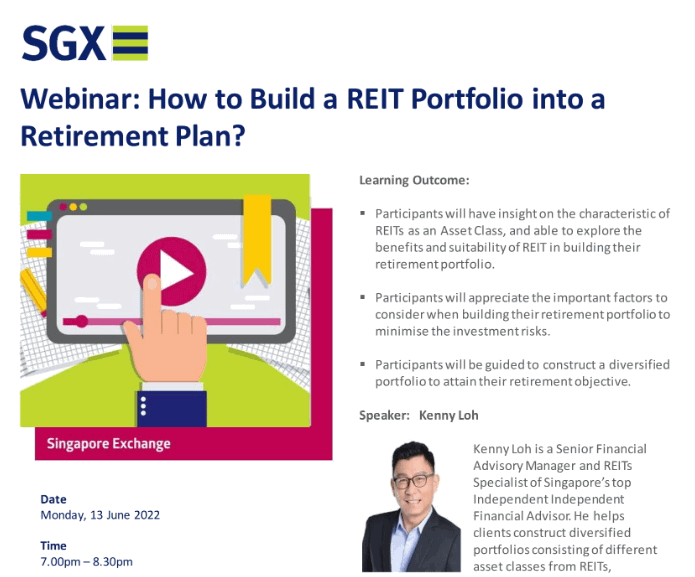
How to Build a REIT Portfolio into a Retirement Plan? (SGX Academy Webinar)


Want to learn the fundamentals of what REITs are, and how can this asset class complement your investment portfolio? Why should you invest in this asset class with an average p.a. yield of 5-7% and $100 minimum investment amount? Tune in to learn how to kickstart/improve your REITs investing!

Date: 1st December (Thursday)

Time: 7pm – 830pm

Venue: Online


Listen to his previous market outlook interviews here:

2022

2021

2020

Kenny Loh is an Associate Wealth Advisory Director and REITs Specialist of Singapore’s top Independent Financial Advisor. He helps clients construct diversified portfolios consisting of different asset classes from REITs, Equities, Bonds, ETFs, Unit Trusts, Private Equity, Alternative Investments, Digital Assets and Fixed Maturity Funds to achieve an optimal risk adjusted return. Kenny is also a CERTIFIED FINANCIAL PLANNER, SGX Academy REIT Trainer, Certified IBF Trainer of Associate REIT Investment Advisor (ARIA) and also invited speaker of REITs Symposium and Invest Fair.  

You can join my Telegram channel #REITirement – SREIT Singapore REIT Market Update and Retirement related news. https://t.me/REITirement

Continue ReadingMoney and Me: What happens after the recent S-REIT crash?