Money and Me: REIT Opportunity & the Mid-Cap Alpha Hunt (April 2026)

  • Post author:

Singapore REITs: Are They Unlocking Value or Diluting Your Returns?

The recent news of First REIT’s S$471.5 million divestment of its Indonesian healthcare assets has sparked a heated debate: Is this a smart strategic pivot, or are unitholders being left with a “watered-down” investment?

While divestments can feel like a retreat, they are often necessary recalibrations designed to protect long-term distributions from volatile currency swings and credit risks.


The “Why” Behind the Indonesia Exit

To understand the move, we have to look at the numbers that aren’t usually in the headlines:

  • The Forex Trap: Over the last five years, while IDR-denominated revenue grew by 23%, the IDR plummeted approximately 28% against the SGD. This effectively wiped out operational gains, hurting both the DPU (Distribution Per Unit) and the Net Asset Value (NAV).
  • Macro Headwinds: Concerns raised by international rating agencies like Fitch and Moody’s regarding the Indonesian investibility landscape made holding these assets a riskier bet for a Singapore-listed REIT.

The Case for “Unlocking Value”

First REIT isn’t just dumping assets; it’s selling from a position of strength:

  • Selling at a Premium: The sale price is 2.1% higher than the latest valuation. This is a crucial “sanity check” for investors, proving that the REIT’s book value is backed by real-world demand.
  • Immediate Rewards: The manager plans to distribute S$9.7 million of the proceeds as a special dividend—putting cash directly back into unitholders’ pockets.
  • Building a “War Chest”: Post-divestment, leverage will plunge from 42.1% to a lean 16.7%. This saves S$18.8 million in annual interest costs and provides massive “dry powder” to hunt for new deals without needing to borrow in a high-interest-rate environment.

The “Dilution” Concern: What’s the Catch?

The strategy isn’t without its growing pains:

  • The Yield Gap: Indonesian assets are high-yield because they are high-risk. Moving into stable, developed markets like Japan and Australia inevitably means lower immediate yields, which could lead to a temporary dip in DPU.
  • Execution Risk: With a gearing of 16.7%, the REIT is currently “cash-rich but asset-light.” The burden is now on the manager to deploy that S$470 million quickly and wisely. If the cash sits idle for too long, it drags down overall returns.

Investor FAQ: Fact vs. Fiction

Q: Is First REIT becoming a “Zombie REIT” by selling its crown jewels? A: Far from it. This is about resilience over raw yield. The “crown jewels” in Indonesia came with heavy currency volatility and tenant concentration risk. By selling at a premium, the manager is “crystallizing” profits to pivot toward stable currencies. The key metric to watch now is the re-investment rate—how efficiently they can swap IDR risk for JPY or AUD stability.

Q: Is 16.7% gearing too conservative? Should they give more cash back? A: In a “higher-for-longer” rate environment, low gearing is a competitive superpower. It allows First REIT to pounce on distressed healthcare opportunities in full cash. Think of it as a war chest strategy rather than being overly cautious; it ensures they won’t have to go back to shareholders for more capital when the right deal comes along.


The Bottom Line:

First REIT is trading immediate high-risk yield for long-term balance sheet strength. For the patient investor, this “recalibration” may be the very thing that saves the portfolio from future currency shocks.


Mid-Cap Gems & Blue-Chip Moves: Where is the Alpha in S-REITs?

While the market giants offer a sense of security, the real excitement in the Singapore REIT (S-REIT) space is happening just beneath the surface. From the high-growth potential of mid-caps to strategic fund-raising by industry leaders, here is how to navigate the current landscape.


1. Unlocking Alpha: Why Mid-Caps are Outperforming the Giants

If the “Giant” REITs are for safety, the Mid-Caps (specifically those in the iEdge Next50 index) are where the growth—or “Alpha”—is currently hiding. According to recent DBS insights, the valuation gap has become too wide to ignore.

  • The Growth Gap: Mid-cap REITs are projected to deliver a DPU growth rate of 4.2% (FY26-27). To put that in perspective, that is nearly 2.5x higher than the large-cap STI REITs.
  • Deep Value: Mid-caps are trading at an average Price-to-NAV (P/NAV) of 0.8-0.9x, while large-caps sit at 1.1x. You are essentially buying these assets at a 10-20% discount, whereas you pay a premium for the “big boys.”
  • Superior Yields: The yield play is clear. While large-caps offer between 4.5% and 6.5%, small and mid-cap REITs are dangling yields between 7% and 9.5%.

The “Catch”: Aren’t they riskier? Smaller REITs are often seen as more vulnerable to interest rate shocks. However, the valuation discount acts as a “margin of safety.” Furthermore, many mid-caps, have fortified their positions with high fixed-rate debt proportions (often above 75%), mirroring the stability of blue chips.

The Catalyst: The Equity Market Development Program (EQDP) This isn’t just about fundamentals; it’s about liquidity. The MAS/SGX EQDP is pushing institutional “passive” money into these mid-sized names. As they gain weight in indices like the iEdge Next50, fund managers are increasingly “forced” to buy, which could trigger a massive price re-rating.


CapitaLand Ascendas REIT (CLAR): A Strategic “Buy the Dip”?

CapitaLand Ascendas REIT (CLAR) recently announced a S$900 million Equity Fund Raising (EFR). While “fund raising” often worries investors, this move is a classic blend of defense and offense.

The Deal at a Glance:

  • The Offer: 28 new units for every 1,000 held.
  • The Price: S$2.35. This represents a significant 7.5% discount to the last trading price of $2.54.

Why Unitholders Should Pay Attention:

  1. Valuation Sweet Spot: CLAR’s P/NAV is currently at 1.1x, which is two standard deviations below its 5-year average. With a current DPU yield of 5.9% (vs. the 5-year mean of 5.5%), the entry point is historically attractive.

Source: REITsavvy.com

  1. Technical Support: The stock is currently trading at a key technical support level, making the $2.35 offer price look even more robust.
  1. High-Quality Pivot: This isn’t “survival” money. The funds are being used to acquire New Economy assets: a Tier III Data Centre in Osaka, logistics in Loyang, and a stake in a Singapore Science Park office.

Strategic Tip: Use It or Lose It This preferential offering is non-renounceable. Unlike some rights issues, you cannot sell your entitlement on the open market. If you don’t subscribe, you simply get diluted by the institutional investors. If you have the cash, applying for excess units is a savvy move, as many retail investors will miss the deadline, leaving extra shares on the table.


Final Thought: Growth or Stability?

The S-REIT market is bifurcating. If you are hunting for capital appreciation and high yield, the Mid-Cap iEdge Next50 space is your hunting ground. If you prefer a blue-chip anchor for your portfolio, the CLAR Preferential Offering provides a rare opportunity to accumulate a market leader at a deep discount.


Reference News:

From divestments to fund raising – Are Singapore REITs unlocking value – or diluting returns?  
https://www.businesstimes.com.sg/companies-markets/first-reit-proposes-s471-5-million-divestment-indonesia-assets

Singapore REITs: Unlocking alpha within the mid-cap S-REITs

https://www.dbs.com.sg/corporate/aics/templatedata/article/generic/data/en/GR/022026/260225_insights_singapore_reits_unlocking_alpha.xml

CapitaLand Ascendas REIT Preferential Offering – What should unitholders do?https://growbeansprout.com/capitaland-ascendas-reit-preferential-offering-2026


Kenny Loh is a distinguished Wealth Advisory Director (RNF# LKK300389588 Representing Financial Alliance) with a specialization in holistic investment planning and estate management. He excels in assisting clients to grow their investment capital and establish passive income streams for retirement. Kenny also facilitates tax-efficient portfolio transfers to beneficiaries, ensuring tax-efficient capital appreciation through risk mitigation approaches and optimized wealth transfer through strategic asset structuring.

In addition to his advisory role, Kenny is an esteemed SGX Academy trainer specializing in S-REIT investing and regularly shares his insights on MoneyFM 89.3. He holds the titles of Certified Estate & Legacy Planning Consultant and CERTIFIED FINANCIAL PLANNER (CFP).

With over a decade of experience in holistic estate planning, Kenny employs a unique “3-in-1 Will, LPA, and Standby Trust” solution to address clients’ social considerations, legal obligations, emotional needs, and family harmony. He holds double master’s degrees in Business Administration and Electrical Engineering, and is an Associate Estate Planning Practitioner (AEPP), a designation jointly awarded by The Society of Will Writers & Estate Planning Practitioners (SWWEPP) of the United Kingdom and Estate Planning Practitioner Limited (EPPL), the accreditation body for Asia.

Arrange for a non-obligatory one-to-one free consultation here!

You can join his Telegram channel #REITirement – SREIT Singapore REIT Market Update and Retirement related news. https://t.me/REITirement
If you need any financial advice, please contact kennyloh@fapl.sg


2026

2025

2024

2023

2022

2021

2020

Continue ReadingMoney and Me: REIT Opportunity & the Mid-Cap Alpha Hunt (April 2026)

Money and Me: Is Headline DPU Hiding the Truth About Your REIT?

  • Post author:

Listen to the recording below

https://audio.sph.com.sg/podcast-ep/01kkjny2k6pn7jt84kyqbxzsf5/


1. Many investors focus solely on the headline DPU, but you’ve highlighted a “Transparency Gap” in statutory statements. What are some of the specific items that can mask a REIT’s core rental cashflow?

The “Transparency Gap” & Masking Core Cashflow

The headline DPU is a bit like a ‘Gross Salary’ vs. ‘Take-Home Pay.’ The big number on the contract looks amazing, but after you strip away the one-off bonuses and accounting tricks, the actual ‘spendable’ cash can be a lot smaller. We’re warning investors not to fall in love with the big number before checking what’s actually left in the bank.

Many investors treat Distributable Income as synonymous with “profit,” but it’s actually a highly adjusted figure. Specific items that mask core rental health include:

  • Rental Support/Guarantees: These are top-ups from sponsors that artificially inflate income when a building is empty or underperforming.
  • One-off Divestment Gains: Using “capital gains” to pad the DPU when organic rental growth is flat.
  • Amortization of Lease Incentives: This is the Accounting ‘magic’ that hides the fact that a tenant got six months of free rent.


2. When we look at DPU “manipulation” or optics, how do management teams typically bridge the gap between actual operational earnings and the distributions paid out to unitholders?

Bridging the Gap: Optics vs. Earnings

Management teams aren’t necessarily ‘faking’ it, but they are using some very creative financial engineering to bridge the gap.” Management teams have a “toolkit” to maintain DPU optics even when the properties aren’t delivering.

The most common methods are:

  1. Management Fees in Units: Instead of paying the manager in cash, the REIT issues new units. This “saves” cash to pay unitholders but leads to long-term dilution.
  2. Capital Distributions: Returning a portion of the original investment (capital) back to unitholders, which is essentially giving you back your own money to keep the yield looking high. It’s like taking $10 out of your left pocket to put $10 in your right and saying you’ve made a profit.
  3. Swiping the Revolving Credit Line (Credit Card Trick): “When rent collection is slow or a major tenant leaves, a manager might tap into their Revolving Credit Facility (RCF)—essentially the REIT’s corporate credit card. They draw down debt to top up the distribution pot so that unitholders don’t see a dip in their quarterly check. On the surface, the DPU looks stable and ‘safe,’ but in reality, that payout wasn’t earned from tenants; it was borrowed from a bank.” This is something like, you paid 5% or 6% interest to the bank so the REIT can give you a 6% yield. It’s a zero-sum game that actually erodes the Net Asset Value (NAV) and reduced the debt ceiling over time.

The ‘Why’ (The Painkiller): “Why do they do it? Because the market is brutal toward DPU cuts. A 2% drop in DPU can trigger a 10% sell-off in the stock price. The manager uses the credit line as a financial painkiller to mask the symptoms of a weak portfolio, hoping that ‘tomorrow’ will be better so they can pay the bank back. But as we know, if you keep using one credit card to pay another, eventually the interest catches up with you.”

How can an investor spot this?”

Go to the Statement of Cash Flows. If the ‘Net Cash from Operating Activities’ is consistently lower than the ‘Total Distributions Paid,’ you know they are borrowing from Peter to pay Paul. It’s a huge red flag for the sustainability of that yield.


3. You’ve raised concerns about the “100% Payout Risk.” Why might distributing every cent of operational cashflow be a red flag rather than a sign of strength?

The “100% Payout Risk”

While a 100% payout ratio looks generous, it can be a red flag. It means the REIT has zero margin for error.

  • Michelle, let’s look at this through the lens of a personal finance. Distributing 100% of cashflow is like a person spending every single cent of their paycheck the moment it hits their bank account. They have zero emergency funds. Now, ask yourself: What happens to that person if they suddenly lose their job, or if a family member has an unexpected medical emergency? They have no buffer. They’re forced to take on high-interest debt or sell their belongings just to survive.
  • It’s the same with a REIT. If they pay out 100%, they have no ‘rainy day fund’ for a major roof repair or a sudden tenant exit. They’re forced to either borrow more at today’s high rates or ask unitholders for more cash through a rights issue. To me, that’s not a sign of a ‘generous’ manager; it’s a sign of a manager living paycheck-to-paycheck.


4. How should investors interpret the use of management fees paid in units rather than cash, and how does this impact the long-term DPU trajectory?

Management Fees in Units: The Long-term Impact

Think of this as a ‘Buy Now, Pay Later’ scheme for DPU.”

  • The Impact: Short term it props up the yield today, but it creates a ‘Unit Snowball” in the long term as it increases the total unit base.  More units mean the next year’s earnings have to be split among more people. Unless the property performs like a rockstar, the DPU will eventually face downward pressure because the “pie” is being sliced into more and more pieces every year.


5. Regarding newly listed entities like UI Boustead REIT, what specific efficiency signals should investors look for in the early stages of a REIT’s life cycle?

Early Efficiency Signals: UI Boustead REIT & New Listings

For a new listing, don’t just fall in love with the ‘IPO Yield.

Efficiency Signals:

  1. Look for a high NPI Margin (Net Property Income). If the manager can’t run a brand-new portfolio efficiently now, they certainly won’t when the buildings start to age
  2. Portfolio Occupancy vs. Market Average: Is the initial high yield propped up by a single “trophy” tenant, or is there a diversified, high-quality base?
  3. Lease Decay: How the REITs address the lease decay, which impact NAV due to short land lease tenure for Industrial property in Singapore.
  4. Expense Ratio: Are administrative costs bloated relative to the size of the portfolio? The large scale of economy should bring the unit admin cost down but not the other way.


6. How does the Management Efficiency Index (MEI) differ from traditional metrics like Gearing or Interest Coverage Ratio when assessing a manager’s performance?

Management Efficiency Index (MEI) vs. Traditional Metrics

Traditional metrics like Gearing or Interest Coverage Ratio tell you about financial health, but the MEI tells you about manager skill and performance.

  • MEI was created by my REITsavvy team to measure the “Alpha” or extra value a manager extracts from the assets per dollar of fee they take.
  • In the US, investors don’t just look at dividends; they obsess over FFO (Funds From Operations). Think of FFO as the ‘True North’ of a REIT’s performance. It’s a metric that ignores the accounting ‘smoke and mirrors’ and focuses purely on the cash generated by the properties themselves.
  • The Management Efficiency Index (MEI) brings that same discipline here. We believe a manager’s primary job is to be a great landlord, not a financial engineer. While traditional metrics like Gearing tell you how much the REIT owes, the MEI tells you how well the manager is working the assets. It filters out the ‘cheap debt’ or ‘top-up’ tricks and asks: ‘If we strip away the fancy financing, how much real value is this manager actually squeezing out of these buildings?’ It’s about measuring the ‘sweat equity’ of the manager, not just their ability to sign a loan document.”


7. In an environment of higher-for-longer interest rates, how can an investor distinguish between a manager who is “entitled” to fees and one who is actively creating value?

Distinguishing “Value-Add” from “Entitlement”

When interest rates stay high, the ‘lazy’ managers get exposed. The ‘entitled’ ones keep collecting their base fees while the share price tanking is ‘not their fault’.

  • The Value Creator: They take the pain with you. They hedge aggressively, they find ways to cut utility costs, and they might even pivot to cash fees to stop the unit dilution. They act like owners, not just employees.


8. For those heading into AGM season, what is the one question every retail investor should ask the board regarding the sustainability of their distributions?

The One Question for AGM Season

If you only ask one thing, make it this:

“Excluding one-off capital distributions and management fees paid in units, what is your ‘Organic Cash DPU’ and is it sufficient to cover the current payout, and show the trend Year on Year”.

This forces the board to strip away the “optics” and reveal the true earnings power of the properties. I urge all investors to ask this question in the AGM. Invite them to listen to this podcast Money&Me with Michelle Martin for a more direct and transparent reply.


9. Looking ahead, do you expect more S-REITs to shift their reporting focus toward these efficiency metrics, or will the market remain anchored to the headline DPU?

Future Outlook: Efficiency vs. Headline DPU

The current market is still addicted to the ‘headline DPU’—it’s the ‘fast food’ of metrics. It’s quick, it’s easy to digest, but it doesn’t tell you anything about the long-term health of the REIT.

As we move past the era of ‘cheap money,’ the big institutional players are already switching to an ‘organic’ diet. They aren’t just asking ‘What is the yield?’ They’re asking: ‘How hard did the manager have to work to get this yield?’

As an educator in this space, my mission is to move the needle on transparency. I want to see REIT managers move away from financial engineering and get back to their core role as disciplined landlords. We need to start measuring things like the Management Efficiency Index (MEI) or Real FFO because, in business, what gets measured gets done. If we focus on real cash flow and property value creation rather than just the decimal point on a dividend, we’ll build a much more resilient REIT market for everyone


Kenny Loh is a distinguished Wealth Advisory Director (RNF# LKK300389588 Representing Financial Alliance) with a specialization in holistic investment planning and estate management. He excels in assisting clients to grow their investment capital and establish passive income streams for retirement. Kenny also facilitates tax-efficient portfolio transfers to beneficiaries, ensuring tax-efficient capital appreciation through risk mitigation approaches and optimized wealth transfer through strategic asset structuring.

In addition to his advisory role, Kenny is an esteemed SGX Academy trainer specializing in S-REIT investing and regularly shares his insights on MoneyFM 89.3. He holds the titles of Certified Estate & Legacy Planning Consultant and CERTIFIED FINANCIAL PLANNER (CFP).

With over a decade of experience in holistic estate planning, Kenny employs a unique “3-in-1 Will, LPA, and Standby Trust” solution to address clients’ social considerations, legal obligations, emotional needs, and family harmony. He holds double master’s degrees in Business Administration and Electrical Engineering, and is an Associate Estate Planning Practitioner (AEPP), a designation jointly awarded by The Society of Will Writers & Estate Planning Practitioners (SWWEPP) of the United Kingdom and Estate Planning Practitioner Limited (EPPL), the accreditation body for Asia.

Arrange for a non-obligatory one-to-one free consultation here!

Click Here to Book a Private Consultation

You can join his Telegram channel #REITirement – SREIT Singapore REIT Market Update and Retirement related news. https://t.me/REITirement
If you need any financial advice, please contact kennyloh@fapl.sg


2025

2024

2023

2022

2021

2020

Continue ReadingMoney and Me: Is Headline DPU Hiding the Truth About Your REIT?

Money and Me: Are S-REITs Still Worth the Climb?

  • Post author:

17th Nov 2025

Industrial REITs are steady, yields are juicy, and rates are falling – so is now the moment to move?

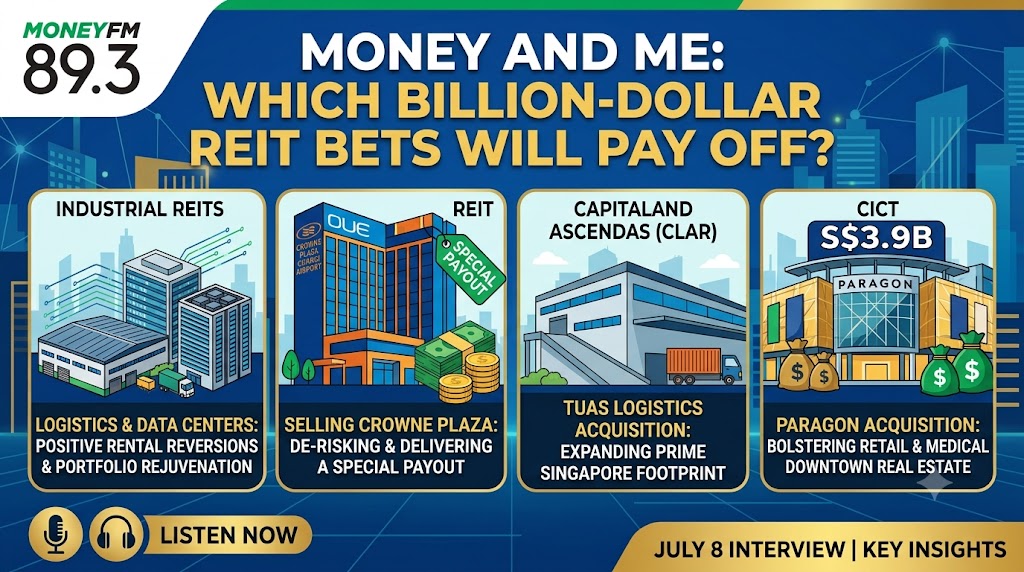
Hosted by Michelle Martin, this episode breaks down why industrial S-REITs have held firm with strong occupancy and rental reversions.

We explore how the wider S-REIT universe has staged a 2025 rebound on easing debt costs and a friendlier rate outlook.

With T-bills slipping near 1.37 – 1.4%, Kenny Loh weighs in on whether REIT yields of 5 – 6% still offer real value.

Is this rally just a “rates are going down” trade – or the early innings of a broader re-rating?

Kenny also shares clear strategies for conservative investors navigating income, risk and timing.


Note: The above analysis are my own personal views and are NOT buy or sell recommendations. Investors who would like to leverage my extensive research and years of Singapore REIT investing experience can approach me separately for a REIT Portfolio Consultation.

Listen to his previous market outlook interviews here:

2025

2024

2023

2022


2021

2020

Kenny Loh is an Associate Wealth Advisory Director and REITs Specialist of Singapore’s top Independent Financial Advisor. He helps clients construct diversified portfolios consisting of different asset classes from REITs, Equities, Bonds, ETFs, Unit Trusts, Private Equity, Alternative Investments, Digital Assets and Fixed Maturity Funds to achieve an optimal risk adjusted return. Kenny is also a CERTIFIED FINANCIAL PLANNER, SGX Academy REIT Trainer, Certified IBF Trainer of Associate REIT Investment Advisor (ARIA) and also invited speaker of REITs Symposium and Invest Fair.  

You can join my Telegram channel #REITirement – SREIT Singapore REIT Market Update and Retirement related news. https://t.me/REITirement

Continue ReadingMoney and Me: Are S-REITs Still Worth the Climb?