Money & Me: Q3 2022 SREIT winners

  • Post author:

19 August 2022

Money and Me: Q3 2022 SREIT winners

Kenny Loh, REIT Specialist and Independent Financial Advisor looks at the top performing SREITS for Q3 2022 and where value in the market is. The article version (transcribed) of the interview can be found below.


Timestamps

0:18 Intro

1:19 Kenny’s clear winners in Q3 2022 this year

2:00 What are the drivers for the good performance for them this year? (EC World, DHLT, Data Center REITs)

Digital Core REIT

3:02 How does the performance of Digital Core REIT compare against its past results?

4:27 What does Digital Core REIT’s planned acquisitions mean in the near term?

DHLT

5:22 Daiwa House Logistics Trust: Will Logistics Trusts continue being a strong driver in the near term?

7:18 How will Japan’s inflation rates impact DHLT?

EC World REIT

8:03 How is EC World REIT performing, despite China’s covid-zero policy?

9:57 Who are the laggards in terms of performance? (poor performance)

 

Transcription:

Q. Kenny, who are the clear winners for Q3 2022 in your book?

It’s quite clear cut that the data center and also industrial are in the rotation play. They actually performed better in Q3, since one and a half years ago. So the top three performers in this quarter would be Digital Core REIT, gone up by 18%, Daiwa Logistics trust about 18% also, and also EC world about 17%. But all this top three performers basically are not really fantastic news. They basically just recovered from the knee jerk sell off in the private quarters.


Q. What are the drivers for why they’ve done so well so far? And do you see any correlation between that and the recovery in global markets that we’ve.

Yeah, based on the fundamental itself, basically these 3 REITs, the valuation is not really over-stretched before the sell off. So during the sell off, basically there are some negative news because one of the hedge funds came out with a report to really short the data center space.

Right. I read the fundamentals, I read the reasoning. I do not agree to it on, on the data center space and for the EC World REIT itself, basically that there was a fear of they not able to do the refinancing. That’s why during that period, during the uncertainty, uh, there is a sell off until they’re able to really delay for one more year to do the refinancing.

So after all the negative news gone away, basically it’s really back to the normal valuation.


Q. Now, when you take a look at the winners, and the top five REITs, if we start with Digital Core REIT, Kenny, how does the performance of Digital Core REIT compare with what you’ve seen in terms of its past results?

Yeah, so, so far, in terms of the share price department, Digital Core REIT, Actually the share price has recovered more than 20% after hitting a bottom of around 70, uh, US cents. But if you look at the NPI and also the DPU, basically, there’s nothing so fantastic. It’s quite comparable to the forecast, the NPI for first, top of 2022, it’s only go up by around 5.9%.

Okay. Not, not so bad. And the DPU just missed by 1.4%, uh, giving a distribution of 2.06 cents versus 2.09 cents as the forecast. But if you look at the yield itself, the estimated annualised DPU, basically at the present moment at current stock price, giving us 4.8%. And this 4.8% annualised this description view is quite comparable to KDC.

And, and at the same time, in terms of evaluation itself, mm-hmm, Digital Core REIT has a much attractive evaluation and also financial ratio compared to capabilities. Digital Core REIT has a, a lower gearing ratio at 25.7, which means that they have a lot more debt room for the future acquisition. At the same time, the price is about 1x.


Q. Speaking of future acquisitions, Digital Core REIT is a pure play data center REIT, and it has said it’s gonna be looking at new markets like Chicago and Dallas and Frankfurt for acquisitions. What could this mean in the near term?

In the near term, I would expect them to continue to grow their portfolio because if you look at the initial portfolio as well, the tenant concentration is pretty huge.

They are only focused on few tenants. So in order to really diversify away all the tenant concentration risk, uh, risk, they probably have to, uh, grow it. And, and that is part of the, the plan in the IPO. So in the near term expect they will, uh, announce, uh, some of the new acquisitions based on their low gearing.

Hopefully they don’t really need to, uh, issue additional rights and also, uh, do a lot more private placements that dilute the shares. Hopefully they just finance the whole thing for that.


Q. Interesting. Let’s look at Daiwa House Logistics Trust, uh, which is among the top five performing trusts for the third quarter of 2022, currently up 21.3%, but for the quarter 18%, we saw a movement up. Now, when it comes to Daiwa House Logistics Trust, it said that it expects demand for large scale logistics to continue to be a strong driver all the way till 2023. Do you agree with them?

I tend to agree because if we are looking forward into the future as well, in the least for the near term, they are basically two catalysts to push the logistics sector and warehouse sectors to do well.

The first catalyst will be this logistic space continued to be driven by the growth in the e-commerce and also wide adoption of the eCommerce. So in order to have a very efficient eCommerce that need the modern warehouse for logistic system or even a supply chain system to handle the huge volume in a very efficient way.

And, and beside the very efficient way, we also need to look the speed, and also, uh, the core structure for the logistic itself. So if we are continue to use the old, old warehouse or old logistics system, you are not able to be competitive moving forward. So modernization on the logistic and also supply chain warehouse probably the drives the REITs to continue to upgrade their warehouse base.

That is the first catalyst, right? For the second catalyst itself for the past two or three years. We also know that we have many, many shutdowns and also cause a lot of supply chain, uh, disruptions. So the manufacturer was forced to change their model from just in time (JIT) to just in case (JIC) models to keep an inventory to prevent all this kind shut down, uh, from happening again, because that is quite destructive to the manufacturing. And also the whole thing you drive up the on the inflation.


Q. Do you expect the way Japan is grappling with inflation to impact Daiwa House Logistics Trusts’ earnings?

When you come to the investment space, uh, there is something called movement in sympathy. Maybe the stock market does not really care where is your location? Right? When there is a sell off, you expect the whole sector to sell.

Then after a while, the, the, maybe the institution, a problem manager have to go and deep dive and to see which REITs have a minimum impact, then that may probably cause a recovery. So, sentiment is important and sector rotation is important in the REITs space so far


Q. So how well do you think another one of in the group of the top five that we’ve seen EC World REIT how well has it done? Despite China’s continuing COVID zero policy.

Right based on the revenue and also the NPI publish, uh, in the latest earning, uh, just, just bear in mind that all this data are lagging.

I don’t really see that, uh, there is any, uh, big impact, EC World seems that holding quite well, uh, in this, uh, zero correct policy, but my biggest concern will be moving forward. It’s not for the past one or two years because moving forward, how EC World are going to manage. And they have refinancing need to be done within in one year’s time.

And China economy is not doing well. Right? There are two fronts. One thing is the GDP is started coming down, right? The growth start to slow down that will affect the business itself. And in return that will also affect the property valuation. Right with the high gearing and also dropping of the valuation itself, it makes, uh EC World much more difficult to do the fundraising or, or do the debt, uh, refinancing.

And also the other thing to signal that China is currently going through the property and also mortgage crisis. So the bank would be very reluctant to, to loan it to the real estate sector because they do not really want to expose into a real estate sector. So, so I would see that probably all the banks in China, they are pulling back and reducing the exposure to real estate that make EC World even more difficult to do refinancing.

So, uh, for me, uh, forward looking risk is much more higher than the, the past financial performance.


Q. Who are the laggards in terms of performance?

The laggards uh, US Office REITs, quite surprisingly based on the past few, so called the earnings release by Manulife US REIT, Prime US REIT and KepPacOak US REIT.

It is quite, I I’m seeing that actually the, the return to the office is not a fast compared to Singapore because Singapore, for, for employees in Singapore, we being asked to go back to the office to work. I think we are more obedient, but ask yourself, it’s taking a little longer over there. Huh? Right, right. Actually the, you can see from a, the data itself, actually the workplace, uh, occupancy is pretty low, right?

And also, uh, this also cause in, uh, uh, slow down in the leasing space and, uh, hybrid work mode of work is still preferred in us moving forward. So that will probably, uh, drag in the US Office sector. But if you really based on the fundamental itself, based on evaluation is pretty attractive. So in terms of share price, I would say that for the Q3 Q4, probably no one wants to take such a risk.

Yeah. But if you are looking for long term, right, five years, 10 years, you can do some study on the fundamentals itself because some of them the REITs are not really impacted. And the financial ratio is also pretty good. Also. Uh, it’s pretty attractive.


Navigating Volatile Markets to Beat Inflation (Physical Seminar 1st October 2022)


Worried about the high inflation rates? Join us as we share tips on how to beat inflation, and our inflation outlook for the rest of the year and beyond. You will learn ways to edit your investment portfolio to beat the high inflation rates, in a SAFE way.

As this is a physcial seminar, seats are limited so sign up today.

Date: 1st October 2022 (Saturday)

Time: 10am – 12pm

Venue: Gateway West (150 Beach Road, #12-01/08, Singapore 189720)

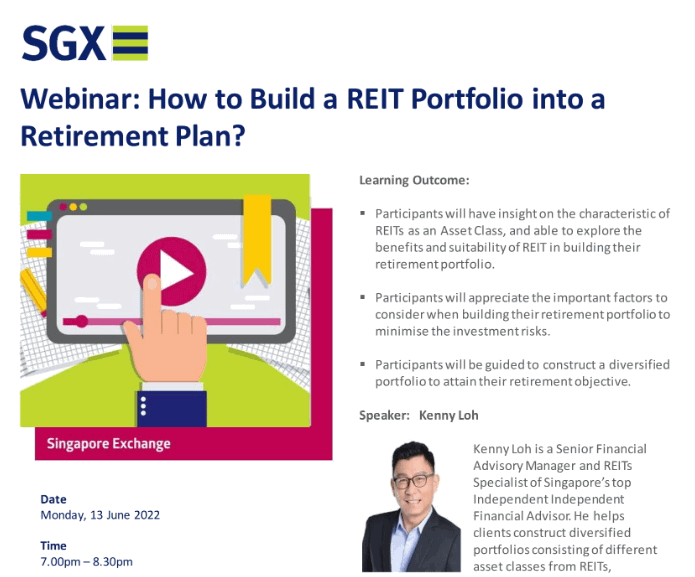
How to Build a REIT Portfolio into a Retirement Plan? (SGX Academy Webinar, 5th October 2022)


Want to learn the fundamentals of what REITs are, and how can this asset class complement your investment portfolio? Why should you invest in this asset class with an average p.a. yield of 5-7% and $100 minimum investment amount? Tune in to learn how to kickstart/improve your REITs investing!


Date: 5th October 2022 (Wednesday)

Time: 7pm – 830pm

Venue: Online
 

Listen to his previous market outlook interviews here:

2022

2021

2020

Kenny Loh is an Associate Wealth Advisory Director and REITs Specialist of Singapore’s top Independent Financial Advisor. He helps clients construct diversified portfolios consisting of different asset classes from REITs, Equities, Bonds, ETFs, Unit Trusts, Private Equity, Alternative Investments, Digital Assets and Fixed Maturity Funds to achieve an optimal risk adjusted return. Kenny is also a CERTIFIED FINANCIAL PLANNER, SGX Academy REIT Trainer, Certified IBF Trainer of Associate REIT Investment Advisor (ARIA) and also invited speaker of REITs Symposium and Invest Fair.  

You can join my Telegram channel #REITirement – SREIT Singapore REIT Market Update and Retirement related news. https://t.me/REITirement

Continue ReadingMoney & Me: Q3 2022 SREIT winners

Are REITs just for retirees?

  • Post author:

In our previous article “What are REITs?”, we shared about the types of asset classes and geographical breakdown of REITs listed in Singapore. In this next article of our #MUSTExplains series, where we share about REITs, the U.S. economy and the office sector, we discuss the reasons why people invest in REITs, and some risks to consider.

REITs may not be as exciting as tech stocks and cryptocurrencies, but here are four popular reasons why investors hold them :

  • Cost-effective way to invest in real estate: Direct property investment is more capital intensive and illiquid, while investing in REITs is more affordable and enables investors to grow their capital in a shorter period of time. It is also more liquid as investors can buy or sell units in a listed REIT on the stock exchange. Real estate is also known to be a hedge against inflation as their prices/rentals increase with inflation.
  • Total return investments: REITs typically provide high dividends and have the potential for moderate, long-term capital appreciation. Long-term total returns of REITs tend to be similar to those of value stocks and exceed the returns of banks’ fixed deposits and lower risk bonds.
  • Stable income stream: As REITs are required to distribute a minimum 90% of their income, their distribution yields tend to be higher than stocks or fixed deposits. SREITs average ~6% in dividend yields and have continued to generate substantial, stable yields through a variety of market conditions. This is why they are preferred by retirement savers and retirees who seek certainty and stability in their returns.
  • Diversification: The returns of REITs typically have a lower correlation with the returns of other equities and fixed-income investments. Investing in REITs thus helps to reduce a portfolio’s overall volatility and improve its returns for a given level of risk.


As with all investments, here are some possible risks when investing in REITs:

  • Market risk: REITs are traded on the stock exchange and their prices are subject to supply and demand conditions. Their prices generally reflect investors’ confidence in the economy, property market and interest rate outlook, among other factors.
  • Income risk: Many factors can affect a REIT’s rental income – for instance, when tenants renew at lower rentals or vacate their space. Therefore, look for stable occupancies, positive rental reversions, and contractual lock-ins of rental rates and other clauses in a REIT’s tenancy agreements to ensure income stability.
  • Leverage risk: If a REIT’s leverage limit approaches too close to the regulatory limit of 50%, it will limit the REIT’s financial flexibility to raise more capital through debt. Furthermore, additional expenses of borrowing such as interest payments and fees incurred in connection with the borrowing will reduce the money available for distribution to unitholders.
  • Refinancing risk: REITs may face higher refinancing costs when loans are due for renewal, or they may be unable to secure refinancing and resort to selling off properties if these assets are mortgaged under the loan. These risks could affect the unit price and income distribution of a REIT.


REIT Structure

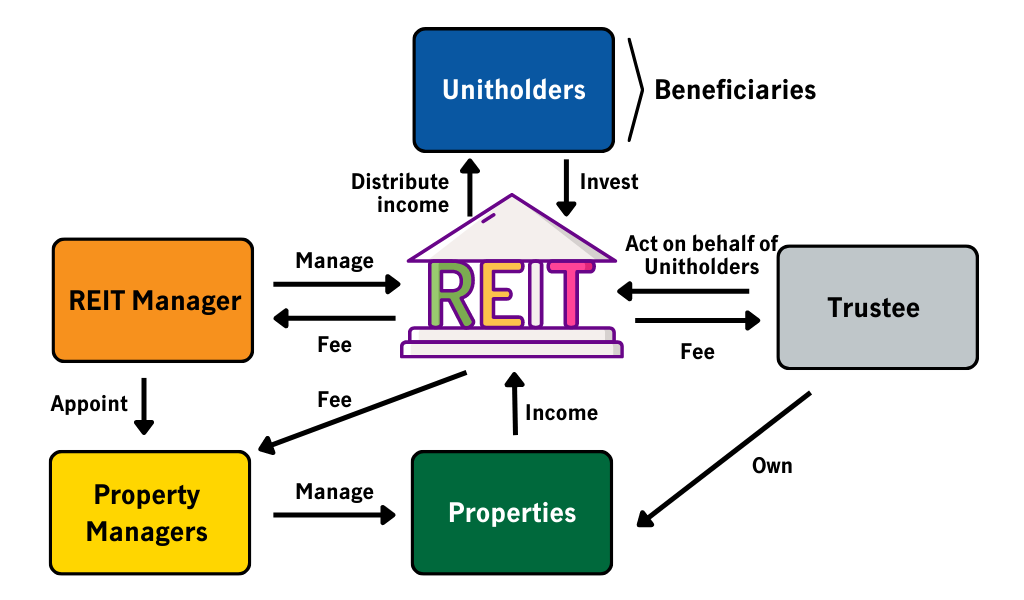
Here’s a diagram of a typical REIT structure.

Besides the REIT vehicle, there are three external parties working in relation to it. All three parties are paid fees for their services.They are the:

  • i.     Trustee – Responsible for the ownership and safe custody of the REIT’s assets, they act on behalf of unitholders to ensure the REIT Manager complies with the law and performs its duties as laid out in the Trust Deed.
  • ii.    REIT Manager – It manages the REIT in the best interests of unitholders, which includes setting the REIT’s strategic direction, managing assets and liabilities, as well as making recommendations to the Trustee on the acquisition, divestment and enhancement of assets according to the REIT’s investment mandate.
  • iii.   Property Manager – It manages the day-to-day operations and maintenance at the respective properties.


Most SREITs also have Sponsors – typically but not necessarily property developers which inject properties into the REIT during listing. Many Sponsors continue to support the growth of the REITs by offering them rights to acquire a future pipeline of properties. Sponsors are often also major unitholders of the REITs they sponsor.

In the next article, we will discuss how to start investing in REITs and stocks. Stay tuned!

Sources:


Disclaimer: This article is for informational purposes only and shall not be construed as financial advice or an offer, invitation or solicitation of any offer to purchase or subscribe for any securities of Manulife US REIT in Singapore or any other jurisdiction nor should it or any part of it form the basis of, or be relied upon in connection with, any contract or commitment whatsoever. You should always do your due diligence and seek professional advice before making any investment decisions. None of the information presented are intended to form the basis for any investment decision, and no specific recommendations are intended.


This article first ran on Manulife US REIT’s thought leadership column, Viewpoints, which publishes regular content on the U.S. economy and the office sector. Follow MUST on LinkedIn for all the latest updates!


Kenny Loh is an Associate Wealth Advisory Director and REITs Specialist of Singapore’s top Independent Financial Advisor. He helps clients construct diversified portfolios consisting of different asset classes from REITs, Equities, Bonds, ETFs, Unit Trusts, Private Equity, Alternative Investments, Digital Assets and Fixed Maturity Funds to achieve an optimal risk adjusted return. Kenny is also a CERTIFIED FINANCIAL PLANNER, SGX Academy REIT Trainer, Certified IBF Trainer of Associate REIT Investment Advisor (ARIA) and also invited speaker of REITs Symposium and Invest Fair.  

You can join my Telegram channel #REITirement – SREIT Singapore REIT Market Update and Retirement related news. https://t.me/REITirement
Continue ReadingAre REITs just for retirees?

Singapore REIT Monthly Update (August 7th 2022)

  • Post author:

Happy National Day!! 

To celebrate 57 years of Singapore’s independence, I’ll be offering free portfolio review consultation! For a limited time only. https://calendly.com/kennyloh/portfolioconsult


Technical Analysis of FTSE ST REIT Index (FSTAS351020)


FTSE ST Real Estate Investment Trusts (FTSE ST REIT Index) decreased from 807.47 to 828.74 (2.63%) compared to last month’s update. The REIT Index has reversed to a short-term uptrend, with the 20-day and 50-day Simple Moving Average (20 SMA and 50 SMA) now on an uptrend. The 200 SMA has acted as a resistance for the past 10 days. However, these are small changes as the REIT Index is still moving on a sideways direction in the long-term (see 2nd chart below).

  • Support Lines: Blue
  • Resistance Lines: Red
  • Short-term direction: Up
  • Medium-term direction: Sideways
  • Long-term direction: Sideways
  • Immediate Support at 800, 20 SMA, 50 SMA
  • Immediate Resistance at 200 SMA

Technically, FTSE ST REIT Index has started a short term uptrend but is currently testing the 200 SMA resistance. Longer term wise the REIT index is still trading in a sideways consolidation range between 800 and 890. The index has to break the 890 resistance convincingly before declaring the “The Returning of the Bull in S-REITs”.

Normal Timeframe chart (~2 years)

Longer Timeframe chart (~3 years)

Previous chart on FTSE ST REIT index can be found in the last post: Singapore REIT Fundamental Comparison Table on July 3rd, 2022.

Fundamental Analysis of 38 Singapore REITs


The following is the compilation of 38 Singapore REITs with colour-coding of the Distribution Yield, Gearing Ratio and Price to NAV Ratio.

  • The Financial Ratios are based on past data and there are lagging indicators.
  • This REIT table takes into account the dividend cuts due to the COVID-19 outbreak. Yield is calculated trailing twelve months (ttm), therefore REITs with delayed payouts might have lower displayed yields, thus yield displayed might be lower for more affected REITs.
  • REITs are updated with the latest Q2 2022 business updates/earnings are highlighted in blue, the rest are updated with Q1 2022 business updates/earning.
  • Since MPACT started trading, values shown below (except price and market cap) are of MCT.
  • MNACT has been delisted, but values are shown below for reference.

Data from StocksCafe REIT Screener. https://stocks.cafe/kenny/advanced

What does each Column mean?

  • FY DPU: If Green, FY DPU for the recent 4 Quarters is higher than that of the preceding 4 Quarters. If Lower, it is Red.
    • Most REITs are green since it is compared to FY20/21 as the base (during the pandemic)
  • Yield (ttm): Yield, calculated by DPU (trailing twelve months) and Current Price as of August 6th, 2022
    • Digital Core REIT: Yield calculated from IPO Prospectus.
    • Daiwa House Logistics Trust: Yield calculated from trailing six months distribution.
  • Gearing (%): Leverage Ratio.
  • Price/NAV: Price to Book Value. Formula: Current Price (as of August 6th, 2022) over Net Asset Value per Unit.
  • Yield Spread (%): REIT yield (ttm) reference to Gov Bond Yields. REITs trading in USD is referenced to US Gov Bond Yield, everything else is referenced to SG Gov Bond Yield.
  •  

Price/NAV Ratios Overview

  • Price/NAV increased to 0.94.
    • Increased from 0.92 from July 2022.
    • Singapore Overall REIT sector is undervalued now.
    • Take note that NAV is adjusted upwards for some REITs due to pandemic recovery.
  • Most overvalued REITs (based on Price/NAV)
    • Parkway Life REIT (Price/NAV = 2.01)
    • Keppel DC REIT (Price/NAV = 1.44)
    • Mapletree Industrial Trust (Price/NAV = 1.43)
    • Ascendas REIT (Price/NAV = 1. 26)
    • Mapletree Logistics Trust (Price/NAV = 1.20)
    • ESR-LOGOS REIT (Price/NAV = 1.12)
    • No change to the Top 3 compared to the March to July updates.
  • Most undervalued REITs (based on Price/NAV)
    • Lippo Malls Indonesia Retail Trust (Price/NAV=0.54)
    • BHG Retail REIT (Price/NAV = 0.57)
    • EC World REIT (Price/NAV = 0.59)
    • ARA Hospitality Trust (Price/NAV = 0.63)
    • OUE Commercial REIT (Price/NAV = 0.66)
    • IREIT Global (Price/NAV = 0.73)

Distribution Yields Overview

  • TTM Distribution Yield decreased to 6.32%
    • Decreased from 6.45% in July 2022.
    • 14 of 40 Singapore REITs have distribution yields of above 7%. (2 less than last month’s update)
    • Do take note that these yield numbers are based on current prices taking into account the delayed distribution/dividend cuts due to COVID-19, and economic recovery. 
  • Highest Distribution Yield REITs (ttm)
    • EC World REIT (11.12%)
    • United Hampshire REIT (9.84%)
    • Prime US REIT (9.75%)
    • First REIT (9.56%)
    • Sasseur REIT (9.19%)
    • Keppel Pacific Oak US REIT (9.12%)
    • Reminder that these yield numbers are based on current prices taking into account delayed distribution/dividend cuts due to COVID-19.
    • Some REITs opted for semi-annual reporting and thus no quarterly DPU was announced.
    • A High Yield should not be the sole ratio to look for when choosing a REIT to invest in.
  • Yield Spread widened to 3.67%.
    • Increased from 3.54% in July 2022.

Gearing Ratios Overview

  • Gearing Ratio decreased to 36.52%. 
    • Decreased from 36.83% in July 2022.
    • Gearing Ratios are updated quarterly. Therefore some of the following REITs have updated gearing ratios compared to last month (those with Q2 2022 updates)
  • Highest Gearing Ratio REITs
    • ARA Hospitality Trust (43.5%)
    • Suntec REIT (43.1%)
    • Lippo Malls Indonesia Retail Trust (42.9%)
    • Manulife US REIT (42.4%)
    • Elite Commercial REIT (41.9%)
    • ESR-LOGOS REIT (40.6%)
    • No change to the Top 3 compared to the April to July updates.

Market Capitalisation Overview

  • Total Singapore REIT Market Capitalisation increased by 3.48% to S$108.6 Billion.
    • Increased from S$104.95 Billion in July 2022.
  • Biggest Market Capitalisation REITs:
    • Capitaland Integrated Commercial Trust ($14.12B)
    • Ascendas REIT ($12.59B)
    • Mapletree Pan Asia Commercial Trust ($10.05B)
    • Mapletree Logistics Trust ($8.48B)
    • Mapletree Industrial Trust ($7.20B)
    • Frasers Logistics & Commercial Trust ($5.28B)
    • MPACT (formerly MCT) moved from 5th to 3rd rank since its merger with MNACT.
  • Smallest Market Capitalisation REITs:
    • BHG Retail REIT ($267M)
    • ARA US Hospitality Trust ($357M)
    • Lippo Malls Indonesia Retail Trust ($377M)
    • First Trust ($444M)
    • EC World REIT ($445M)
    • United Hampshire REIT ($477M)

Disclaimer: The above table is best used for “screening and shortlisting only”. It is NOT for investing (Buy / Sell) decision. If you want to know more about investing in REITs, here’s a subsidised 2-day course with all you need to know about REITs and how to start investing in them.

Top 20 Best Performers of the Month in July 2022


 (Source: https://stocks.cafe/kenny/advanced)

SG 10 Year & US 10 Year Government Bond Yield

  • SG 10 Year: 2.63% (decreased from 2.82%)
  • US 10 Year: 2.83% (decreased from 2.92%)

Major REIT News in July 2022


S-REITs Earnings Season for the Period Ending 30 June 2022 has begun

A total of 30 S-REITs have released their earnings/business updates for the Period Ending 30 June 2022 (31 May 2022 for SPH Reit), as of 6th August 2022.

MNACT delists on August 3rd, 2022

Mapletree North Asia Commercial Trust has delisted on August 3rd, 2022, while Mapletree Commercial Trust has renamed to Mapletree Pan Asia Commercial Trust.


Summary


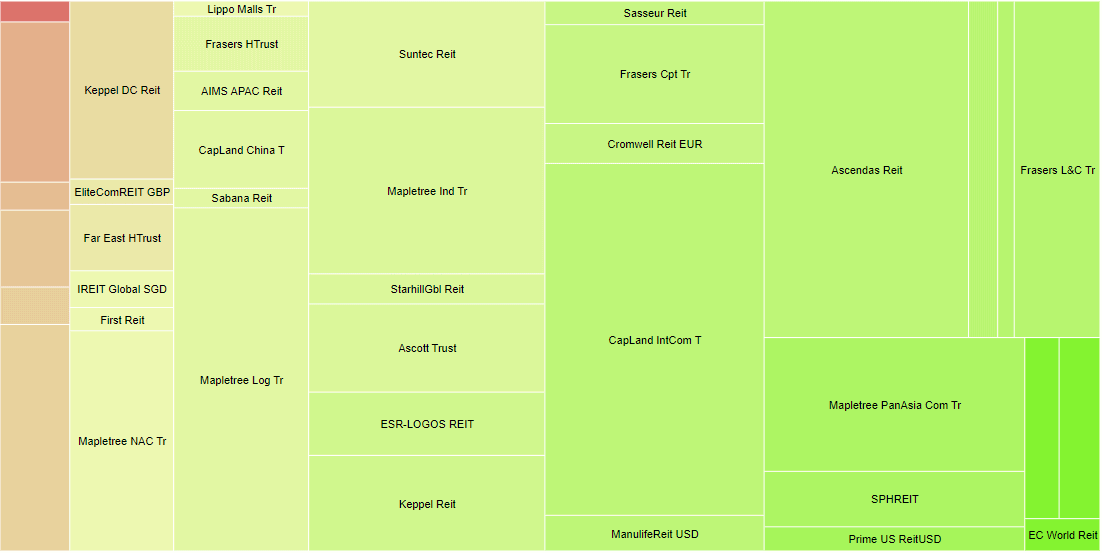
Fundamentally, the whole Singapore REITs landscape is undervalued based on the average Price/NAV value of the S-REITs. Below is the market cap heat map for the past 1 month. Generally, S-REITs in the past month have increased in market cap as July was the bullish month for S-REITs.

(Source: https://stocks.cafe/kenny/overview)

Yield spread (in reference to the 10 year Singapore government bond of 2.63% as of 7th August 2022) widened from 3.47% to 3.67%. The S-REIT Average Yield increased slightly from 6.30% to 6.32%, while the decrease in the Government Bond Yields more than offsets this Average S-REIT Yield increase. This resulted in the widening of yield spread. The yield of the REITs sector needs to increase to maintain the average yield spread of 4%. S-REITs have been resilient and have one of the highest risk-adjusted dividend yields compared to other stock exchanges.

Technically, FTSE ST REIT Index has started a short term uptrend but is currently testing the 200 SMA resistance. Longer term wise the REIT index is still trading in a sideways consolidation range between 800 and 890. The index has to break the 890 resistance convincingly before declaring the “The Returning of the Bull in S-REITs”.

Note: This above analysis is for my own personal research and it is NOT a buy or sell recommendation. Investors who would like to leverage my extensive research and years of Singapore REIT investing experience can approach me separately for a REIT Portfolio Consultation.

Kenny Loh is an Associate Wealth Advisory Director  and REITs Specialist of Singapore’s top Independent Financial Advisor. He helps clients construct diversified portfolios consisting of different asset classes from REITs, Equities, Bonds, ETFs, Unit Trusts, Private Equity, Alternative Investments, Digital Assets and Fixed Maturity Funds to achieve an optimal risk adjusted return. Kenny is also a CERTIFIED FINANCIAL PLANNER, SGX Academy REIT Trainer, Certified IBF Trainer of Associate REIT Investment Advisor (ARIA) and also invited speaker of REITs Symposium and Invest Fair.  You can join my Telegram channel #REITirement – SREIT Singapore REIT Market Update and Retirement related news. https://t.me/REITirement

Continue ReadingSingapore REIT Monthly Update (August 7th 2022)