Money & Me: Further Interest Rate Hikes, FHT’s failed Privatization bid

  • Post author:

16 September 2022

Money and Me: What could unitholders responsible for FHT’s failed privatisation bid be holding out for?

Frasers Hospitality Trust, suffered a 24 percent dip in share prices after a $1.35 billion proposal to take the trust private fell through.. The privatisation offer seemed generous enough,– at a 7 per cent premium to net asset value (NAV) But earlier this week, the global hotel and serviced residence trust clocked in 74.88 percent of shareholder votes who were in favour of the proposal, narrowly missing the 75 per cent needed for the resolution to pass. Many market watchers were surprised including our guest Kenny Loh, REIT Specialist and Independent Financial Advisor.

We find out why and ask if hospitality Reits listed in Singapore – which have seen a remarkable revival in fortunes-  can continue their march forward. Michelle Martin and Kenny Loh also take a closer look at the S-reit landscape month-on-month performance across sectors.

The article version (transcribed) of the interview can be found below.


Transcription:

Introduction

We’re surveying the REIT universe. Frasers Hospitality Trust suffered a 24% dip in its share price, after a 1.35 billion proposal to take the trust private fell even though the offer seemed generous. Cash offering of 70 cents per stapled security, a 7% premium to its net asset value by sponsor Fraser’s Property.

But the global hotel and service resident clocked in 74.88% of shareholder votes, just missing 75% that it needed for that resolution to pass. So we’ll take a closer look at that. Also scanning Mapletree Pan Asia commercial trust, seeing a bullish call by DBS on its share price. And in just a while, we’ll also take a look at Parkway Life REIT and their move to further expand their Healthcare REITs portfolio over in Japan. 


Q. Can you give us a sense of an overview of how REITs have performed the past month? I understand that the year’s best performers are hospitality trusts and the worst performers are REITs with 100% overseas assets.

Right based on the latest month of performance, actually, there’s a sell off across the board for the whole REIT universe in Singapore. And based on last week, with inflation data coming out, there was a sell off in the US Stock market, and Singapore REITs are not spared too. And if we are looking at a whole index itself, the REIT index is really forming some sort of bearish chart pattern, the falling wedge. This I don’t like as an investor, as the breaking down the support of this may result in a larger sell off of the Singapore itself.

So, last month was a pretty bad month for Singapore REITs. And at a present moment, the REIT index is holding at the critical support level.


Q. For the failed Frasers Hospitality Trust privatisation bid, why do you think unitholders rejected this privatisation bid, despite the attractive offer?

I was surprised unitholders rejected this privatization. I thinkthe offer is pretty good based on past performance. I think why the unit holder they rejected the offer, I think is all down to the price. Because if you look at a price chart, historically Frasers Hospitality Trust used to trade between 63 cents to 86 cents.

And close to 70% of the time, they are trading above 70 cents value, which means that most investors who invested in Fraser Hospitality Trust, basically they’re losing money. And coupled with a dividend, maybe some of them probably would breakeven with the share price and also the dividend from a total return perspective.

So I think that mainly on a price perspective, but however, It is actually a narrow miss of 75% mark because the 74.88% who voted for the prioritization is only 0.12%, which a small number. So I think that with the adjustment of the share price during the next attempt, probably you’ll swing these unitholders to vote for the privatisation.


Q. What would privatization mean for unitholders of FHT?

There are two scenarios. One scenario is a privatisation does not go through. Based on the current portfolio, I think there are a lot of challenges for FCT to turn around because there will be too much uncertainty, e.g. Rate hike and inflation. Also by looking at their debt portfolio they may have to face the refinancing risk pretty soon, because they currently have a high gearing ratio of 39.3%. And at the same time, they have a decreasing DPU trend, even during pre-COVID. So is the NAV/Unit value.

This means that fundamentally, I think the current portfolio is not a fundamentally strong portfolio. Coupled with all these uncertainties, if shareholders continue to hold onto FHT and FHT faces refinancing risks, they will then have to issue additional rights. And that will further dilute the DPU and also the share price. Although the sentiment in the Hospitality REITs recovery is good, there are better choices out there.

For example, CDL Hospitality Trusts, Far East Hospitality Trust and Ascott Residence Trust. If you look at the offering price itself, they are offering 1.07 times of the NAV (book value), which is pretty high at the present moment. Ascott is only trading at 0.94, FEHT at 0.7 and CDLHT at 0.97. The principal is much higher than those relatively better Hospitality trusts out there.


Q. What are the possible headwinds for FHT that you see?

One would be the continual decrease of DPU. The other possible concern would be the resurgence of COVID around the world, which will dent the hospitality sector. And at the present moment, the ICR is also pretty low. I may have a concern that they may turn out to be the next Eagle Hospitality Trust, where they are not able to pay the dividends.


Q. Mapletree Pan Asia Commercial Trust is trading at a yield aboe 5%, at $0.89, with a bullish call by DBS. Do you think MPACT’s valuation is attractive right now?

I do agree with the DBS call because if you look at the present price to book value, it is trading below or close to minus one standard division of the five year average. In other words, it’s undervalued. And if you look at the forward earnings and the forward DPU, the forward DPU is expected to rise.

2 reasons: one attributed to the future easing of restrictions for Hong Kong and China. Eventually China will ease COVID restrtctions. And Festival Walk, one of the famous retail malls in Hong Kong, definitely will be benefit from this reopening and reduction on quarantine measures. Festival Walk contributed 21% of MPACT’s NPI. So a reopening of a China will help, uh, Hong Kong itself.

And at the same time, also we will help Singapore because right now we have very few Chinese tourists coming to Singapore due to all the restrictions. When the borders reopen, there’ll be revenge traveling. We have seen it for Singapore. Once it opens, everyone goes out. We don’t even care about air ticket prices. They’ll come here and perform revenge traveling and revenge spending. This will help VivoCity, which contributes close to 22% of the NPI.

So if you combine this two major properties, that is a 43% contribution to NPI benefitted from the reopening.


Q. When it comes to MPACT, do you see any possible risks ahead that investors should be aware of?

Yes. Yes, there, there are risks. After the merger. There are two risks in this expect. One of them is a fundamental risk. So the fundamental side, if we have a slower than expected reopening of China and Hong Kong, or we are entering into a severe recession because now everybody is talking about recession. A severe recession will defnitely impact DPU. That is more on the fundamental side.

The other aspect is the political aspect because we know that now tension is pretty high between US and China on the Taiwan issue. So if any incident creates a war, maybe they just fire the missile out to each other. Right. Or they have a sanction on China or sanction on Hong Kong or whatever thing, definitely you affect the sentiment of the investment community.


Q: Do you think these latest acquisitions are a positive for ParkwayLife REIT’s portfolio? PLREIT has recently acquired 3 Hokkaido nursing homes.

Yes. positive because with the current high price to book value, about 1.94 times, and also the low DPU yield of about 3%, any acquisition out there would be quite attractive because definitely it’ll be much better than the current valuation and also the DPU.

This acquisition actually is yield-accretive. They are getting 6.5% NPI yield. And at the same time, the valuation of this property is 12% below the valuation compared to the REIT valuation itself, it is pretty attractive. There definitely be a retating after the portfolio to be integrated into the REIT.

And at the same time, a very low cost of debt. You just imagine that you are borrowing with an interest rate of close to 0%, and you are investing in some properties generating 6.5%. The spread is huge. It’s really a no brainer. 


Q. Can you help us understand how PLREIT has been performing compared to pre-COVID levels?

Yeah, it, it really depends on each investor. When was their investment time? Five years ago. Definitely. This is one, this is one of the best REITs. But if its only for just after COVID or maybe one year ago, probably performance is not so fantastic but still quite good.

So I’m just referring to the, the, before the COVID and also based on the past five year, if you come just purely come back to the previous high of the pre COVID at the present stock price, it has already surpassed the previous pre-COVID high up by 25%. Other REITs do not have this kind of performance.

Yeah, because REITs at the present moment is coming down, and subjected to sector rotation. At the same time, the DPU has been growing steadily over year since the IPO and PLREIT is unscathed during the COVID period, they continue to pay good dividend, continue to grow that dividend, due to the strength in the underlying portfolio that’s why they’re able to combine such a high premium to the book value at the same time that did not go to the correction during this period.

Q. What is your feel of the recessionary headwind? And what could this mean for REITs?

Investors need to be selective in this case because during the recession period, most of the companiesthey’ll be going through cost cutting measures. First of all, they’ll try to reduce expense. Secondly, they start to cut headcounts. Thirdly, they may shut down the facilities. Tenant profile is important. If the tenant profiles are very strong, they’re quite reputable and they are in essential industries, definitely they can tide through this recession pretty well.

The Logistics and Industrial sector probably is more defensive at this time. Healthcare is also defensive. I think Singapore should be able to avoid the recession. So retail malls in Singapore, they’re probably more resilient in nature because we cannot live without retail malls.

Nowhere to go, nowhere to eat, nothing to do. If we are entering a recession, everyone will be tightening their belts. The hospitality sector will be impacted. Tourism will be affected. But at the same time, there is a revenge spending phenomena when China reopens, because everyone there have been locked down for three years. Right? You, you just imagine the potential explosion of the needs to spend and to travel that may maybe kick start and help us in the recovery of the global economy. 


Navigating Volatile Markets to Beat Inflation (Physical Seminar 1st October 2022)


Worried about the high inflation rates? Join us as we share tips on how to beat inflation, and our inflation outlook for the rest of the year and beyond. You will learn ways to edit your investment portfolio to beat the high inflation rates, in a SAFE way.

As this is a physcial seminar, seats are limited so sign up today.

Date: 1st October 2022 (Saturday)

Time: 10am – 12pm

Venue: Gateway West (150 Beach Road, #12-01/08, Singapore 189720)


How to Build a REIT Portfolio into a Retirement Plan? (SGX Academy Webinar, 5th October 2022)


Want to learn the fundamentals of what REITs are, and how can this asset class complement your investment portfolio? Why should you invest in this asset class with an average p.a. yield of 5-7% and $100 minimum investment amount? Tune in to learn how to kickstart/improve your REITs investing!


Date: 5th October 2022 (Wednesday)

Time: 7pm – 830pm

Venue: Online
 

Listen to his previous market outlook interviews here:

2022

2021

2020

Kenny Loh is an Associate Wealth Advisory Director and REITs Specialist of Singapore’s top Independent Financial Advisor. He helps clients construct diversified portfolios consisting of different asset classes from REITs, Equities, Bonds, ETFs, Unit Trusts, Private Equity, Alternative Investments, Digital Assets and Fixed Maturity Funds to achieve an optimal risk adjusted return. Kenny is also a CERTIFIED FINANCIAL PLANNER, SGX Academy REIT Trainer, Certified IBF Trainer of Associate REIT Investment Advisor (ARIA) and also invited speaker of REITs Symposium and Invest Fair.  

You can join my Telegram channel #REITirement – SREIT Singapore REIT Market Update and Retirement related news. https://t.me/REITirement

Continue ReadingMoney & Me: Further Interest Rate Hikes, FHT’s failed Privatization bid

Singapore REIT Monthly Update (September 3rd 2022)

  • Post author:

Happy 20th anniversary to S-REITs!

Back in 17th July 2002, CapitaMall Trust was listed on the Singapore exchange. Today, there are 38 S-REITs, with a combined market cap of over S$100 Billion. 


Technical Analysis of FTSE ST REIT Index (FSTAS351020)


FTSE ST Real Estate Investment Trusts (FTSE ST REIT Index) decreased from 828.74 to 792.62 (4.36%) compared to last month’s update. The REIT Index broke the 800 psychological support and current testing the trend support at about 792. The 20-day and 50-day Simple Moving Average (20 SMA and 50 SMA) are about to crossover, the 20 SMA dropping sharply in the past month. The REIT Index failed to break the 200 SMA Resistance in August, and is now on a short-term downtrend.

  • Support Lines: Blue
  • Resistance Lines: Red
  • Short-term direction: Down
  • Medium-term direction: Down
  • Long-term direction: Sideways
  • Immediate Support at 792 (Blue Line)
  • Immediate Resistance at 200 SMA

Technically, FTSE ST REIT Index is currently at a very crucial support level at 792. Breaking this support will start the bear trend for Singapore REIT sector. If the REIT index is able to rebound from this level, it is expected the index will have short term bullish momentum towards 830 (200D SMA resistance).


Normal Timeframe chart (~2 years)


Previous chart on FTSE ST REIT index can be found in the last post: Singapore REIT Fundamental Comparison Table on August 7th, 2022.


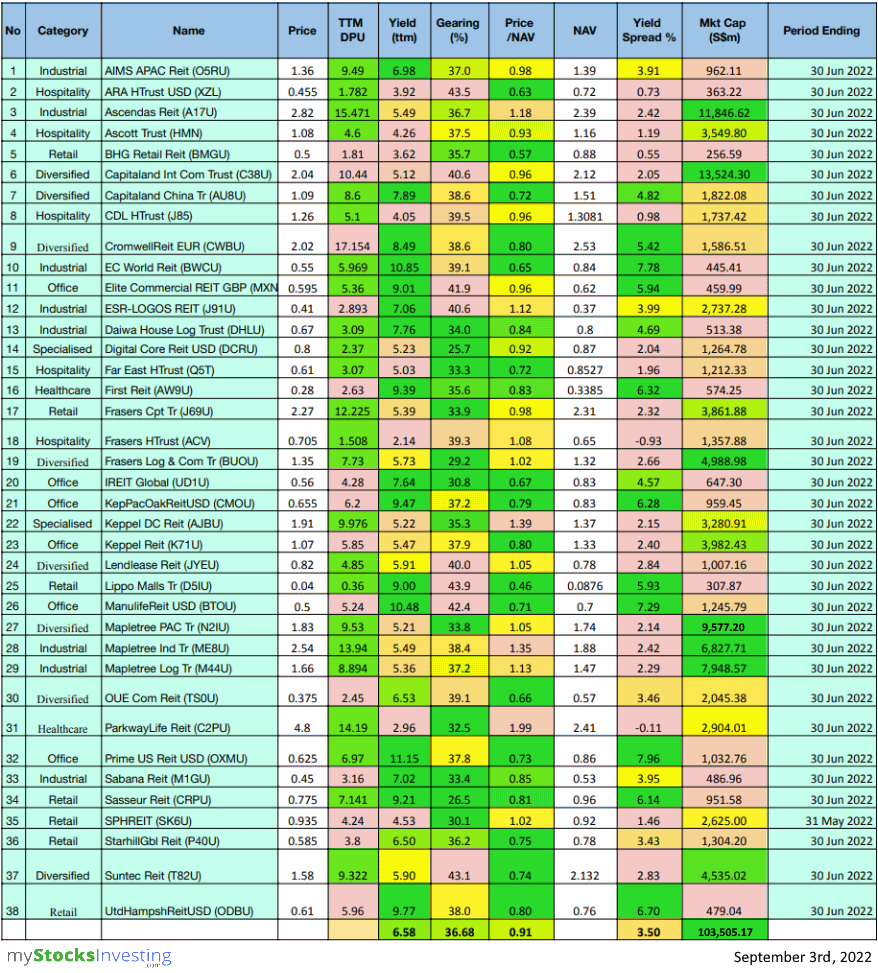
Fundamental Analysis of 38 Singapore REITs


The following is the compilation of 38 Singapore REITs with colour-coding of the Distribution Yield, Gearing Ratio and Price to NAV Ratio.

  • The Financial Ratios are based on past data and there are lagging indicators.
  • This REIT table takes into account the dividend cuts due to the COVID-19 outbreak. Yield is calculated trailing twelve months (ttm), therefore REITs with delayed payouts might have lower displayed yields, thus yield displayed might be lower for more affected REITs.
  • All REITs are now updated with the latest Q2 2022 business updates/earnings.
  • Since MPACT started trading, values shown below (except price and market cap) are of MCT.
  • MNACT has been removed.

Data from StocksCafe REIT Screener. https://stocks.cafe/kenny/advanced


What does each Column mean?

  • FY DPU: If Green, FY DPU for the recent 4 Quarters is higher than that of the preceding 4 Quarters. If Lower, it is Red.
    • Most REITs are green since it is compared to FY20/21 as the base (during the pandemic)
  • Yield (ttm): Yield, calculated by DPU (trailing twelve months) and Current Price as of September 3rd, 2022
    • Digital Core REIT: Yield calculated from IPO Prospectus.
    • Daiwa House Logistics Trust: Yield calculated from trailing six months distribution.
  • Gearing (%): Leverage Ratio.
  • Price/NAV: Price to Book Value. Formula: Current Price (as of September 3rd, 2022) over Net Asset Value per Unit.
  • Yield Spread (%): REIT yield (ttm) reference to Gov Bond Yields. REITs trading in USD is referenced to US Gov Bond Yield, everything else is referenced to SG Gov Bond Yield.
  •  

Price/NAV Ratios Overview

  • Price/NAV decreased to 0.91.
    • Decreased from 0.95 from August 2022.
    • Singapore Overall REIT sector is undervalued now.
    • Take note that NAV is adjusted upwards for some REITs due to pandemic recovery.
  • Most overvalued REITs (based on Price/NAV)
    • Parkway Life REIT (Price/NAV = 1.99)
    • Keppel DC REIT (Price/NAV = 1.39)
    • Mapletree Industrial Trust (Price/NAV = 1.35)
    • Ascendas REIT (Price/NAV = 1.18)
    • Mapletree Logistics Trust (Price/NAV = 1.13)
    • ESR-LOGOS REIT (Price/NAV = 1.12)
    • No change to the Top 6 compared to last month’s update.
  • Most undervalued REITs (based on Price/NAV)
    • Lippo Malls Indonesia Retail Trust (Price/NAV=0.46)
    • BHG Retail REIT (Price/NAV = 0.57)
    • ARA Hospitality Trust (Price/NAV = 0.63)
    • EC World REIT (Price/NAV = 0.65)
    • OUE Commercial REIT (Price/NAV = 0.66)
    • IREIT Global (Price/NAV = 0.67)

Distribution Yields Overview

  • TTM Distribution Yield Increased to 6.58%.
    • Increased from 6.32% in August 2022.
    • 15 of 40 Singapore REITs have distribution yields of above 7%. (1 more than last month’s update)
    • Do take note that these yield numbers are based on current prices taking into account the delayed distribution/dividend cuts due to COVID-19, and economic recovery. The recent sell-off contributed to the increase in average yield.
  • Highest Distribution Yield REITs (ttm)
    • Prime US REIT (11.15%)
    • EC World REIT (10.85%)
    • Manulife US REIT (10.48%)
    • United Hampshire REIT (9.77%)
    • Keppel Pacific Oak US REIT (9.47%)
    • First REIT (9.39%)
    • Reminder that these yield numbers are based on current prices taking into account delayed distribution/dividend cuts due to COVID-19.
    • Some REITs opted for semi-annual reporting and thus no quarterly DPU was announced.
    • A High Yield should not be the sole ratio to look for when choosing a REIT to invest in.
  • Yield Spread tightened to 3.50%.
    • Decreased from 3.67% in August 2022.

Gearing Ratios Overview

  • Gearing Ratio increased slightly to 36.68%. 
    • Decreased from 36.52% in August 2022.
    • Gearing Ratios are updated quarterly. Therefore some of the following REITs have updated gearing ratios compared to last month.
  • Highest Gearing Ratio REITs
    • Lippo Malls Indonesia Retail Trust (43.9%)
    • ARA Hospitality Trust (43.5%)
    • Suntec REIT (43.1%)
    • Manulife US REIT (42.4%)
    • Elite Commercial REIT (41.9%)
    • ESR-LOGOS REIT (40.6%)

Market Capitalisation Overview

  • Total Singapore REIT Market Capitalisation decreased by 4.69% to S$103.51 Billion.
    • Decreased from S$108.60 Billion in August 2022.
  • Biggest Market Capitalisation REITs:
    • Capitaland Integrated Commercial Trust ($13.52B)
    • Ascendas REIT ($11.85B)
    • Mapletree Pan Asia Commercial Trust ($9.58B)
    • Mapletree Logistics Trust ($7.95B)
    • Mapletree Industrial Trust ($6.83B)
    • Frasers Logistics & Commercial Trust ($4.99B)
    • MPACT (formerly MCT) moved from 5th to 3rd rank since its merger with MNACT.
  • Smallest Market Capitalisation REITs:
    • BHG Retail REIT ($257M)
    • Lippo Malls Indonesia Retail Trust ($308M)
    • ARA Hospitality Trust ($363M)
    • EC World REIT ($445M)
    • Elite Commercial REIT ($460M)
    • United Hampshire REIT ($479M)

Disclaimer: The above table is best used for “screening and shortlisting only”. It is NOT for investing (Buy / Sell) decision. If you want to know more about investing in REITs, here’s a subsidised 2-day course with all you need to know about REITs and how to start investing in them.


Top 20 Worst Performers of the Month in August 2022


 (Source: https://stocks.cafe/kenny/advanced)


SG 10 Year & US 10 Year Government Bond Yield

  • SG 10 Year: 3.07% (decreased from 2.63%)
  • US 10 Year: 3.19% (decreased from 2.83%)


Major REIT News in August 2022


S-REITs Earnings Season for the Period Ending 30 June 2022 has wrapped up

All S-REITs have finished reporting their earnings. Of the 37 REITs who reported their earnings for Q1 and/or Q2 (taking most recent DPU) (excl. DC REIT), the overview on Q-o-Q or H-o-H DPU change are as follows:

16 REITs have reported an increase in DPU,

7 REITs have reported no change in DPU, and

14 REITs have reported a decrease in DPU.


S-REITs are now 20 years old!

THE SMART INVESTOR: Time flies, and in the blink of an eye, it’s been 20 years since the first Singapore REIT (S-REIT) was listed on our shores.

The REIT Association of Singapore (Reitas) organised an event to celebrate this milestone, and Singapore Exchange’s (SGX: S68) CEO Loh Boon Chye noted that the S-REIT sector continues to be one of the fastest-growing in Asia.

S-REITs form the second-largest REIT market outside of Japan, with a total of 43 REITs (and Business Trusts) with a market value of more than S$111 billion, making up close to 12% of the market capitalisation of all SGX stocks.

The very first REIT, CapitaMall Trust, was listed on the Singapore market back on 17 July 2002.

It was later merged with CapitaCommercial Trust to form CapitaLand Integrated Commercial Trust (SGX: C38U). Read More


Lendlease Global Commercial REIT first S-REIT to attain net-zero carbon target

EDGEPROP: Lendlease Global Commercial REIT (LREIT) has achieved its net-zero carbon target ahead of its original target through energy-efficiency initiatives and reducing energy consumption within its Singapore assets, it announced on Aug 29.

“LREIT is poised to make strides in our decarbonisation journey to achieve absolute zero carbon by 2040, as the first S-REIT to attain net-zero carbon status,” says Kelvin Chow, the CEO of LREIT’s manager. “Besides adopting energy-efficiency measures, we are actively exploring new ways to reduce our energy consumption.” Read More


Summary


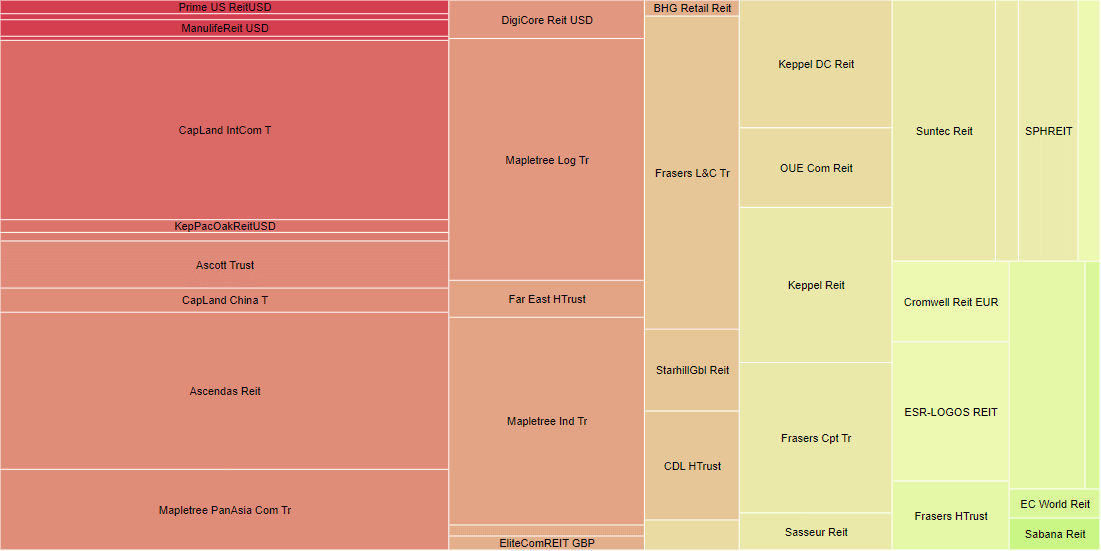
Fundamentally, the whole Singapore REITs landscape is undervalued based on the average Price/NAV value of the S-REITs. Below is the market cap heat map for the past 1 month. Generally, S-REITs in the past month have decreased in market cap. August has been a bearish month for S-REITs.


(Source: https://stocks.cafe/kenny/overview)

Yield spread (in reference to the 10 year Singapore government bond of 3.07% as of 3rd September 2022) tightened from 3.67% to 3.50%. The S-REIT Average Yield increased from 6.32% to 6.58%, while the increase in the Government Bond Yields more than offsets this Average S-REIT Yield increase. This resulted in the tightening of yield spread. The yield of the REITs sector needs to increase to maintain the average yield spread of 4%. Despite the bearish month of August, S-REITs have been resilient and have one of the highest risk-adjusted dividend yields compared to other stock exchanges.


Technically, FTSE ST REIT Index is currently at a very crucial support level at 792. Breaking this support will start the bear trend for Singapore REIT sector. If the REIT index is able to rebound from this level, it is expected the index will have short term bullish momentum towards 830 (200D SMA resistance).


Note: This above analysis is for my own personal research and it is NOT a buy or sell recommendation. Investors who would like to leverage my extensive research and years of Singapore REIT investing experience can approach me separately for a REIT Portfolio Consultation.

Kenny Loh is an Associate Wealth Advisory Director  and REITs Specialist of Singapore’s top Independent Financial Advisor. He helps clients construct diversified portfolios consisting of different asset classes from REITs, Equities, Bonds, ETFs, Unit Trusts, Private Equity, Alternative Investments, Digital Assets and Fixed Maturity Funds to achieve an optimal risk adjusted return. Kenny is also a CERTIFIED FINANCIAL PLANNER, SGX Academy REIT Trainer, Certified IBF Trainer of Associate REIT Investment Advisor (ARIA) and also invited speaker of REITs Symposium and Invest Fair.  You can join my Telegram channel #REITirement – SREIT Singapore REIT Market Update and Retirement related news. https://t.me/REITirement
Continue ReadingSingapore REIT Monthly Update (September 3rd 2022)

Money & Me: Q3 2022 SREIT winners

  • Post author:

19 August 2022

Money and Me: Q3 2022 SREIT winners

Kenny Loh, REIT Specialist and Independent Financial Advisor looks at the top performing SREITS for Q3 2022 and where value in the market is. The article version (transcribed) of the interview can be found below.


Timestamps

0:18 Intro

1:19 Kenny’s clear winners in Q3 2022 this year

2:00 What are the drivers for the good performance for them this year? (EC World, DHLT, Data Center REITs)

Digital Core REIT

3:02 How does the performance of Digital Core REIT compare against its past results?

4:27 What does Digital Core REIT’s planned acquisitions mean in the near term?

DHLT

5:22 Daiwa House Logistics Trust: Will Logistics Trusts continue being a strong driver in the near term?

7:18 How will Japan’s inflation rates impact DHLT?

EC World REIT

8:03 How is EC World REIT performing, despite China’s covid-zero policy?

9:57 Who are the laggards in terms of performance? (poor performance)


Transcription:

Q. Kenny, who are the clear winners for Q3 2022 in your book?

It’s quite clear cut that the data center and also industrial are in the rotation play. They actually performed better in Q3, since one and a half years ago. So the top three performers in this quarter would be Digital Core REIT, gone up by 18%, Daiwa Logistics trust about 18% also, and also EC world about 17%. But all this top three performers basically are not really fantastic news. They basically just recovered from the knee jerk sell off in the private quarters.


Q. What are the drivers for why they’ve done so well so far? And do you see any correlation between that and the recovery in global markets that we’ve.

Yeah, based on the fundamental itself, basically these 3 REITs, the valuation is not really over-stretched before the sell off. So during the sell off, basically there are some negative news because one of the hedge funds came out with a report to really short the data center space.

Right. I read the fundamentals, I read the reasoning. I do not agree to it on, on the data center space and for the EC World REIT itself, basically that there was a fear of they not able to do the refinancing. That’s why during that period, during the uncertainty, uh, there is a sell off until they’re able to really delay for one more year to do the refinancing.

So after all the negative news gone away, basically it’s really back to the normal valuation.


Q. Now, when you take a look at the winners, and the top five REITs, if we start with Digital Core REIT, Kenny, how does the performance of Digital Core REIT compare with what you’ve seen in terms of its past results?

Yeah, so, so far, in terms of the share price department, Digital Core REIT, Actually the share price has recovered more than 20% after hitting a bottom of around 70, uh, US cents. But if you look at the NPI and also the DPU, basically, there’s nothing so fantastic. It’s quite comparable to the forecast, the NPI for first, top of 2022, it’s only go up by around 5.9%.

Okay. Not, not so bad. And the DPU just missed by 1.4%, uh, giving a distribution of 2.06 cents versus 2.09 cents as the forecast. But if you look at the yield itself, the estimated annualised DPU, basically at the present moment at current stock price, giving us 4.8%. And this 4.8% annualised this description view is quite comparable to KDC.

And, and at the same time, in terms of evaluation itself, mm-hmm, Digital Core REIT has a much attractive evaluation and also financial ratio compared to capabilities. Digital Core REIT has a, a lower gearing ratio at 25.7, which means that they have a lot more debt room for the future acquisition. At the same time, the price is about 1x.


Q. Speaking of future acquisitions, Digital Core REIT is a pure play data center REIT, and it has said it’s gonna be looking at new markets like Chicago and Dallas and Frankfurt for acquisitions. What could this mean in the near term?

In the near term, I would expect them to continue to grow their portfolio because if you look at the initial portfolio as well, the tenant concentration is pretty huge.

They are only focused on few tenants. So in order to really diversify away all the tenant concentration risk, uh, risk, they probably have to, uh, grow it. And, and that is part of the, the plan in the IPO. So in the near term expect they will, uh, announce, uh, some of the new acquisitions based on their low gearing.

Hopefully they don’t really need to, uh, issue additional rights and also, uh, do a lot more private placements that dilute the shares. Hopefully they just finance the whole thing for that.


Q. Interesting. Let’s look at Daiwa House Logistics Trust, uh, which is among the top five performing trusts for the third quarter of 2022, currently up 21.3%, but for the quarter 18%, we saw a movement up. Now, when it comes to Daiwa House Logistics Trust, it said that it expects demand for large scale logistics to continue to be a strong driver all the way till 2023. Do you agree with them?

I tend to agree because if we are looking forward into the future as well, in the least for the near term, they are basically two catalysts to push the logistics sector and warehouse sectors to do well.

The first catalyst will be this logistic space continued to be driven by the growth in the e-commerce and also wide adoption of the eCommerce. So in order to have a very efficient eCommerce that need the modern warehouse for logistic system or even a supply chain system to handle the huge volume in a very efficient way.

And, and beside the very efficient way, we also need to look the speed, and also, uh, the core structure for the logistic itself. So if we are continue to use the old, old warehouse or old logistics system, you are not able to be competitive moving forward. So modernization on the logistic and also supply chain warehouse probably the drives the REITs to continue to upgrade their warehouse base.

That is the first catalyst, right? For the second catalyst itself for the past two or three years. We also know that we have many, many shutdowns and also cause a lot of supply chain, uh, disruptions. So the manufacturer was forced to change their model from just in time (JIT) to just in case (JIC) models to keep an inventory to prevent all this kind shut down, uh, from happening again, because that is quite destructive to the manufacturing. And also the whole thing you drive up the on the inflation.


Q. Do you expect the way Japan is grappling with inflation to impact Daiwa House Logistics Trusts’ earnings?

When you come to the investment space, uh, there is something called movement in sympathy. Maybe the stock market does not really care where is your location? Right? When there is a sell off, you expect the whole sector to sell.

Then after a while, the, the, maybe the institution, a problem manager have to go and deep dive and to see which REITs have a minimum impact, then that may probably cause a recovery. So, sentiment is important and sector rotation is important in the REITs space so far


Q. So how well do you think another one of in the group of the top five that we’ve seen EC World REIT how well has it done? Despite China’s continuing COVID zero policy.

Right based on the revenue and also the NPI publish, uh, in the latest earning, uh, just, just bear in mind that all this data are lagging.

I don’t really see that, uh, there is any, uh, big impact, EC World seems that holding quite well, uh, in this, uh, zero correct policy, but my biggest concern will be moving forward. It’s not for the past one or two years because moving forward, how EC World are going to manage. And they have refinancing need to be done within in one year’s time.

And China economy is not doing well. Right? There are two fronts. One thing is the GDP is started coming down, right? The growth start to slow down that will affect the business itself. And in return that will also affect the property valuation. Right with the high gearing and also dropping of the valuation itself, it makes, uh EC World much more difficult to do the fundraising or, or do the debt, uh, refinancing.

And also the other thing to signal that China is currently going through the property and also mortgage crisis. So the bank would be very reluctant to, to loan it to the real estate sector because they do not really want to expose into a real estate sector. So, so I would see that probably all the banks in China, they are pulling back and reducing the exposure to real estate that make EC World even more difficult to do refinancing.

So, uh, for me, uh, forward looking risk is much more higher than the, the past financial performance.


Q. Who are the laggards in terms of performance?

The laggards uh, US Office REITs, quite surprisingly based on the past few, so called the earnings release by Manulife US REIT, Prime US REIT and KepPacOak US REIT.

It is quite, I I’m seeing that actually the, the return to the office is not a fast compared to Singapore because Singapore, for, for employees in Singapore, we being asked to go back to the office to work. I think we are more obedient, but ask yourself, it’s taking a little longer over there. Huh? Right, right. Actually the, you can see from a, the data itself, actually the workplace, uh, occupancy is pretty low, right?

And also, uh, this also cause in, uh, uh, slow down in the leasing space and, uh, hybrid work mode of work is still preferred in us moving forward. So that will probably, uh, drag in the US Office sector. But if you really based on the fundamental itself, based on evaluation is pretty attractive. So in terms of share price, I would say that for the Q3 Q4, probably no one wants to take such a risk.

Yeah. But if you are looking for long term, right, five years, 10 years, you can do some study on the fundamentals itself because some of them the REITs are not really impacted. And the financial ratio is also pretty good. Also. Uh, it’s pretty attractive.


Navigating Volatile Markets to Beat Inflation (Physical Seminar 1st October 2022)


Worried about the high inflation rates? Join us as we share tips on how to beat inflation, and our inflation outlook for the rest of the year and beyond. You will learn ways to edit your investment portfolio to beat the high inflation rates, in a SAFE way.

As this is a physcial seminar, seats are limited so sign up today.

Date: 1st October 2022 (Saturday)

Time: 10am – 12pm

Venue: Gateway West (150 Beach Road, #12-01/08, Singapore 189720)

How to Build a REIT Portfolio into a Retirement Plan? (SGX Academy Webinar, 5th October 2022)


Want to learn the fundamentals of what REITs are, and how can this asset class complement your investment portfolio? Why should you invest in this asset class with an average p.a. yield of 5-7% and $100 minimum investment amount? Tune in to learn how to kickstart/improve your REITs investing!


Date: 5th October 2022 (Wednesday)

Time: 7pm – 830pm

Venue: Online


Listen to his previous market outlook interviews here:

2022

2021

2020

Kenny Loh is an Associate Wealth Advisory Director and REITs Specialist of Singapore’s top Independent Financial Advisor. He helps clients construct diversified portfolios consisting of different asset classes from REITs, Equities, Bonds, ETFs, Unit Trusts, Private Equity, Alternative Investments, Digital Assets and Fixed Maturity Funds to achieve an optimal risk adjusted return. Kenny is also a CERTIFIED FINANCIAL PLANNER, SGX Academy REIT Trainer, Certified IBF Trainer of Associate REIT Investment Advisor (ARIA) and also invited speaker of REITs Symposium and Invest Fair.  

You can join my Telegram channel #REITirement – SREIT Singapore REIT Market Update and Retirement related news. https://t.me/REITirement

Continue ReadingMoney & Me: Q3 2022 SREIT winners