Refine your trading strategies and learn from one another! Prove yourself to be the best trader in Southeast Asia!
Prove yourself to be the best trader in the region as the tournament is open to both Singaporeans and Malaysians! Click here to register now!
Join our upcoming Active Trading Tournament 2023, hosted in partnership with UBS and sponsored by SGX. This Year, traders will be tested not only on their trading skills but also for their methodology and their presentation during INVEST Fair on 12 Aug!
Register for INVEST Fair: Singapore’s largest investment-themed fair here!
2 rounds in the Tournament:
– Tournament Trading Round
– Top 5 Finalists Pitch Round
The top 5 traders with highest portfolio returns for the tournament trading round will be invited to INVEST Fair SG on 12 August to do a live pitch on stage in front of panel of judges to win cash prizes.
Top 3 winning finalists of the Finalist Pitch Round will be selected based on the judging criteria: 70% by returns and 30% by the panel of judges.
It’s one of the Biggest, Most Exciting and Prestigious Trade-Sport Tournaments in the Region which focuses on the trading of Daily Leverage Certificates (DLC). Feeling hopeful on a rebound? You can choose the Long DLCs. Market bad? You can choose the Short DLCs!
Whether you’re holding Long or Short views on the market…meet and battle other traders in this year’s Tournament where every participant’s portfolios will be made transparent to the public!
Dare to accept our challenge? Up to $10,000 worth of prizes to be won!
Prizes to be won!
Register now and stand to WIN these Prizes:
🔹1x Macbook Air Laptop 13″ (Worth SGD$1,500)
🔹1x Samsung Odyssey Curve Monitor (Worth SGD$700)
Cash Prizes
🏆 1st Place: SGD$4,000
🏆 2nd Place: SGD$2,000
🏆 3rd Place: SGD$1,000
💎 SGD$40 Worth of Vouchers to be won DAILY!
💎 SGD$20 Worth of Vouchers for 10x Lucky Winners who make at least 3x trades!
Key Dates to Take Note:
✅ Registration Period: Starts Today! ✅ Tournament Trading Period: 17 July – 4 Aug 2023 ✅ Final Pitch Period (Top 5 Finalists): 12 Aug 2023 at INVEST Fair
Register now to be amongst the 2 lucky winners who’d win either a Macbook or a Samsung Odyssey Curve Monitor!
Technical Analysis of FTSE ST REIT Index (FSTAS351020)
FTSE ST Real Estate Investment Trusts (FTSE ST REIT Index) decreased from 714.12 to 716.79(0.32%)compared to last month’s update. The REIT index is still currently trading within a descending triangle with the pink lines showing the resistance and support. This is a medium-term consolidation pattern until the next big move (upside breakout or downside breakout). This is a continuation of last month’s update, still trading within the descending triangle.
Short-term direction: Sideways
Medium-term direction: Down (50D SMA is sloping down)
Long-term direction: Down (200D SMA is sloping down)
Immediate Support at 700 (Descending Triangle support)
Immediate Resistance is Descending Triangle Resistance & 200D SMA Dynamic Resistance (about 725))
The following is the compilation of 38 Singapore REITs with colour-coding of the Distribution Yield, Gearing Ratio and Price to NAV Ratio.
The Financial Ratios are based on past data and these are lagging indicators.
This REIT table takes into account the dividend cuts due to the COVID-19 outbreak. Yield is calculated trailing twelve months (ttm), therefore REITs with delayed payouts might have lower displayed yields, thus yield displayed might be lower for more affected REITs.
All REITs are now updated with the latest Q1 2023 business updates/earnings.
I have introduced weighted average (weighted by market cap) to the financial ratios, in addition to the existing simple average ratios. This is another perspective where smaller market cap REITs do not disproportionately affect the average ratios.
FY DPU: If Green, FY DPU for the recent 4 Quarters is higher than that of the preceding 4 Quarters.If Lower, it isRed.
Yield (ttm): Yield, calculated by DPU (trailing twelve months) and Current Price as of June 30th, 2023. Notes:
ESR-LOGOS REIT and Paragon REIT: Annualised yield, after taking into account switch to semi-annual distribution declaration. For Paragon REIT: calculated after converting from 13 months of distribution to 12 months.
Gearing (%): Leverage Ratio.
Price/NAV: Price to Book Value. Formula: Current Price over Net Asset Value per Unit.
Yield Spread (%): REIT yield (ttm) reference to Gov Bond Yields. REITs trading in USD is referenced to US Gov Bond Yield, everything else is referenced to SG Gov Bond Yield.
Price/NAV Ratios Overview
Price/NAV increased to 0.79. (Weighted Average: 0.79)
Increased from 0.78 in June 2023.
Singapore Overall REIT sector is undervalued now.
Take note that NAV is adjusted upwards for some REITs due to pandemic recovery.
Most overvalued REITs (based on Price/NAV)
ParkwayLife Reit (C2PU)
1.70
Keppel DC Reit (AJBU)
1.58
Mapletree Ind Tr (ME8U)
1.19
Capitaland Ascendas Reit (A17U)
1.15
Mapletree Log Tr (M44U)
1.13
Paragon REIT (SK6U)
1.05
Only 6 REITs are overvalued now based on Price/NAV value.
No change in the Top 3 in the last 5 months.
Most undervalued REITs (based on Price/NAV)
Lippo Malls Tr (D5IU)
0.23
Prime US Reit USD (OXMU)
0.28
ManulifeReit USD (BTOU)
0.31
KepPacOakReitUSD (CMOU)
0.39
EC World Reit (BWCU)
0.43
ARA HTrust USD (XZL)
0.44
Distribution Yields Overview
TTM Distribution Yield decreased to 8.93%. (Weighted Average: 6.33%)
Decreased from 9.08% in June 2023 (Weighted Average was 6.29%)
20 of 40 Singapore REITs have distribution yields of above 7%.
Do take note that these yield numbers are based on current prices taking into account the delayed distribution/dividend cuts due to COVID-19, and economic recovery.
8 REITs have a ttm yield of over 10%!
Highest Distribution Yield REITs (ttm)
Prime US Reit USD (OXMU)
31.19
ManulifeReit USD (BTOU)
27.46
KepPacOakReitUSD (CMOU)
18.41
Elite Commercial REIT GBP (MXNU)
14.66
EC World Reit (BWCU)
13.86
UtdHampshReitUSD (ODBU)
13.36
Reminder that these yield numbers are based on current prices. This has caused Manulife US REIT and Prime US REIT’s ttm yields to be over 25%.
Some REITs opted for semi-annual reporting and thus no quarterly DPU was announced.
A High Yield should not be the sole ratio to look for when choosing a REIT to invest in.
Yield Spreadtightened to 5.75%.(Weighted Average remains 4.39%)
Tightened from 6.05% in June 2023. (Weighted Average was 4.39%)
Gearing Ratios Overview
Gearing Ratio remains at 37.98%. (Weighted Average: 38.37%)
Remains at 37.98% from June 2023. (Weighted Average: 38.37%)
Gearing Ratios are updated quarterly. Therefore, compared to last month, no REIT has updated gearing ratios.
S-REITs Gearing Ratio has been on a steady uptrend. It was 35.55% in Q4 2019.
Highest Gearing Ratio REITs
ManulifeReit USD (BTOU)
49.5
Elite Commercial REIT GBP (MXNU)
46.6
Prime US Reit USD (OXMU)
43.7
Lippo Malls Tr (D5IU)
42.9
Suntec Reit (T82U)
42.8
UtdHampshReitUSD (ODBU)
42.6
Market Capitalisation Overview
Total Singapore REIT Market Capitalisation decreased slightly by 0.17% to S$94.26 Billion.
Decreased from S$94.42 Billion in June 2023.
Biggest Market Capitalisation REITs (S$):
Capitaland Int Com Trust (C38U)
12,704.52
Capitaland Ascendas Reit (A17U)
11,942.24
Mapletree PAC Tr (N2IU)
8,494.23
Mapletree Log Tr (M44U)
8,008.15
Mapletree Ind Tr (ME8U)
6,260.89
Frasers Log & Com Tr (BUOU)
4,654.06
No change in the rankings since September 2022.
Smallest Market Capitalisation REITs (S$):
Lippo Malls Tr (D5IU)
139.02
Elite Commercial REIT GBP (MXNU)
147.05
ARA HTrust USD (XZL)
193.53
BHG Retail Reit (BMGU)
245.81
Prime US Reit USD (OXMU)
249.30
UtdHampshReitUSD (ODBU)
251.86
Disclaimer: The above table is best used for “screening and shortlisting only”. It is NOT for investing (Buy / Sell) decision. If you want to know more about investing in REITs, here’s a subsidised 2-day course with all you need to know about REITs and how to start investing in them.
There are no major REIT news in June 2023. Major REIT news are such: mergers, huge acquisitions, trading suspensions etc.
Summary
Fundamentally, the whole Singapore REITs landscape remains extremely undervalued based on the average Price/NAV (at 0.79) value of the S-REITs, with a very attractive DPU yield of 8.93%! (Weighted average yield of 6.33%). Do take note that NAV and DPU are lagging numbers.
Performances over this month have been very mixed. There are poor performances by both large and small cap REITs, as well as good performances by both large and small cap REITs.
Yield spread (in reference to the 10-year Singapore government bond yield of 3.08% as of 2nd July 2023) tightened from 6.05% to 5.75%. (Weighted Average Yield Spread is currently 4.39%, which is still attractive).
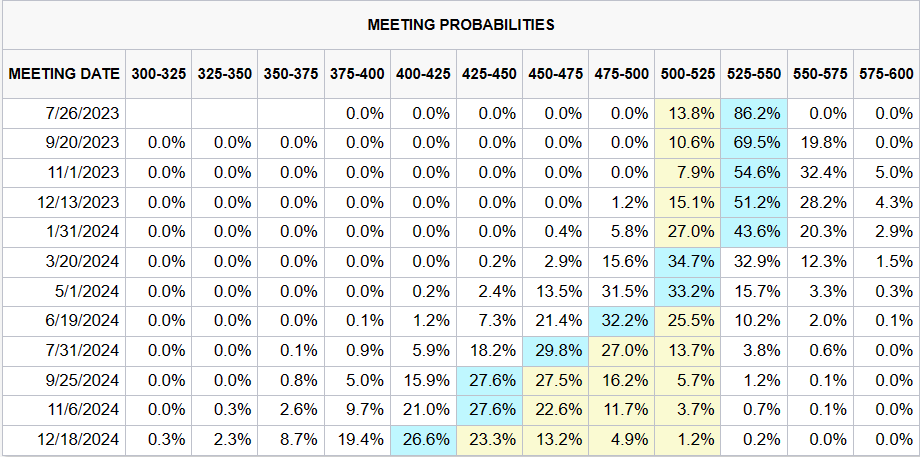
Technically, FTSE ST REIT Index is still trading within a Descending Triangle, which is a medium-term consolidation chart pattern. It is predicted the REIT index will be range bound for a while until the next breakout. The US Fed has kept the current interest rate at 5.25% as of June 13/14, however there is a 86% probability (currently) that the target rate will be hiked to 5.25-5.50%. It has also continued to show a potential peaking of the interest rate in 2023, with interest rates being cut in the future. Cutting interest rates will favor the real estate and REITs sector, with the largest target rate probability for the 13 December Fed meeting to be also 5.25-5.50%.
Based on the current overall S-REIT P/NAV of 0.79 and current average DPU yield of 8.93%, the Singapore REITs sector is extremely attractive and possibly has bottomed. 2H 2023 would be a cautiously bullish for S-REITs but investors have to be very selective with fundamentally strong S-REITs. This is due to the probable reversal of interest rates, which can be a positive catalyst for the real estate sector.
Note: This above analysis is for my own personal research and it is NOT a buy or sell recommendation. Investors who would like to leverage my extensive research and years of Singapore REIT investing experience can approach me separately for a REIT Portfolio Consultation.
Kenny Loh is a Wealth Advisory Director and REITs Specialist of Singapore’s top Independent Financial Advisor. He helps clients construct diversified portfolios consisting of different asset classes from REITs, Equities, Bonds, ETFs, Unit Trusts, Private Equity, Alternative Investments, Digital Assets and Fixed Maturity Funds to achieve an optimal risk adjusted return. Kenny is also a CERTIFIED FINANCIAL PLANNER, SGX Academy REIT Trainer, Certified IBF Trainer of Associate REIT Investment Advisor (ARIA) and also invited speaker of REITs Symposium and Invest Fair. You can join my Telegram channel #REITirement – SREIT Singapore REIT Market Update and Retirement related news. https://t.me/REITirement
Money and Me: Are S-REITs in for a promising 2H2023?
What does the recent US Fed’s interest rate decision and new economic projections mean for Singapore REITs? And are investors’ interests rotating from banks to the REITs sector? Dan Koh unravels these questions and more with Kenny Loh, REIT Specialist and Independent Financial Advisor. They also discuss the attractiveness of REITs today and some signs of a turnaround that investors should be watching closely.
Note: The above analysis are my own personal views and are NOT buy or sell recommendations. Investors who would like to leverage my extensive research and years of Singapore REIT investing experience can approach me separately for a REIT Portfolio Consultation.
Listen to his previous market outlook interviews here:
Kenny Loh is an Associate Wealth Advisory Director and REITs Specialist of Singapore’s top Independent Financial Advisor. He helps clients construct diversified portfolios consisting of different asset classes from REITs, Equities, Bonds, ETFs, Unit Trusts, Private Equity, Alternative Investments, Digital Assets and Fixed Maturity Funds to achieve an optimal risk adjusted return. Kenny is also a CERTIFIED FINANCIAL PLANNER, SGX Academy REIT Trainer, Certified IBF Trainer of Associate REIT Investment Advisor (ARIA) and also invited speaker of REITs Symposium and Invest Fair.