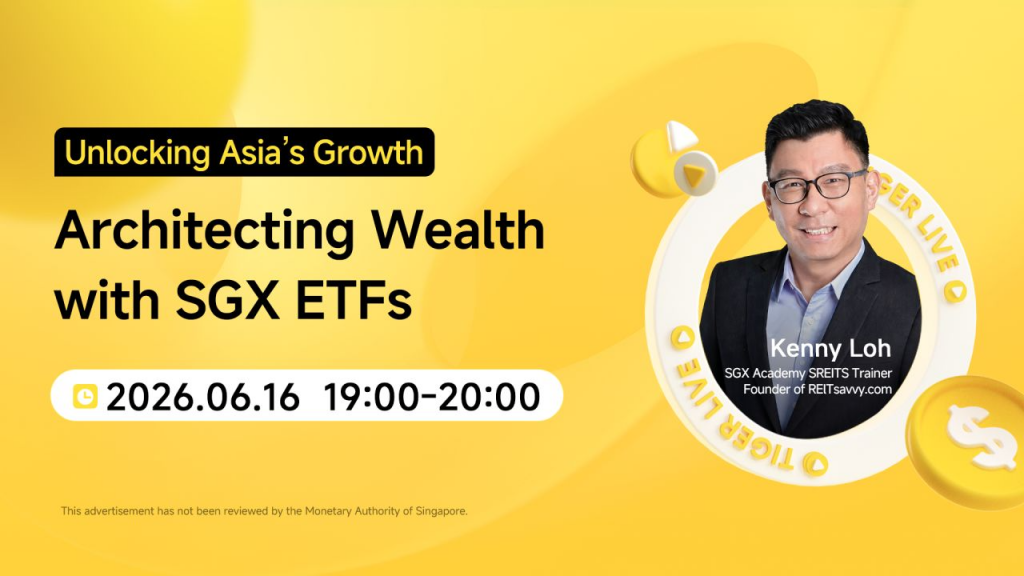
SGX ETF 26H2 Playbook — Building Asia Exposure with Growth, Yield & Discipline
🎯 3 Key Takeaways
- SGX ETFs are portfolio building blocks. Investors can use them to access local blue chips, regional tech, real estate, and defensive income exposure through one market.
- Allocation comes before product selection. Growth, yield, and balanced investors need different ETF mixes, not the same “one-size-fits-all” portfolio.
- Execution discipline matters. Limit orders and proper trading windows can help investors reduce slippage and improve price control.
🏛️ The 5 Strategic Pillars
| Pillar | Core Focus | |
| 1 | SGX ETF Universe | Local blue chips, regional tech, real estate, defensive assets |
| 2 | Asset Bucket Mapping | Understand what role each ETF plays |
| 3 | Portfolio Profiles | Growth Accelerator, Yield Fortress, All-Weather Engine |
| 4 | Trading Execution | Limit orders, slippage control, trading timing |
| 5 | Wealth Architecture | Build portfolios around objectives, not noise |
📊 SGX ETF Snapshot
Asset Buckets
SGX ETFs offer investors access to several key asset buckets. Local blue chips can serve as the Singapore market anchor, while regional tech provides exposure beyond Singapore. Real estate exposure includes CSOP iEdge S-REIT(SRT), and defensive or fixed income products can help support portfolio stability.
The takeaway: SGX ETFs are not just passive products sitting on a list. Each one should have a clear job inside the portfolio.
Portfolio Structure
Kenny introduced three portfolio profiles: Growth Accelerator, Yield Fortress, and All-Weather Engine.
- Growth Accelerator allocates 70% of total capital to stocks.
- Yield Fortress focuses more on income and stability.
- All-Weather Engine reflects a more balanced allocation mindset.
The key question is not “Which ETF looks interesting?”
The better question is: “What role should this ETF play in my portfolio?”
Execution
ETF investing may look simple, but execution still affects returns. Kenny highlighted limit orders as the preferred tool over market orders to avoid price slippage. He also emphasized trading during the underlying market’s normal trading hours.
🏭 Asset Bucket Rotation
| Asset Bucket | Signal | Action |
| Local Blue Chips | Singapore market anchor | Core domestic exposure |
| Regional Tech | Broader Asian growth | Growth satellite allocation |
| Real Estate | Includes $CSOP iEdge S-REIT(SRT)$ | Income and property-linked exposure |
| Defensive & Fixed Income | Stability bucket | Portfolio shock absorber |
The framework is straightforward:
Do not buy ETFs randomly. Assign every ETF a job.
A growth ETF should support growth.
An income ETF should support cash flow.
A defensive ETF should help cushion volatility.
A diversification ETF should reduce concentration risk.
Once each ETF has a role, portfolio construction becomes much cleaner.
🧱 ETF Deep Dive
Portfolio Role
Every ETF should answer one simple question: what does it add to the portfolio?
If the goal is growth, the allocation may lean more toward equity exposure. If the goal is income, real estate and defensive buckets become more relevant. If the goal is resilience, investors may need a broader mix across different asset categories.
This is where ETF investing becomes more strategic. The product is only one part of the decision. The bigger issue is whether the product fits the investor’s profile.
Trading Discipline
A strong ETF strategy can still suffer from weak execution.
Market orders may expose investors to unnecessary slippage, especially when liquidity is thinner or when the underlying market is less active. Limit orders provide better price control and help investors avoid paying more than intended.
Timing also matters. Because ETF pricing is connected to the activity of the underlying market, trading during the underlying market’s normal trading hours can support cleaner execution.
🎯 The Playbook
Growth Allocation
The Growth Accelerator allocates 70% of total capital to stocks. This profile is built for investors seeking higher growth exposure, but higher equity allocation also requires stronger risk discipline.
Growth investors should focus on whether the ETF exposure matches their long-term objective, not whether the theme sounds exciting in the moment.
Yield Allocation
Yield Fortress is built around income and stability. Real estate exposure, including CSOP iEdge S-REIT(SRT), belongs in this conversation because it connects ETF investing with property-linked income exposure.
For yield-focused investors, the goal is not just upside. The goal is repeatable portfolio cash flow with a structure that can withstand changing market conditions.
Balanced Allocation
The All-Weather Engine focuses on broader diversification. This profile is designed for investors who do not want their portfolio to depend on one single market theme.
Balanced investors should think across buckets: growth, income, defensive exposure, and fixed income. The aim is not to chase the hottest ETF, but to build a portfolio that can stay functional across different environments.
Execution Rules
- Use limit orders instead of market orders.
- Avoid careless trades during unstable windows.
- Trade during the underlying market’s normal trading hours.
- Do not let poor execution weaken a good ETF strategy.
⚠️ Risk Rules
- Don’t buy ETFs without knowing their portfolio role.
- Don’t confuse diversification with simply buying more products.
- Don’t use market orders when limit orders can reduce slippage risk.
- Don’t ignore the trading hours of the ETF’s underlying market.
- Don’t chase the product first. Build the portfolio framework first.
🧭 Final Takeaway
Kenny Loh’s SGX ETF framework is not about finding one perfect ETF.
It is about building a complete portfolio system.
Start with the asset bucket.
Match it with the right portfolio profile.
Then execute with discipline.
For investors looking to access Asia’s growth, SGX ETFs can be a practical gateway. But the edge is not just in the ETF itself.
The edge is in the structure.
Use ETFs as building blocks, not shortcuts.
Disclaimer: Investing carries risk. This is not financial advice. The above content should not be regarded as an offer, recommendation, or solicitation on acquiring or disposing of any financial products, any associated discussions, comments, or posts by author or other users should not be considered as such either. It is solely for general information purpose only, which does not consider your own investment objectives, financial situations or needs
Kenny Loh is a distinguished Wealth Advisory Director (RNF# LKK300389588 Representing Financial Alliance) with a specialization in holistic investment planning and estate management. He excels in assisting clients to grow their investment capital and establish passive income streams for retirement. Kenny also facilitates tax-efficient portfolio transfers to beneficiaries, ensuring tax-efficient capital appreciation through risk mitigation approaches and optimized wealth transfer through strategic asset structuring.
In addition to his advisory role, Kenny is an esteemed SGX Academy trainer specializing in S-REIT investing and regularly shares his insights on MoneyFM 89.3. He holds the titles of Certified Estate & Legacy Planning Consultant and CERTIFIED FINANCIAL PLANNER (CFP).
With over a decade of experience in holistic estate planning, Kenny employs a unique “3-in-1 Will, LPA, and Standby Trust” solution to address clients’ social considerations, legal obligations, emotional needs, and family harmony. He holds double master’s degrees in Business Administration and Electrical Engineering, and is an Associate Estate Planning Practitioner (AEPP), a designation jointly awarded by The Society of Will Writers & Estate Planning Practitioners (SWWEPP) of the United Kingdom and Estate Planning Practitioner Limited (EPPL), the accreditation body for Asia.
Arrange for a non-obligatory one-to-one free consultation here!
You can join his Telegram channel #REITirement – SREIT Singapore REIT Market Update and Retirement related news. https://t.me/REITirement
If you need any financial advice, please contact kennyloh@fapl.sg