SME Succession Planning: The 90-Day Danger Zone That Can Destroy Your Business

  • Post author:

As an SME owner, you’ve spent years—perhaps decades—building your business from the ground up. You’ve weathered market shifts, hiring challenges, and economic crashes. But there is one risk that most founders keep on the back burner, even though it’s the single biggest threat to their legacy: Business Succession Planning.

A recent article in The Business Times highlighted a sobering reality that I see far too often in my work as a legacy and estate planner: When a founder delays succession planning, the business doesn’t just stall—it bleeds value.

If you aren’t there tomorrow, what happens to your business in the first 90 days? That window usually decides whether your company survives for the next generation or becomes a cautionary tale.

The 5 Immediate Risks of “Waiting Until Later”

When a founder passes away or becomes incapacitated without a structured plan, five things tend to happen simultaneously, creating a “perfect storm” for the business:

  • The Cashflow Freeze: Shares and personal assets often get locked in probate for months. While your accounts are frozen, your obligations aren’t. Payroll, suppliers, and bank loans remain due. Many businesses simply don’t have the liquidity to survive this window.
  • Operational Legal Limbo: Without a clear successor or legal authority, the “engine room” stops. Bank mandates stall, new contracts can’t be signed, and existing clients may hesitate to renew, fearing the business is unstable.
  • Internal Disputes: In the absence of a written roadmap, even the most tight-knit families and business partners can fall into conflict. When no one knows the “right” way forward, decision-making becomes paralyzed.
  • Forced Sales and Control Loss: If surviving partners want to keep the business but can’t afford to buy out your deceased estate’s stake, they may be forced to bring in external buyers. This leads to “value leakage” and a loss of the original vision.
  • The Fire Sale: Without trusts or structured liquidity, a lifetime of work is often liquidated at a fraction of its true worth just to cover taxes or immediate debts.

How We Replace Chaos with Structure

My role as a Business Succession and Legacy Planner is to ensure that your business is an “evergreen” asset—one that can thrive independently of your day-to-day presence. We achieve this by addressing each risk factor with a concrete, legal, and financial solution.

To combat Asset Freezes, we establish immediate liquidity strategies—often through specialized insurance or business trusts—to ensure payroll and bills are met from Day 1. To solve Legal Limbo, we create clear governance frameworks and Power of Attorney structures so authority is transferred instantly and legally, keeping operations seamless.

When it comes to Partner Conflict, I facilitate and draft funded Buy-Sell Agreements. This ensures surviving partners have the immediate cash to buy out shares at a fair, pre-agreed price, preventing messy disputes. Finally, to prevent Legacy Erosion, we use trusts and estate structuring to ensure your family is provided for financially without the business needing to be dismantled or sold off to pay them out.


Preliminary Succession Risk Assessment

Are you prepared? Take a moment to answer these four questions honestly. If you answer “No” or “I’m not sure” to any of them, your business is currently at risk.

  1. Liquidity: If you passed away tomorrow, does the business have a dedicated source of cash (separate from frozen bank accounts) to pay staff and suppliers for at least 3 to 6 months?
  2. Authority: Is there a legal document currently in place that grants a specific person the immediate right to sign contracts and manage bank accounts in your absence?
  3. The Buy-Out: If you have business partners, is there a legally binding agreement—and a dedicated fund—to buy out your shares so your family gets the cash and the partners keep the business?
  4. Family Harmony: Have you sat down with your heirs and partners to document exactly who will lead and who will own the shares, or is it “assumed” everyone will just figure it out?

Secure Your Legacy Today

Business succession planning isn’t about “leaving” your business; it’s about strengthening it. It’s about ensuring that the values, culture, and financial success you’ve built can endure for decades to come.

Don’t leave your life’s work to chance or the slow grind of the probate courts. I specialize in helping SME owners navigate these complex emotional and financial waters to create a bulletproof estate and succession strategy.

Important: The information and opinions in this article are for general information purposes only. They should not be relied on as professional financial advice. Readers should seek unbiased financial advice that is customised to their specific financial objectives, situations & needs. This advertisement or publication has not been reviewed by the Monetary Authority of Singapore.

Kenny Loh is a distinguished Wealth Advisory Director with a specialization in holistic investment planning and estate management. He excels in assisting clients to grow their investment capital and establish passive income streams for retirement. Kenny also facilitates tax-efficient portfolio transfers to beneficiaries, ensuring tax-efficient capital appreciation through risk mitigation approaches and optimized wealth transfer through strategic asset structuring.

In addition to his advisory role, Kenny is an esteemed SGX Academy trainer specializing in S-REIT investing and regularly shares his insights on MoneyFM 89.3. He holds the titles of Certified Estate & Legacy Planning Consultant and CERTIFIED FINANCIAL PLANNER (CFP).

With over a decade of experience in holistic estate planning, Kenny employs a unique “3-in-1 Will, LPA, and Standby Trust” solution to address clients’ social considerations, legal obligations, emotional needs, and family harmony. He holds double master’s degrees in Business Administration and Electrical Engineering, and is an Associate Estate Planning Practitioner (AEPP), a designation jointly awarded by The Society of Will Writers & Estate Planning Practitioners (SWWEPP) of the United Kingdom and Estate Planning Practitioner Limited (EPPL), the accreditation body for Asia.

If you need any financial advice, please contact kennyloh@fapl.sg

罗国强(Kenny Loh) 是一位杰出的财富咨询总监,专长于综合投资规划与遗产管理。他擅长协助客户实现投资资本增值,并建立退休被动收入来源。同时,他通过税务优化的方式帮助客户将投资组合高效转移给受益人,运用风险缓释策略确保资本增值的税务效率,并通过战略性资产配置实现财富传承的最优化。

除咨询工作外,罗国强是新加坡交易所学院(SGX Academy)的特聘讲师,专注于新加坡房地产投资信托(S-REIT)投资领域,并定期在MoneyFM 89.3电台分享专业见解。他拥有认证遗产与传承规划顾问(Certified Estate & Legacy Planning Consultant)及国际认证财务规划师(CFP)资格。

在逾十年的综合遗产规划经验中,他独创“遗嘱、持久授权书与备用信托三合一”解决方案,兼顾客户的社会责任、法律义务、情感需求及家庭和谐。他持有工商管理硕士与电气工程硕士双学位,并获英国遗嘱撰写及遗产规划从业者协会(SWWEPP)与亚洲认证机构遗产规划从业者有限公司(EPPL)联合授予副遗产规划从业师(AEPP)专业资格。

Arrange for a non-obligatory one-to-one free consultation here!

立即预约免费一对一咨询(无需承担任何义务)!

Continue ReadingSME Succession Planning: The 90-Day Danger Zone That Can Destroy Your Business

Singapore REITs 2026 Market Outlook

  • Post author:

(1) Review of 2025 Singapore REITs Performance (The Wrap-Up)

Key Takeaway: A Strong Rebound driven by rate stabilization and the start of SORA decline.

  • Overall Performance: 2025 is shaping up to be the best year for S-REITs since 2019, with total returns (price gain + dividend) projected to be around 12-15% YTD (as of Dec 2025). This marks a significant rebound from the challenging high-rate environment of 2023/2024.

  • Driver: The primary catalyst has been the stabilisation and decline of borrowing costs. The 3-month Compounded SORA in Singapore has trended down (e.g., from a peak near 4.5% to around $1.28% by late 2025), significantly easing the refinancing burden.

  • Fundamental Stability: Most S-REITs demonstrated stable operating performance in 2025, with resilient occupancy rates and positive rental reversions across Retail, Industrial, and Office sectors.
  • Valuation: Despite the price recovery, the sector is generally still trading at an attractive valuation, with the average P/NAV (Price-to-Net Asset Value) around 0.85 (simple average) and a trailing 12-month yield around 5.5%.

(2) Projected US and Singapore Interest Rates

Key Takeaway: The “Lower-for-Longer” narrative is shifting to a rate-cutting cycle, providing a strong tailwind for 2026.

Rate Benchmark2025 Year-End Estimate2026 Outlook (Consensus)Impact on S-REITs
US Fed Funds Rate3.50% – 3.75% (Following cuts in late 2025)Further cuts expected in H1 2026, reaching a terminal rate potentially in the 3.00% – 3.25% range end of 2026.Drives global capital flows and sentiment. Lower US rates support global growth and ease the cost of capital for S-REITs with US/overseas assets.
Singapore Interest Rate (SORA)1.25% – 1.50% (3-months)Expected to remain low and stable or track further down as US rates ease and global liquidity improves.Directly lowers the cost of debt for S-REITs, which directly translates to DPU savings. Will benefit S-REITs with borrowing in SGD.

(3) How the Interest Rate Shift Will Affect REIT DPU and Valuation

Key Takeaway: Lower rates are the most significant positive catalyst for DPU and valuation compression in 2026.

  • Direct Impact on DPU (Distribution Per Unit):
    • Lower SORA/cost of debt directly reduces interest expense for REITs with floating-rate debt or upcoming refinancing. This saving is immediately accretive to Distributable Income and, thus, DPU.
    • Analysts have noted that even a 25-50 basis point decline in debt cost can visibly improve DPU for REITs with shorter debt maturity profiles.
    • Unlikely for all the REITs to benefit fully from the interest rate cut as majority of the REITs have extend the debt maturity profile with higher fixed rate previously. Only REITs with shorter WADM (Weighted Debt Maturity Profile) and low percentage of fixed rate will benefit the most.
  • Indirect Impact on Valuation (NAV):
    • Yield Compression: As bond yields fall, the required yield on S-REITs becomes less competitive. Investors shift from lower-risk bonds to REITs for yield, driving up REIT prices. This narrows the Yield Spread (REIT Yield minus Government Bond Yield).
    • Capitalisation Rates: Lower borrowing costs are expected to lead to a compression of cap rates in the private real estate market, driving up the valuation of the physical properties (Net Asset Value – NAV), especially for prime assets. This will support the REIT’s share price and P/NAV ratio.
  • Historical Parallel: Historically, REITs have often performed strongly in the 12 months following the commencement of an easing cycle, as lower rates enhance their appeal as an income-generating asset.

(4) Key Financial Ratios for REIT Selection in 2026

Given the shift in the interest rate cycle, investors should focus on ratios that signal stability and capacity for growth.

RatioRationale for 2026 SelectionCurrent MAS Guideline/Target
Gearing Ratio (Aggregate Leverage)Indicates debt capacity for accretive acquisitions. Lower is safer in a volatile market.<50% (Regulatory Limit)
Interest Coverage Ratio (ICR)Measures the ability to service interest payments from earnings. Must be high enough to satisfy MAS requirements if gearing is close to the limit.>1.5x (New MAS threshold)
Weighted Average Lease Expiry (WALE)Predictability of income stream. Longer WALE (e.g., >3.5$ years) signals stable cash flow, favoured in a transition period.N/A
Price-to-NAV (P/NAV)Valuation metric. REITs trading at a significant discount (P/NAV < 1.0) with strong fundamentals may offer the greatest capital upside as valuations recover. However, some REITS always traded at premium or discount. Thus, it is important to compare the current P/NAV with the historical P/NAV range.N/A
Distribution Yield SpreadMeasures REIT yield relative to the Singapore 10Y Government Bond. Wider spread suggests better value proposition compared to risk-free assets.N/A

REITs ranked by the highest WALE (Source: REITsavvy.com)

REITs ranked by the highest Interest Coverage Ratio (Source: REITsavvy)

Expect Improvement in Gearing (decreased) and ICR (increase) for S-REITs in 2026 (Source: REITSavvy Overview)

(5) Sector Outlook

Key Takeaway: Industrial (Data Centre/Logistics) and Suburban Retail are positioned for continued strength, while Hospitality sees growth from tourism.

SectorOutlook for 2026Key Drivers / Headwinds
Industrial (Logistics/Data Centre)Strongest Outlook. Structural growth and positive rental reversions.Driven by e-commerce, AI adoption, and resilient demand for logistics. Data Centres are favoured for long-duration leases and secular growth.
Retail (Suburban)Resilient. Positive rental reversions and strong footfall.Supported by necessity spending, resilient domestic consumption, and limited new supply.
OfficeStable but Divergent. Prime CBD assets in Singapore remain resilient. US Commercial Office may see bottom and rebound with lower interest rate.Flight to quality: High occupancy for modern, premium assets in core areas. Pressure on older, non-core assets. May see re-rating of the valuation of US commercial office. Probable resumption of dividend for US Office REITs.
HospitalityGrowth Recovery. Benefits from continued post-pandemic tourism boom.Strong RevPAR (Revenue Per Available Room) growth driven by recovering international visitor arrivals.
HealthcareDefensive/Stable. Long-term leases with rent escalations provide DPU stability.Driven by aging demographics and defensive nature of the assets. Lower yields reflect lower risk profile.

(6) Wrap Up: Summary of Outlook 2026

  • The Pivot Year: 2026 is expected to be a pivotal recovery year for S-REITs, transitioning from a survival phase to a growth phase, primarily driven by a more accommodative lower interest rate environment.
  • DPU Inflection: We expect DPU growth to inflect upwards for the sector as lower interest expenses translate directly to distributable income.
  • The New Mantra: Investors should focus on Quality, Balance Sheet Strength, and Sector Exposure to secular growth trends (Data Centres, Logistics, Suburban Retail).
  • Actionable Strategy: S-REITs are poised to be an attractive income play, with a potential to deliver both stable yield and capital appreciation as market valuations converge with private asset values.

Kenny Loh is a distinguished Wealth Advisory Director with a specialization in holistic investment planning and estate management. He excels in assisting clients to grow their investment capital and establish passive income streams for retirement. Kenny also facilitates tax-efficient portfolio transfers to beneficiaries, ensuring tax-efficient capital appreciation through risk mitigation approaches and optimized wealth transfer through strategic asset structuring.

In addition to his advisory role, Kenny is an esteemed SGX Academy trainer specializing in S-REIT investing and regularly shares his insights on MoneyFM 89.3. He holds the titles of Certified Estate & Legacy Planning Consultant and CERTIFIED FINANCIAL PLANNER (CFP).

With over a decade of experience in holistic estate planning, Kenny employs a unique “3-in-1 Will, LPA, and Standby Trust” solution to address clients’ social considerations, legal obligations, emotional needs, and family harmony. He holds double master’s degrees in Business Administration and Electrical Engineering, and is an Associate Estate Planning Practitioner (AEPP), a designation jointly awarded by The Society of Will Writers & Estate Planning Practitioners (SWWEPP) of the United Kingdom and Estate Planning Practitioner Limited (EPPL), the accreditation body for Asia.

You can join his Telegram channel #REITirement – SREIT Singapore REIT Market Update and Retirement related news. https://t.me/REITirement

Continue ReadingSingapore REITs 2026 Market Outlook

Singapore REITs Monthly Update (January 12th, 2026)

  • Post author:

Technical Analysis of FTSE ST REIT Index (FSTAS351020)

FTSE ST Real Estate Investment Trusts (FTSE ST REIT Index) increased from 698.76 to 721.34 (3.23%) compared to two month’s ago update. Over this period, the REIT Index has remained in a short-term uptrend, rebounding strongly from the key support zone around 694–696, which has held on multiple pullbacks.

The index is currently trading above its 20-day and 50-day moving averages, indicating improving short-term momentum, while the 200-day moving average near 676 continues to slope upward, confirming a medium-term bullish structure. Recent price action shows a series of higher lows, suggesting accumulation and strengthening buying interest.

On the upside, the index is approaching a major resistance zone around 729–731, which has capped gains on several occasions (January 2024, September 2024, and recently). A decisive breakout above 731 could open the door for a move towards 740–750, levels last seen in mid-2023. On the downside, immediate support is seen around 706–708 (50-day moving average), followed by stronger support at 694–696. A break below 694 would weaken the current bullish setup and may signal a deeper pullback towards the 200-day moving average.

Overall, the index remains constructively bullish, but a confirmed breakout above the 731 resistance level is needed to validate further upside, while failure at this level could result in continued consolidation.

  • Short-term direction: Up
  • Medium-term direction: Sideways
  • Long-term direction: Up
  • Immediate Support: 20D SMA (707)
  • Immediate Resistance: 729 (line)

FTSE REIT Index Chart (2 years)

Previous chart on FTSE ST REIT index can be found in the last post: Singapore REIT Fundamental Comparison Table on November 23rd, 2025.

Fundamental Analysis of 39 Singapore REITs

The following is the compilation of 39 Singapore REITs with colour-coding of the Distribution Yield, Gearing Ratio and Price to NAV Ratio.

  • The Financial Ratios are based on past data and these are lagging indicators.
  • All REITs have the latest Q3 2025 values, except Centurion Accommodation REIT where their values are based on their IPO Prospectuses.
  • I have introduced weighted average (weighted by market cap) to the financial ratios, in addition to the existing simple average ratios. This is another perspective where smaller market cap REITs do not disproportionately affect the average ratios. As of May 2025, I have removed EC World REIT from these calculations.
  • I have included Centurion Accommodation REIT in this latest update, using values from the IPO Prospectus.

Data from REITsavvy Screener. https://screener.reitsavvy.com/

What does each Column mean?

  • FY DPU: If Green, FY DPU for the recent 4 Quarters is higher than that of the preceding 4 Quarters. If Lower, it is Red.
  • Yield (ttm): Yield, calculated by DPU (trailing twelve months) and Current Price as of January 18th, 2026.
  • Gearing (%): Leverage Ratio.
  • Price/NAV: Price to Book Value. Formula: Current Price over Net Asset Value per Unit.
  • Yield Spread (%): REIT yield (ttm) reference to Gov Bond Yields. REITs are referenced to SG Gov Bond Yield.

As of May 2024, all REITs’ Yield Spread will be referenced to SG Gov Bond Yields, regardless of trading currency.

Price/NAV Ratios Overview

  • Price/NAV increased to 0.86 (Weighted Average: 1.02)
    • Increased from 0.83 from November 2025 (Weighted Average was 0.99)
    • Singapore Overall REIT sector is slightly undervalued (or at fair value if weighted)
  • Most overvalued REITs (based on Price/NAV)
    ParkwayLife REIT 1.73
    Keppel DC REIT 1.41
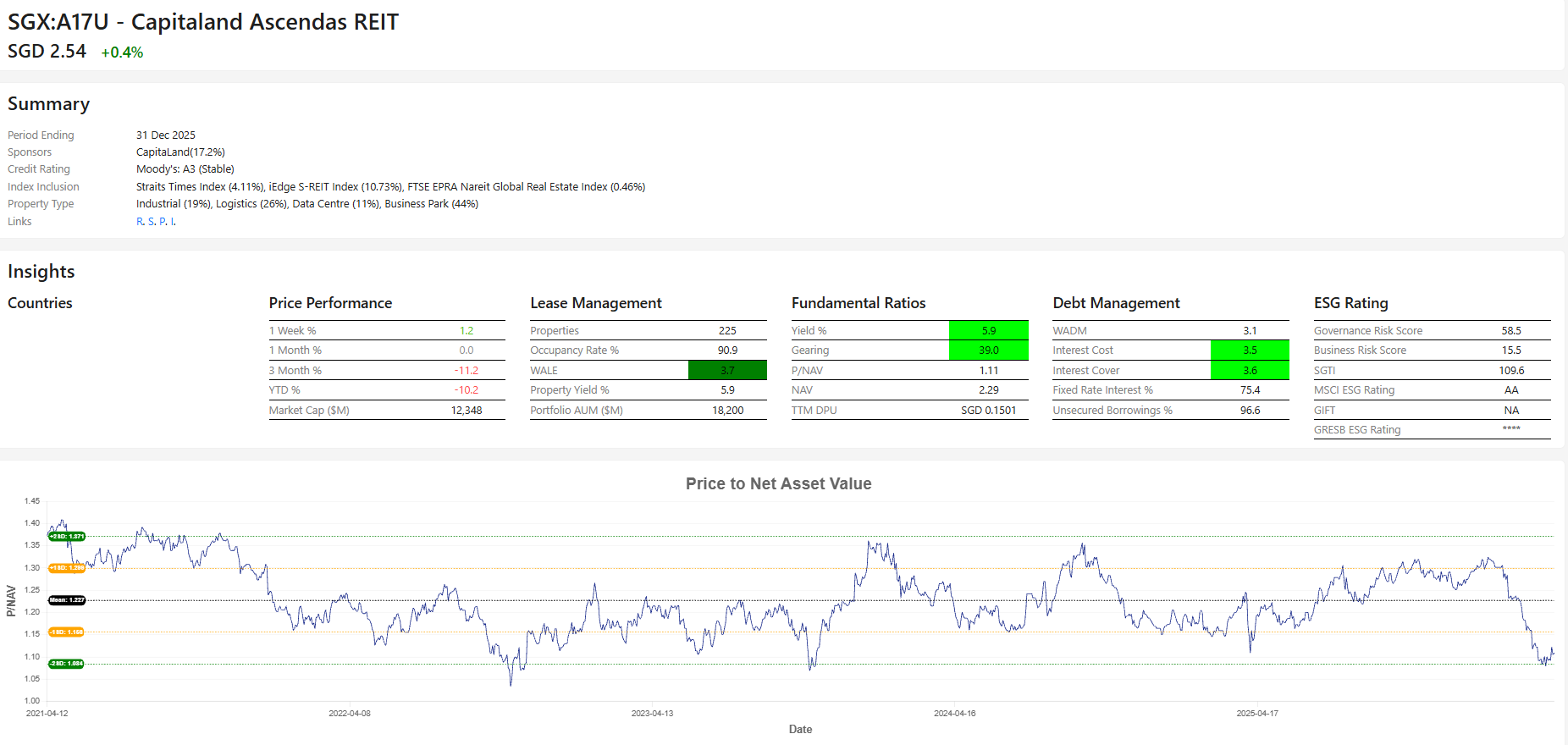
    Capitaland Ascendas REIT 1.30
    AIMS APAC REIT 1.25
    Mapletree Industrial Tr 1.24
    Capitaland Integrated Commercial Trust 1.13

    EC World REIT is currently suspended and has a N.M P/NAV value.

  • Most undervalued REITs (based on Price/NAV)
    Lippo Malls Indonesia Retail Trust 0.19
    Keppel Pacific Oak US REIT 0.33
    Manulife US REIT 0.33
    Acrophyte Hospitality Trust 0.38
    Prime US REIT 0.40
    CDL Hospitality Trust 0.59

Distribution Yields Overview

  • TTM Distribution Yield decreased to 5.41%. (Weighted Average increased to 5.17%)
    • Decreased from 5.58% in November 2025. (Weighted Average was 5.32%)
    • 10 of 39 Singapore REITs have ttm distribution yields of above 7%.
  • Highest Distribution Yield REITs (ttm)
    Sasseur REIT 8.80
    Elite UK REIT 8.36
    IREIT Global 8.27
    Daiwa House Logistics Trust 8.18
    First REIT 7.96
    United Hampshire REIT 7.96

    Reminder that these yield numbers are based on current prices.

    • Some REITs opted for semi-annual reporting and thus no quarterly DPU was announced.
    • A High Yield should not be the sole ratio to look for when choosing a REIT to invest in.
  • Yield Spread decreased to 3.42%. (Weighted Average is 3.86%)
    • Decreased from 3.77% in November 2025. (Weighted Average was 3.86%)
    • From May 2024 onwards, all my yield spread measurements are now in relation to SG Gov Bond Yields, no longer a mix with US Gov Bond Yields.

Gearing Ratios Overview

  • Gearing Ratio remained at 39.99%. (Weighted Average: 37.61%)
    • Remained at 39.99% in November 2025. (Weighted Average: 37.54%)
    • Gearing Ratios are updated quarterly. Therefore, no values changed and all values are based on the most recent Q2 2025 updates.
    • S-REITs Gearing Ratio has been on a steady uptrend. It was 35.55% in Q4 2019.
  • Highest Gearing Ratio REITs
    EC World REIT 71.1
    Manulife US REIT 56.2
    Prime US REIT 46.6
    Lippo Malls Indonesia Retail Trust 43.3
    ESR REIT 43.3
    Keppel Pacific Oak US REIT 43.1

    MUST and EC World REIT’s gearing ratio has exceeded MAS’s gearing limit of 50%. However, the aggregate leverage limit is not considered to be breached if exceeding the limit is due to circumstances beyond the control of the REIT Manager.

Market Capitalisation Overview

  • Total Singapore REIT Market Capitalisation increased by 2.84% to S$101.07 Billion.
    • Increased from S$98.28 Billion in November 2025.
  • Biggest Market Capitalisation REITs (S$m):
    Capitaland Integrated Commercial Trust 17634.45
    Capitaland Ascendas REIT 13127.10
    Mapletree Pan Asia Commercial Trust 7701.21
    Mapletree Logistics Tr 6876.90
    Mapletree Industrial Tr 5962.77
    Keppel DC REIT 4903.98
  • Smallest Market Capitalisation REITs (S$m):
    Lippo Malls Indonesia Retail Trust 76.97
    Manulife US REIT 165.34
    Acrophyte Hospitality Trust 194.13
    EC World REIT 226.74
    BHG Retail REIT 249.41
    Keppel Pacific Oak US REIT 309.19

Disclaimer: The above table is best used for “screening and shortlisting only”. It is NOT for investing (Buy / Sell) decision. If you want to know more about investing in REITs, scroll down for more information on the REITs courses.

Top 20 Best/Worst Performers of December 2025

SG 10 Year Government Bond Yield

  • SG 10 Year: 2.20% (increased from 2.02%)

Summary

The Singapore REIT sector has extended its recovery, with the FTSE ST All-Share REIT Index rising from 698.76 to 721.34 (+3.23%) over the past two months. The index continues to trade within a higher range of 695–730, supported by higher lows and improving momentum. Prices remain above the 20-day and 50-day moving averages, while the rising 200-day moving average suggests medium-term stabilisation. Resistance at 729–731 remains key, with 695–700 acting as critical downside support.

On the macro front, interest rates have stabilised at supportive levels. The US 10-year Treasury yield is consolidating around 4.1–4.2%, while the Singapore 10-year yield has eased to approximately 2.2%. Although the pace of yield decline has slowed, the lack of renewed upside pressure continues to support REIT valuations and income demand.

Valuations remain attractive, with many REITs still trading below NAV, particularly within industrial, retail, and selected hospitality segments. Sector yields in the mid-5% to 6% range continue to offer a reasonable premium over risk-free rates. Yield spreads have tightened modestly as prices recovered, but remain supportive on a historical basis.

US 10 Year Risk Free Rate

According to CME FedWatch, markets continue to price in a gradual easing cycle from late 2026, rather than near-term aggressive cuts. While immediate financing relief is limited, downside rate risk appears contained. REITs with shorter debt maturities and higher floating-rate exposure are likely to benefit earlier, with more visible DPU improvements expected into 2026–2027.

Overall, the Singapore REIT sector remains in an early recovery phase, supported by improving technicals, reasonable valuations, and a stabilising rate environment. Near-term performance is likely to be driven by stock selection, with quality large-cap REITs attracting flows, while selective value opportunities persist among mid- and small-cap names.

Kenny Loh is a distinguished Wealth Advisory Director with a specialization in holistic investment planning and estate management. He excels in assisting clients to grow their investment capital and establish passive income streams for retirement. Kenny also facilitates tax-efficient portfolio transfers to beneficiaries, ensuring tax-efficient capital appreciation through risk mitigation approaches and optimized wealth transfer through strategic asset structuring.

In addition to his advisory role, Kenny is an esteemed SGX Academy trainer specializing in S-REIT investing and regularly shares his insights on MoneyFM 89.3. He holds the titles of Certified Estate & Legacy Planning Consultant and CERTIFIED FINANCIAL PLANNER (CFP).

With over a decade of experience in holistic estate planning, Kenny employs a unique “3-in-1 Will, LPA, and Standby Trust” solution to address clients’ social considerations, legal obligations, emotional needs, and family harmony. He holds double master’s degrees in Business Administration and Electrical Engineering, and is an Associate Estate Planning Practitioner (AEPP), a designation jointly awarded by The Society of Will Writers & Estate Planning Practitioners (SWWEPP) of the United Kingdom and Estate Planning Practitioner Limited (EPPL), the accreditation body for Asia.

You can join his Telegram channel #REITirement – SREIT Singapore REIT Market Update and Retirement related news. https://t.me/REITirement

Continue ReadingSingapore REITs Monthly Update (January 12th, 2026)