
PART 3: WHAT THE REIT RESULTS REVEAL
Q9. Why might higher rents on renewed leases fail to produce bigger payouts for REIT investors?
| LIVE SOUNDBITE: “Headline rental reversion only applies to the slice of leases expiring that year—and higher interest bills, overseas vacancies, and FX losses can easily eat up the gains.” |
- Portfolio Rollover Math: A REIT typically renews only 15% to 25% of its leases annually. A +10% reversion on one-fifth of the portfolio only lifts total gross revenue by roughly 2% in year one.
- Refinancing Lag: Loans hedged at 1% to 2% several years ago are still rolling onto higher market rates in certain foreign currencies, absorbing the incremental rental income.
- Overseas & Currency Drag: Strong Singapore operational gains are frequently offset by higher vacancies in US, European, or Australian properties, or weaker foreign currencies translating back into a strong Singapore dollar.
Q10. Could you use two S-REITs to show how you assess their payouts, risks and current prices?
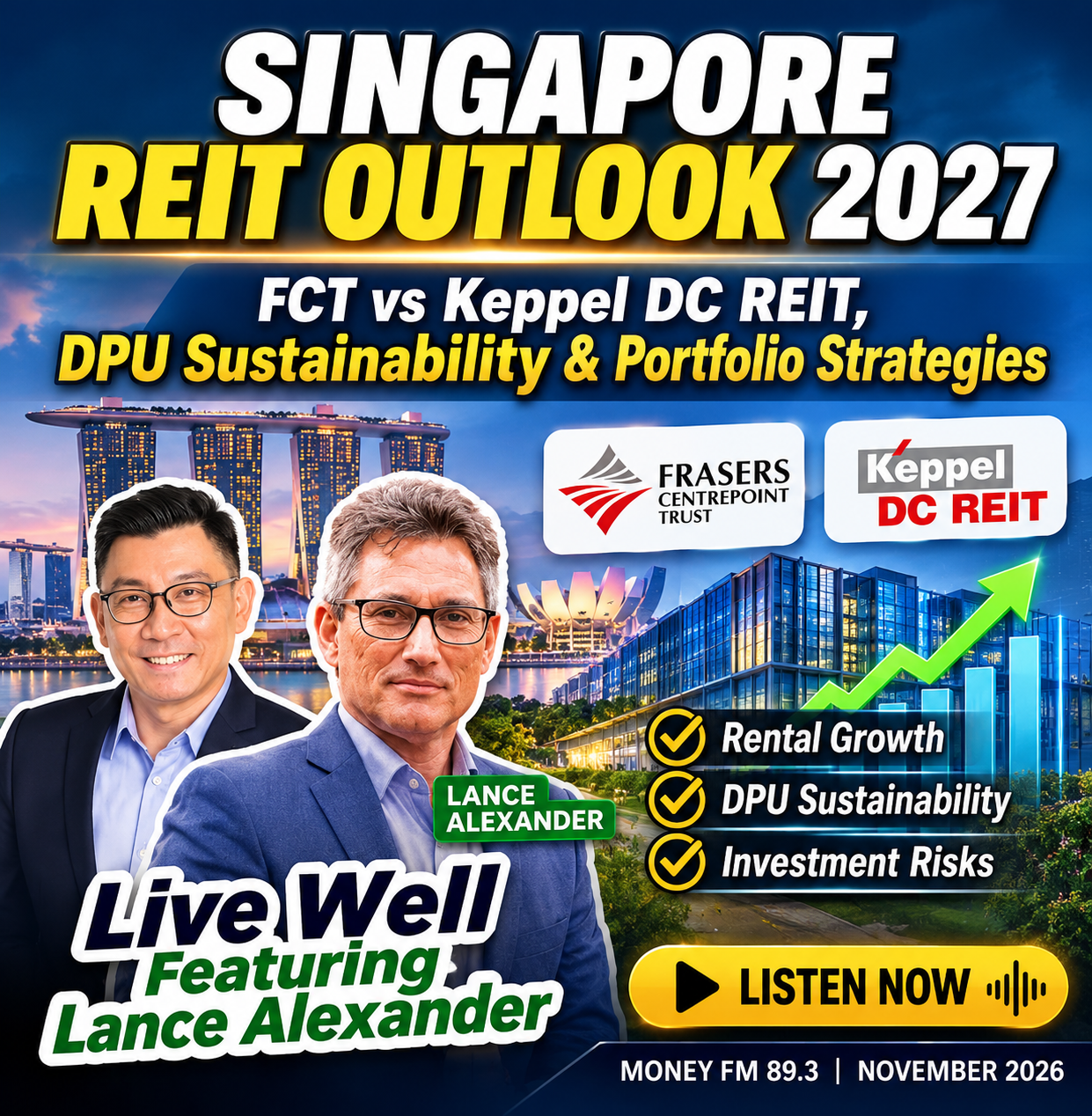
| LIVE SOUNDBITE: “Compare Frasers Centrepoint Trust (FCT) as a defensive domestic income play against Keppel DC REIT as a growth-oriented AI infrastructure play.” |
- Frasers Centrepoint Trust (FCT) — Defensive Income: At around S$2.12, FCT offers a ~5.8% yield backed by record FY2026 DPU (12.35 cents) and near-100% occupancy across dominant suburban malls like NEX and Causeway Point. Its risk is low—pure Singapore exposure, essential retail spending, and falling SGD debt costs.
- Keppel DC REIT — Growth & AI Tailwinds: Trading around S$2.14 at a lower ~4.7% yield, investors pay a tighter yield because 9M 2026 DPU surged 11.7% on Singapore AI demand and Tokyo data centre acquisitions, backed by a strong 6.5x interest coverage ratio. Here, you trade upfront yield for stronger DPU growth potential.
Q11. What risks could outweigh the reasons for investing in S-REITs now?
| LIVE SOUNDBITE: “The biggest threats are a resurgence in global inflation that stalls rate cuts, dilutive equity fundraising, and structural weakness in overseas commercial properties.” |
- Sticky Inflation & Delayed Rate Cuts: If tariffs or fiscal deficits reignite US inflation and force bond yields back up, the S-REIT recovery thesis gets pushed out again.
- Dilutive Fundraising Overhang: REITs with gearing above 42–43% may be forced to issue new units at steep discounts to pay down debt or fund acquisitions, diluting existing unitholders.
- Structural Overseas Asset Impairment: Hybrid work trends in Western offices and soft consumer spending in China/Hong Kong continue to weigh on valuations and occupancy for regionally diversified REITs.
PART 4: WHAT RETAIL INVESTORS SHOULD CONSIDER
Q12. How should investors decide whether to keep their current mix of investments or make changes?
| LIVE SOUNDBITE: “Start with your cash flow needs and portfolio concentration—rebalance out of winners that have grown oversized, rather than chasing yesterday’s top performer.” |
- Check Drift & Concentration: Because Singapore banks and AI stocks rallied strongly over the past two years, they may now make up a much larger percentage of your portfolio than you originally intended. Trimming gains to redeploy into lagging S-REITs locks in profits.
- Align with Your Income Timeline: If you are nearing retirement and need reliable passive income now that 6-month T-bill yields have dropped below 3%, shifting gradually into quality 5.5%–6% yielding S-REITs makes practical sense.
- Stage Your Entries: Avoid going all-in on a single day; use dollar-cost averaging over 3 to 6 months to navigate macro volatility.
Q13. How much weight should retail investors give institutional buying when making their own decisions?
| LIVE SOUNDBITE: “Treat institutional flows as a barometer of market sentiment and liquidity, not a blind buy signal.” |
- Different Mandates & Time Horizons: Institutions rebalance monthly or quarterly to track benchmarks, manage fund redemptions, or hedge macro risk—their goals are very different from a retail investor building a 10-year retirement income portfolio.
- Confirmation Tool Only: Institutional inflows validate that a sector has liquidity and re-rating momentum, which helps prevent you from catching a falling knife. Always verify the REIT’s fundamentals—gearing, ICR, and DPU sustainability—before committing your own capital.
Q14. What developments in banks, AI stocks and REITs will you be watching next?
| LIVE SOUNDBITE: “Three things: bank margin guidance for 2027, Big Tech AI capex budgets, and whether S-REITs can translate lower SORA rates into broad-based DPU growth.” |
- Banks: Management guidance on 2027 Net Interest Margins, wealth fee momentum, and whether special dividends or share buybacks will be extended.
- AI Stocks: Upcoming hyperscaler capital expenditure forecasts and supply-chain order books to see if AI infrastructure spending remains durable.
- S-REITs: Full-year 2026 distribution announcements, average cost of debt trajectories as SORA settles lower, and whether acquisitions become DPU-accretive again.
Read Part 1: Singapore REIT Outlook 2027 https://mystocksinvesting.com/singapore-reits/singapore-reits-market-outlook/money-and-me-banks-nvidia-ai-stocks-s-reits-time-to-rethink-your-portfolio/
Kenny Loh is a distinguished Wealth Advisory Director with a specialisation in holistic investment planning and estate management. He excels in assisting clients to grow their investment capital and establish passive income streams for retirement. Kenny also facilitates tax-efficient portfolio transfers to beneficiaries, ensuring capital appreciation through risk mitigation approaches and optimised wealth transfer through strategic asset structuring.
In addition to his advisory role, Kenny is an esteemed SGX Academy trainer specializing in S-REIT investing and regularly shares his insights on MoneyFM 89.3. He holds the titles of Certified Estate & Legacy Planning Consultant and CERTIFIED FINANCIAL PLANNER (CFP).
With over a decade of experience in holistic estate planning, Kenny employs a unique “3-in-1 Will, LPA, and Standby Trust” solution to address clients’ social considerations, legal obligations, emotional needs, and family harmony. He holds double master’s degrees in Business Administration and Electrical Engineering, and is an Associate Estate Planning Practitioner (AEPP), a designation jointly awarded by The Society of Will Writers & Estate Planning Practitioners (SWWEPP) of the United Kingdom and Estate Planning Practitioner Limited (EPPL), the accreditation body for Asia.
For enquiries email: kennyloh@fapl.sg
You can join his Telegram channel #REITirement – SREIT Singapore REIT Market Update and Retirement related news. https://t.me/REITirement
2026
- Money and Me: Singapore Banks vs AI Stocks vs S-REITs (Nov 2026)
- Money and Me: S-REITs after the sell-off – bargains or yield traps? (Oct 2026)
Money and Me: S-REITs: Buying Opportunity, Value Trap or Time to Move On? (Sept 2026) - Money and Me: Investors calling for better Forward Guidance (Aug 2026)
- Money and Me:Which Billion-Dollar REIT Bets Will Pay Off? (July 2026)
- Money and Me: Should you use your CPF to buy a newly included REIT? (June 2026)
- Money and Me: REIT Opportunity & the Mid-Cap Alpha Hunt (April 2026)
- Money and Me: Is Headline DPU Hiding the Truth About Your REIT? (March 2026)
2025
- Money and Me: Are S-REITs Still Worth the Climb? (October 2025)
- Money and Me: S-REITs vs Banks – Is It Time to Rotate? (August 2025)
- Money and Me: Are S-REITs Still Worth the Risk in 2025? (July 2025)
- Money and Me: REITs Among Upcoming IPO’s and what you need to know (June 2025)
- Money and Me: S-REITs Bounce Back? China’s REIT Game-Changer and the hunt for yield of up to 8% (May 2025)
- Money and Me: How are S-REIT’s doing amidst the Tariffs Turnaround? (April 2025)
- 𝗠𝗼𝗻𝗲𝘆 𝗮𝗻𝗱 𝗠𝗲: 𝗦-𝗥𝗘𝗜𝗧𝘀 𝗥𝗮𝗹𝗹𝘆, 𝗧𝗿𝗲𝗮𝘀𝘂𝗿𝘆 𝗬𝗶𝗲𝗹𝗱𝘀 𝗗𝗿𝗼𝗽, 𝗮𝗻𝗱 𝗖𝗗𝗟’𝘀 𝗙𝗮𝗺𝗶𝗹𝘆 𝗗𝗿𝗮𝗺𝗮 (March 2025)
- Money and Me: CPF Special Account Closure, Retirement Planning, and Investment Strategies with Kenny Loh (February 2025)
- Money and Me: What is your T-Bill to S-REIT allocation? (January 2025)
2024
- Money and Me: Trump’s Second Term, Bitcoin, Tesla, AI, and Suntec REIT Mandatory Cash Offer (December 2024)
- Money and Me: Data Centered S-REITs; here is what you need to know (November 2024)
- Money and Me: Finding attractive S-REITs in a rate cutting environment (October 2024)
- Money and Me: What’s behind the S-REIT Rally? Fed Rate Cuts, and should Finfluencers be managed? (September 2024)
- Money and Me: Navigating S-REITs Amid Earnings Season and Potential US Rate Cuts (August 2024)
- Money and Me: Navigating Challenges for Mapletree REITs and REITs related to Changi Business Park
(June 2024) - Money and Me: Winners and Losers Among S-REITs, Frasers Property’s Profit Plunge, and the Impact of Sustained High Interest Rates (May 2024)
- Money and Me: Manulife US REIT where could it be heading? Are we at the tail end of the down cycle for S-Reits? (April 2024)
- Money and Me: Will more S-REIT’s suspend distributions? (March 2024)
- Money and Me: US Office Reits – the immediate outlook is bleak but there are opportunities for investors (February 2024)
- Money and Me: Why S-REIT investors are focused on valuations in 2024? (January 2024)
2023
- Money and Me: Can Manulife US REIT be saved? (December 2023)
- Money and Me: Finding bargains in the S-REITs sector today (November 2023)
- Money and Me: How a contrarian investor reads a sell-off (October 2023)
- Money and Me: Finding bargains in the S-REITs sector today (September 2023)
- Money and Me: S-REITs earning stars and landscape quakes (August 2023)
- Money and Me: 3 Singapore REITs to watch (July 2023)
- Money and Me: Are S-REITs in for a promising 2H2023? (June 2023)
- Money and Me: How might the expectations of an impending recession affect S-REITs? (May 2023)
- Money and Me: S-REITs’ 2023 1st quarter report card review (April 2023)
- Money and Me: S-REITs that will hold up well in an increasing interest rate environment (March 2023)
- Money and Me: Winners and losers of latest S-REITs earnings season (February 2023)
- Money and Me: S-REITs’ 2023 outlook (January 2023)
2022
- Money & Me: Is 2023 the year of recovery for S-REITs? (December 2022)
- Money & Me: What happens after the recent S-REIT crash? (November 2022)
- Money & Me: Further Interest Rate Hikes, FHT’s failed Privatization bid (September 2022)
- Money & Me: Q3 2022 SREIT winners (August 2022)
- Money and Me: REIT picking in an inflationary environment (July 2022)
- Money and Me: Are Hospitality REITs the clear way to play the reopening trade in Singapore? (June 2022)
- Money and Me: Can S-REITs maintain its upswing from Q1? (May 2022)
- Money & Me: The case for being bullish on S-REITs amid the Ukraine crisis (March 2022)
- Money & Me: Optimism for S-REIT’s given earnings signals and mapping the possibilities for shareholders in the Mapletree merger (February 2022)
- Money & Me: Mapletree merger, growth in commercial S-Reits and the potential return of Reit IPOs in 2022 (January 2022)
2021
- Money & Me: First Reit, CapitaLand, Daiwa, Digital Core Reit and the best of the S-Reit pivots (December 2021)
- Money and Me: VTL’s and hospitality and retail, a new Reit ETF and Making sense of offers for SPH (November 2021)
- Money and Me: Who benefits from the ESR – ARA Logos Logistics Trust merger? (October 2021)
- Money and Me: China’s Evergrande Group property and the spillover in the property market, breaking down what CapitaLand Invest means for the investor and global REITs to watch (September 2021)
- Money and Me: Are retail and hospitality aggressive plays given the pace of reopening? (August 2021)
- Money and Me: Which REITs have seen a limited impact on occupancy during COVID? (July 2021)
- Money and Me: An overview of the REIT performance (June 2021)
- Money and Me: S-REIT’s: which are most likely and which least likely to be affected by new social restrictions? (May 2021)
- Money and Me: What’s the link between bond yields and S-REITs? (April 2021)
2020
- Money and Me: REITS that did well in 2020 (December 2020)
- Money and Me: An overview of S-REITS, value rotations and REITS paying out higher dividends (November 2020)
- Money and Me: Yield Generating Asset Classes (October 2020)
- Money and Me: The REIT outlook within and beyond Singapore (August 2020)
- Money and Me: Ugly Duckling Earnings turning into Beautiful S- Reit swans? (July 2020)
- Money and Me: V for S-REITs? (June 2020)
- Money and Me: Will revenge spending help REITs? (May 2020)
- Money and Me: What REITs to Look out for? (April 2020)